

October 2026 Construction Materials Standards: Corrosion, Chimney, and Ventilation Updates
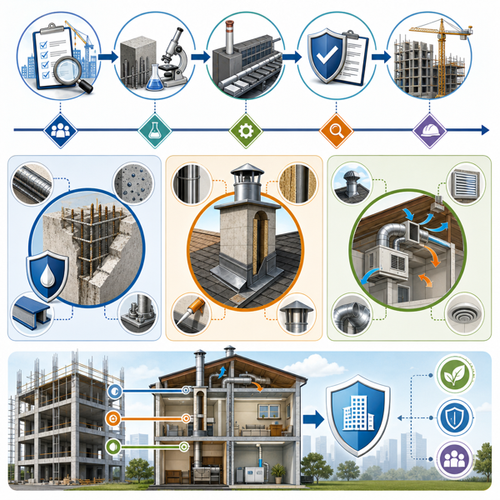
The landscape for construction materials and building practices advanced significantly in October 2026 with the publication of three pivotal international standards. These newly released documents address vital aspects of structural resilience, performance verification, and lifecycle maintenance. Covering weathering steel corrosion measurement, concrete chimneys, and ventilation system handover in non-residential buildings, these standards reinforce quality, compliance, and innovation within the construction sector.
Overview / Introduction
Construction materials and building systems are at the heart of every resilient, energy-efficient, and safe built environment. As modern building projects grow in complexity, the need for internationally harmonized standards has never been greater. Professional stakeholders—including engineers, quality and compliance managers, researchers, and procurement experts—rely on such standards for both regulatory conformity and technical excellence.
This article (Part 2 of 2) provides an in-depth look at three newly published standards for October 2026:
- Corrosion measurement for weathering steel structures
- Design and execution requirements for concrete chimneys
- Testing, measurement, and handover guidelines for ventilation systems in non-residential buildings
By examining the latest technical requirements and implementation insights, readers can ensure that their organizations remain compliant and at the forefront of construction quality and safety.
Detailed Standards Coverage
ISO 19691:2026 - Measurement Method of Corrosion for Weathering Steel Structures
Measurement method of corrosion for weathering steel structures
This international standard, developed by the ISO Technical Committee for Corrosion of metals and alloys, introduces a robust methodology for measuring corrosion loss in unpainted weathering steel structures—such as bridges, towers, and exposed steel frameworks—using attached steel coupons. The standard also includes a predictive model for long-term corrosion and criteria for evaluating the suitability of both existing and new weathering steel applications.
Scope and Key Requirements:
- Specifies procedures for exposure tests using steel coupons to accurately measure corrosion loss over time.
- Standardizes coupon design: typically square (40–150 mm), 1.5–3 mm thick, made of the same alloy as the target structure.
- Outlines installation techniques to ensure representativeness and safety, using robust adhesives and protective measures against dislodgement.
- Provides comprehensive evaluation methods—including documentation, corrosion product removal, and calculation formulas.
- Incorporates electrochemical methods for assessing the protective qualities of rust layers.
- Delivers reporting templates and guidance for long-term corrosion predictions based on field data.
Who Needs to Comply:
- Structural engineers, bridge owners, infrastructure managers, and construction firms using weathering steel.
- Maintenance planners and organizations responsible for lifecycle integrity assessment of steel structures.
Practical Implications:
- Enables more accurate planning of maintenance interventions by providing site-specific corrosion data.
- Assists in determining the appropriateness of weathering steel for both new and retrofit projects, factoring in real microclimatic conditions.
- Helps avoid premature failures and optimize investment in protective measures.
Notable Changes:
- First edition, introducing systematic exposure testing at the structure level, surpassing previous laboratory-only methodologies.
Key highlights:
- Field-applicable corrosion loss measurement for exposed steel
- Predictive models for long-term deterioration
- Practical guidance for maintenance and material selection
Access the full standard:View ISO 19691:2026 on iTeh Standards
EN 13084-2:2026 - Free-Standing Chimneys – Part 2: Concrete Chimneys
Free-standing chimneys – Part 2: Concrete chimneys
The newly revised EN 13084-2:2026 sets out specific design, construction, and performance requirements for cast-in situ and prefabricated concrete chimneys. Developed under the authority of CEN/TC 297 “Free-standing industrial chimneys,” this standard integrates the latest Eurocode references and covers essential safety, durability, and quality control criteria.
Scope and Key Requirements:
- Applies to both cast-in situ and prefabricated concrete chimney designs, ensuring compatibility with EN 13084-1:2025 general requirements.
- Dictates minimum concrete strength (C25/30 or higher), reinforcement, wall thickness, and material durability in compliance with EN 206-1:2026 and EN 1992-1-1:2023 (Eurocode 2).
- Details reinforcement strategies, including vertical/horizontal bar spacing, concrete cover, crack width limitations, and handling of openings or wall penetrations.
- Provides calculations for mechanical resistance and stability, including the effects of wind, temperature, seismic activity, and foundation rotation.
- Specifies detailed procedures for both construction and prefabrication, as well as for quality control and inspection.
Who Needs to Comply:
- Structural engineers, chimney designers, precast and cast-in situ concrete manufacturers, EPC contractors, and industrial facility operators.
- Project managers and owners involved in the design, execution, and maintenance of free-standing chimney structures.
Practical Implications:
- Enhances safety and service life by ensuring that concrete chimneys are designed to withstand harsh operational and environmental conditions.
- Allows integration with current Eurocode provisions, streamlining regulatory approval and design validation across Europe.
- Provides clarification and harmonization of prior requirements with concrete-specific details for different construction techniques.
Notable Changes:
- Updated cross-references and scope for concrete chimneys.
- Enhanced clarity and calculation procedures.
- Revisions to crack width limitation, thermal design, and inclusion of prefabricated element guidance.
Key highlights:
- Covers both cast-in situ and prefabricated chimney designs
- Integrates current Eurocode and concrete standards
- Details structural safety, durability, and quality control measures
Access the full standard:View EN 13084-2:2026 on iTeh Standards
EN 12599:2026 - Ventilation for Buildings: Test Procedures and Measurement Methods to Hand Over Air Conditioning and Ventilation Systems for Non-Residential Buildings
Ventilation for buildings – Test procedures and measurement methods to hand over air conditioning and ventilation systems for non-residential buildings
EN 12599:2026 provides a comprehensive procedure for the assessment, verification, and formal handover of mechanical ventilation and air conditioning systems in non-residential environments. The standard guides professionals through all necessary administrative checks, functional inspections, performance measurements, and documentation for compliant system delivery.
Scope and Key Requirements:
- Applies to mechanical ventilation systems (including the mechanical component of hybrid systems) and all or partial air conditioning systems in non-residential buildings.
- Does not apply to heat generation, refrigeration, compressed air, water conditioning, process-specific, or industrial ventilation systems.
- Defines a stepwise process: administrative checks, completeness checks, functional checks, performance measurements, and reporting.
- Provides measurement protocols for air flow, ductwork airtightness, temperature, humidity, sound pressure levels, and other operational parameters.
- Specifies statistical sampling for measurement locations and test extent, including new requirements for measurement uncertainty and system sampling.
Who Needs to Comply:
- HVAC engineers, commissioning agents, quality inspectors, facility managers, and contractors delivering or verifying non-residential ventilation and air conditioning installations.
- Organizations requiring thorough documentation for regulatory or owner acceptance.
Practical Implications:
- Facilitates rigorous, standardized handover of building services, minimizing disputes and ensuring that installed systems meet design and legal requirements.
- Allows early detection of installation or performance issues, reducing rework costs and operational risks.
- Supports compliance with energy efficiency and occupational comfort mandates.
Notable Changes:
- Now exclusively applicable to non-residential buildings.
- Updated measurement and testing protocols, integration with EN 16211 and EN 16798-3.
- Enhanced annexes on calculation methods, performance checks, and uncertainty evaluation.
Key highlights:
- Comprehensive handover and commissioning guidelines
- Performance verification for non-residential ventilation and AC
- Supports clear documentation, compliance, and quality assurance
Access the full standard:View EN 12599:2026 on iTeh Standards
Industry Impact & Compliance
The adoption of these new standards is poised to generate tangible benefits across the construction materials and building sector:
- Strengthened Compliance: Clear, harmonized methodologies facilitate smoother regulatory approval processes and align project practices with international best practices.
- Enhanced Asset Longevity: Precision in corrosion assessment (ISO 19691:2026) and robust guidance for concrete chimneys (EN 13084-2:2026) reduce long-term material risk and unplanned maintenance costs.
- Quality Assurance for Building Systems: EN 12599:2026 elevates the reliability and transparency of HVAC handover in non-residential projects, supporting occupant comfort and energy efficiency.
- Operational Risk Reduction: Accurate corrosion prediction, structural design, and standardized HVAC testing minimize both safety hazards and operational interruptions.
Compliance Timelines:
- Newly constructed assets and systems should be designed per these standards beginning October 2026.
- Ongoing and retrospective compliance may be mandated by local authorities—early alignment ensures smoother audit outcomes.
Risks of Non-Compliance:
- Potential for non-conforming structures to face remediation orders or legal penalties
- Increased probability of premature failure, costly repairs, or safety incidents
- Reputational risk for stakeholders delivering sub-standard results
Technical Insights
Although covering distinct domains, these three standards share several technical underpinnings and best practices:
- Measurement Integrity and Documentation: All three require systematic test recording, structured reporting formats, and the retention of documentation for stakeholder review.
- Field-Applicable Verification: Emphasis on in-situ (on-site) testing—be it corrosion coupons, chimney inspections, or air quality metrics—supersedes reliance on laboratory-only or theoretical values.
- Material and System Consistency: Standards mandate that test samples (steel coupons, concrete elements) match the composition or specifications of the structure/component under assessment.
- Sampling and Uncertainty Considerations: EN 12599:2026, in particular, prescribes statistical sampling and the calculation of measurement uncertainty, reflecting a sector-wide trend towards rigorous, data-driven quality assurance.
- Lifecycle Perspective: Each standard supports asset management across its operational lifecycle—whether through predictive maintenance models or structured handover protocols.
Implementation Best Practices:
- Early Planning: Engage design, procurement, and commissioning teams with new standards at project inception.
- Training and Skills Development: Ensure staff expertise in specialized testing and reporting, such as exposure coupon management or HVAC functional verification.
- Integration with BIM & Digital Records: Link measurement, test, and compliance data directly with digital asset records for traceability and audit-readiness.
- Engage Accredited Testing and Certification Bodies: Use independent, qualified laboratories or inspectors where required to verify compliance and assure impartiality.
Conclusion / Next Steps
The October 2026 publication of ISO 19691:2026, EN 13084-2:2026, and EN 12599:2026 marks a major stride in the evolution of quality, durability, and performance standards for construction materials and building environments. Organizations involved in infrastructure, structural engineering, industrial construction, and HVAC system delivery should:
- Review these standards in detail to ensure full alignment with upcoming project specifications and compliance requirements.
- Integrate their methodologies and reporting protocols into your quality management systems.
- Train technical and compliance staff in the new testing, evaluation, and handover procedures introduced.
- Leverage iTeh Standards’ authoritative resources to access the complete standards, implementation aids, and stay updated on sector-specific best practices.
By proactively adopting these standards, professionals safeguard their projects against future risks, support sustainability and operational excellence, and demonstrate a commitment to global benchmarks in construction materials and building performance.
Categories
- Latest News
- New Arrivals
- Generalities
- Services and Management
- Natural Sciences
- Health Care
- Environment
- Metrology and Measurement
- Testing
- Mechanical Systems
- Fluid Systems
- Manufacturing
- Energy and Heat
- Electrical Engineering
- Electronics
- Telecommunications
- Information Technology
- Image Technology
- Precision Mechanics
- Road Vehicles
- Railway Engineering
- Shipbuilding
- Aircraft and Space
- Materials Handling
- Packaging
- Textile and Leather
- Clothing
- Agriculture
- Food technology
- Chemical Technology
- Mining and Minerals
- Petroleum
- Metallurgy
- Wood technology
- Glass and Ceramics
- Rubber and Plastics
- Paper Technology
- Paint Industries
- Construction
- Civil Engineering
- Military Engineering
- Entertainment