


Electronics Standards Spotlight: 5 Key Updates for June 2026
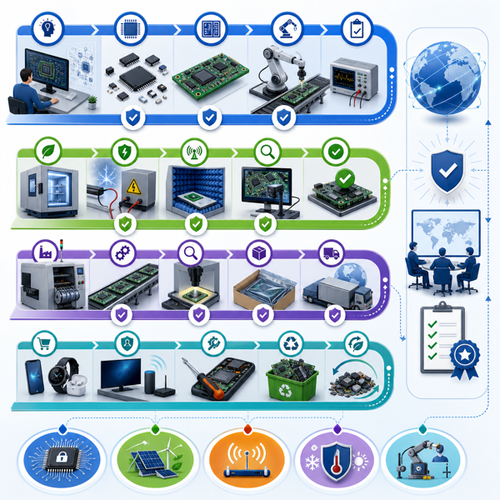
The electronics industry continues to evolve at a rapid pace, with standards providing the foundation for quality, safety, and interoperability. In June 2026, five new and revised standards were released, shaping the future of interactive displays, frequency control, energy storage, flexible devices, and printed electronic components. This article (Part 2 of 2) delves into each newly published standard, highlights key changes, and outlines their significance for professionals across the electronics landscape.
Overview / Introduction
Modern electronics demand precise measurement, durability, and advanced functionality. International standards ensure that manufacturers, engineers, and researchers adhere to best practices and meet rigorous requirements for performance and reliability. From touch and interactive displays to energy storage solutions, these standards not only drive innovation but also ensure cross-market compatibility and consumer safety.
In this article, you will discover:
- The main features and scope of each new standard released in June 2026
- Who needs to comply and the industries impacted
- What’s new compared to prior editions
- Implementation strategies for seamless compliance
Let’s explore the latest updates that are shaping next-generation electronics.
Detailed Standards Coverage
IEC TR 62908-1-3:2026 - Pen Touch Technology Overview
Touch and interactive displays – Part 1-3: Generic – Overview of pen touch technology
The latest edition of IEC TR 62908-1-3 offers a comprehensive overview of pen touch technology for interactive displays. This technical report aims to foster standardization across different pen touch products, presenting their critical performance characteristics, measurement concerns, and practical nuances.
Significant enhancements have been made in this second edition, including comprehensive treatment of writing characteristics—such as the physical interaction between pen and display surfaces—and expanded real-world examples (e.g., frictional responses between different surfaces and applications in education settings).
Target Users:
- Manufacturers and developers of interactive displays
- Educational technology companies
- Consumer electronics OEMs and ODMs
- Quality and compliance specialists
Implementation Implications:
- Provides baseline understanding for R&D teams developing pen-enabled devices
- Influences specifications for product design and UX
- Offers guidance on performance measurements relevant for quality assurance
Notable Changes:
- Added detailed writing characteristics as a core performance metric
- Examples for frictional response across various pen/surface types
- Use-case insights for classroom settings
Key highlights:
- Categorization of pen types (resistive, capacitive, EMI, optical, ultrasonic)
- Exploration of tracking speed, pressure sensitivity, parallax, and writing comfort
- Guidance for future standardization, including combined finger and pen touch modalities
Access the full standard:View IEC TR 62908-1-3:2026 on iTeh Standards
EN IEC 60444-11:2026 - Quartz Crystal Measurement Methods
Measurement of quartz crystal unit parameters – Part 11: Standard method for the determination of the load resonance frequency fL and the effective load capacitance CLeff using automatic network analyzer techniques and error correction
EN IEC 60444-11:2026 standardizes the accurate measurement of load resonance frequency (fL) and effective load capacitance (CLeff) for quartz crystal units. Leveraging automated network analyzer techniques ensures repeatable, precise results, reducing manual errors and providing robust error correction. The revision consolidates key content from the now-withdrawn IEC TR 60444-4 and corrects important calculation formulae.
Scope and Use:
- Applies to quartz crystals with a figure of merit M > 4
- Used by manufacturers, calibration laboratories, and quality control entities
- Essential for production of high-precision timing devices used in telecommunications, automotive electronics, and industrial process controls
Implementation Implications:
- Enhanced error correction protocols improve test reliability
- Standardized procedures increase cross-lab reproducibility
- Faster automated testing reduces workload and improves throughput
Key highlights:
- Automated measurement frameworks for fL and CLeff
- Corrections to formulas ensure accuracy and reliability
- Integration of previous withdrawn standard’s core elements for continuity
Access the full standard:View EN IEC 60444-11:2026 on iTeh Standards
IEC TR 63650:2026 - Electrochemical Capacitors for Energy Storage
Electrochemical capacitor for use in electrical energy storage
IEC TR 63650:2026 presents a technical roadmap for the application and standardization of electrochemical capacitors (supercapacitors) in electrical energy storage (EES). The document investigates available technologies, application scenarios, testing regimes, and industry gaps that require further standardization.
Scope and Application:
- Focuses on supercapacitors used in EES for utility grids, microgrids, renewable integration, backup power, and industrial systems
- Identifies essential testing parameters for both capacitor cells and assembled modules
- Proposes pathways to fill current standards gaps
Implementation Implications:
- Serves as a reference for R&D and product development
- Supports evaluation of safety, cycle life, and performance for energy storage projects
- Aids procurement teams in assessing and qualifying supercapacitor products
Key highlights:
- Summarizes current technology classifications and technical features
- Outlines real-world EES application cases (e.g., frequency regulation, microgrids, energy recovery)
- Details essential testing regimes and standardization roadmap
Access the full standard:View IEC TR 63650:2026 on iTeh Standards
IEC 62715-6-22:2026 - Crease and Waviness Measurement for Foldable Displays
Flexible displays – Part 6-22: Mechanical test methods – Crease and waviness measurement methods for foldable displays
This revised international standard provides detailed measurement conditions and methods specifically designed to assess surface creasing and waviness in foldable displays. The 2026 update expands coverage to include displays featuring multiple folding axes and introduces new data analysis logic—the most robust toolset yet for evaluating geometric distortion in flexible panels.
Target Markets and Users:
- OEMs and ODMs for foldable mobile devices, laptops, and tablets
- Display material suppliers
- Quality control and R&D teams in flexible electronics
Implementation Implications:
- Defined measurement protocols for crease and waviness enable product comparisons and fair benchmarking
- Supports claims of durability and visual quality during product marketing and certification processes
- Streamlines acceptance testing and customer qualification
Key highlights:
- Multifold axis measurement supported
- New logic for detailed data analysis
- Techniques for both non-contact and contact profilometry
Access the full standard:View IEC 62715-6-22:2026 on iTeh Standards
IEC 62899-402-8:2026 - Printability Measurement of Pattern Dimensions
Printed electronics – Part 402-8: Printability – Measurement of qualities – Shape pattern dimension
IEC 62899-402-8:2026 introduces standardized methods for measuring the dimensions of two-dimensional shape patterns (e.g., circles, rectangles, lines) crucial to the printability and performance of printed electronics. The standard fills a critical gap, providing consistent measurement criteria across both simple and combined patterns in electronics manufacturing.
Scope and Applicability:
- Serves printed electronics companies, testing labs, and R&D
- Supports fabrication of printed circuits, sensors, flexible displays, and IoT devices
- Applies to substrates with 2D patterns; 3D features are covered separately
Implementation Implications:
- Enables accurate evaluation of process yield and quality control
- Facilitates cross-supplier comparison and benchmarking
- Provides best practices for shape recognition, measurement, and reporting
Key highlights:
- Measurement techniques for common shapes and their combinations
- Guidance for both basic and advanced (automated) analysis
- Enables systematic comparison with design specifications
Access the full standard:View IEC 62899-402-8:2026 on iTeh Standards
Industry Impact & Compliance
The updates to these five standards impact a wide range of electronics stakeholders:
- Manufacturers and OEMs: Gain clarity on measurement and performance requirements for touch displays, foldable devices, supercapacitors, and printed electronic patterns, directly enhancing product quality and competitive positioning.
- Quality Managers and Engineers: Benefit from standardized, reproducible testing and improved traceability, which eases audits and downstream customer requirements.
- R&D Teams: Reference clear, harmonized guidelines for new product development and iterative design enhancements.
- Procurement and Compliance Officers: Can verify supplier qualifications against internationally recognized criteria, facilitating risk mitigation and robust sourcing.
Compliance Considerations:
- Adoption of these standards is essential for market access, particularly for exports into regulated regions.
- Many standards set explicit or normative testing regimes, which may require upgrades to equipment or measurement protocols.
- Organizations should review timelines for product launches and ensure teams are trained on new methodologies.
Top Benefits:
- Improved device interoperability across the supply chain
- Lower non-conformity risks
- Streamlined quality certifications and market entry
Risks of Non-Compliance:
- Increased rework and scrap costs
- Potential regulatory fines or market access barriers
- Customer dissatisfaction and loss of reputation
Technical Insights
Across these standards, several technical requirements and best practices emerge:
- Measurement Techniques: Automated and error-corrected methods (e.g., for frequency and capacitance) reduce human error and increase throughput.
- Surface Characterization: Detailed test protocols—including non-contact topography and profilometry—facilitate consistent measurement of physical features like creases, waviness, and pattern edges.
- Testing for Durability: For foldable and printed electronics, standards specify precise preparation, conditioning, and evaluation steps to ensure test results are comparable and reproducible.
- Digital Data Management: Many standards recommend or presuppose the use of advanced software tools for shape/frequency recognition and data analysis, emphasizing the importance of rigorous reporting and traceability.
Implementation Best Practices:
- Develop internal guidelines and train staff on new measurement and test protocols.
- Upgrade laboratory and production test equipment to match enhanced accuracy and automation requirements.
- Regularly audit processes to ensure continued compliance as standards evolve.
- Engage with suppliers to verify their alignment and understanding of updated international standards.
Certification Considerations:
- Participation in external certification schemes may be required for certain applications, e.g., by major equipment buyers or regulators.
- Proper documentation and test reporting (as outlined in these standards) is essential for successful audits and certifications.
Conclusion / Next Steps
The June 2026 wave of new electronics standards delivers substantial benefits for design, quality, and compliance across the sector. As industry boundaries blur between displays, power storage, and next-generation production techniques, following these standards is crucial for innovation and global trade.
Key Takeaways:
- New standards bring clearer metrics, better data, and harmonized procedures.
- Early adoption will differentiate your organization in quality, reliability, and customer trust.
Recommendations:
- Review your current protocols versus new or revised requirements.
- Engage your technical teams with standard documents on the iTeh Standards platform.
- Consider cross-functional training sessions to maximize compliance.
- Stay ahead of your competition and regulatory demands by subscribing to standards updates.
Explore all newly published standards on iTeh Standards: https://standards.iteh.ai
Stay updated, compliant, and competitive in the dynamic world of electronics.
Categories
- Latest News
- New Arrivals
- Generalities
- Services and Management
- Natural Sciences
- Health Care
- Environment
- Metrology and Measurement
- Testing
- Mechanical Systems
- Fluid Systems
- Manufacturing
- Energy and Heat
- Electrical Engineering
- Electronics
- Telecommunications
- Information Technology
- Image Technology
- Precision Mechanics
- Road Vehicles
- Railway Engineering
- Shipbuilding
- Aircraft and Space
- Materials Handling
- Packaging
- Textile and Leather
- Clothing
- Agriculture
- Food technology
- Chemical Technology
- Mining and Minerals
- Petroleum
- Metallurgy
- Wood technology
- Glass and Ceramics
- Rubber and Plastics
- Paper Technology
- Paint Industries
- Construction
- Civil Engineering
- Military Engineering
- Entertainment