


June 2026: New Standards for Beverage Coolers and Burner Controls in Domestic and Commercial Equipment
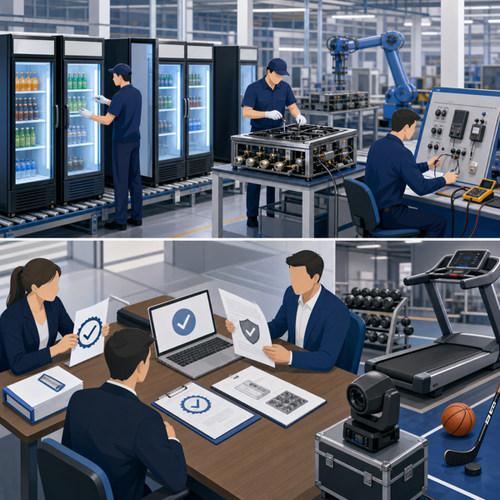
The June 2026 publication cycle has brought significant advancements for professionals engaged in the Domestic and Commercial Equipment, Entertainment, and Sports sectors. Two new international standards have been released, setting benchmarks for commercial beverage coolers and automatic electrical burner control systems. These updates strengthen safety, energy efficiency, and regulatory alignment, ensuring robust product performance and compliance across global markets. In this article, we provide an in-depth examination of prEN ISO 22044 and EN IEC 60730-2-5:2026—essential reading for manufacturers, quality managers, engineers, and compliance officers involved in refrigeration and automated control systems.
Overview / Introduction
Within the landscape of domestic and commercial equipment, consistent product performance, safety, and energy efficiency are of paramount importance. International standards set rigorous benchmarks, enabling organizations to manufacture, install, and maintain equipment to globally accepted best practices. The release of new or revised standards shapes industry expectations and regulatory requirements, impacting product lifecycles from design through to market deployment.
This article will clarify:
- The technical and operational requirements of the new standards
- Key changes and notable enhancements
- Compliance and implementation strategies
- Implications for market access, product reliability, and energy use
Detailed Standards Coverage
prEN ISO 22044 - Commercial Beverage Coolers: Classification, Requirements, and Test Conditions
Commercial beverage coolers – Classification, requirements and test conditions (ISO/DIS 22044:2024)
This newly updated standard governs the classification, essential requirements, and laboratory test conditions for commercial beverage coolers fitted with integral refrigeration systems. It is a critical resource for manufacturers, procurement specialists, and quality assurance teams wanting to ensure that their products conform to global benchmarks for safety, hygiene, and energy efficiency.
Scope and Application: prEN ISO 22044 applies to refrigerated cabinets for displaying and selling pre-packaged beverages, where the design allows customer access to products. It covers all cooler types (vertical, semi-vertical, horizontal, open, and closed) but excludes remote or secondary refrigeration system cabinets.
Key Requirements and Specifications:
- Classification by Temperature & Design: The standard details temperature classes using M-can temperature metrics, supporting labelling and product selection for specific environments.
- Construction and Materials: Emphasis is placed on durable, corrosion-resistant, and food-safe materials. Internal compartments must prevent contaminant build-up and allow for easy cleaning.
- Thermal Insulation: Rigid, moisture-resistant insulation and effective vapour barriers are specified to minimize energy loss and enhance temperature stability.
- Mechanical Durability: Requirements for doors, lids, and essential fittings include resistance to extensive cycles of opening and closing (100,000+), with dedicated testing protocols to validate performance.
- Refrigeration System Requirements: Systems must be designed for operating and rest state maximum pressures, including safe refrigerant containment and provisions for automatic defrost/condensate management.
- Electrical Safety: All electrical components must conform to IEC 60335-1:2020 and IEC 60335-2-89:2019 for safe operation and integration.
- Testing: Extensive testing for temperature control, water vapour condensation, energy consumption (Specific Energy Consumption metrics), seal efficacy, and durability. Tests occur both outside and within a controlled test room, simulating real-world operating conditions.
Notable 2026 Updates:
- Editorial restructuring and relocation of gross/net volume calculation protocols for clarity
- Addition of Class K5 temperature category and corresponding performance/energy metrics
- Enhanced linkages to EU Ecodesign and Energy Labelling Regulations (Annex ZA and ZB)
Compliance Audience:
- Commercial refrigeration manufacturers
- Equipment testing laboratories
- Retailers procuring beverage display solutions
- Energy efficiency programme managers
Practical Implications:
- Aligns commercial coolers with current EU regulatory requirements
- Supports consistent and reliable product performance and labelling
- Streamlines market entry and regulatory acceptance in global jurisdictions
Key highlights:
- Rigorous construction and hygiene standards for food safety
- Testing methods for energy efficiency and product load recovery
- Updated temperature classification and compliance with latest EU directives
Access the full standard:View prEN ISO 22044 on iTeh Standards
EN IEC 60730-2-5:2026 - Automatic Electrical Controls for Burner Systems
Automatic electrical controls – Part 2-5: Particular requirements for automatic electrical burner control systems
EN IEC 60730-2-5:2026 provides enhanced requirements for electrical control systems governing burners intended for household and commercial settings—including catering, heating, and air conditioning equipment. It is crucial for OEMs, control system designers, and compliance professionals who develop or procure automated burner management and safety systems.
Scope and Application: The standard covers burner control systems for oil, gas, coal, and other combustibles. It encompasses:
- Integral and modular burner control systems
- Systems for both AC and DC operation (within specified voltage limits)
- Controls featuring smart/remote operation capabilities
- Controls using thermistors (with dedicated annex)
- Applications ranging from homes to large industrial settings (including process industries)
Key Requirements and Specifications:
- Inherent and Functional Safety: Defines architecture and operational sequences ensuring safe burner operations, including start-up, monitoring, safety shut-down, and lock-out/reset functionality.
- Burner Types & Control Functions: Details for direct ignition, pilot ignition, full/low rate start, proof of flame detection, high-temperature operation, and programmable timing sequences.
- Component and System Requirements: Covers programming units, electronic ignition sources, flame and HTO (high temperature operation) detectors, and battery-powered controls.
- Electrical and Environmental Protection: Provisions for electric shock, insulation, moisture/dust ingress, electromagnetic compatibility (EMC), and resistance to mechanical/environmental stresses.
- Testing and Performance Assessment: Extensive testing of timing sequences, endurance (cycle counts), safety shut-down, flame detector response, and self-checking functionality to ensure operational reliability in all intended applications.
Notable 2026 Updates:
- Alignment with IEC 60730-1 Ed. 6.0, bringing all recent safety and procedural changes
- Enhanced requirements for communication-enabled (smart) burner controls
- Clearer functional safety protocols for interconnected and programmable systems
Compliance Audience:
- Control system and appliance manufacturers
- OEMs integrating smart-enabled heating and combustion controls
- Laboratories performing safety and EMC testing
- Engineers specifying process heating or HVAC safety controls
Practical Implications:
- Ensures all burner control systems are fit for use in sensitive environments (e.g., public facilities, commercial kitchens)
- Supports integration with modern building automation and remote control networks
- Provides benchmarks for labelling and regulatory approval across global markets
Key highlights:
- Defines architectures for safe automatic burner operation
- Addresses smart/remote-device enabled control systems
- Specifies rigorous testing for flame detection and fail-safety
Access the full standard:View EN IEC 60730-2-5:2026 on iTeh Standards
Industry Impact & Compliance
The 2026 standards updates herald a new era in operational safety, energy efficiency, and market credibility for domestic and commercial equipment. For beverage cooler manufacturers, prEN ISO 22044 is essential for meeting the latest EU Ecodesign and energy labelling directives—critical for continued market access. Automatic burner control system suppliers must now integrate fail-safe architectures, advanced flame detection, and remote capability protocols as described in EN IEC 60730-2-5:2026.
Compliance Strategies and Timelines:
- Organizations must review equipment designs and update product documentation/testing procedures accordingly
- Manufacturers are strongly encouraged to coordinate with notified bodies and laboratories for product certification
- Transition to new standards should be completed before enforcement dates stipulated by regional or national authorities
Benefits of Adopting These Standards:
- Enhanced consumer and staff safety
- Lower operational costs through improved energy performance
- Greater marketability and regulatory alignment
- Reduced risk of liability and product failure recalls
Risks of Non-Compliance:
- Restricted market access in regulated regions (e.g., EU)
- Potential safety incidents or regulatory penalties
- Competitive disadvantage against compliant market players
Technical Insights
Shared Technical Requirements:
- Emphasis on robust testing, both in controlled environments and field-simulated conditions
- Integration of safety circuits and performance fail-safes (burner controls)
- Adherence to electrical and mechanical durability standards
- Alignment with energy consumption and environmental protection directives
Implementation Best Practices:
- Conduct gap analyses on existing products to identify areas needing updates
- Collaborate with accredited testing organizations early in design/retrofit phases
- Maintain detailed technical files and testing documentation for audits or regulatory inquiries
- Train staff on updated procedures for testing, marking, and reporting per the new standard’s clauses
- Leverage smart-enabled and remote monitoring features for both compliance and operational optimization
Testing and Certification Considerations:
- Engage third-party laboratories for formal evaluations (thermal, electrical, EMC tests)
- Implement manufacturer or in-house pre-testing to reduce cost/time-to-market
- Ensure marking, user information, and technical documentation are thorough and up to date
Conclusion / Next Steps
The June 2026 standards publications for commercial beverage coolers and automatic burner control systems mark an important shift toward safer, more sustainable, and globally harmonized equipment within the Domestic and Commercial Equipment, Entertainment, and Sports sector. Organizations are advised to:
- Examine the full standards in detail (accessible via the provided iTeh links)
- Begin updating product designs, technical processes, and compliance documentation
- Stay engaged with ongoing regulatory and standards development to anticipate future changes
For detailed requirements and implementation guidelines, access the full standards through iTeh Standards. Staying proactive ensures not only compliance, but a competitive advantage in a fast-evolving market.
Categories
- Latest News
- New Arrivals
- Generalities
- Services and Management
- Natural Sciences
- Health Care
- Environment
- Metrology and Measurement
- Testing
- Mechanical Systems
- Fluid Systems
- Manufacturing
- Energy and Heat
- Electrical Engineering
- Electronics
- Telecommunications
- Information Technology
- Image Technology
- Precision Mechanics
- Road Vehicles
- Railway Engineering
- Shipbuilding
- Aircraft and Space
- Materials Handling
- Packaging
- Textile and Leather
- Clothing
- Agriculture
- Food technology
- Chemical Technology
- Mining and Minerals
- Petroleum
- Metallurgy
- Wood technology
- Glass and Ceramics
- Rubber and Plastics
- Paper Technology
- Paint Industries
- Construction
- Civil Engineering
- Military Engineering
- Entertainment