


June 2026: New Fastener Standard Redefines Grooved Pins in Mechanical Systems
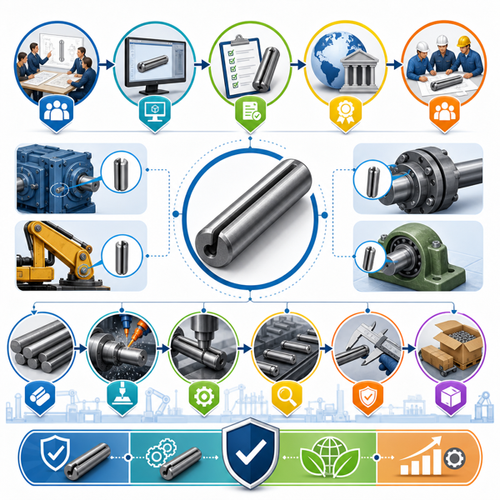
Staying ahead in the field of mechanical systems and components requires continuous adaptation to the latest standards. June 2026 brings a significant update with the publication of EN ISO 8743:2026, fundamentally redefining specifications for grooved pins. These components, essential for reliable assembly, rotation, and guiding in countless systems, now comply with enhanced technical and quality requirements. For professionals across manufacturing, engineering, and quality assurance, this new standard is essential reading.
Overview
Mechanical systems and components for general use form the backbone of industries ranging from automotive to precision manufacturing and heavy machinery. Within this domain, fasteners play a pivotal role—ensuring safe, reliable joints and assemblies. International standards set out detailed requirements for these components, supporting interoperability, safety, and consistent performance across global markets.
The latest update—EN ISO 8743:2026—focuses specifically on grooved pins with half-length centre grooves. This article will explain the scope of the new standard, the changes it introduces, and what industry professionals need to know to achieve compliance and unlock the full value of this update.
Detailed Standards Coverage
EN ISO 8743:2026 – Fasteners: Grooved Pins, Half-Length Centre Grooved
Fasteners – Grooved pins – Half-length centre grooved (ISO 8743:2026)
This newly published European and International Standard specifies the characteristics and requirements for grooved pins with half-length centre oval grooves (closed ends), manufactured in steel and stainless steel. The pins covered by this standard come in nominal diameters from 1 mm up to 25 mm, providing a broad range for mechanical and general use applications.
Scope and Applications
- EN ISO 8743:2026 is designed for components and assemblies where controlled relative rotation, precise positioning, and guiding of parts are needed.
- The symmetrical structure simplifies installation, while the oval grooves and elastic fit provide a high level of pull-out resistance.
- The standard references ISO 13669 for general requirements, including principles for grooved pins and assembly, mechanical properties, and dimensional control.
Key Requirements and Specifications
- Material grades: Steel and stainless steel (now includes A2, A4, C1, and F1 grades).
- Nominal diameters: 1 mm to 25 mm, with non-preferred diameters (1, 3.5, 7, 9, 14, 18 mm) now included for additional design flexibility.
- Dimensional tolerances: Updated tolerances on the rounded and chamfered ends, groove length, and location
- Expanded diameter (d₂): Increased values for the shortest ranges in steel, values now provided for stainless steel pins.
- Fit and assembly: Principles requiring optimal fit and ensuring ease of installation and removal.
- Mechanical and physical properties: Ensures pins are tested for shear resistance, hardness, and straightness.
- Labelling and designation: Stricter requirements for on-package labeling and designation for system traceability.
Target Users/Industries
- Manufacturers of mechanical subassemblies (machinery, automotive components, equipment)
- Assembly and installation operations
- Quality control and assurance professionals overseeing fastener compliance
- Procurement specialists sourcing compliant fasteners for regulated markets
Notable Changes from Previous Editions
The 2026 revision introduces several crucial updates:
- Integration with ISO 13669: Centralizes common requirements for grooved pins, improving harmonization across product families.
- Extended material grades: Stainless steel grades A2, A4, C1, F1 now specified.
- Broader diameter range: Non-preferred and more precise diameters supported.
- Tightened tolerances: On expanded diameter, groove placement, and end shapes.
- Improved inspection and performance protocols, supporting modern quality assurance needs.
Key highlights:
- Precise dimensional tolerances for improved fit
- Enhanced material grade selection, including new stainless steel options
- Updated labeling and designation requirements for traceability
Access the full standard:View EN ISO 8743:2026 on iTeh Standards
Industry Impact & Compliance
Compliance with EN ISO 8743:2026 is critical for organizations working in sectors where precise, reliable mechanical fastening solutions are required. Adopting the updated standard ensures:
- Market access: Products conforming to the latest standard meet national and international requirements, easing export and procurement processes.
- Risk mitigation: Proper fit, strength, and traceability reduce risk of failure and liability.
- Competitive advantage: Early adopters demonstrate commitment to quality and regulatory excellence, often demanded in supply chain audits.
Compliance Considerations
- All conflicting national standards must be withdrawn by December 2026 per CEN protocol.
- Quality management systems (ISO 9001 and similar) may require updates to documentation, incoming inspection, and training.
- Suppliers and procurement teams should update sourcing specifications to reflect EN ISO 8743:2026.
Benefits of Implementation
- Improved reliability and service life of assemblies
- Reduced installation errors and improved maintenance opportunities
- Consistent global quality and customer satisfaction
Risks of Non-Compliance:
- Legal and supply chain challenges if products do not conform to current standards
- Increased warranty claims and product recalls
- Missed opportunities in international bids and supply agreements
Technical Insights
Common Technical Requirements
- Unified principles for grooved pins: Now referenced from ISO 13669 for cross-standard consistency
- Tighter mechanical performance tests: Including shear, hardness, and pin straightness
- Enhanced control of expanded diameter and groove tolerance: Ensures optimal mechanical strength and precise assembly
- Updated marking and documentation requirements: For full lifecycle traceability
Implementation Best Practices
- Review all engineering drawings and update callouts to reference EN ISO 8743:2026, especially dimensions and materials.
- Audit supplier certifications to ensure steel and stainless steel grades meet the revised criteria.
- Train assembly and inspection teams on the new fitment tolerances, labeling, and in-process controls.
- Update inspection protocols with new dimensional and mechanical checks (e.g., groove placement, expanded diameter measurements).
- Synchronize documentation across engineering, sourcing, and QA functions using the latest designation and labeling guidelines.
Testing and Certification
- Use calibrated measurement tools for groove length and diameter checks.
- Perform mechanical property testing including shear resistance and hardness tests as indicated.
- Maintain certification records to verify compliance with both material and dimensional requirements.
Conclusion & Next Steps
The publication of EN ISO 8743:2026 marks an important milestone in the evolution of fastener standards for mechanical systems and components. With its focus on dimensional precision, material flexibility, and harmonized technical requirements, this standard serves as a foundation for safe, reliable, and high-performance assemblies in a wide variety of industries.
Key takeaways:
- EN ISO 8743:2026 brings expanded coverage and stricter requirements for grooved pins.
- Adoption ensures compliance, reduces risk, and enhances both product performance and supply chain integrity.
Recommendations:
- Engineering, QA, and procurement teams should act now to review and implement the updated requirements.
- Regularly consult recognized platforms like iTeh Standards for authoritative reference documents and the latest updates.
Stay ahead in your field by embracing the new standard and driving excellence in every aspect of your operations.
Categories
- Latest News
- New Arrivals
- Generalities
- Services and Management
- Natural Sciences
- Health Care
- Environment
- Metrology and Measurement
- Testing
- Mechanical Systems
- Fluid Systems
- Manufacturing
- Energy and Heat
- Electrical Engineering
- Electronics
- Telecommunications
- Information Technology
- Image Technology
- Precision Mechanics
- Road Vehicles
- Railway Engineering
- Shipbuilding
- Aircraft and Space
- Materials Handling
- Packaging
- Textile and Leather
- Clothing
- Agriculture
- Food technology
- Chemical Technology
- Mining and Minerals
- Petroleum
- Metallurgy
- Wood technology
- Glass and Ceramics
- Rubber and Plastics
- Paper Technology
- Paint Industries
- Construction
- Civil Engineering
- Military Engineering
- Entertainment