


June 2026 Update: New Fibre Optic Connector Standard for Telecommunications and AV Engineering
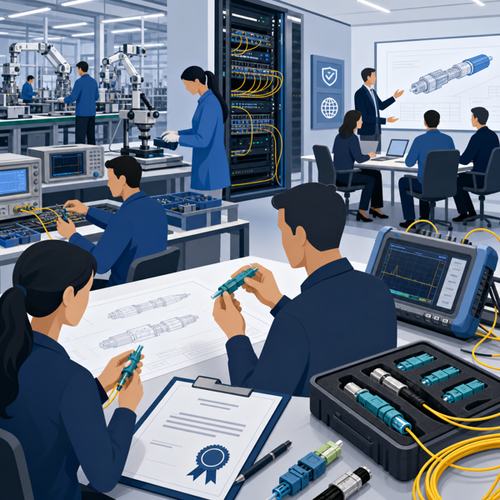
In June 2026, the landscape of Telecommunications and Audio/Video Engineering takes a significant step forward with the publication of the EN IEC 61754-2:2026 standard. This release addresses the evolving demands of fibre optic connectivity for both infrastructure providers and solution developers. As the only major update this month in this sector, the standard introduces new requirements for the widely used BFOC/2,5 connector family, setting a refreshed benchmark for precision, interoperability, and network performance. Understanding and implementing these changes is crucial for maintaining compliance and tackling the challenges of high-bandwidth communications.
Overview / Introduction
Telecommunications and audio/video engineering form the critical infrastructure of modern society. As data rates soar and networks expand, the need for robust, reliable, and interoperable systems grows ever more pressing. Standards like EN IEC 61754-2:2026 ensure that industry players—including network providers, equipment manufacturers, and integrators—can rely on universally accepted benchmarks for quality and compatibility.
In this article, professionals will discover:
- The scope and essential requirements of the updated BFOC/2,5 fibre optic connector standard
- Practical compliance strategies and the ramifications for network infrastructure
- Technical insights to assist in implementation and procurement
Detailed Standards Coverage
EN IEC 61754-2:2026 – Fibre Optic Connector Interface: Type BFOC/2,5 Family
Fibre optic interconnecting devices and passive components – Fibre optic connector interfaces – Part 2: Type BFOC/2,5 connector family
The EN IEC 61754-2:2026 standard sets forth the interface dimensions and physical requirements for the BFOC/2,5 connector family—ubiquitous in telecommunications, data centers, broadcast studios, and enterprise AV systems. Superseding its 1997 predecessor, this revision responds to new industry expectations for high-density connectivity, low loss, and global interoperability.
Scope and Applicability:
- Defines critical dimensions, tolerances, and characteristics for BFOC/2,5 connector interfaces
- Covers plugs, adaptors, ferrule geometries, and active device receptacles
- Harmonizes interface dimensions across the European and International markets
Key Requirements and Specifications:
- Addition of new clauses dedicated to terminology and references, expanding clarity and traceability
- Defines the interface for active device receptacles, paving the way for integration in next-generation hardware
- Updates ferrule grades and end face geometry by referencing advanced standards—IEC 61755-3 and IEC 63267-3 series—for improved optical performance and reduced signal loss
- Introduces improved specifications for the resilient alignment sleeve (adaptors) and the rigid bore sleeve (active device receptacles)
- Achieves harmonization for reference dimensions with other connector standards within the IEC 61754 series, supporting consistency and easier cross-compatibility
Target Audience:
- Telecom network operators
- System integrators and installers
- AV engineering firms
- Fibre optic component manufacturers
- Quality assurance and compliance officers
Implications for Implementation: Organizations upgrading or installing network hardware that utilizes BFOC/2,5 connectors must ensure that all components conform to the updated geometry and performance benchmarks. The harmonized approach also reduces the risk of mismatched or suboptimal connections, lowering maintenance costs and supporting long-term infrastructure investments.
Notable Changes from the Previous Edition:
- Expanded content with new clauses and bibliographic references
- Revised critical interface and ferrule requirements based on cutting-edge research
- Improved alignment and dimension standards to match contemporary needs
Key highlights:
- Comprehensive technical revision—first major update since 1997
- Enhanced end face geometry and ferrule performance, reducing insertion loss
- Full harmonization with other IEC connector standards for simplified system integration
Access the full standard:View EN IEC 61754-2:2026 on iTeh Standards
Industry Impact & Compliance
The updated EN IEC 61754-2:2026 standard redefines the expectations for BFOC/2,5 fibre optic connector interfaces throughout the telecommunications and audio/video sectors. Compliance is not only a mark of quality but an operational imperative—to minimize compatibility risks, reduce downtime, and optimize high-speed data transmission.
Key considerations:
- Transition timeline: Organizations should target convergence before the withdrawal of conflicting standards by June 2027.
- Procurement: Updated component specifications will drive purchasing decisions. Suppliers and integrators must vet product lines for compliance with the June 2026 edition.
- Quality assurance: System validation and acceptance testing should reference the new measurement and dimensional criteria defined in this standard.
- Certification: Conformance to EN IEC 61754-2:2026 will become a differentiator for manufacturers and service providers bidding on infrastructure projects.
Benefits of adoption:
- Enhanced network reliability and uniformity
- Reduced risk of connector mismatch or field failures
- Streamlined maintenance and spare part logistics
Risks of non-compliance:
- Higher probability of incompatible connections across international markets
- Increased maintenance and troubleshooting costs due to undefined interface geometries
- Potential loss of certification, eligibility, or market access for components and systems
Technical Insights
Common Technical Requirements:
- All connectors must now adhere to precisely defined dimensions for plug, adaptor, ferrule, and receptacle interfaces, as specified in detailed tables and figures from the standard.
- Ferrule end face geometry is linked to the IEC 61755-3 and IEC 63267-3 series, demanding tighter control of surface profile and concentricity to minimize insertion loss.
- Alignment sleeve performance (resilient and rigid bore variants) is specified with enhanced consistency to ensure optimal fibre alignment and minimize return loss.
Implementation Best Practices:
- Audit existing connector inventories for dimensional and performance compliance.
- Update in-house drawings, specifications, and procurement documents to directly reference EN IEC 61754-2:2026.
- Train technical staff and contractors on the revised connector geometries and measurement benchmarks.
- When qualifying new products or systems, require suppliers to demonstrate compliance using updated test protocols from referenced IEC standards.
Testing and Certification:
- Withdraw force, alignment accuracy, and interface dimensional checks should make use of IEC 61300-3-33 and related standards.
- Certification bodies and quality managers should update checklists to reflect the new edition of the standard, ensuring all incoming and installed components are verified.
Conclusion / Next Steps
The EN IEC 61754-2:2026 standard marks a new era in fibre optic connectivity for telecommunications and audio/video engineering. With its revised and harmonized specifications, the standard delivers a pathway for robust, high-quality, and future-focused infrastructure.
Key takeaways:
- Early adoption guarantees seamless interoperability and lowers long-term operational risk
- Compliance delivers tangible business benefits through reliability and cost savings
- Staying abreast of standards evolution is essential for procurement, system design, and network operation
Recommendation: Organizations should review their connector portfolios, update procurement and QA processes, and access the full standard for detailed implementation guidance.
For more information and to explore additional technical standards in telecommunications and AV engineering, visit the iTeh Standards platform and stay at the forefront of industry compliance.
Categories
- Latest News
- New Arrivals
- Generalities
- Services and Management
- Natural Sciences
- Health Care
- Environment
- Metrology and Measurement
- Testing
- Mechanical Systems
- Fluid Systems
- Manufacturing
- Energy and Heat
- Electrical Engineering
- Electronics
- Telecommunications
- Information Technology
- Image Technology
- Precision Mechanics
- Road Vehicles
- Railway Engineering
- Shipbuilding
- Aircraft and Space
- Materials Handling
- Packaging
- Textile and Leather
- Clothing
- Agriculture
- Food technology
- Chemical Technology
- Mining and Minerals
- Petroleum
- Metallurgy
- Wood technology
- Glass and Ceramics
- Rubber and Plastics
- Paper Technology
- Paint Industries
- Construction
- Civil Engineering
- Military Engineering
- Entertainment