

September 2026: New Fire Safety Engineering Standard Transforms Building Process
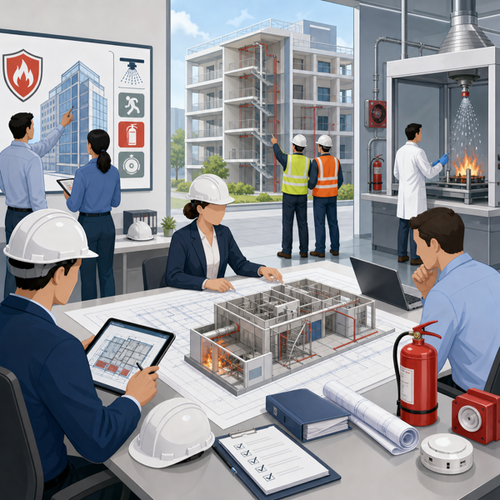
Building safety, especially fire safety, sits at the heart of responsible construction and operation. In September 2026, a major step forward was made for the building and construction sector with the publication of a new technical specification under the Environment, Health Protection, and Safety category—CEN/TS 18332:2026 - Fire Safety Engineering – Review and Control in the Building Process. This single but transformative standard provides a harmonized reference for the review and control of fire safety engineering at every stage of a building's lifecycle, from planning and design through construction, operation, and even demolition.
With a focus on technical, rather than purely regulatory, oversight, the specification is designed to elevate transparency, consistency, and competency in fire safety for all building stakeholders. Below, we break down the need-to-know aspects of this vital new standard, how it can help your organization, and why compliance is now more critical than ever.
Overview
Fire safety is a fundamental concern for any building project, touching on regulatory requirements, social responsibility, insurance, and business continuity. Traditional fire safety codes have been either rigidly prescriptive or open to varying local interpretation. As buildings become more complex, the need for a clear, robust standard to guide engineering-based fire safety solutions, alongside conventional codes, has become urgent.
CEN/TS 18332:2026 addresses this gap. It gives industry professionals an agreed process for reviewing and controlling fire safety aspects throughout all phases of a building’s life. This not only supports compliance but encourages the adoption of modern, evidence-based safety strategies and innovations such as performance-based design, new materials, and digital building information modeling (BIM).
By reading this article, you will learn:
- The scope and structure of this new fire safety engineering standard.
- How it changes and clarifies responsibilities for stakeholders and reviewers.
- The practical impacts on construction, operation, maintenance, and refurbishment.
- Key steps and best practices for compliance.
Detailed Standards Coverage
CEN/TS 18332:2026 – Fire Safety Engineering: Review and Control in the Building Process
Full Title: Fire safety engineering – Review and control in the building process
This technical specification, developed by CEN/TC 127 and published in September 2026, provides a European-wide framework for reviewing and controlling fire safety engineering across the entire lifecycle of a building. It stands apart from national regulation, focusing instead on harmonized technical methodologies, eligibility requirements for reviewers, and robust documentation practices.
Scope and Key Requirements
The standard covers:
- When and how to conduct reviews and controls related to fire safety—planning, design, construction, operation, maintenance, refurbishment, and even demolition.
- Eligibility and independence criteria for reviewers, to ensure impartial validation of fire engineering work.
- Integration of fire safety design into overall building control and documentation—including engineering and prescriptive code approaches.
- Specification of functional and performance-based fire safety objectives, such as mitigation of injury, life safety, property and environmental protection, and resilience.
Technical Specifications and Procedures
Key requirements and specifications outlined in the standard include:
- General Fire Safety Objectives: Protecting life (human and animal), safeguarding the environment, and supporting operational continuity and property protection.
- Functional and Performance Criteria: Ensuring that fire occurrences are prevented, fire and smoke spread is limited, structural stability is maintained for set periods, safe evacuation is enabled, and firefighting/rescue operations are possible.
- Phases of the Building Process: Detailed provisions for:
- Planning and Design: Structuring the design with fire safety at the core, including qualitative risk reviews.
- Construction: Integrating fire safety requirements in all disciplines, managing field changes, and running compliance tests.
- Operation and Maintenance: Documenting usage restrictions, ensuring handover of fire safety systems information, and adapting strategies for change of use or refurbishment.
- Levels of Control and Review: A risk-based matrix for internal, third-party, or authority-led review, scaled to the complexity of the building and fire consequences.
- Third Party Review: Clear guidelines for independent review, reviewer qualifications, and documentation.
- Verification and Validation: Methods for demonstrating compliance with performance criteria, from qualitative risk assessment to deterministic and probabilistic analysis.
- Documentation and Communication: Requirement for comprehensive records, including fire safety briefs, design documents, and as-built records for traceability and stakeholder engagement.
Target Audiences
This standard is vital for a wide spectrum of industry professionals:
- Architects and building designers
- Fire safety engineers
- Quality managers and compliance officers
- Facility managers and operators
- Contractors and construction managers
- Regulators, local authorities, and insurance assessors
Implementation Implications
Adopting CEN/TS 18332:2026 means:
- Creating multi-disciplinary competence teams for design and review.
- Ensuring systematic documentation, with traceability across all project phases.
- Establishing clear, risk-based review and approval processes, with defined roles and accountabilities.
- Developing inspection and test plans (ITPs) for construction and commissioning.
- Planning for the ‘whole life’ of the building, including refurbishment, adaptation, and responsible demolition (especially for product reuse and sustainability).
Notable Advancements
As an advanced, technically focused standard, CEN/TS 18332:2026:
- Moves beyond national borders and regulatory variance, delivering harmonized technical rigor.
- Provides practical frameworks for both prescriptive and performance-based (engineering) fire safety strategies.
- Mandates clear documentation, traceability, and integration with digital building models.
- Responds to sustainability and circular economy concerns by considering the reuse of products and systems.
Key highlights:
- Comprehensive fire safety review and control framework for all building phases.
- Scalable risk-based approach: from self-checks to independent third-party and authority reviews.
- Guidance on reviewer qualification and independence for integrity in the review process.
Access the full standard:View CEN/TS 18332:2026 on iTeh Standards
Industry Impact & Compliance
The introduction of CEN/TS 18332:2026 marks a decisive shift from inconsistent fire safety oversight to a unified, technically robust model for the building sector. For businesses and public authorities, this means:
- Improved risk management and liability protection through well-documented, auditable processes and the inclusion of independent review where needed.
- Increased quality assurance and confidence as a result of defined reviewer competence and independence criteria.
- Smoother approvals and market access, especially in cross-border projects, by complying with a pan-European technical specification.
- Incentivizing innovation by supporting performance-based designs alongside prescriptive codes—benefitting buildings with novel layouts, materials, or use cases.
- Streamlined handover and lifecycle management, with better records for future refurbishment, adaptation, and sustainability obligations.
Compliance Considerations & Timelines
- Adoption: CEN/TS 18332:2026 is immediately applicable as a technical specification. In some jurisdictions, it may run parallel to existing national standards until ratified as a full European Standard (EN).
- Integration: Early adoption is highly recommended for new projects or major refurbishments, particularly those involving innovative fire engineering approaches.
- Documentation: Phased implementation should be supported by reviewing existing quality management systems (QMS) and documentation practices.
- Training: Professional upskilling for fire safety engineers, designers, and compliance teams is advisable to ensure understanding and alignment with the new procedures.
Benefits of Adoption
- Enhanced safety and quality—reducing the risk of catastrophic fire events.
- Fewer disputes between stakeholders through transparent, documented review and control.
- Better risk pricing from insurers and improved business continuity.
- Competitive advantage in tendering or developing landmark, sustainable, or high-risk buildings.
Risks of Non-Compliance
- Exclusion from certain procurement or approval processes.
- Deficient fire safety systems risking lives, property, and operations.
- Legal, financial, and reputational damage in the case of incidents or regulatory findings.
Technical Insights
CEN/TS 18332:2026 presents several technical innovations and best practices which, when adopted, serve as the backbone for state-of-the-art fire safety management:
Common Technical Requirements
- Risk-based Review Structures: Projects are classified according to fire risk and complexity, with assigned levels of review—from self-checks to third-party and authority evaluations.
- Integration with Performance Codes: Requirements are linked to both qualitative (functional) and quantitative (performance-based) objectives, supporting flexible yet rigorous design.
- Inspection and Testing Plans: Systematic approach to construction phase testing, including FAT (Factory Acceptance Tests), SAT (Site Acceptance Tests), and ITPs (Inspection and Test Plans).
- Digital Traceability: Use of BIM and documented change management to enable lifetime traceability of fire safety solutions and controls.
Best Practices for Implementation
- Establish Early Coordination: Involve all stakeholders—including fire safety engineers, architects, and owners—from the concept stage.
- Document Everything: Maintain meticulous records at every phase, including assumptions, design briefs, test results, and amendments.
- Independence Matters: Assign independent and qualified reviewers appropriate for the project’s risk level.
- Plan for Lifecycle: Consider fire safety not just as a design issue, but as an operational and maintenance responsibility. Prepare for adaptive reuse and responsible demolition.
- Leverage Digital Tools: Integrate BIM and quality management systems to ensure traceability and streamlined information management.
Testing and Certification
- Verification and Validation Procedures: From scenario analysis to third-party testing, all methods are to be documented and reviewed in line with the standard’s requirements.
- Checklist and Templates: The standard provides informative annexes on checklists for design and construction phase controls, streamlining the compliance process.
Conclusion and Next Steps
CEN/TS 18332:2026 delivers a transformative step towards harmonized, transparent, and technically rigorous fire safety standards across Europe. For any organization engaged in the design, construction, operation, or refurbishment of buildings, early adoption provides clear safety, compliance, and competitive benefits.
Key takeaways:
- The standard is applicable to all building projects, regardless of size or complexity—especially where performance-based design or innovative solutions are planned.
- Emphasizes risk-based, scalable review and control processes to ensure life safety, asset protection, and regulatory compliance.
- Offers clear processes for documentation, stakeholder engagement, and review auditor qualifications.
Recommendations for Organizations:
- Conduct a gap analysis to compare current practices to the new standard’s requirements.
- Train key staff in the principles and methods outlined in CEN/TS 18332:2026.
- Engage third-party reviewers early for complex or high-impact projects.
- Integrate digital tools for documentation and lifecycle traceability.
For forward-looking organizations, embracing CEN/TS 18332:2026 is not only about compliance—it’s about leading on safety, resilience, and operational excellence.
Explore the complete standard and stay ahead in fire safety engineering:View CEN/TS 18332:2026 on iTeh Standards
Categories
- Latest News
- New Arrivals
- Generalities
- Services and Management
- Natural Sciences
- Health Care
- Environment
- Metrology and Measurement
- Testing
- Mechanical Systems
- Fluid Systems
- Manufacturing
- Energy and Heat
- Electrical Engineering
- Electronics
- Telecommunications
- Information Technology
- Image Technology
- Precision Mechanics
- Road Vehicles
- Railway Engineering
- Shipbuilding
- Aircraft and Space
- Materials Handling
- Packaging
- Textile and Leather
- Clothing
- Agriculture
- Food technology
- Chemical Technology
- Mining and Minerals
- Petroleum
- Metallurgy
- Wood technology
- Glass and Ceramics
- Rubber and Plastics
- Paper Technology
- Paint Industries
- Construction
- Civil Engineering
- Military Engineering
- Entertainment