

September 2026: New Safety Standard for Firewood Processors in Wood Technology
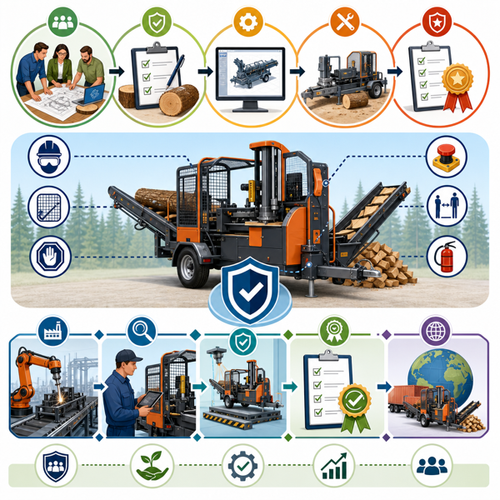
September 2026: New Safety Standard for Firewood Processors in Wood Technology
Staying current with safety requirements is essential in the rapidly evolving wood technology sector. This September, a significant new standard—prEN 18181—addresses the safety of combined firewood processors in agricultural and forestry machinery. As wood processing becomes more sophisticated, adopting robust safety standards is vital for manufacturers, equipment managers, safety officers, and operators seeking to ensure both regulatory compliance and safe, efficient operations. Here’s what the new standard means for you.
Overview / Introduction
The wood technology industry is foundational to both forestry and agricultural economies across Europe and beyond. Equipment like firewood processors play a pivotal role in turning raw logs into usable fuel, but as these machines become more advanced and automated, the risks to users and bystanders increase. Standards are critical—they not only reduce accident rates and machinery downtime but also ensure products meet harmonized technical, environmental, and regulatory benchmarks.
This article breaks down the new prEN 18181 safety standard, outlining its scope, key requirements, and the practical impact on industry professionals. Whether you’re a manufacturer, compliance officer, engineer, or procurement specialist, you’ll find actionable insights on adopting this new guideline and maintaining best-in-class safety performance.
Detailed Standards Coverage
prEN 18181 – Safety for Combined Firewood Processors
Agricultural and forestry machinery – Combined firewood processors – Safety
Published by CEN on 2026-09-04, prEN 18181 sets a new benchmark by specifying safety requirements—and detailed verification procedures—for the design and construction of firewood processors. These machines are widely used for making firewood, integrating cutting (via circular saw or chain blade) and splitting (with horizontal movement using one or more splitting wedges) into a single operation. Notably, the standard excludes machines that require manual intervention for material transfer, vertical splitting actions, or feature accessories like separate conveyors that aren’t integral to the processor itself.
Scope and Application
- Applies to manual, semi-automatic, and fully automatic firewood processors.
- Covers machines equipped with integral infeed and outfeed conveyors and integral log lifting devices operated via “hold-to-run” controls.
- Focuses exclusively on processors designed so that one operator oversees the process, although secondary operators might participate in feeding or unloading.
- Does not apply to legacy machinery manufactured before publication.
- Excludes machinery with non-integral accessories or vertical splitting mechanisms.
Key Safety Requirements and Specifications
The standard’s core mandates include:
- Comprehensive hazard analysis (see Annex A): The standard lists all significant hazards—mechanical, electrical, ergonomic, noise, dust, and more—associated with firewood processing equipment.
- Control system reliability: All safety-related functions, such as starting, stopping, emergency stop, guards, and interlocking devices, must meet at least Category 1 of EN ISO 13849-1:2023 for performance level c or d, depending on the function’s criticality.
- Ergonomic controls: Controls and operator interfaces must comply with EN 894-series and EN ISO 14738 for user comfort and safety. Operator stations require sufficient clearance and visibility, with all controls clearly identified and accessible—even when working with large-dimension logs.
- Electrical, hydraulic, and noise requirements: All electrical systems must meet at least IP54 protection, with plugs and main switches at IP44. Hydraulic components, noise emission limits, and dust management have binding performance requirements.
- Guarding and secure mode: Guards must prevent operator contact with active saws, with “secure mode” functionality ensuring all hazardous machine movement stops when an interlock or guard is open. Particular dimensions and materials for guards are dictated to ensure efficacy and durability (e.g., replaceable lips for saw blade slots).
- Emergency stop provisions: Emergency stops are mandatory for automatic machines where the operator is not continuously present; their positioning and performance must follow EN ISO 13850 and EN 60204-1.
- User instructions and marking: Machines must be properly marked, and instruction manuals must be exhaustive, including all warnings, maintenance instructions, and explanations of all safety provisions.
Who Needs to Comply
- Manufacturers of new firewood processors, especially those integrating automatic or semi-automatic functionality.
- Procurement specialists involved in purchasing forestry and agricultural machinery.
- Operators and site managers using or supervising the installation and operation of firewood processors.
- Safety inspectors and market surveillance authorities responsible for machinery compliance.
Practical Implications for Implementation
By mandating precise requirements for control systems, electrical safety, ergonomic design, and guarding, the standard minimizes the risk of operator injury and unplanned downtime. It also streamlines conformity assessments, helping manufacturers align with EU Machinery Regulation (EU) 2023/1230 and other local legislation. Companies that implement prEN 18181 will benefit from a clear, harmonized framework for product design and safety assessment, making market entry, certification, and procurement decisions more straightforward.
Notable Changes Compared to Previous Requirements
- Enhanced focus on automation: prEN 18181 addresses new risks for semi-automatic and automatic firewood processors, including robust remote control requirements.
- Refined approach to integrated accessories: Only integral conveyors and lifting devices are regulated, while separate add-ons are excluded from core requirements.
- Alignment with current EU regulations: Incorporates references and risk analyses to support easier proof of compliance with EU Machinery Regulation.
Key highlights:
- Applies to all newly manufactured firewood processors after September 2026
- Covers manual, semi-automatic, and automatic machines
- Detailed prescriptions for control system category and operator safety features
- Enforces proper guarding, secure modes, and emergency stop protocols
- Requires clear marking and comprehensive instructions for end users
Access the full standard:View prEN 18181 on iTeh Standards
Industry Impact & Compliance
Impact on Businesses and Operations
The adoption of prEN 18181 is set to drive large-scale improvements in workplace safety, operational reliability, and regulatory compliance across wood technology. For businesses:
- Equipment manufacturers must revise design, documentation, and verification procedures to meet the new performance and safety criteria.
- Procurement teams will need to specify compliance with prEN 18181 in requests, purchase orders, and supplier contracts.
- Operators and maintenance staff will benefit from clearer instructions, reduced exposure to mechanical and ergonomic hazards, and minimized risks when performing routine tasks.
Compliance Considerations and Timelines
- Timeline: The standard is applicable to all new machines manufactured after September 2026.
- Documentation: Manufacturers must maintain documentation demonstrating conformity, including risk assessments, performance verification, marking records, and user instruction booklets.
- Certification: Adherence to prEN 18181 can streamline CE marking under the EU Machinery Regulation. Early compliance may also offer procurement advantages, as buyers increasingly specify compliance to recognized standards.
- Auditing: Regulatory authorities and market surveillance teams now have clearer benchmarks for inspections and incident investigations.
Benefits of Adopting the Standard
- Fewer workplace accidents and equipment-related injuries
- Enhanced trust with buyers and end users through certified safety performance
- Simplified audit and certification procedures for European and international markets
- Improved operational efficiency through best-practice ergonomic design
- Support for sustainable, responsible wood processing and procurement
Risks of Non-Compliance
- Increased liability and insurance costs due to workplace accidents
- Regulatory enforcement actions, fines, or market exclusion for non-conformity
- Loss of procurement contracts requiring compliance with state-of-the-art safety standards
- Reputation risk due to preventable incidents or recalls
Technical Insights
Common Technical Requirements Across Wood Processing Equipment
prEN 18181 builds on a robust body of European and international standards, ensuring:
- Modular, reliable control systems that respond safely to faults or operator actions
- Ergonomically optimized controls, reducing repetitive strain and fatigue
- Strict guarding of hazardous moving parts with verifiable mechanical and electrical safety features
- Specified performance levels (PL c or d) for critical functions including stopping, guarding, and emergency shut-down
Implementation Best Practices
Professionals implementing this standard should:
- Conduct a thorough hazard analysis for each new machine design, using Annex A.
- Select certified components (e.g., control units, guards, actuators) that meet the IP and performance criteria.
- Design operator stations for clear visibility and intuitive access to all controls and emergency stops.
- Document all processes and training—clear manuals, safety marking, and routine verification procedures are crucial.
- Engage with suppliers and certification bodies early to ensure that both documentation and hardware meet latest requirements.
Testing and Certification Considerations
- Verification of safety requirements: Full conformity with prEN 18181 must be demonstrated via tests, inspection, and documentation, including control reliability, mechanical guarding, sound and dust emission measurements, and clear marking.
- Third-party certification: For larger equipment or international market entry, independent testing to prEN 18181 may expedite CE marking, ISO certification, and procurement eligibility.
- Operator training: Ensure all staff are versed in the safe operation and emergency procedures specified in the machine’s instructions and mandated by this standard.
Conclusion / Next Steps
The publication of prEN 18181 marks a milestone for safety and operational excellence in wood technology, specifically for agricultural and forestry machinery. Its broad applicability, rigorous safety protocols, and harmonization with current EU regulations establish a new benchmark for firewood processing equipment across Europe and beyond.
Key takeaways:
- Manufacturers and procurement teams must update specifications and conform new purchases to prEN 18181 from September 2026 onward.
- Safety professionals and quality managers should review existing safety programs and training to align with the new requirements.
- Operators and end users will benefit from safer, easier-to-operate machinery and clearer guidance.
Recommendations:
- Begin integrating prEN 18181 requirements into R&D, supply chain, and procurement procedures immediately.
- Consult the full standard and engage with your notified bodies, safety consultants, and equipment suppliers to ensure a smooth transition.
- Stay up to date with future publications, technical amendments, and sector guidance by bookmarking iTeh Standards as your go-to source for new and revised wood technology standards.
For further details and to access the full content of the standard, follow this direct link:
Access the full standard:View prEN 18181 on iTeh Standards
Categories
- Latest News
- New Arrivals
- Generalities
- Services and Management
- Natural Sciences
- Health Care
- Environment
- Metrology and Measurement
- Testing
- Mechanical Systems
- Fluid Systems
- Manufacturing
- Energy and Heat
- Electrical Engineering
- Electronics
- Telecommunications
- Information Technology
- Image Technology
- Precision Mechanics
- Road Vehicles
- Railway Engineering
- Shipbuilding
- Aircraft and Space
- Materials Handling
- Packaging
- Textile and Leather
- Clothing
- Agriculture
- Food technology
- Chemical Technology
- Mining and Minerals
- Petroleum
- Metallurgy
- Wood technology
- Glass and Ceramics
- Rubber and Plastics
- Paper Technology
- Paint Industries
- Construction
- Civil Engineering
- Military Engineering
- Entertainment