


July 2026: New ISO Standard Streamlines Rehabilitation of Underground Gas Piping with PE Materials
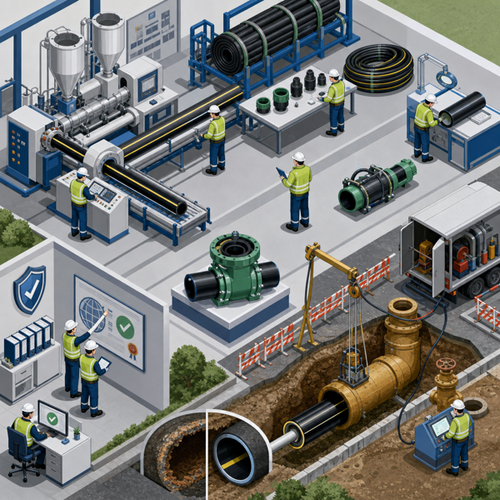
July 2026: New ISO Standard Streamlines Rehabilitation of Underground Gas Piping with PE Materials
The gas distribution industry takes a major step forward this July with the publication of ISO 11301-1:2026, the latest international standard setting requirements for polyethylene (PE) piping systems used in the rehabilitation of underground gas supply networks. Consolidating and updating several previous ISO documents, the new standard delivers a comprehensive, harmonized set of requirements and testing guidelines for PE pipes, fittings, and assemblies – both as manufactured and as installed. Here’s why this change is so significant for fluid systems and pipeline professionals worldwide, and what you need to know to ensure compliance and optimize safety.
Overview
The safe and efficient operation of underground gas supply networks is critical for public safety, environmental protection, and continuity of service. Over time, aging infrastructure and the advent of new materials and installation technologies have made the rehabilitation of existing pipelines an industry priority. International standards play a vital role, offering trusted, universally recognized benchmarks for product performance, installation, and testing.
This article provides:
- An in-depth summary of the new ISO 11301-1:2026 standard for Fluid Systems and Components for General Use
- Guidance on the technical specifications, compliance requirements, and new mandates
- Practical advice for engineers, compliance managers, and procurement teams involved with underground gas piping upgrades
Detailed Standards Coverage
ISO 11301-1:2026 – Piping Systems for Rehabilitation of Underground Gas Supply Networks — Part 1: Polyethylene (PE) Material
Piping systems for rehabilitation of underground gas supply networks — Part 1: Polyethylene (PE) material
ISO 11301-1:2026 is the cornerstone standard for gas network rehabilitation using PE piping. It defines the baseline for manufacturing, installing, testing, and marking polyethylene pipes, fittings, and assemblies used in both renovation and trenchless replacement projects. Importantly, this standard is not applicable to the existing host pipe; rather, it addresses the new and replacement system components integrated within the infrastructure.
Scope and Application
This standard applies to:
- Renovation using lining: Both continuous pipes (inserted without cross-sectional reduction) and close-fit pipes (temporarily deformed for insertion and reverted on-site)
- Trenchless replacement: Including pipe bursting, pipe extraction, horizontal directional drilling (HDD), and impact moling
- Types of PE pipes: Single-layered solid-wall pipes (with or without identification stripes), co-extruded multilayered pipes where all layers have identical minimum required strength (MRS), and PE-coated pipes with peelable thermoplastic external layers
- Jointing methods: Butt fusion, electrofusion, mechanical and fabricated fittings; not applicable to push-fit joints for discrete pipe segments
Key Requirements and Specifications
- Material compliance: Pipes and fittings must be made from compounds conforming to ISO 4437 series standards for PE gas piping (and equivalent EN 1555 series in Europe), ensuring long-term strength and durability
- General characteristics: Pipes and fittings must be clean, defect-free, and have smooth surfaces. Markings must remain legible throughout storage, handling, and installation.
- Geometric and mechanical properties: Must be verified through rigorous design calculations and validated for each technique family (lining, close-fit, trenchless replacement) to withstand operational and installation loadings
- Physical characteristics: Include adherence to dimensional tolerances, minimum wall thickness, standard dimension ratio (SDR), oxidation resistance, and performance under pressure and temperature cycling
- Joint integrity: Strict requirements for butt fusion and electrofusion joints, including mandatory removal of outer fusion beads and, if specified, inner beads. Compatibility testing between different pipe/fitting combinations is essential
- Marking and traceability: Mandatory details such as standard reference, manufacturer, nominal diameter, SDR, material, production date, and clear “GAS” identification, plus differentiation for coated pipes
- Fitness for purpose: Installed pipeline systems must pass integrity tests (water/gas pressure), maintain minimum free bore for flow and maintenance, and demonstrate resistance to operating loads over their design life
Who Needs to Comply
- Pipeline designers and engineers
- Gas distribution utilities and network owners
- PE pipe and fitting manufacturers and suppliers
- Installation contractors focused on trenchless or renovation techniques
- Compliance managers and quality control personnel in the gas sector
Practical Implications and Notable Changes
This standard replaces and consolidates ISO 11299-1:2018, ISO 11299-2:2018, ISO 11299-3:2018, ISO 21225-1:2018, and ISO 21225-2:2018, harmonizing technical content to improve both global applicability and clarity for practitioners. The key advancements include:
- A unified approach to requirements for both as-manufactured and as-installed components
- Detailed clarification of technique families and their specific performance benchmarks
- Harmonization between ISO and EN (European) standards for multinational project applicability
- Expansion of requirements for hybrid/multilayer PE pipes and robust marking for traceability
Key highlights:
- Covers all major PE pipe rehabilitation and trenchless replacement techniques
- Sets strict protocols for jointing, marking, and post-installation testing
- Replaces multiple older standards with one harmonized specification
Access the full standard:View ISO 11301-1:2026 on iTeh Standards
Industry Impact & Compliance
How These Standards Affect Business
The adoption of ISO 11301-1:2026 impacts multiple operational dimensions:
- Procurement and sourcing: Manufacturers and buyers must ensure all PE pipes and fittings are certified to the new requirements—failure to comply risks project delays or regulatory penalties
- Installation practices: Contractors must update site QA/QC protocols to incorporate new installation, marking, and joint testing mandates
- Design and engineering: Specification documents and tenders should now reference ISO 11301-1:2026 to ensure contract alignment and long-term network reliability
- Asset management: Utilities benefit from enhanced traceability and fitness-for-purpose criteria, supporting risk mitigation and regulatory compliance
Compliance Considerations
- Implementation timelines vary by region; organizations should map roll-out based on local regulatory mandates and market expectations
- Crosswalk with previous standards: Transition plans for phasing out legacy pipelines and documentation (including ISO 11299 and ISO 21225) should be scheduled
- Documentation: Comprehensive record-keeping is essential, especially regarding installation manuals, test results, and marking data
Benefits of Adopting the Standard
- Safety: Improved integrity testing and requirements for as-installed systems reduce the risk of gas leaks or catastrophic failure
- Cost-effectiveness: Clear design and installation guidelines reduce project errors, rework, and long-term operational costs
- International compatibility: A harmonized framework simplifies multinational projects and supplier qualification
- Innovation: Explicit acceptance of advanced multilayer and coated pipe technologies encourages innovation while ensuring robust performance benchmarks
Risks of Non-Compliance
- Regulatory action, including financial penalties or forced remediation
- Potential safety incidents due to substandard materials or installation
- Loss of market/supplier qualification in highly regulated geographies
- Increased operational costs due to repairs, leaks, or premature asset failure
Technical Insights
Common Technical Requirements
ISO 11301-1:2026 emphasizes:
- Use of high-quality PE compounds (e.g., PE100 RC for increased resistance to stress cracking)
- Precise geometric and mechanical property validation for every application technique
- Engineering controls during installation to maintain as-manufactured tolerances and avoid surface damage
- Standardized use of jointing methods (butt fusion, electrofusion) with strict inspection and de-beading processes
Implementation Best Practices
- Pre-project evaluation: Confirm all materials have full traceability to ISO 11301-1:2026 compliance
- Training: Ensure installers and QA/QC staff are up-to-date on butt fusion and electrofusion expectations—including proper tool use for de-beading
- On-site verification: Regularly inspect pipe surfaces, markings, and joints both before and after installation
- Pressure testing: Use both water and/or gas pressure tests as per installation manual agreements, and document all results for commissioning
- Consistent documentation: Maintain detailed records for markings, batch numbers, test outcomes, and installation methods for regulatory and quality control
Testing and Certification Considerations
- Third-party certification is recommended for major projects, assuring compliance with ISO and EN harmonized standards
- Site acceptance tests should follow the regime outlined in the standard and project-specific installation manuals
- Fusion compatibility tests may be required for custom assemblies or when mixing manufacturers
Conclusion and Next Steps
The publication of ISO 11301-1:2026 signals a significant move toward harmonized, reliable, and future-ready standards for the rehabilitation of underground gas networks. With its rigorous requirements for PE materials, installation, and post-construction validation, this standard not only improves pipeline safety, but also streamlines global supply chains and supports innovation.
Key takeaways:
- ISO 11301-1:2026 consolidates multiple legacy standards and raises the global benchmark for PE gas piping systems
- Early adoption ensures compliance, operational safety, and eligibility for international projects
- Robust documentation and staff training are vital to successful implementation
Recommendations:
- Review procurement, design, and installation documents to align with ISO 11301-1:2026
- Schedule staff training on the new requirements
- Engage with certified suppliers and installers familiar with the latest protocols
- Stay informed: Monitor standard updates on iTeh Standards and consult with industry associations for best practices
Stay ahead in gas infrastructure: Explore ISO 11301-1:2026 on iTeh Standards and ensure your team is ready for the next generation of safe, efficient, and compliant pipeline rehabilitation.
Categories
- Latest News
- New Arrivals
- Generalities
- Services and Management
- Natural Sciences
- Health Care
- Environment
- Metrology and Measurement
- Testing
- Mechanical Systems
- Fluid Systems
- Manufacturing
- Energy and Heat
- Electrical Engineering
- Electronics
- Telecommunications
- Information Technology
- Image Technology
- Precision Mechanics
- Road Vehicles
- Railway Engineering
- Shipbuilding
- Aircraft and Space
- Materials Handling
- Packaging
- Textile and Leather
- Clothing
- Agriculture
- Food technology
- Chemical Technology
- Mining and Minerals
- Petroleum
- Metallurgy
- Wood technology
- Glass and Ceramics
- Rubber and Plastics
- Paper Technology
- Paint Industries
- Construction
- Civil Engineering
- Military Engineering
- Entertainment