


June 2026: New Standard for High Modulus Polyethylene Fibre Ropes in Textile and Leather Technology
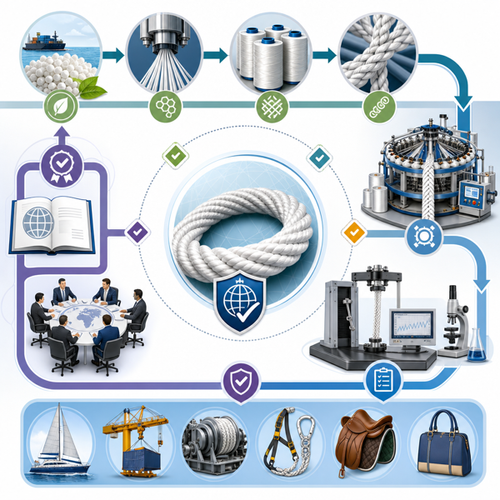
With the June 2026 release of EN ISO 10325:2026, the textile and leather technology sector sees a significant update in the standards governing high modulus polyethylene fibre ropes. This standard, developed through ISO and CEN collaboration, delivers comprehensive requirements for 8-strand and 12-strand braided ropes as well as covered rope constructions using high modulus polyethylene (HMPE). The implementation of this standard is crucial for manufacturers, engineers, and quality professionals committed to safety and technical excellence in fibre rope production.
Overview / Introduction
The textile and leather technology industry continually evolves to meet demands for higher performance, safety, and reliability—none more so than in the area of technical textiles like fibre ropes. High modulus polyethylene (HMPE) ropes are prized for their exceptional tensile strength, light weight, and high durability, finding applications in marine, industrial, and specialized textile sectors. With the publication of EN ISO 10325:2026, professionals now have an updated, harmonized reference for the construction, designation, and compliance aspects of these high-performance ropes.
Why are standards like EN ISO 10325:2026 critical? They:
- Enhance product uniformity and quality across the industry
- Streamline procurement and specification processes
- Ensure safety and performance in demanding environments
This article offers a detailed look at the new standard’s scope, technical requirements, implementation factors, and what the changes mean for industry professionals.
Detailed Standards Coverage
EN ISO 10325:2026 – Fibre Ropes Made of High Modulus Polyethylene
Fibre ropes – High modulus polyethylene – 8-strand braided ropes, 12-strand braided ropes and covered ropes (ISO 10325:2026)
The latest edition of EN ISO 10325 sets the bar for the manufacture and quality assurance of fibre ropes composed of high modulus polyethylene (HMPE). Scope covers not only 8-strand and 12-strand braided ropes, but also ropes with covered constructions—including single braid, double braid, and multi-core types—intended for general-purpose use.
Key requirements and specifications:
- Material selection: Only HMPE fibres that meet defined performance benchmarks are permitted
- Construction types: Specific guidelines for 8-strand and 12-strand braids, as well as combinations that include covers (such as double braided and multi-core constructions)
- Physical properties: Prescribes minimum breaking force, linear density, and test methodologies to verify compliance
- Labelling and packaging: Standardized approaches for marking rope lengths, specifications, and batch identification
- Marking and traceability: Requirements for clear identification of rope type and material to facilitate traceability
Who needs to comply:
- Rope manufacturers
- Technical textile producers
- Marine, industrial, and transport sectors utilizing HMPE ropes
- Quality and procurement personnel sourcing fibre ropes
Practical implications for implementation: Manufacturers are encouraged to align processes with the detailed construction, material, and physical property requirements to ensure conformity. Since the standard supersedes EN ISO 10325:2018, organizations must review updated requirements, particularly in the areas of safety warnings, definitions for general purpose use, and revised physical property tables.
Notable changes from EN ISO 10325:2018:
- Introduction of explicit safety and risk warnings
- New definition of general purpose use
- Revised description of HMPE materials
- Updated figures, tables, and physical property benchmarks
- Enhanced clarity in labelling, packaging, and marking requirements
Key highlights:
- Aligns European and International HMPE rope requirements for global consistency
- Detailed technical definitions for a broad range of braided and covered rope types
- Updated safety and risk considerations
Access the full standard:View EN ISO 10325:2026 on iTeh Standards
Industry Impact & Compliance
The release of EN ISO 10325:2026 significantly impacts manufacturing, engineering, and procurement activities within the textile and leather technology sector:
- Improved product safety: Clearer safety warnings and risk considerations foster safer rope application in critical and general-purpose contexts.
- Unified technical language: Updated definitions and harmonized terminology enable better communication between suppliers, buyers, and end-users.
- Procurement confidence: Transparent labelling, marking, and test procedures enhance traceability, reducing the risk of supply chain inconsistencies.
Compliance considerations:
- Organizations must withdraw obsolete standards and align their rope products by December 2026.
- Adoption cycles may require adjustments in test protocols, documentation, and supply chain communication.
- Early engagement with the new standard reduces costly non-compliance risks—such as product recalls or legal liabilities—while opening access to new markets demanding conformity with the latest specifications.
Benefits of adopting EN ISO 10325:2026:
- Enhanced market reputation through best-in-class quality
- Increased customer trust via internationally recognized certification
- Reduced product failures and warranty claims
Risks of non-compliance:
- Loss of market access in regions enforcing the latest CEN/ISO standards
- Exposure to liability in the event of safety incidents
- Inefficiencies and increased costs from having to rework processes post-inspection
Technical Insights
Common technical requirements in EN ISO 10325:2026:
- Adheres to strict material performance criteria for HMPE fibres, balancing strength and durability with safety.
- Mandates specific construction parameters, such as braid pitch and lay length, promoting consistent rope properties across manufacturers.
- Requires standardized physical property testing, including breaking force and linear density measurements, using defined laboratory procedures to ensure repeatable results.
Implementation best practices:
- Gap assessment: Analyze existing manufacturing and quality control processes against the new EN ISO 10325:2026 requirements.
- Training: Educate production and QA teams on changes, especially in new labelling, marking, and testing requirements.
- Supplier engagement: Ensure all HMPE fibre suppliers understand and meet the revised material requirements.
- Traceability: Improve data systems for rope batch tracking, which is now more rigorously defined in marking and packaging clauses.
Testing and certification considerations:
- Revisit laboratory protocols to verify physical properties outlined in the new standard, using ISO-aligned test methods.
- Develop robust documentation practices for compliance audits or third-party certification purposes.
Conclusion / Next Steps
EN ISO 10325:2026 marks a new chapter in quality assurance and technical reliability for HMPE fibre ropes in the textile and leather technology sector. The revised standard introduces meaningful improvements in safety, material specification, and traceability, reflecting the industry's commitment to innovation and harmonized practices.
Recommendations for organizations:
- Review and update internal standards, supplier contracts, and product specifications to align with EN ISO 10325:2026.
- Build training programs around new technical and compliance requirements.
- Engage proactively with both product development and quality teams to ensure smooth transition.
Stay up to date with international standards developments and access authoritative documents through iTeh Standards. Early adoption will not only future-proof your operations but secure your position as a trusted supplier in the global technical textiles market.
Categories
- Latest News
- New Arrivals
- Generalities
- Services and Management
- Natural Sciences
- Health Care
- Environment
- Metrology and Measurement
- Testing
- Mechanical Systems
- Fluid Systems
- Manufacturing
- Energy and Heat
- Electrical Engineering
- Electronics
- Telecommunications
- Information Technology
- Image Technology
- Precision Mechanics
- Road Vehicles
- Railway Engineering
- Shipbuilding
- Aircraft and Space
- Materials Handling
- Packaging
- Textile and Leather
- Clothing
- Agriculture
- Food technology
- Chemical Technology
- Mining and Minerals
- Petroleum
- Metallurgy
- Wood technology
- Glass and Ceramics
- Rubber and Plastics
- Paper Technology
- Paint Industries
- Construction
- Civil Engineering
- Military Engineering
- Entertainment