


May 2026: ISO 21154 Introduces New LNG Boil-Off Rate Measurement Standard for Marine Vessels
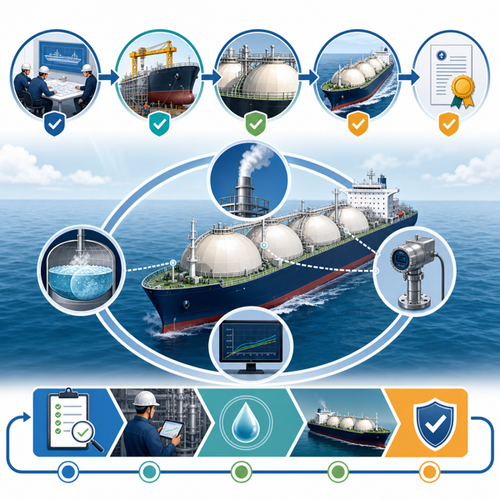
The global shipping industry witnessed a major advancement in May 2026 with the publication of ISO 21154:2026—an international standard dedicated to the boil-off-rate (BOR) measurement for cargo containment systems (CCS) in liquefied natural gas (LNG) ships. Responding to the crucial requirement for precision and reliability in LNG management, this new standard answers the industry's growing demand for measurable, energy-efficient containment in marine transportation.
With a specific scope targeting the cargo containment systems of LNG carriers, floating storage and regasification units (FSRUs), and LNG bunkering vessels, ISO 21154:2026 establishes the method, equipment, and processes for standardized BOR testing. Here, we explore its importance for the marine structures sector, provide a detailed breakdown of the standard, and offer compliance and technical insights for implementing organizations.
Overview / Introduction
Shipbuilding and marine structures play an essential role in the safe, sustainable, and efficient transport of liquefied natural gas. As the global push for green fuels accelerates, LNG has gained popularity thanks to its high calorific value and lower emissions profile. Maintaining the integrity and efficiency of LNG cargo containment is vital—not only to minimize product loss and emissions but also to support shipowners in managing operational costs and complying with international regulations.
Standards in this sector underpin everything from safety and performance to cost calculations and environmental compliance. The 2026 edition of ISO 21154 provides:
- Uniform measurement principles for boil-off rates
- Clear data acquisition and reporting methods
- Application guidance for a wide range of vessel types
This article will help industry professionals—shipbuilders, compliance officers, engineers, and procurement specialists—understand how the new standard affects their work and guides best practice across the industry.
Detailed Standards Coverage
ISO 21154:2026 - Boil-off-Rate Measurement Method for Cargo Containment Systems of LNG Ships
Ships and marine technology — Boil-off-rate measurement method for cargo containment system of LNG ships
ISO 21154:2026 is the first edition in its category, establishing a rigorous framework for measuring and reporting the boil-off-rate (BOR) in LNG vessel containment systems. The standard covers the principles, required equipment, test conditions, operating procedures, data acquisition/processing, and reporting formats necessary for effective BOR measurement.
Scope and Application:
- Applicable to cargo containment systems (CCS) on LNG carriers, FSRUs, and LNG bunkering vessels
- Provides reference methods that can be adapted for fuel containment systems (FCS) on LNG-fueled ships
- Addresses measurement under natural boil-off and active boil-off scenarios
Key Requirements and Specifications:
- Measurement Principle: The core method is based on tracking the change in LNG quantity over time, using a heat balance approach to determine product loss to boil-off
- Measurement Conditions: Specifies environmental, operational, and equipment conditions (including temperature, pressure, and fill rate) under which tests should be performed for reliability and repeatability
- Data Handling: Detailed processes for real-time data acquisition, recordkeeping, data posting, and structured test reports
- Reporting: Standardized test reports and informative examples included in annexes to facilitate global harmonization in documentation and auditing
Stakeholders and Compliance:
- Mandatory for shipbuilders, fleet owners, CCS manufacturers, LNG terminal operators, and technical consultants involved in the lifecycle of LNG marine transportation
- Also benefits regulatory bodies, classification societies, and energy companies pursuing standardized compliance and efficiency metrics
Practical Implications:
- Enables accurate performance assessment of LNG cargo containment, supporting project planning, operational optimization, and regulatory certification
- Helps shipowners and designers benchmark thermal insulation efficiency, maximize cargo retention, and streamline compliance processes
- Facilitates fair and transparent operational cost calculations based on quantifiable product loss
Key highlights:
- Defines uniform measurement criteria for boil-off-rate in marine LNG applications
- Mandates detailed data logging and reporting for auditability
- Supports both cargo and fuel system testing, addressing expanding LNG applications
Access the full standard:View ISO 21154:2026 on iTeh Standards
Industry Impact & Compliance
The publication of ISO 21154:2026 is set to fundamentally strengthen the marine LNG transport sector’s safety, efficiency, and sustainability posture. Its adoption enables marine organizations to:
- Demonstrate compliance with global and local regulations on LNG transport, supporting port entry, insurance, and cross-border operations
- Benchmark operational efficiency by tracking and minimizing boil-off, leading to direct fuel savings and reduced shipping costs
- Enhance sustainability reporting by quantifying and controlling emissions associated with boil-off gas
- Facilitate technical audits and inspections, providing a reliable method to verify containment performance
Compliance Considerations and Timelines:
- New build LNG carriers and retrofitted vessels are likely to encounter ISO 21154 compliance requirements in ship classification and commissioning processes
- Organizations should align procurement, technical specifications, and training for BOR testing with the requirements set forth in this standard
- Early adoption offers competitive advantages in efficiency, charter options, and market access
Benefits of Adoption:
- Reduces uncertainties in cargo loss calculations
- Lowers environmental and reputational risk
- Simplifies reporting for regulators and clients
Risks of Non-Compliance:
- Regulatory penalties, shipping delays, or vessel detentions
- Higher energy/losses costs due to inaccurate containment assessment
- Reduced competitiveness in emerging low-carbon fuel markets
Technical Insights
A closer look at the technical requirements across ISO 21154 reveals several recurring themes:
- Precision Measurement: The standard emphasizes continuous, high-fidelity measurement of temperature, pressure, and fill levels, ensuring the calculated BOR accurately reflects real-world operational parameters
- Controlled Test Conditions: Strict guidance on how to perform tests under stable conditions minimizes variability, supporting cross-operator and cross-vessel comparisons
- Automated Data Logging: Emphasis on digital data acquisition and secure storage drives modernization of onboard monitoring systems
- Test Report Standardization: Inclusion of detailed report formats and example tables (Annex A) streamlines technical communication across supply chains
Implementation Best Practices:
- Invest in robust, calibrated measurement instruments and automate data acquisition where possible
- Train technical teams on the measurement protocols and recordkeeping obligations of ISO 21154
- Standardize test scheduling as part of routine vessel maintenance or commissioning
- Engage classification societies early to verify pre-compliance and avoid costly retrofits
Testing and Certification Considerations:
- Laboratories and independent inspectors conducting BOR assessments should develop protocols aligned with ISO 21154
- Certification and approval processes for new ships can be accelerated by presenting compliant BOR test records
Conclusion / Next Steps
ISO 21154:2026 sets a new benchmark for LNG shipping safety, efficiency, and regulatory compliance. By aligning with this internationally recognized methodology, organizations within the marine structures sector can dramatically improve LNG cargo management, ensure stakeholder trust, and maintain a competitive advantage in the evolving fuels market.
Key takeaways:
- ISO 21154:2026 is now the definitive reference for boil-off-rate measurement in LNG cargo and fuel systems aboard marine vessels
- Adoption is essential for compliance, operational optimization, and environmental reporting
- Implementing robust BOR measurement and documentation practices boosts efficiency and risk control
Recommendations:
- Review the full text of ISO 21154:2026 and update internal procedures accordingly
- Invest in compliant BOR measurement solutions
- Regularly consult iTeh Standards for ongoing updates and further guidance
Stay ahead in marine engineering by adopting the very latest in standards development.
Explore full details and instant access to ISO 21154:2026 on iTeh Standards:View ISO 21154:2026 on iTeh Standards
Categories
- Latest News
- New Arrivals
- Generalities
- Services and Management
- Natural Sciences
- Health Care
- Environment
- Metrology and Measurement
- Testing
- Mechanical Systems
- Fluid Systems
- Manufacturing
- Energy and Heat
- Electrical Engineering
- Electronics
- Telecommunications
- Information Technology
- Image Technology
- Precision Mechanics
- Road Vehicles
- Railway Engineering
- Shipbuilding
- Aircraft and Space
- Materials Handling
- Packaging
- Textile and Leather
- Clothing
- Agriculture
- Food technology
- Chemical Technology
- Mining and Minerals
- Petroleum
- Metallurgy
- Wood technology
- Glass and Ceramics
- Rubber and Plastics
- Paper Technology
- Paint Industries
- Construction
- Civil Engineering
- Military Engineering
- Entertainment