


June 2026 Releases: New Standards Advance Process Measurement, Tool Safety, and Additive Manufacturing
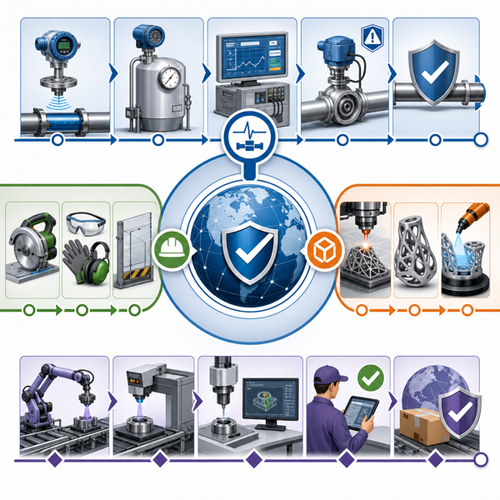
New Manufacturing Engineering Standards: June 2026 Releases
June 2026 has seen the publication of five significant international standards shaping the future of manufacturing engineering. This vital update (Part 3 of 4 in our manufacturing series for June) covers new and revised specifications in process measurement and control, electric tools for woodworking, and state-of-the-art flaw detection in additive manufacturing of metals. For engineers, quality managers, compliance officers, researchers, and procurement specialists, understanding these documents is crucial to staying ahead in an evolving industry landscape.
Overview / Introduction
Manufacturing engineering is evolving rapidly, demanding ever-higher standards of precision, safety, and process assurance. International standards underpin this growth, enabling interoperability, enhancing product quality, and ensuring safety across diverse manufacturing environments. This article unpacks the latest standards published in June 2026, providing a detailed look at their scope, key requirements, and the practical implications for professionals working with process measurement and control devices, electric woodworking tools, and advanced metal additive manufacturing.
Whether you’re seeking to maintain compliance, drive innovation, or enhance operational efficiency, these new guidelines provide a roadmap for best practices across the sector.
Detailed Standards Coverage
IEC 61298-1:2026 - General Considerations for Evaluating Performance
Process measurement and control devices – General methods and procedures for evaluating performance – Part 1: General considerations
IEC 61298-1:2026 establishes foundational principles for conducting tests and reporting on the functional and performance characteristics of process instrumentation—excluding process measurement transmitters (PMTs), which are now addressed by IEC 62828 series. The standard guides testing for a wide range of devices with unique input & output variables and analog or digital interfaces. It also provides a general reference for developing future process instrumentation standards.
Key themes and requirements include:
- Realistic test conditions, covering environmental, electrical, and mechanical influences
- Economic considerations in testing
- Clear documentation and traceability of test methods and results
- Independence of test outcomes from cross-effects
- Step-by-step guidance for preparing, executing, and reporting tests (including lab setup, calibration, error evaluation, and reporting protocols)
- Significant change: Removal of PMTs from the standard’s scope for focused alignment with IEC 62828
Key highlights:
- Comprehensive criteria for reproducibility and comparability of measurement results
- Structured approach to sampling, mounting, vibration, and pre-conditioning
- Alignment with international terminology and reference requirements
Access the full standard:View IEC 61298-1:2026 on iTeh Standards
IEC 61298-2:2026 – Tests Under Reference Conditions
Process measurement and control devices – General methods and procedures for evaluating performance – Part 2: Tests under reference conditions
IEC 61298-2:2026 details standardized testing methodology for functional and performance characteristics under reference (controlled) conditions, serving process instrumentation except PMTs. This edition sharpens focus on test reproducibility and comparability, aiding not only practitioners but also future standards drafters.
Scope and applications:
- Defines procedures for accuracy, dynamic behavior, and functional characteristics
- Details preconditioning cycles, selection of test points, and data presentation
- Specifies test procedures for analog and digital instruments (including dynamic and drift tests)
Practical implications:
- Required for all organizations evaluating process control devices under controlled conditions
- Equips compliance teams with structured reporting methods vital for audits and certifications
Notable revision:
- Removal of PMTs from the scope
Key highlights:
- Transparent presentation and processing of measurement data
- Consistent terminology and accuracy assessment
- Standardized dynamic and drift testing protocols
Access the full standard:View IEC 61298-2:2026 on iTeh Standards
IEC 61298-3:2026 – Tests for the Effects of Influence Quantities
Process measurement and control devices – General methods and procedures for evaluating performance – Part 3: Tests for the effects of influence quantities
IEC 61298-3:2026 focuses on evaluating how environmental and operational factors—termed ‘influence quantities’—affect process instrumentation performance. The standard encompasses both analog and digital devices and interfaces with product-specific standards for specialized tests. All references to PMTs have been removed (these are now addressed separately), and this edition refines the handling of electromagnetic compatibility (EMC) by referring to dedicated IEC standards.
Scope and requirements:
- Test effects of temperature, humidity, vibration, shock, position, power supply variation, and process medium properties
- Recommends methods for accelerated functional testing and additional long-term assessments
- Covers both electrical and pneumatic outputs, ensuring devices withstand real-world stresses
Who should comply:
- Process industries, instrumentation manufacturers, calibration labs, and anyone assessing device resilience against external influences.
Key highlights:
- Structured procedures for environmental and electrical disturbance testing
- EMC and electrical safety now referenced directly instead of detailed coverage
- Practical resilience and reliability benchmarks for process measurement and control devices
Access the full standard:View IEC 61298-3:2026 on iTeh Standards
EN IEC 62841-3-3:2026 – Safety Requirements for Transportable Planers and Thicknessers
Electric motor-operated hand-held tools, transportable tools and lawn and garden machinery – Safety – Part 3-3: Particular requirements for transportable planers and thicknessers
This standard, harmonized across Europe as EN IEC 62841-3-3:2026, establishes safety requirements for electric planers and thicknessers that are transportable, aimed at woodworking applications (maximum planing width of 330 mm). It supersedes EN 61029-2-3:2011, offering enhanced safety and testing protocols.
Scope and requirements:
- Applies to transportable electric planers, thicknessers, and combined units for wood and similar materials
- Details construction, mechanical strength, guarding, marking, safe starting, overload protection, electrical safety, and endurance requirements
- Specifies noise and vibration measurement protocols (Annex I), vital for occupational safety
- Excludes stationary (non-transportable) machines
Practical importance:
- Critical for manufacturers, testing labs, importers, and employers in the woodworking sector
- Ensures conformity with the Machinery Directive in Europe and facilitates CE marking
Key highlights:
- Comprehensive coverage of mechanical and electrical hazards
- Specific guidance for bridge-type and anti-kickback guards
- Updated testing for stability, endurance, and material specifications
Access the full standard:View EN IEC 62841-3-3:2026 on iTeh Standards
CEN ISO/ASTM TR 52958:2026 – Additive Manufacturing: In-Situ Coaxial Photodiode Monitoring
Additive manufacturing of metals – Powder bed fusion (PBF) – In-situ coaxial photodiode monitoring for lack of fusion flaw detection in PBF-LB (ISO/ASTM TR 52958:2026)
This innovative technical report defines a workflow for in-situ monitoring and detection of lack-of-fusion flaws in laser powder bed fusion (PBF-LB) additive manufacturing processes using coaxial photodiode sensors and machine learning algorithms.
Scope and cutting-edge contributions:
- Specifies experimental procedures and flaw detection algorithms for PBF-LB systems
- Emphasizes coaxial photodiode-based in-situ data acquisition and cluster/statistical algorithms for flaw identification
- Provides protocol for setting statistical thresholds and clustering parameters, using intentionally seeded flaws for calibration
- Outlines validation with computed tomography (CT) and addresses hardware/multi-laser system limitations
Who should pay attention:
- Additive manufacturing engineers, quality assurance specialists, R&D teams, OEMs, and laboratories focused on metal 3D printing
Key highlights:
- Step-by-step workflow for integrating photodiode monitoring in production environments
- Combines data-driven flaw detection with physical validation via CT scanning
- Addresses both hardware configuration and data processing best practices
Access the full standard:View CEN ISO/ASTM TR 52958:2026 on iTeh Standards
Industry Impact & Compliance
The June 2026 standards bring powerful tools for organizations aiming to elevate both safety and performance across manufacturing engineering operations.
Key impact areas:
- Process accuracy: Detailed, repeatable methods for accuracy and dynamic testing foster confidence in process instrumentation results, reducing measurement uncertainty and compliance risks.
- Resilience: Environmental and functional impact testing ensure installed devices withstand operational stresses, supporting reliability for critical process sectors (pharma, energy, chemicals, etc.).
- Worker safety: Enhanced requirements for woodworking tool safety mitigate mechanical, electrical, and ergonomic risks in production and onsite environments.
- Additive assurance: Innovative workflow for in-situ PBF-LB flaw detection allows real-time intervention and validation, reducing scrap and advancing quality assurance in metal 3D printing.
Compliance timeline:
- Many standards have fixed compliance dates for CE marking or contractual obligations—early adoption gives organizations a competitive edge
- Updated terminology and scope changes (notably the segregation of PMT tests) require revision of in-house procedures and quality documentation
Benefits:
- Risk mitigation from product failure or non-conformance
- Enablement of audits and certifications (ISO 9001, regulatory approvals, customer audits)
- Improved safety reputation and lowered incident costs
Risks of non-compliance:
- Regulatory fines, supply chain delays, reputational harm, and exclusion from tenders or partnerships
Technical Insights
The five new standards share multiple technical themes and best practices relevant to today’s manufacturing landscape:
- Standardized Test Methodologies: Robust procedures (sampling, calibration, measurement setup) ensuring reproducible and auditable results
- Environmental Stress Testing: Guidance on temperature, humidity, vibration, and electric supply influence, vital for process reliability and product claims
- In-Situ and Data-Driven Monitoring: Integration of sensor feedback and advanced data analytics (machine learning) for contemporary manufacturing environments
- Documentation and Reporting: Structured approaches to reporting, error evaluation, and documentation supporting traceability and cross-border acceptance
- Certification Considerations: Clear relationship between standard adoption and route to CE marking, ISO/IEC 17025, and other conformity assessments
Implementation best practices:
- Read and analyze standard applicability for your products and processes.
- Align internal procedures (test labs, quality, engineering) with new test protocols and reporting formats.
- Integrate new testing tools (e.g., in-situ photodiode monitoring for additive manufacturing) into your workflows.
- Train staff—from lab technicians to engineers—on fresh compliance requirements.
- Engage with certification bodies or regulators early to ensure smooth audits.
Conclusion / Next Steps
The newly published standards for June 2026 mark a decisive step forward for manufacturing engineering worldwide. Implementing these documents positions organizations at the forefront of safety, quality, and technological sophistication:
- Consistently reproducible measurement results ensure process assurance.
- Upgraded machinery safety requirements reduce risk for employees and users.
- Data-driven, in-process assurance in additive manufacturing enables next-level defect control and cost savings.
Recommendations:
- Review each standard in detail, update internal documentation, and map compliance gaps.
- Prioritize training and communication for all technical and compliance personnel.
- Monitor upcoming parts in this standards series to remain current on best practices.
Explore these standards and more on iTeh Standards to keep your organization ahead in manufacturing engineering. Stay informed, stay compliant, and drive excellence in your processes.
Categories
- Latest News
- New Arrivals
- Generalities
- Services and Management
- Natural Sciences
- Health Care
- Environment
- Metrology and Measurement
- Testing
- Mechanical Systems
- Fluid Systems
- Manufacturing
- Energy and Heat
- Electrical Engineering
- Electronics
- Telecommunications
- Information Technology
- Image Technology
- Precision Mechanics
- Road Vehicles
- Railway Engineering
- Shipbuilding
- Aircraft and Space
- Materials Handling
- Packaging
- Textile and Leather
- Clothing
- Agriculture
- Food technology
- Chemical Technology
- Mining and Minerals
- Petroleum
- Metallurgy
- Wood technology
- Glass and Ceramics
- Rubber and Plastics
- Paper Technology
- Paint Industries
- Construction
- Civil Engineering
- Military Engineering
- Entertainment