

October 2026: New Functional Safety Standards for Materials Handling Equipment Software and Performance Levels
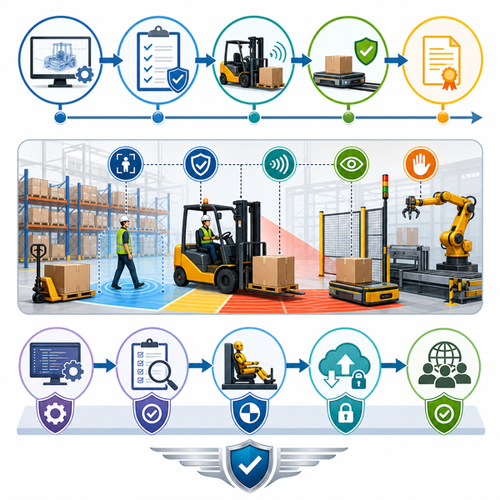
The October 2026 update introduces two significant international standards impacting the safety and performance of materials handling equipment—crucial for enhanced operational integrity in earth-moving machinery. Covering the functional safety of software-driven control systems and comprehensive performance level tables, these new ISO publications address current industry challenges while paving the way for more robust compliance and risk mitigation strategies across construction, mining, and heavy equipment sectors.
Overview
Materials handling equipment forms the backbone of industries such as construction, mining, infrastructure, and logistics. Within this sector, earth-moving machinery—ranging from dump trucks to excavators—plays an especially pivotal role. As operational complexity grows with the integration of advanced control systems and networked electronics, ensuring the functional safety of both hardware and software components becomes ever more crucial. International standards guide manufacturers, integrators, and operators in implementing proven safety requirements, verifying performance, and documenting compliance.
In this article, you'll gain detailed insights into the latest standards published in October 2026, specifically:
- How new ISO specifications address emerging risks associated with software errors, data transmission failures, or control system lapses
- What the new machine performance level requirements mean for system design, procurement, and ongoing certification
- Practical advice for effective implementation and audit-readiness
Detailed Standards Coverage
ISO 19014-4:2026 - Design and Evaluation of Software and Data Transmission for Safety-Related Parts of the Control System
Earth-moving machinery — Functional safety — Part 4: Design and evaluation of software and data transmission for safety-related parts of the control system
This comprehensive standard sets out principles for the safe development of software and management of signal transmission in the safety-related parts of machine control systems (MCS) specific to earth-moving machinery, as categorized by ISO 6165:2022. The document aims to mitigate significant hazards—such as hazardous machine behaviors from incorrect control responses—via robust requirements for embedded software design, validation, and data integrity protection.
Scope & Requirements:
- Covers the full software development lifecycle for safety-related control system elements, including planning, requirements capture, architecture, module design, coding, integration, validation, and documentation.
- Identifies and prescribes specific methods to avoid and control software faults, from design artefacts through testing (e.g., requirements traceability, defensive programming, boundary and structure testing).
- Mandates methods for maintaining data integrity—such as checks for range, corruption, completeness, and authentication, especially during transmission between control units (ECUs) using bus systems.
- Sets detailed provisions regarding partitioning of software resources and runtime environments to guarantee independence between safety-related and non-safety-related functions (critical for mixed-criticality systems).
- Outlines validation requirements for parameterization, ensuring that changes to parameters post-development maintain safety and are protected from unauthorized access or accidental corruption.
- Lists a matrix of recommended and required protection measures for common transmission errors—covering peer communication failure, message repetition, data falsification, unintended delays, and bus overloads. Techniques include watchdog timers, sequence numbers, cyclic redundancy checks, minslotting, and bus guardians.
Use & Target Stakeholders:
- Designed for manufacturers, safety engineers, software developers, system integrators, and regulatory inspectors working with modern earth-moving machinery.
- Directly affects design, deployment, and lifecycle management for any entity producing or operating such machines post-publication (October 2026). Machinery built prior to this date is exempt.
Practical Implications:
- Adoption ensures that software-driven safety functions are dependable and scrutinized at every development phase—reducing risks of unforeseen machine control failures in field operations.
- Provides a systematic approach for updating legacy systems, validating reused or modified modules, and integrating new technologies while maintaining legal and contractual compliance.
- Enhances the ability to demonstrate due diligence during audits or certifications—crucial for accessing regulated and international markets.
Key highlights:
- Covers the full V-model for software safety in machine control systems, including traceability, modularity, and independent review.
- Specifies error control methods for data transmission across ECUs, crucial for networked machinery.
- Requires formal documentation, robust testing, and verification strategies tailored to the machine's safety performance level.
Access the full standard:View ISO 19014-4:2026 on iTeh Standards
ISO 19014-5:2026 - Tables of Performance Levels for Earth-Moving Machinery
Earth-moving machinery — Functional safety — Part 5: Tables of performance levels
This ISO standard provides both the methodology and the required performance levels (MPLr) for a detailed array of functions across different types of earth-moving machines. These performance levels can be directly mapped or applied to safety control systems (SCS) for functions like braking, steering, speed control, and operator presence within the entire portfolio of covered equipment—in line with ISO 6165:2022 definitions.
Scope & Requirements:
- Establishes normative tables (Annexes A–AA) that define the minimal acceptable machine performance levels for functions and scenarios across a wide range of machinery including dump trucks, loaders, excavators, graders, rollers, compactors, and specialized attachments.
- MPLrs derive from a Machine Control System Safety Analysis (MCSSA) process—calculating worst-case risk and applying it across the equipment’s functional safety requirements. Criteria consider hazards during operation, maintenance, and interaction with bystanders or co-workers.
- Requires SCS designers and machine manufacturers to cross-reference their implementations against these tables to confirm compliance with the identified MPLr for every safety function.
- Reiterates the necessity of maintaining up-to-date risk assessments (per ISO 12100:2010 and ISO 19014-1:2026), especially in the case of unique machine configurations, alternative applications, or new technologies (electric or hydrostatic systems, for example).
- Mandates that machines conform to ISO 19014-1, -2, and -4 for both risk quantification and effective risk reduction measures, ensuring a holistic, multi-standard approach to functional safety.
Use & Target Stakeholders:
- Essential for engineers involved in machine safety analysis, performance verification, and compliance documentation.
- A primary reference for procurement professionals assessing supplier adherence, as well as auditors and inspectors verifying fielded machinery against global best practices.
Practical Implications:
- Using the MPLr tables streamlines risk assessment by providing off-the-shelf baseline requirements for standard use-cases and machine types, avoiding redundant individual analyses where standardized data suffice.
- Integration of these tables into engineering design and technical documentation ensures alignment with international expectations and supports swift regulatory approvals.
- Keeps organizations audit-ready and well-positioned for cross-border equipment sales where adherence to ISO standards is a purchasing condition.
Key highlights:
- Contains detailed, function-by-function MPLr data per earth-moving machine type (over 20 equipment classes covered via exhaustive annexes).
- Enables traceability and mapping from risk scenarios to required safety system design.
- Structures compliance for both traditional and emerging machine technologies.
Access the full standard:View ISO 19014-5:2026 on iTeh Standards
Industry Impact & Compliance
The introduction of ISO 19014-4:2026 and ISO 19014-5:2026 marks a new era in the management of risk and assurance of safety for materials handling equipment. Their adoption supports:
- Uptake of harmonized, auditable safety management systems across all international operations
- Accelerated innovation—by clarifying compliance requirements for sophisticated, software-based machine control and integrated electronics
- Minimized risk of operational mishaps resulting from software faults or inadequate performance monitoring
- Streamlined market access, as adherence to current ISO standards is often a non-negotiable criterion in procurement, government contracting, and major tenders
- Certainty in legal defensibility and insurance claims, backed by up-to-date, published standards compliance
Compliance Considerations:
- These standards are mandatory for any machinery manufactured after October 2026 and recommended as best practice for upgrades or system redesigns of pre-existing assets
- Organizations must integrate requirements into their product development, certification, and procurement cycles
- Documented evidence (testing, validation, audit trails) becomes central to regulatory submissions and market authorizations
- Non-compliance introduces risks: legal liabilities, regulatory penalties, restricted market access, loss of brand reputation, and—most critically—potential for injury or fatality related to machine malfunction
Technical Insights
Common Technical Requirements
Both standards emphasize the following:
- Robust definition and traceability of system safety requirements throughout the software development lifecycle
- Comprehensive validation and verification (V&V) plans, integrating simulation, hardware-in-the-loop, and black-box testing
- Data transmission integrity: required use of error detection/correction (CRC, sequence numbers), watchdogs, and independence concepts for networked ECUs
- Performance mapping: safety functions (such as braking, speed, direction control) are mapped directly to required safety levels—enabling system designers to select components and architectures that are proven to meet those levels
Implementation & Best Practices
- Adopt the V-model approach for software engineering, as referenced by ISO 19014-4
- Use a configuration management system throughout the software lifecycle for artefact traceability
- Select language subsets and certified tools with increased confidence levels for safety-related software
- Document justification for selected methods wherever alternative approaches are implemented
- Perform regular impact analyses when modifying safety-related software components, and update artefacts accordingly
- Reference MPLr tables (ISO 19014-5) at the concept stage of design or during procurement to set clear specification requirements
- Leverage annex materials in both standards for checklists, scenario mapping, and cross-functional team alignment
Testing and Certification
- Design, implement, and document exhaustive testing strategies (boundary, structure, stress, black-box)
- Employ model-based and automatic test generation tools for high-integrity systems
- Prepare for third-party audits by maintaining verifiable chains of design, implementation, and V&V deliverables
Conclusion & Next Steps
The October 2026 publication of ISO 19014-4 and ISO 19014-5 is a substantial advancement in safeguarding both operators and businesses relying on modern materials handling equipment. These standards are integral for anyone designing, specifying, certifying, or procuring earth-moving machinery worldwide.
Key takeaways:
- New, rigorous requirements for software and data communication in safety-related machine control
- Comprehensive MPLr tables now standardize safety levels for a wide range of operations and equipment types
- Adoption is both a competitive advantage and a compliance necessity for equipment manufacturers and fleet operators
Recommendations:
- Assess current machine inventories and development pipelines for gaps relative to the new standards
- Update procurement documents to require ISO 19014-4 and ISO 19014-5 compliance in all new purchases
- Engage safety, engineering, and quality teams in training around these updated requirements
- Bookmark and monitor the iTeh Standards platform for further developments and new guidance as regulations continue to evolve
For the full text of each standard and implementation tools, refer to the provided links above. Staying ahead in compliance ensures not only operational safety and efficiency but also reputational leadership in the dynamic materials handling sector.
Categories
- Latest News
- New Arrivals
- Generalities
- Services and Management
- Natural Sciences
- Health Care
- Environment
- Metrology and Measurement
- Testing
- Mechanical Systems
- Fluid Systems
- Manufacturing
- Energy and Heat
- Electrical Engineering
- Electronics
- Telecommunications
- Information Technology
- Image Technology
- Precision Mechanics
- Road Vehicles
- Railway Engineering
- Shipbuilding
- Aircraft and Space
- Materials Handling
- Packaging
- Textile and Leather
- Clothing
- Agriculture
- Food technology
- Chemical Technology
- Mining and Minerals
- Petroleum
- Metallurgy
- Wood technology
- Glass and Ceramics
- Rubber and Plastics
- Paper Technology
- Paint Industries
- Construction
- Civil Engineering
- Military Engineering
- Entertainment