


May 2026 Updates: New Mechanical Components Standards Released
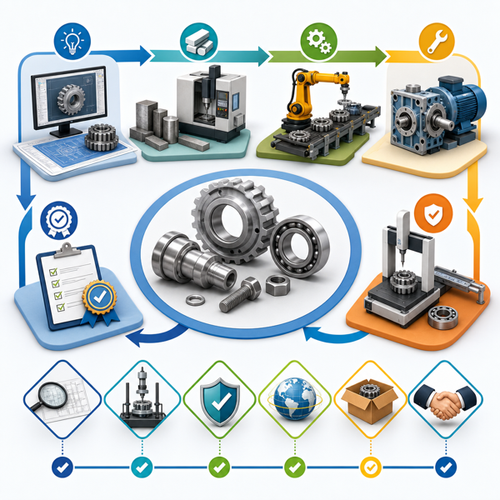
The month of May 2026 marks a significant update for the field of mechanical systems and components for general use, with the publication of five international ISO standards. Ranging from fasteners and grooved pins to bearing reliability and hydrodynamic plain journal bearings, these standards are set to refine quality expectations, design practices, and compliance demands for professionals across manufacturing, engineering, procurement, and maintenance.
Whether you’re a quality manager, design engineer, or responsible for compliance and procurement, these new standards offer solutions and guidance tailored to the rapidly evolving needs of the mechanical components sector.
Overview / Introduction
Mechanical systems and components are foundational to countless industries—spanning automotive, aerospace, industrial manufacturing, energy, and beyond. Ensuring reliability, safety, and efficiency within this domain hinges on the adoption of robust international standards. These standards harmonize design, production, and testing requirements, driving market access and global interoperability.
In May 2026, ISO released five major updates relevant to mechanical fasteners, pins, rolling bearings, and plain journal bearings. This article dives into each new publication, uncovering the critical changes, implementation requirements, and industry benefits. By reading on, you will:
- Learn what each new standard offers and its technical scope
- Understand compliance requirements and industry impacts
- Gain practical insights for engineering and procurement
Detailed Standards Coverage
ISO 8743:2026 - Fasteners — Grooved Pins — Half-Length Centre Grooves
Fasteners — Grooved pins — Half-length centre grooves
ISO 8743:2026 focuses on the specification and characteristics of grooved pins with half-length centre oval grooves, available in steel and stainless steel, and covers nominal diameters from 1 mm to 25 mm. These pins are engineered for precision assembly—enabling both relative rotational movement and secure positioning of components. Their symmetrical design allows simple installation, while the elastic fit behaviour provides high pull-out resistance—a critical requirement in industrial assemblies subject to vibration or dynamic loading.
The standard aligns with the general requirements for grooved pins (ISO 13669), and introduces notable revisions from previous editions:
- Expanded non-preferred diameter options
- Increased expanded diameter values for certain lengths and inclusion of stainless steel pins
- Refined tolerances for groove location and length, end shapes, and additional permissible materials
- Enhanced labelling and packaging requirements
Applicable to sectors such as machinery manufacturing, automotive assembly, and any field where mechanical retention and rotational tolerance are essential, this standard simplifies benchmarking against supplier quality, ensures interchangeability, and facilitates global sourcing.
Key highlights:
- Explicit requirements for groove geometry, material grades, and expanded diameters
- Improved measurement tolerances and material options (A2, A4, C1, F1 stainless, other by agreement)
- Alignment with latest global best practices (through collaboration with CEN)
Access the full standard:View ISO 8743:2026 on iTeh Standards
ISO/TR 25269:2026 - Rolling Bearings — Calculation of Theoretical Reliability
Rolling bearings — Calculation of theoretical reliability
ISO/TR 25269:2026 delivers a technical report detailing a method for the reliability analysis of rolling bearings, specifically relating to their fatigue life as per ISO 281 and ISO 16281. The document addresses the statistical methods (Weibull distribution) underpinning modern bearing life prediction, providing guidance for calculating the probability of failure under defined conditions.
The technical report explicitly excludes failure mechanisms like wear, microspalling, or white etching cracks and focuses on fatigue-driven lifetimes. It emphasizes that calculated reliability serves as an analytical benchmark—not as the sole criterion for bearing selection. Real-world application must also consider factors such as minimum load, lubricant quality, thermal management, and load uncertainty safety factors.
Engineers and reliability specialists in automotive, aerospace, industrial equipment, and energy sectors will find this standard invaluable for lifecycle analysis, root-cause investigations, and optimizing maintenance strategies.
Key highlights:
- Reliability calculation method compatible with ISO 281, ISO 16281, VDMA 23904, and IEC/TS 61400-4-1
- Focus on rolling contact fatigue, not total bearing failure
- Cautions against use as the sole bearing selection criteria—endorses use alongside established safety factors
Access the full standard:View ISO/TR 25269:2026 on iTeh Standards
ISO 7902-1:2026 - Hydrodynamic Plain Journal Bearings Under Steady-State Conditions — Circular Cylindrical Bearings — Part 1: Calculation Procedure
Hydrodynamic plain journal bearings under steady-state conditions — Circular cylindrical bearings — Part 1: Calculation procedure
ISO 7902-1:2026 sets out a comprehensive calculation procedure for oil-lubricated hydrodynamic plain bearings, which achieve shaft/bearing surface separation purely through a lubricant film under steady-state operation. The standard is vital for the design and dimensioning of plain bearings in heavy-duty applications: turbines, motors, gearboxes, rolling mills, and pumps.
Key features include:
- Calculation basis and step-by-step methodology for bearings with angular spans (360°, 180°, 150°, 120°, 90°) and central loading
- Permissible and empirical limits on wear, mechanical, and thermal loading—supporting robust bearing life and operational reliability
- Guidance restricted to continuous, steady-state operations (dynamic loads such as vibration are excluded)
This standard applies across power generation, energy, process industries, and heavy industrial machinery—where reliable bearing performance under defined operating parameters is critical.
Key highlights:
- Defined calculation steps for sizing and optimizing bearing design
- Quantitative methods for estimating load-carrying capacity, frictional power loss, lubricant requirements, and heat dissipation
- Enhanced alignment with latest reference standards and updated symbols/bibliography
Access the full standard:View ISO 7902-1:2026 on iTeh Standards
ISO 7902-3:2026 - Hydrodynamic Plain Journal Bearings Under Steady-State Conditions — Circular Cylindrical Bearings — Part 3: Permissible Operational Parameters
Hydrodynamic plain journal bearings under steady-state conditions — Circular cylindrical bearings — Part 3: Permissible operational parameters
ISO 7902-3:2026 supplements ISO 7902-1 by specifying empirical permissible values for key operational parameters in hydrodynamic plain journal bearings. Its function is to provide designers and operators with critical reference thresholds—including minimum lubricant film thickness, maximum permissible temperature, and allowable surface pressure.
These parameters are foundational for ensuring long component life and preventing failure from wear, excessive mechanical stress, or overheating. While the published values are empirical, the standard allows for adaptation based on manufacturer data or special applications, reinforcing its applicability from standard to custom industrial solutions.
Users in the energy, transportation, industrial, and heavy machinery sectors should use ISO 7902-3 in tandem with ISO 7902-1 to thoroughly assess the reliability and durability of bearing solutions.
Key highlights:
- Permissible limits for lubrication film thickness (
hlim), temperature (Tlim), and pressure (plim) - Reference to calculation examples and technical details in ISO 7902-1
- Adaptable empirical values for customized or manufacturer-specified applications
Access the full standard:View ISO 7902-3:2026 on iTeh Standards
ISO 13809:2026 - Fasteners — Hexalobular Socket Set Screws
Fasteners — Hexalobular socket set screws
ISO 13809:2026 introduces the global specification for hexalobular (sometimes referred to as Torx®) socket set screws. Covering metric coarse threads from M3 to M30 for steel, and M3 to M24 for stainless steel, the standard is targeted at applications where precise fastening without tensile load is critical—such as machinery subassemblies, electronics, and light vehicle components.
It delivers:
- Detailed dimensions, thread forms, and end point types (flat, truncated cone, cup, dog point)
- Material, hardness, and finishing requirements, referencing ISO 898-5 and ISO 3506-3 for mechanical properties
- Clear marking and packaging instructions for traceability and procurement control
- Notes on customization via associated ISO standards when alternative requirements arise
This standard empowers quality managers, procurement teams, and engineers to specify, source, and inspect hexalobular set screws with confidence—ensuring global compatibility and compliance.
Key highlights:
- Unified metric sizes and grades for steel and stainless steel
- Comprehensive dimensional and end form guidance for a range of applications
- Direct tie-in to ISO’s global fastener quality framework
Access the full standard:View ISO 13809:2026 on iTeh Standards
Industry Impact & Compliance
The release of these updated ISO standards in mechanical systems and components has important ramifications for organizations worldwide:
- Product Quality & Lifecycle Assurance: Updated requirements for dimensional tolerances, material grades, and performance thresholds contribute to longer-lasting, more reliable components in assemblies—from energy plants to precision machinery.
- Procurement & Supplier Management: Universal specifications streamline the vetting of suppliers and components, reducing risk and increasing market access.
- Compliance & Risk Mitigation: Adherence to ISO standards provides a defensible position in contractual and regulatory contexts, reducing legal and operational risks associated with non-conformance.
- Engineering Best Practice: Clear calculation procedures and empirical operational parameters support safe, optimal designs tuned to each application.
Compliance Considerations: Timelines for implementation depend on contract cycles, industry-specific mandates, and internal QMS updates. Early adoption allows organizations to leverage the benefits of updated requirements in their next design or procurement cycle, and avoid costly rework associated with outdated specifications.
Technical Insights
A holistic review of these new standards reveals several technical themes:
- Precision in Fit and Function: Both ISO 8743 (grooved pins) and ISO 13809 (hexalobular screws) stress tight adherence to dimensional and material properties for consistent assembly performance.
- Standardized Calculation Procedures: The ISO 7902 series introduces rigorous, stepwise engineering methodologies for bearing sizing and performance assessments—critical for safe, efficient operations.
- Reliability-Driven Design: ISO/TR 25269 and the rolling bearing life standards reinforce the importance of probabilistic thinking, especially in mission-critical and life-limited components.
- Testing & Certification: All standards reference supporting test and acceptance criteria, ensuring that certification is unambiguous and verifiable in audit situations.
- Adaptability: Whether referencing allowable material substitutions, empirical parameter adjustment, or custom application adaptation, each standard remains anchored to real-world engineering flexibility, while preserving the integrity of minimum requirements.
Best Practices for Implementation:
- Integrate updated standards into internal design, procurement, and QA documentation
- Update supplier requirements and audit schedules to the new standard editions
- Invest in staff training and documentation updates to facilitate smooth adoption
- Engage with notified bodies or certification partners early when certification is required
Conclusion / Next Steps
The May 2026 publication batch for mechanical systems and components reshapes best practices in fastener selection, bearing design, and assembly reliability. Organizations are encouraged to:
- Review and implement the new standards within their design, quality, and procurement processes
- Liaise with suppliers to assure conformity to the latest requirements
- Utilize iTeh Standards as a resource for ongoing standards intelligence and full-document access
Staying informed and proactive will ensure your business remains competitive, compliant, and ready to deliver products that meet or exceed global expectations. Explore these standards in detail at iTeh Standards, and contact your standards department or representative for tailored implementation support.
Categories
- Latest News
- New Arrivals
- Generalities
- Services and Management
- Natural Sciences
- Health Care
- Environment
- Metrology and Measurement
- Testing
- Mechanical Systems
- Fluid Systems
- Manufacturing
- Energy and Heat
- Electrical Engineering
- Electronics
- Telecommunications
- Information Technology
- Image Technology
- Precision Mechanics
- Road Vehicles
- Railway Engineering
- Shipbuilding
- Aircraft and Space
- Materials Handling
- Packaging
- Textile and Leather
- Clothing
- Agriculture
- Food technology
- Chemical Technology
- Mining and Minerals
- Petroleum
- Metallurgy
- Wood technology
- Glass and Ceramics
- Rubber and Plastics
- Paper Technology
- Paint Industries
- Construction
- Civil Engineering
- Military Engineering
- Entertainment