

September 2026: New Standard Enhances Safety in Railway Wheel Bearing Testing
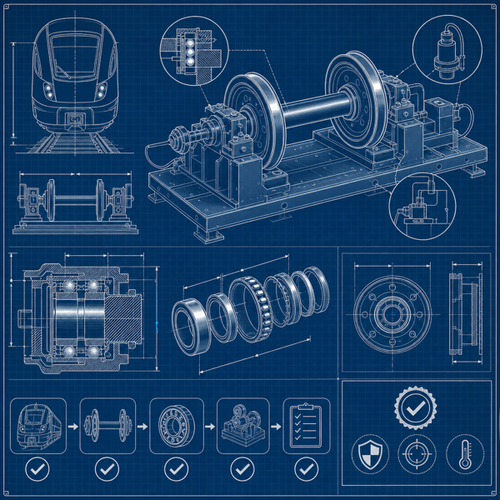
Railway engineering professionals have welcomed a pivotal development this September 2026: the release of CEN/TS 18323:2026, a technical specification aiming to improve safety, reliability, and performance assurance for wheel bearings with rotating outer rings. This newly published standard, crafted by the European Committee for Standardization (CEN), details rigorous methodologies and test setups for rail applications—addressing crucial aspects in performance testing and acceptance criteria for both symmetric and asymmetric bearing arrangements.
While only one standard is newly released this month, its comprehensive provisions promise to influence practices across European railway networks and suppliers. The standard seeks to address unique technical challenges associated with rotating outer ring configurations—directly impacting vehicle manufacturers, bearing suppliers, maintenance operations, and quality compliance teams.
Overview / Introduction
Railway engineering is a sector where reliability, safety, and performance are non-negotiable. Wheel bearings, critical to the structural and operational health of rolling stock, bear immense loads under challenging conditions. Failures in this component can cause costly downtime or even catastrophic incidents. Standards for design, testing, and routine assessment are therefore at the heart of quality assurance and safety compliance in the railway sector.
CEN/TS 18323:2026 offers new, standardized guidance for rig performance testing specifically focused on wheel bearings where the bearing's outer ring rotates—a configuration found across both mainline and urban rail applications. This article explores the new standard in depth, from technical requirements to compliance implications and recommended best practices for industry professionals.
Detailed Standards Coverage
CEN/TS 18323:2026 – Rig Performance Testing for Wheel Bearings with Rotating Outer Ring
Railway application — Wheel bearings with rotating outer ring — Rig performance testing
The CEN/TS 18323:2026 technical specification fills a long-standing gap in guidance for laboratory-based rig testing of railway wheel bearings arranged with the rotating outer ring. While existing standards, such as EN 12082-1, address conventional setups (rotating axle or inner ring), they do not sufficiently account for the specific thermal and stress patterns involved in outer ring rotation scenarios—which are critical for certain single wheel and axle bridge arrangements in modern rolling stock.
Scope and Application
This document lays out:
- Test setups and methodologies for type-testing bearing assemblies where the outer ring rotates
- Testing guidance for both cartridge bearings (self-contained units with two or more rows of rolling elements) and composite/single row roller bearings (both symmetric and asymmetric)
- Emphasis on grease-lubricated bearing arrangements, clarifying that oil-lubricated systems require different test setups
- Test acceptance criteria that hinge on detailed thermal behavior observations, reflecting the more demanding operational environment
Key Requirements & Methodology
The standard specifies:
- Rigorous test specifications: including mounting conditions, boundary dimensions, interface tolerances, grease properties, and detailed performance monitoring criteria
- Defined test rig features: including axles or journals for mounting, dummy wheels, speed and force application systems, temperature and force measurement devices, ventilation simulation, and optional dummy wheel surface measurement
- Parameterization of test conditions: such as static nominal radial and dynamic axial forces, wheel diameter ranges, operational and test speeds (with built-in safety margins), and sequence cycling up to a target cumulative distance
- Comprehensive test execution: pre-test thermal migration checks, repetitive loading cycles, continuous temperature monitoring, and post-test inspections of bearings and lubricants
- Robust acceptance criteria: results required during and following the test—including thermal limits, mechanical integrity, and physico-chemical properties (with reference to several annexes for detailed methodologies)
Who Needs to Comply?
Professionals and organizations that should refer to or adopt this standard include:
- Rolling stock manufacturers and system integrators
- Rail vehicle operators with fleets incorporating single wheel or axle bridge arrangements
- Maintenance depots and bearing testing laboratories
- Bearing manufacturers and suppliers targeting urban rail, light rail, or specialized mainline applications
- Quality assurance and compliance officers
Practical Implications
By providing clear guidance on test setups, acceptance criteria, and performance reporting (aligned with deployment procedures in EN 12082-2 but without mandating compliance with EN 12080 or EN 12081), the standard enables the industry to:
- Validate new and existing bearing technologies for specific applications
- Ensure reliable performance in demanding wheel arrangements
- Minimize the risk of undetected thermal stresses leading to premature failure
Notable Changes & Innovations
This is a new technical specification and not a revision. However, it extends the logic of EN 12082-1 into domains previously unaddressed—tailoring performance test methods to non-standard rotation scenarios, with both informative annexes and examples to guide implementation and adaptation.
Key highlights:
- Clear methodology for bearings with a rotating outer ring
- Robust, test-driven acceptance criteria based on thermal behavior
- Flexibility for different bearing arrangements and service profiles
Access the full standard:View CEN/TS 18323:2026 on iTeh Standards
Industry Impact & Compliance
The advent of CEN/TS 18323:2026 represents a step forward in qualification and reliability for specialized wheel bearing configurations in the railway sector. Its adoption promotes:
- Improved safety: through early identification of thermal or mechanical shortcomings in test environments that mirror field conditions
- Better alignment: with state-of-the-art practices in design verification and validation for single-wheel and axle bridge vehicles
- Structured performance testing: making it easier for suppliers to demonstrate compliance and for operators to accept new technologies
Compliance Considerations
- The standard is provisionally valid for three years (subject to later conversion into a full European Standard) and can be referenced in procurement specs or vendor qualification processes
- Immediate use is encouraged for new systems and whenever redeploying or modifying axlebox designs with a rotating outer ring
- Coordination with EN 12082-1 and EN 12082-2 is suggested for procedures, but CEN/TS 18323:2026 provides the definitive guide for these specific configurations
Benefits of Adoption
- Reduced risk of mechanical failures or unscheduled downtime
- Enhanced customer and regulatory confidence in product safety
- Potential competitive advantage in tender processes by documenting compliance with the latest technical guidance
Risks of Non-Compliance
- Missed identification of key thermal or mechanical vulnerabilities, leading to in-service failures
- Reputational and liability risks, particularly as industry, regulatory bodies, and operators increasingly reference this standard in procurement and certification processes
Technical Insights
Common Technical Requirements
- Use of test rigs that closely simulate real operational conditions—including force application, speed cycles, and cooling airflow
- Reliance on continuous temperature monitoring at critical zones: inner ring (given new rotation regimes), dummy wheel surfaces, and at points exposed to airflow
- Need for robust reporting: test cycles, distances, forces, temperature profiles, and post-test physical & chemical analysis
Implementation Best Practices
- Review existing test setups: Ensure that laboratories or suppliers can simulate outer ring rotations with the accuracy demanded by this standard
- Calibrate force and temperature measurement systems: Emphasize reliability, repeatability, and traceability of all data collection
- Conduct pre-tests when possible: To monitor grease migration and bedding-in effects before formal test cycles
- Cite the standard in tender and procurement documentation: Urge suppliers to comply with CEN/TS 18323:2026 as evidence of rigorous qualification
- Align reporting templates: Use recommended structure for performance test reports (see section 6.5 of the standard)
Testing and Certification Considerations
- While the standard does not prescribe a certification process, rigorous application of its principles and reporting mechanisms facilitates third-party validation and audit
- Integration with wider quality management systems (QMS accreditation and its scope, as referenced in the standard) enhances credibility for both manufacturers and operators
Conclusion / Next Steps
The publication of CEN/TS 18323:2026 marks a milestone for organizations operating or supplying specialized railway vehicles with non-conventional wheel bearing arrangements. Its tailored requirements and innovative acceptance criteria help ensure robust safety margins and reliable performance in demanding real-world scenarios.
Key takeaways:
- Railway operators and suppliers now have a dedicated standard for wheel bearing rig testing when the outer ring rotates—a previously under-standardized field
- Implement the standard’s methodologies for all new equipment and when auditing or retrofitting existing fleets
- Invest in testing equipment and measurement protocols to fully align with this newest guidance
Recommendation: All stakeholders—engineers, procurement teams, quality and compliance managers—should review the full text, evaluate current processes, and update internal specifications to reference CEN/TS 18323:2026. Staying ahead in compliance ensures better safety outcomes and competitiveness in the evolving European railway sector.
For the full technical specification and implementation details, access the official publication here:
Categories
- Latest News
- New Arrivals
- Generalities
- Services and Management
- Natural Sciences
- Health Care
- Environment
- Metrology and Measurement
- Testing
- Mechanical Systems
- Fluid Systems
- Manufacturing
- Energy and Heat
- Electrical Engineering
- Electronics
- Telecommunications
- Information Technology
- Image Technology
- Precision Mechanics
- Road Vehicles
- Railway Engineering
- Shipbuilding
- Aircraft and Space
- Materials Handling
- Packaging
- Textile and Leather
- Clothing
- Agriculture
- Food technology
- Chemical Technology
- Mining and Minerals
- Petroleum
- Metallurgy
- Wood technology
- Glass and Ceramics
- Rubber and Plastics
- Paper Technology
- Paint Industries
- Construction
- Civil Engineering
- Military Engineering
- Entertainment