


May 2026 Update: New European Standard for Wood Veneer Floor Coverings
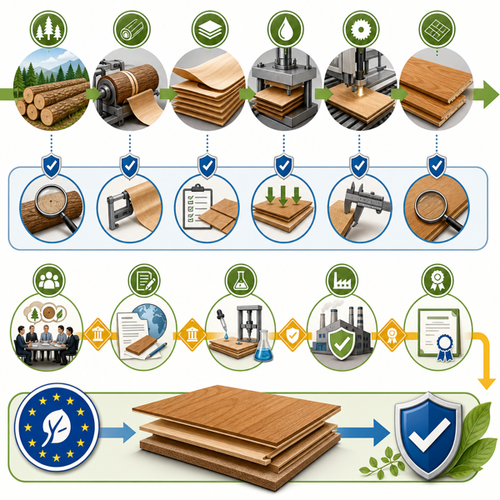
Wood technology professionals have a critical new reference point in May 2026 with the publication of EN 14354:2026, offering updated and detailed requirements for wood veneer floor coverings. This latest European standard sets out modern expectations for quality, performance, and testing of wood-based panels, with direct implications for manufacturers, suppliers, and specifiers across the flooring and construction industries.
With more advanced and transparent specifications, this single new standard brings much-needed clarity to product classification, testing methods, and the lifecycle management of wood veneer floor coverings for indoor environments.
Overview / Introduction
The wood technology sector remains at the forefront of sustainable construction and interior design, with wood veneer floor coverings enjoying popularity for their visual appeal, durability, and eco-friendly credentials. Maintaining high consistent quality and safety is vital for industry competitiveness—this is where harmonized international standards play a pivotal role.
The May 2026 update focuses on a single, but significant, document: EN 14354:2026, which defines terms, test methods, and essential requirements for wood veneer flooring intended for internal use. By incorporating the most recent scientific and technical advances, this standard ensures products meet demanding performance and safety benchmarks, supporting both innovation and regulatory compliance.
Whether you are responsible for product development, procurement, quality control, or compliance in the wood flooring supply chain, this article will provide you with:
- A summary of the standard's scope and main requirements
- Key technical and classification details
- Compliance and implementation insight
- Recommendations for maximizing value from the standard
Detailed Standards Coverage
EN 14354:2026 - Wood-Based Panels – Wood Veneer Floor Coverings
Wood-based panels – Wood veneer floor coverings
This standard, prepared by CEN’s Technical Committee 112, supersedes the previous EN 14354:2017 and reflects extensive stakeholder feedback and advances in flooring technologies.
Scope and Applications
EN 14354:2026 applies to wood veneer floor coverings designed for internal (indoor) use. It provides clear boundaries by specifying that multilayer parquets (top layer thickness ≥ 2.5 mm, as per EN 13489) and modular mechanical locked floor covering (MMF) panels with highly wear-resistant surfaces (per EN 16511) are excluded.
The standard applies broadly to:
- Manufacturers of hardwood and softwood veneer flooring
- Flooring product designers and specifiers
- Installation professionals
- Quality control laboratories
- Procurement teams sourcing wood-based flooring
Key Requirements and Technical Specifications
EN 14354:2026 sets out stringent requirements along several dimensions:
- Material and Structure: Floor coverings must consist of a top veneer layer (< 2.5 mm) attached to a wood-based substrate (≥ 75% wood content) and possibly a backing layer. Surface treatments, either film-forming (e.g., lacquers ≥ 20 μm) or non-film forming (e.g., oils, waxes), must be clearly described.
- Physical Properties: Includes tolerances for thickness, length, width, squareness, edge straightness, curvature ("cup"), and lipping—each rigorously measured as per dedicated annexed test methods.
- Performance Classification: Products are categorized according to usage intensity (domestic or commercial; moderate to heavy), with performance determined by:
- Resistance to indentation (Brinell hardness)
- Thickness swelling (after water exposure)
- Resistance to chemical agents
- Locking strength (for mechanical joint systems)
- Wear and abrasion resistance (per specified test protocols)
- Micro scratch resistance, castor chair resistance (for coated products)
- Additional Requirements: Provisions for water resistance, dimensional stability under varying humidity, and mechanical joint integrity (against water leaks) may be specified contractually between supplier and client.
Testing and Compliance
Testing methods include micrometer measurements, abrasion tests (falling sand, sandpaper methods), lacquer adhesion (cross-cut test), and more. The standard also describes detailed procedures for report generation, ensuring transparency and traceability across product assessment.
Marking, Packaging, and Documentation
Manufacturers must provide thorough labeling, packaging to protect the product throughout distribution and installation, and comprehensive user documentation addressing installation, maintenance, renovation, and refurbishment.
Notable Changes from EN 14354:2017
The 2026 revision introduces several significant updates:
- Clear definitions of substrate, top layer, coatings, and renovation processes
- Revised moisture, thickness, and strength requirements
- New or modified test methods for surface hardness, abrasion, and water resistance
- Explicit requirements for marking and user documentation
- New measures for extending floor lifespan (maintenance, local repairs, refurbishment guidance)
Key highlights:
- Expanded and refined product and substrate definitions
- Advanced testing for coatings and surface wear
- New and updated classification/performance tables for easier product comparison
Access the full standard:View EN 14354:2026 on iTeh Standards
Industry Impact & Compliance
The introduction of EN 14354:2026 raises the bar for the wood veneer flooring sector, enabling higher quality assurance and product reliability. Organizations involved in manufacturing, specifying, installing, or certifying wood veneer flooring must now:
- Review existing product lines against the updated requirements
- Update quality control and product testing protocols
- Review packaging and documentation procedures to meet new marking and user information clauses
- Ensure marketing and sales claims align with classification results according to the standard
Compliance considerations:
- Transition timelines may be mandated by regional or national standardization bodies; early adoption ensures market continuity
- Non-compliance could result in market access barriers, product recalls, reputational loss, or failure in public tenders
Benefits of adoption:
- Demonstrates commitment to quality and safety
- Enhances customer confidence and reduces liability risks
- Supports exports and cross-border market access within Europe and beyond
- Positions businesses as leaders in sustainable, high-quality flooring
Risks of non-compliance:
- Regulatory penalties and competitive disadvantages
- Increased customer complaints and warranty issues
- Reputational harm in key markets
Technical Insights
Common Technical Requirements
Across the new standard, several technical requirements recur, notably:
- Material content and moisture management: All core and top layers must adhere to precise moisture and wood content limits
- Dimensional tolerances: Strict controls of squareness, straightness, thickness, lipping, and surface curvature
- Surface performance: Wear, scratch, and chemical resistance are assessed using harmonized, repeatable methods
- Repairability and lifespan: Maintenance and refurbishment processes are integrated into product planning and user guidance
Implementation Best Practices
- Early engagement with testing laboratories: Ensure that new or updated products are validated against all applicable test annexes
- Staff training: Technical, sales, and customer-facing staff should understand key standard requirements and differences from earlier versions
- Supplier collaboration: Where substrates or coatings are sourced externally, ensure supply chain partners are aligned with EN 14354:2026 requirements
- Documentation reviews: Update datasheets, labeling, and user instructions to ensure alignment with the marking and documentation clause
Testing and Certification
- Align regular internal testing procedures with relevant annexes (dimensional measurement, coating adhesion, abrasion resistance, etc.)
- Maintain clear test reports as stipulated (with laboratory and sample identification, climate conditions, deviations, equipment used, etc.)
- Seek third-party certification where necessary for market or regulatory recognition
Conclusion / Next Steps
The May 2026 publication of EN 14354:2026 marks a new era in quality assurance for wood veneer floor coverings in Europe and beyond. Manufacturers, specifiers, and professionals in wood technology should:
- Download and study the full standard to understand the implications for your product lines and operations.
- Update internal processes by aligning quality control, testing, and documentation with new requirements.
- Communicate proactively with supply chain partners and customers about the benefits and improved assurances under the new standard.
- Stay engaged with industry updates to be ready for future changes and market developments.
Ensuring timely and effective implementation of EN 14354:2026 will help your organization deliver superior flooring products, meet evolving regulatory demands, and maintain a leadership edge in the wood technology field.
Access the full standard:View EN 14354:2026 on iTeh Standards
Categories
- Latest News
- New Arrivals
- Generalities
- Services and Management
- Natural Sciences
- Health Care
- Environment
- Metrology and Measurement
- Testing
- Mechanical Systems
- Fluid Systems
- Manufacturing
- Energy and Heat
- Electrical Engineering
- Electronics
- Telecommunications
- Information Technology
- Image Technology
- Precision Mechanics
- Road Vehicles
- Railway Engineering
- Shipbuilding
- Aircraft and Space
- Materials Handling
- Packaging
- Textile and Leather
- Clothing
- Agriculture
- Food technology
- Chemical Technology
- Mining and Minerals
- Petroleum
- Metallurgy
- Wood technology
- Glass and Ceramics
- Rubber and Plastics
- Paper Technology
- Paint Industries
- Construction
- Civil Engineering
- Military Engineering
- Entertainment