


Welding Procedure Qualification: The Importance of Overlay Welding Standards in Modern Manufacturing
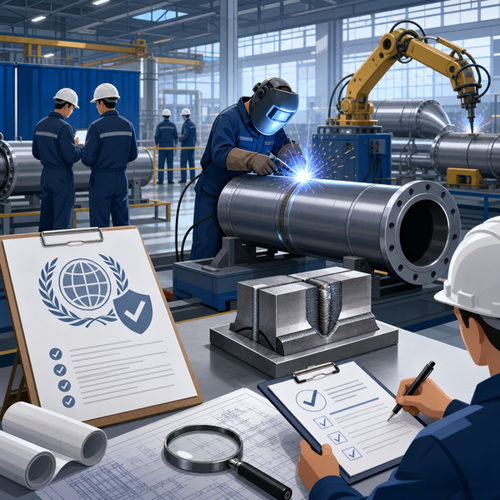
Meeting the demands of today's manufacturing landscape requires precision, consistency, and above all, safety. For industries that rely on welding metallic materials—such as construction, energy, transportation, and heavy equipment—the stakes are higher than ever. Ensuring the quality and safety of welded structures is not just about craftsmanship; it’s about adhering to rigorous standards that have global recognition. In this article, we unravel the vital role played by overlay welding standards, focusing on SIST EN ISO 15614-7:2017, and explain how compliance can propel your business toward greater productivity, security, and scalability.
Overview / Introduction
Welding is a foundational process in modern manufacturing, uniting metals to create everything from towering skyscrapers to intricate medical devices. Within the spectrum of welding techniques, overlay welding—also known as cladding or hardfacing—stands out for its ability to deposit protective or functional layers onto components, extending their life and performance.
In today’s competitive market, simply knowing how to weld isn’t enough. Manufacturers must comply with international standards that specify and qualify welding procedures. This is especially true for overlay welding, a process critical to high-stakes applications such as pressure vessels, pipes subject to corrosion, and machinery exposed to extreme wear.
This article offers an accessible, yet comprehensive, look at the standard SIST EN ISO 15614-7:2017. We’ll discuss why welding standards matter, what requirements they introduce, and how adopting them can enhance operational excellence, safety, and scalability.
Detailed Standards Coverage
SIST EN ISO 15614-7:2017 - Overlay Welding Procedure Qualification
Specification and qualification of welding procedures for metallic materials – Welding procedure test – Part 7: Overlay welding (ISO 15614-7:2016)
Overlay welding is essential for industries looking to improve component surfaces—either for better corrosion resistance (cladding) or to rebuild worn parts (hardfacing). However, performing overlay welding without a qualified procedure risks subpar results, unexpected failures, and safety hazards.
SIST EN ISO 15614-7:2017 provides a globally recognized framework for ensuring welding procedures are thoroughly tested and documented before being used in production. It sets out the conditions and requirements for the execution of welding procedure tests and defines the range of variables covered by a successful qualification.
Key requirements and scope:
- What’s covered: Qualification of preliminary welding procedure specifications (pWPS) for all overlay welding processes applicable to metallic materials. The standard applies regardless of whether the process is manual metal arc, submerged arc, plasma arc, or other suitable welding methods.
- Testing protocols: Specifies test-piece shapes, dimensions, and the tests (non-destructive and destructive) needed to demonstrate procedure effectiveness. Includes corrosion-resistant overlays and hardfacing.
- Documentation and validity: Requires welding procedure qualification records (WPQRs) and ensures qualifications remain valid even as the standard evolves, with only additional tests needed for new requirements.
- Route to compliance: If an organization has previously qualified a procedure under an earlier edition, only additional new tests mandated by this revision are necessary.
- Special considerations: For dissimilar metal joints requiring buttering (a buffer welding technique), qualification is governed by ISO 15614-1.
- Welding processes and variables: Defines variables such as filler material, number of layers, thickness, welding process, position, preheating/interpass/post-weld heat-treatment conditions, arc energy, and process-specific features.
- Examinations: Both non-destructive (NDT) and destructive testing are mandatory, including visual tests, macro/micro examinations, hardness tests, bend tests, and chemical analysis.
Who needs to comply:
- Manufacturers and fabricators in oil and gas, chemical processing, shipbuilding, power generation, and any industry using overlay welds for protection, regeneration, or extending the life of components.
- Quality managers, welding engineers, and inspectors responsible for compliance in regulated sectors.
- Businesses seeking conformity with EU Directives (notably the Pressure Equipment Directive 2014/68/EU) to access European and global markets.
Practical implications:
- Standardizes the approach to overlay welding across teams and geographies, reducing variations and enhancing repeatability.
- Enables traceability of procedures and qualifications, which is critical during audits, incident investigations, or customer inquiries.
- By defining test protocols, acceptance criteria, and record-keeping, this standard brings clarity and confidence to welding processes essential for high-value and safety-critical applications.
Key highlights:
- Universality across overlay welding processes and industries
- Aligns with EU safety legislation (Pressure Equipment Directive)
- Focuses on robust testing (NDT, hardness, chemical, and mechanical tests)
- Utilizes international terminology for clarity
- Ensures previous procedure qualifications remain valid with minimal disruption
Access the full standard:View SIST EN ISO 15614-7:2017 on iTeh Standards
Industry Impact & Compliance
Overlay welding standards have far-reaching implications for manufacturers, engineers, and quality assurance teams:
- Compliance with legislation: Meeting the requirements of SIST EN ISO 15614-7:2017 confers presumption of conformity with essential requirements of the EU Pressure Equipment Directive (2014/68/EU), streamlining CE marking and access to European markets.
- Risk reduction: By adhering to defined qualification procedures, organizations minimize the risks of weld failure, costly repairs, or catastrophic incidents.
- Market competitiveness: Certified overlay welding processes signal technical competence to clients, leading to more business opportunities and greater trust.
- Audit and traceability: The use of standardized qualification records (WPQRs) ensures every weld can be traced back to its qualified process, supporting fast, effective responses to customer or regulator queries.
- Operational excellence: Well-qualified welding procedures increase productivity by reducing rework, minimizing downtime, and ensuring weld quality from the start.
Risks of non-compliance include:
- Product failures, recalls, or safety incidents
- Exclusion from regulated markets or tenders
- Legal and insurance repercussions in case of accidents
- Loss of reputation and business opportunities
Implementation Guidance
Successfully implementing SIST EN ISO 15614-7:2017 starts with a structured approach:
- Understanding standard requirements: Assign responsible engineers or quality managers to study the full text of the standard and related normative documents.
- Gap analysis: Compare current overlay welding procedures and record-keeping with the standard’s requirements. Identify any missing controls, tests, or documentation.
- Develop or update procedures: Draft preliminary welding procedure specifications (pWPS) using the variables and tolerances specified.
- Welding procedure qualification test: Manufacture test pieces matching the intended application, using the actual processes and materials.
- Testing: Perform the specified non-destructive and destructive tests (visual, macro/micro examinations, hardness, bend tests, chemical analysis, ferrite content as required).
- Documentation: Prepare detailed welding procedure qualification records (WPQRs), including all test results, deviations, and compliance evidence.
- Training and upskilling: Ensure welders, operators, and inspectors are familiar with new procedures and tests. Training is crucial for consistent results.
- Ongoing review and updates: As the standard is updated or application needs evolve, reassess procedures and requalify where required.
Best practices:
- Use a cross-functional team (engineering, QA/QC, operations) for implementation.
- Employ third-party testing or certification bodies for impartiality and increased credibility.
- Digitize records using enterprise quality management software for rapid retrieval and analysis.
- Leverage external resources such as iTeh Standards to access the latest editions and interpretations.
Conclusion / Next Steps
International overlay welding standards like SIST EN ISO 15614-7:2017 are now indispensable in modern manufacturing. They not only ensure safety and product quality but also open the doors to global markets by confirming regulatory compliance. Implementing these standards boosts productivity, reduces operational risk, and provides the scalability needed for long-term growth.
For manufacturers, quality managers, and engineers, the path forward is clear:
- Study the detailed requirements of overlay welding standards.
- Qualify your welding procedures rigorously and maintain up-to-date records.
- Train your teams on the importance and execution of standardized welding processes.
To lead in today’s competitive landscape, make welding standardization a cornerstone of your operations. For more details or to access the official text, explore SIST EN ISO 15614-7:2017 on iTeh Standards and ensure your company stands at the forefront of quality and safety.
Categories
- Latest News
- New Arrivals
- Generalities
- Services and Management
- Natural Sciences
- Health Care
- Environment
- Metrology and Measurement
- Testing
- Mechanical Systems
- Fluid Systems
- Manufacturing
- Energy and Heat
- Electrical Engineering
- Electronics
- Telecommunications
- Information Technology
- Image Technology
- Precision Mechanics
- Road Vehicles
- Railway Engineering
- Shipbuilding
- Aircraft and Space
- Materials Handling
- Packaging
- Textile and Leather
- Clothing
- Agriculture
- Food technology
- Chemical Technology
- Mining and Minerals
- Petroleum
- Metallurgy
- Wood technology
- Glass and Ceramics
- Rubber and Plastics
- Paper Technology
- Paint Industries
- Construction
- Civil Engineering
- Military Engineering
- Entertainment