

Hexagon & Hexalobular Socket Screw Standards: Enhancing Productivity, Security, and Scalability
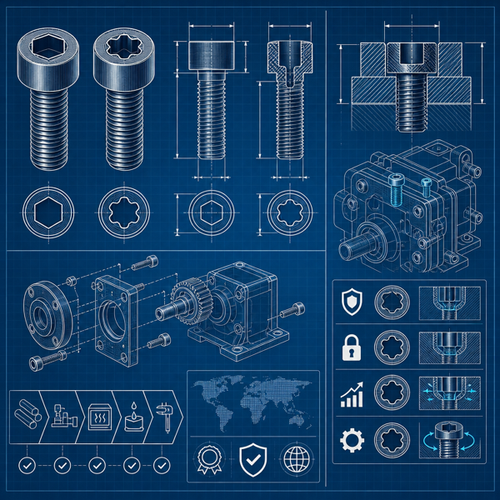
Choosing the right fasteners is an unassuming yet pivotal step for mechanical systems, automation, robotics, and advanced manufacturing lines. Socket screws are found in virtually every engineered product—from electronics to aerospace assemblies—and the global network of manufacturers, maintainers, and innovators depend on objective, internationally harmonized standards to ensure that fasteners deliver reliability, safety, and efficiency. Four recently updated ISO standards—ISO 10642:2026, ISO 13809:2026, ISO 4026:2026, and ISO 4027:2026—define the essential requirements for hexagon socket countersunk head screws, hexalobular socket set screws, and set screws with specific head and point configurations. These standards are essential not just for compliance but also for enabling productivity, quality, and global scalability. Backed by clear specifications and practical best practices, their adoption is now fundamental for businesses aiming to implement new manufacturing technologies, streamline assembly, and maintain the highest security standards in mechanical design.
Overview / Introduction
In today's interconnected world, the demand for mechanical systems that are robust, safe, and universally compatible has never been higher. Whether you're developing industrial automation, assembling automotive components, or managing supply chains for consumer electronics, fastener reliability is non-negotiable. Incorrect fastener selection, non-uniform quality, or compatibility issues can cause production stoppages, safety hazards, or costly recalls. That is why international standards for hexagon and hexalobular socket screws, and for set screw points, have become essential.
This guide explores four critical ISO standards, each defining precise characteristics for a different category of fastener:
- ISO 10642:2026: Hexagon socket countersunk head screws with reduced loadability
- ISO 13809:2026: Hexalobular socket set screws
- ISO 4026:2026: Hexagon socket set screws with flat point
- ISO 4027:2026: Hexagon socket set screws with truncated cone point
By implementing these standards, businesses large and small can ensure compatibility across designs, boost productivity, lower risks, and unlock the capacity to scale or integrate advanced manufacturing technologies.
Detailed Standards Coverage
ISO 10642:2026 - Hexagon Socket Countersunk Head Screws with Reduced Loadability
Fasteners — Hexagon socket countersunk head screws with reduced loadability
Scope and Application: ISO 10642:2026 specifies characteristics for hexagon socket countersunk head screws in steel and stainless steel with metric coarse pitch threads ranging from M2 to M20 (product grade A), suited for applications requiring a flush finish while accepting reduced head loadability due to the geometric design. The standard acknowledges that these screws' countersunk head dimensions and the hexagon socket penetration collectively limit tensile strength. Notably, such screws are marked with a property class preceded by zero, signaling this particular limitation to all stakeholders.
Key Requirements:
- Intended for applications needing fasteners flush with the assembled surface.
- Coverage of dimensions, tolerances, and head geometry (per ISO 225, ISO 965-1, ISO 888, ISO 4753).
- Loadability in the head is assumed to be ~80% of loadability in the thread across all sizes and property classes.
- Calls for precise assembly alignment to maximize strength and avoid premature failure.
- Specifies marking protocols on product and packaging for clear identification.
Implementation & Stakeholders:
- Essential for industries where component flushness and structural integrity matter (e.g., aerospace, automotive, electronics, machinery).
- Facilitates interchangeability across suppliers and borders, lowering costs and simplifying procurement.
Notable Features:
- Standardized head design for consistency.
- Reduced loadability indicated by clear marking.
- Alignment best practices reduce installation risk.
Access the full standard:View ISO 10642:2026 on iTeh Standards
ISO 13809:2026 - Hexalobular Socket Set Screws
Fasteners — Hexalobular socket set screws
Scope and Application: ISO 13809:2026 is the essential guideline for set screws featuring a hexalobular (commonly known as Torx) socket, with metric coarse pitch threads from M3 to M30 (steel) and M3 to M24 (stainless steel). This standard emphasizes precision, compatibility, and improved assembly tool grip compared to standard hex sockets, which is critical in automation, robotics, automotive, and precision assembly settings. These set screws are not intended for use under tensile loads.
Key Requirements:
- Complete specification for external dimensions, socket form, pitch, thread tolerances, and optional point types.
- Hexalobular drive enhances torque transmission and reduces cam-out compared to hex sockets.
- Option to select different hardness classes and stainless steel grades per application (referencing ISO 898-5, ISO 3506-3).
- Compatible with dimensional options from ISO 888, ISO 965-1, and ISO 4753.
- Marking and package labelling for traceability and quality assurance.
Implementation & Stakeholders:
- Key for industries requiring high assembly repetition rates with minimal tool wear and damage risk (e.g., electronics, automotive, machinery assembly, consumer goods).
- Supports automation and high-speed production lines.
Notable Features:
- Torx/hexalobular socket for secure, slip-resistant engagement.
- Multiple dimensional and hardness options for broad application scope.
- Facilitates modular product architectures and rapid assembly.
Access the full standard:View ISO 13809:2026 on iTeh Standards
ISO 4026:2026 - Hexagon Socket Set Screws with Flat Point
Fasteners — Hexagon socket set screws with flat point
Scope and Application: ISO 4026:2026 defines hexagon socket set screws with a flat point, covering metric threads from M1.6 to M30 (steel) and M1.6 to M24 (stainless steel), product grade A. These fasteners are widely used where a secure, repeatable, and non-damaging grip is required—such as in securing pulleys, collars, and custom assemblies, particularly where the mating part must not be marred or indented.
Key Requirements:
- Standardizes all relevant dimensions, tolerances, and material grades.
- Thread and surface finish referencing ISO 888, ISO 965-1, ISO 4753.
- Offers guidance on hardness and stainless steel grades (ISO 898-5, ISO 3506-3).
- Prohibits tensile load use, prioritizing shear and compression applications.
- Product and packaging marking for transparency and logistics.
Implementation & Stakeholders:
- Vital in light and precision engineering (e.g., electronics, motion systems, medical devices, instrument construction).
- Promotes interchangeability across industries and applications.
Notable Features:
- Flat-point design minimizes surface damage.
- Wide range of sizes supports various component scales.
- Product grade A quality for critical applications.
Access the full standard:View ISO 4026:2026 on iTeh Standards
ISO 4027:2026 - Hexagon Socket Set Screws with Truncated Cone Point
Fasteners — Hexagon socket set screws with truncated cone point
Scope and Application: ISO 4027:2026 covers hexagon socket set screws with a distinctive truncated cone point design, for threads M1.6 to M30 (steel) and M1.6 to M24 (stainless steel), product grade A. The truncated cone point is engineered for secure, positive seating in a mating surface recess, often used in fixing pulleys, gears, or components where a mechanical 'bite' is required, but removable force is minimized.
Key Requirements:
- Clearly defines all head, point, and thread dimensions for total consistency.
- Designed to provide high holding power without risking excessive surface penetration or irreversible damage.
- Material grades and hardness options allow adaptation for diverse environments (per ISO 898-5, ISO 3506-3).
- Prohibits tensile load usage; designed solely for axial holding.
- Calls for batch and product marking for process control.
Implementation & Stakeholders:
- Common in mechanical power transmission, plant machinery, and drive train assembly.
- Supports rapid, reliable component swapping and secure adjustment.
Notable Features:
- Truncated cone point maximizes holding power.
- Suitable for repeated adjustments or precise mechanical fitting.
- Comprehensively covers product quality marking and packaging.
Access the full standard:View ISO 4027:2026 on iTeh Standards
Industry Impact & Compliance
The rapid deployment of advanced manufacturing technologies, expansion into global markets, and the advent of smart factories all underscore the importance of reliable, easily sourced, and universally interchangeable fasteners. These four ISO standards play a pivotal role by:
- Eliminating ambiguity in procurement, enabling organizations to source components from multiple suppliers with confidence.
- Reducing assembly and maintenance time, since parts are engineered to fit seamlessly, reducing trial-and-error at installation.
- Enhancing security and safety, especially in dynamic applications subject to vibration or repeated stress.
- Supporting automation and robotics, where repeatability, high assembly speed, and minimized tool slip are essential.
Non-compliance exposes organizations to:
- Safety and liability risks from fastener failures.
- High maintenance costs due to incompatibility or part failure.
- Productivity losses from downtime or rework.
- Obsolescence as partners and jurisdictions mandate increasingly strict adherence to international standards.
Implementation Guidance
Adopting these socket set screw standards can be straightforward, but thoughtful planning ensures maximum benefit:
Common Implementation Approaches:
- Specification and Procurement: Use the detailed ISO standard references when specifying fasteners in all engineering drawings, procurement documents, or supplier agreements.
- Quality Control: Leverage the marking, labelling, and traceability requirements in these standards for robust inbound part verification.
- Training: Guide engineering and assembly teams in interpreting product marking codes and recognizing load limitations (especially for countersunk head screws with reduced loadability).
- Interoperability Testing: For businesses operating in cross-functional or multinational environments, test sample lots to ensure compatibility.
- Continuous Monitoring: Stay updated with standard revisions; incremental adjustments can quickly cascade into improved outcomes.
Best Practices:
- Always match socket tool specifications to drive design (e.g., hexalobular/Torx vs hexagon).
- Use only product grade A certified parts for critical assemblies or when mandated by regulation.
- Maintain records using ISO’s designation and labelling systems to facilitate audits or root-cause analysis.
- Integrate standard-compliant fasteners as part of digital twin simulations, PLM systems, or BOM configurations.
Resources for Organizations:
- The iTeh Standards Platform offers access to the full text and latest updates for all major ISO fastener standards.
- Industry consortia, engineering societies, and procurement groups often publish practical implementation guides tailored to sector-specific needs.
- ISO member bodies provide detailed FAQ and training resources for standards interpretation and use.
Conclusion / Next Steps
The complexity and interconnectedness of today's mechanical systems require organizations to anchor their designs and operations on robust, internationally recognized standards. ISO 10642:2026, ISO 13809:2026, ISO 4026:2026, and ISO 4027:2026 collectively provide comprehensive requirements for socket screws and set screws—with hexagon and hexalobular designs—that optimize assembly integrity, process efficiency, and system safety.
Key takeaways:
- These four standards ensure reliable fastener performance in mechanical, electronic, and automation applications.
- Their clear, harmonized requirements promote productivity, security, and system scalability.
- Non-compliance is costly, while implementation is a proven pathway to future-proofing your business in an era of technological evolution.
Next steps for stakeholders:
- Review and update engineering documentation to reference the latest ISO fastener standards.
- Train teams to recognize product markings and loadability indicators.
- Explore the complete standards for detailed technical requirements and best practices.
Visit iTeh Standards to access authoritative, up-to-date content and implementation resources for the fastener standards that will empower your business to excel.
Categories
- Latest News
- New Arrivals
- Generalities
- Services and Management
- Natural Sciences
- Health Care
- Environment
- Metrology and Measurement
- Testing
- Mechanical Systems
- Fluid Systems
- Manufacturing
- Energy and Heat
- Electrical Engineering
- Electronics
- Telecommunications
- Information Technology
- Image Technology
- Precision Mechanics
- Road Vehicles
- Railway Engineering
- Shipbuilding
- Aircraft and Space
- Materials Handling
- Packaging
- Textile and Leather
- Clothing
- Agriculture
- Food technology
- Chemical Technology
- Mining and Minerals
- Petroleum
- Metallurgy
- Wood technology
- Glass and Ceramics
- Rubber and Plastics
- Paper Technology
- Paint Industries
- Construction
- Civil Engineering
- Military Engineering
- Entertainment