


July 2026 Metallurgy Standards: New Heat Treatment Vocabulary, Fracture Testing, and Steel Profiles
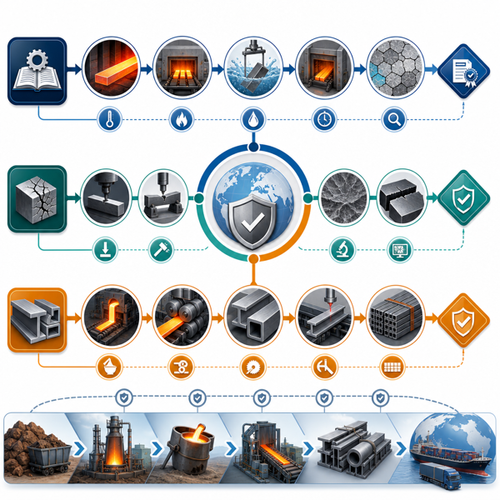
July 2026 Metallurgy Standards: New Heat Treatment Vocabulary, Fracture Testing, and Steel Profiles
July 2026 marks a significant milestone for the metallurgy sector with the publication of three influential international standards. These latest releases—from foundational heat treatment terminology to fracture toughness testing and dimensional requirements for steel sections—address key industry challenges in terminology alignment, mechanical testing, and component interoperability. For quality managers, engineers, compliance officers, and procurement specialists in metallurgy, these standards provide essential frameworks for quality assurance, process validation, and global market compatibility.
Overview
The metallurgy sector continues to evolve with advancements in material sciences and process engineering. Standards play a vital role in establishing common language, defining best practices, assuring safety, and enhancing the quality and traceability of products and processes. With updates effective July 2026, professionals across steel production, heat treatment, construction, and mechanical testing will find critical resources to improve consistency, compliance, and innovation.
In this article, you will discover:
- Scope, key requirements, and implications of each new standard
- How these updates affect day-to-day metallurgy operations
- Technical insights and implementation best practices
- Direct access to the full, authoritative standards via iTeh Standards
Detailed Standards Coverage
ISO 4885:2026 - Ferrous Materials — Heat Treatments — Vocabulary
Ferrous materials — Heat treatments — Vocabulary
What it Covers: ISO 4885:2026 is an essential vocabulary standard for metallurgists and heat treating professionals. It offers precise definitions for terms used in the heat treatment of ferrous materials—including steel and cast iron—facilitating clear communication and shared understanding among global industry participants. Annex A provides multilingual equivalents in French, German, Russian, Chinese, and Japanese, enhancing its international utility. Table 1 details iron-carbon (Fe-C) phase relationships, anchoring terminology in foundational metallurgical science.
Key Requirements and Specifications:
- Over 66 new terms added (e.g., “continuous austenitization diagram”, “expanded austenite”, “partitioning”)
- Terms now classified into nine categories, ranging from annealing and quenching to thermomechanical treatment and microstructural descriptors
- Deletion and integration of outdated/ambiguous terms, with synonyms and harmonized definitions
- Multilingual index and visually clarified terminology relationships (e.g., innovative diagrams and tables)
Who Needs to Comply:
- Steel producers and processors
- Heat treatment companies
- Quality and compliance teams
- Researchers, educators, and technical translators
Practical Implications: Implementing ISO 4885:2026 promotes consistent training, documentation, and technical communications. Personnel across manufacturing and R&D can avoid misinterpretations that often lead to process deviations or quality escapes. This is also indispensable for organizations working across borders or in multilingual environments.
Notable Changes from the Previous Version:
- Reclassification into nine categories for ease of reference
- Introduction of multi-language term tables
- Addition and refinement of new and existing terms, removal of obsolete ones
Key highlights:
- Harmonized and expanded heat treatment vocabulary
- Facilitates multilingual and international collaboration
- Reduces ambiguity and risk in technical documentation
Access the full standard:View ISO 4885:2026 on iTeh Standards
EN ISO 12135:2026 - Metallic Materials — Unified Method of Test for the Determination of Quasistatic Fracture Toughness
Metallic materials - Unified method of test for the determination of quasistatic fracture toughness (ISO 12135:2021, including corrected version 2022-08)
What it Covers: EN ISO 12135:2026 is a unified European and ISO standard detailing test methods for quantifying the fracture toughness of homogeneous metallic materials under quasistatic loading. It specifies the use of notched and fatigue-precracked specimens, covering a range of geometrical configurations and providing procedures for both stable and unstable crack extension. The standard emphasizes the determination of key parameters such as stress intensity factor (K), crack-tip opening displacement (δ), J-integral (J), and corresponding resistance (R-) curves.
Key Requirements and Specifications:
- Specimen preparation (notching, fatigue precracking, dimensions)
- Choice of test configurations (three-point bend, compact tension, etc.)
- Methods for measuring and analyzing crack initiation, stable propagation, and instability
- Data qualification, including criteria for statistical treatment and reporting
- Special analysis for weldments (referenced to ISO 15653)
Who Needs to Comply:
- Metallurgical test laboratories
- Structural engineers and material scientists
- Manufacturers of metallic components (e.g., aerospace, automotive, energy, infrastructure)
- Quality assurance and certification bodies
Practical Implications: Adopting EN ISO 12135:2026 enables organizations to demonstrate material integrity and ensure component safety in critical service environments. It supports regulatory compliance, root-cause investigation of failures, and the qualification of new materials and welding procedures.
Notable Changes from Previous Editions:
- Revised calculation methods for CTOD and J-integral, including recent research advances
- Improved handling of fatigue precrack straightness challenges
- Updated data analysis, reporting, and correction procedures
Key highlights:
- Enables quantification of fracture toughness for a wide range of metallic materials
- Facilitates international alignment of testing and reporting
- Supports life prediction and failure analysis in safety-critical structures
Access the full standard:View EN ISO 12135:2026 on iTeh Standards
EN 10365:2026 - Hot Rolled Steel Channels, I and H Sections — Dimensions and Masses
Hot rolled steel channels, I and H sections - Dimensions and masses
What it Covers: EN 10365:2026 defines the dimensional and mass properties of a comprehensive set of hot rolled steel profiles used widely in construction, infrastructure, and heavy engineering. The standard covers both I- and H-shaped beams (IPE, HE, HL, HLZ, HD, HP, UBP, UB, UC, IPN, J) and various channel profiles (UPE, PFC, UPN, U, CH), ensuring interoperability and compatibility in steel design and procurement.
Key Requirements and Specifications:
- Exact nominal dimensions and masses for each profile
- Detailed tolerance requirements referencing EN 10024, EN 10034, and EN 10279
- Sections optimized for functional consistency and load-carrying capacity
- Application of standardized designations for ordering, logistics, and documentation
- Focused on carbon steels; excludes stainless steel profiles
Who Needs to Comply:
- Steel manufacturers and fabricators
- Structural and civil engineers
- Procurement and quality assurance teams
- Construction and infrastructure project managers
Practical Implications: The EN 10365:2026 standard enables uniform specification, selection, and quality assessment of steel profiles across projects. This helps minimize supply chain errors, ensures regulatory and customer requirements are met, and streamlines calculation of structural properties in design.
Notable Changes from the Previous Edition:
- Addition of new dimensions to expand the range of applicable sections
- Inclusion of Annex A on sectional property calculations
- Editorial update for symbol harmonization with related standards (EN 10024, EN 10034, EN 10279)
Key highlights:
- Comprehensive scope covering major I, H, and channel profiles
- Enhanced dimension and property references
- Supports reliable procurement and fabrication
Access the full standard:View EN 10365:2026 on iTeh Standards
Industry Impact & Compliance
The publication of these standards in July 2026 introduces several direct and indirect impacts across the metallurgy sector:
- Consistency and Clarity: Updated terminology (ISO 4885:2026) ensures all stakeholders—manufacturers, suppliers, engineers, researchers—work from a shared vocabulary, reducing the risk of misinterpretation.
- Technical Integrity: Unified and precise fracture toughness testing (EN ISO 12135:2026) bolsters material validation, enabling safer, longer-lasting engineering solutions and supporting regulatory compliance in construction, transport, and infrastructure.
- Supply Chain Efficiency: Standardized dimensions and masses (EN 10365:2026) facilitate seamless procurement, fabrication, and installation of structural steel components across international markets.
Compliance Considerations and Timelines:
- Organizations should review existing documentation, training materials, and testing protocols for alignment with the new standards
- Update procurement and supply specifications to reference new document titles, designations, and tolerance regimes
- Compliance teams should map transition deadlines and adapt quality management systems accordingly
Benefits of Adopting These Standards:
- Enhanced product and process quality
- Reduced compliance and operational risks
- Improved global competitiveness
- Easier integration with digital engineering workflows (BIM, PLM)
Risks of Non-Compliance:
- Increased likelihood of production errors, misunderstandings, or regulatory non-conformance
- Higher costs due to rework, delays, or supply chain disputes
- Potential exclusion from contracts or markets requiring up-to-date standard references
Technical Insights
A cross-analysis of the three standards highlights critical technical requirements and best practices for metallurgy professionals:
- Terminology as a Foundation: Proper use of standardized terminology (ISO 4885:2026) is vital for effective implementation of both testing protocols (EN ISO 12135:2026) and component specifications (EN 10365:2026).
- Accuracy in Testing: Test labs should calibrate all fracture toughness equipment, adhere to specified test configurations, and follow statistical data treatment guidelines to avoid errors in material qualification.
- Dimensional Precision: Project teams must verify that beam, column, and channel specifications used in construction projects match the new EN 10365:2026 tables, including new section options and mass calculations.
- Documentation and Training: Teams should update technical manuals, CAD libraries, and ERP/MRP databases to incorporate new terms, calculation procedures, and sectional data.
Implementation Best Practices:
- Conduct a gap assessment of your current specifications and operating procedures.
- Train cross-functional teams on the major changes and new requirements in each standard.
- Update procurement contracts, product drawings, and inspection criteria with the revised references.
- Engage third-party certification where appropriate for quality assurance.
Testing and Certification:
- For fracture toughness, ensure all laboratory procedures follow EN ISO 12135:2026—particularly specimen prep, crack measurement, and reporting formats.
- For structural profiles, leverage EN 10365:2026’s tables to calibrate warehouse stocks and verify supplier data sheets.
Conclusion / Next Steps
July 2026’s metallurgy standards offer pivotal improvements to terminology, testing rigor, and dimensional consistency across the field. To maximize benefits, organizations should proactively:
- Audit and update internal documentation to align with new vocabulary and testing methods
- Communicate with supply chain partners regarding new section dimensions and designations
- Train staff and update quality procedures for seamless standard adoption
- Monitor iTeh Standards for amendments or related new publications
Staying current with these standards is not just about compliance—it’s about building a culture of quality, safety, and technical excellence in metallurgy.
Explore these new standards, enhance your operations, and secure your place at the forefront of global metallurgy by visiting iTeh Standards:
Stay informed – your commitment to quality and innovation starts with the latest standards.
Categories
- Latest News
- New Arrivals
- Generalities
- Services and Management
- Natural Sciences
- Health Care
- Environment
- Metrology and Measurement
- Testing
- Mechanical Systems
- Fluid Systems
- Manufacturing
- Energy and Heat
- Electrical Engineering
- Electronics
- Telecommunications
- Information Technology
- Image Technology
- Precision Mechanics
- Road Vehicles
- Railway Engineering
- Shipbuilding
- Aircraft and Space
- Materials Handling
- Packaging
- Textile and Leather
- Clothing
- Agriculture
- Food technology
- Chemical Technology
- Mining and Minerals
- Petroleum
- Metallurgy
- Wood technology
- Glass and Ceramics
- Rubber and Plastics
- Paper Technology
- Paint Industries
- Construction
- Civil Engineering
- Military Engineering
- Entertainment