


August 2026: New Standard for Underwater Optical Fibre Cable Pressure Testing Released
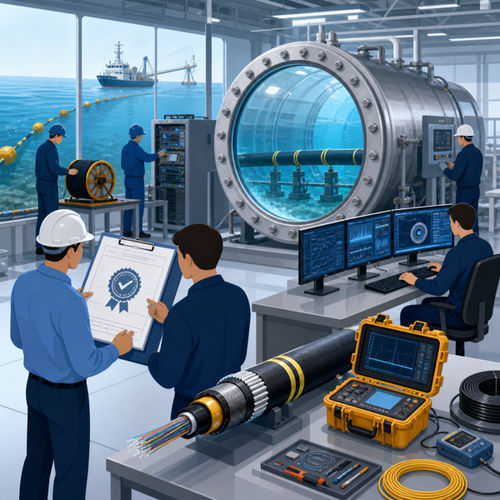
In August 2026, the rapidly evolving field of telecommunications and audio-video engineering welcomes a crucial new addition to its standards library: EN IEC 60794-1-210:2026. This international standard, developed by CLC and approved by CENELEC, addresses the pressing need for robust and reliable testing methodologies for underwater optical fibre cables, specifically targeting their resistance to hydrostatic pressure. With the exponential increase in global data traffic and subsea infrastructure, this update is of significant consequence for manufacturers, installers, network operators, and regulators worldwide.
Overview / Introduction
Telecommunications and audio-video engineering lie at the heart of our connected world. From high-speed internet and streaming to international communications, optical fibre cables serve as the backbone enabling seamless data transfer—especially for underwater and subsea networks. Ensuring these cables withstand challenging environmental conditions is vital for service quality, safety, and infrastructure resilience.
Standards in this sector not only define quality and interoperability but also act as a benchmark for safety, durability, and regulatory compliance. This article delves into the newly published EN IEC 60794-1-210:2026, unveiling its technical framework, core requirements, and impact on industry stakeholders. Readers will gain a detailed understanding of the environmental testing protocols and the practical implications of adopting this latest standard.
Detailed Standards Coverage
EN IEC 60794-1-210:2026 – Underwater Cable Hydrostatic Pressure Testing
Optical fibre cables – Part 1-210: Generic specification – Basic optical cable test procedures – Environmental test methods – Underwater cable resistance to hydrostatic pressure, Method F10
EN IEC 60794-1-210:2026 prescribes the environmental test procedures for evaluating the resistance of underwater optical fibre cables to hydrostatic pressure, commonly encountered in subsea applications. Released in August 2026 as the successor to portions of EN IEC 60794-1-22:2018, this standard brings the latest scientific rigor and practical efficiency to cable performance verification.
Scope and Applicability
This standard covers the test methodology—designated as Method F10—for subjecting complete optical fibre cables to controlled hydrostatic pressure in laboratory environments. The protocols ensure that cables designed for submerged applications (e.g., oceanic data links, underwater sensor arrays, subsea energy infrastructure) demonstrate adequate mechanical and optical integrity under realistic operational pressures.
Method F10 is divided into:
- F10A: Radial hydrostatic pressure test (uniform pressure application around the cable)
- F10B: Longitudinal hydrostatic pressure test (pressure applied along the cable axis)
- Subdivided into F10B.1 and F10B.2 for different setups
- F10C: Longitudinal test with the cable passing through a vessel
Key Requirements and Testing Procedures
- Sample Preparation: Specifies cable length, handling, and conditioning requirements prior to testing to ensure results reflect real-world installation conditions.
- Test Apparatus: Details the construction and calibration of pressure vessels, use of water as the pressure medium, and integration with optical attenuation measurement devices. Also, it mandates devices for monitoring pressure and detecting leaks or failures.
- Test Procedures:
- For F10A, the cable sample is coiled and subjected to uniform hydrostatic pressure in a vessel for a specified duration.
- For F10B/B.1/B.2, the cable may be tested longitudinally (pressure applied along the length) to identify potential weaknesses at cable joints, splices, or interfaces.
- F10C covers situations where lengthy cables must be evaluated as they pass through the testing apparatus.
- Performance Metrics:
- Optical attenuation is monitored continuously to check for performance degradation under pressure.
- The standard sets acceptability thresholds for changes in optical characteristics and defines the allowable level of physical deformation, leakage, or breakage.
- Test results must be thoroughly documented, including all apparatus settings, measurements, and observed anomalies.
Who Should Comply?
- Optical cable manufacturers
- Organizations engaged in the design, deployment, or maintenance of underwater/subsea networks
- Testing laboratories and quality assurance teams in telecom and energy infrastructure sectors
- Procurement and compliance officers ensuring supply chain reliability
Practical Implications & Notable Changes
- New Structure: This is the first edition as a standalone document, specifically streamlining the underwater pressure test method. It partially replaces the relevant section of the previous EN IEC 60794-1-22:2018.
- Enhanced Clarity: Updated terminology and procedure elaboration make test execution more uniform across laboratories worldwide.
- Alignment with International Best Practices: Ensures results are globally comparable and suitable for cross-border infrastructure projects.
Key highlights:
- Defines stringent protocols for hydrostatic pressure resistance (Method F10)
- Details instrumentation, setup, and data-reporting requirements
- Ensures cables meet rigorous performance and reliability benchmarks under underwater pressure conditions
Access the full standard:View EN IEC 60794-1-210:2026 on iTeh Standards
Industry Impact & Compliance
For businesses operating in telecommunications and audio-video engineering—especially those involved in the deployment or management of underwater communication networks—EN IEC 60794-1-210:2026 represents a foundational requirement for product validation and procurement.
How Does This Standard Affect Businesses?
- Risk Mitigation: Adhering to this standard reduces the risk of premature cable failures, network outages, and costly repairs in submerged environments.
- Market Access: Compliance ensures eligibility for public tenders and cross-border projects where international standards are required.
- Reputation and Reliability: Demonstrating conformity enhances stakeholder confidence, which is crucial for mission-critical applications like energy and data transport.
Compliance Considerations
- Implementation Timeline: The standard goes into effect immediately upon publication, with a transition period for superseding conflicting national standards (mandatory withdrawal by August 2029).
- Documentation & Certification: Compliance must be documented via formal test reports that adhere to the standard’s reporting templates.
- Ongoing QA: Organizations should update internal test protocols and train quality teams to the new procedures outlined in Method F10.
Benefits of Adoption
- Improved service continuity for underwater network operators
- Enhanced performance evidence for manufacturers
- Streamlined supply chain compliance for project managers
Risks of Non-Compliance
- Increased likelihood of undetected cable faults under operational pressures
- Lost business opportunities due to unmet specification requirements
- Potential liability issues in the event of infrastructure failure
Technical Insights
EN IEC 60794-1-210:2026 is built around precise, reproducible laboratory methods. Successful implementation requires:
- Specialized Equipment: Acquisition or certification of pressure vessels capable of controlled, uniform hydrostatic loading across the cable sample.
- Detailed Measurement Systems: Integration with high-sensitivity optical attenuation monitors ensures that the slightest degradation can be captured and reported.
- Test Repeatability: Procedures must be executed consistently, with clear documentation for apparatus setup, environmental conditions, cable configuration, and all measured data.
- Personnel Training: Staff involved in testing and quality assurance should be familiarized with the latest requirements to minimize errors and optimize test reliability.
- Certification Best Practices: End-users and project owners should seek suppliers with accredited laboratories capable of providing certified compliance to EN IEC 60794-1-210:2026.
Testing and Certification Considerations
- Rigorous pre-test inspection of cables
- Carefully controlled pressurization and depressurization cycles
- Post-test analysis for microbending, macrobending, or physical damage
- Archived test records for traceability
Conclusion / Next Steps
The August 2026 publication of EN IEC 60794-1-210:2026 provides the telecommunications and audio-video engineering sector with a clear, technical, and internationally harmonized method for verifying the resilience of underwater optical fibre cables against hydrostatic pressure. For businesses, early adoption not only ensures compliance but is a proactive step toward reducing lifecycle costs, supporting network dependability, and expanding access to international projects.
Key recommendations:
- Review the new standard in detail and update internal procedures accordingly
- Engage with accredited labs for independent product certification
- Stay informed on complementary standards and future revisions
For comprehensive details and full documentation, professionals are encouraged to consult the official standard:
Access the full standard:View EN IEC 60794-1-210:2026 on iTeh Standards
Stay ahead of the curve by leveraging the latest best practices in optical cable testing—explore, implement, and certify to EN IEC 60794-1-210:2026 with iTeh Standards.
Categories
- Latest News
- New Arrivals
- Generalities
- Services and Management
- Natural Sciences
- Health Care
- Environment
- Metrology and Measurement
- Testing
- Mechanical Systems
- Fluid Systems
- Manufacturing
- Energy and Heat
- Electrical Engineering
- Electronics
- Telecommunications
- Information Technology
- Image Technology
- Precision Mechanics
- Road Vehicles
- Railway Engineering
- Shipbuilding
- Aircraft and Space
- Materials Handling
- Packaging
- Textile and Leather
- Clothing
- Agriculture
- Food technology
- Chemical Technology
- Mining and Minerals
- Petroleum
- Metallurgy
- Wood technology
- Glass and Ceramics
- Rubber and Plastics
- Paper Technology
- Paint Industries
- Construction
- Civil Engineering
- Military Engineering
- Entertainment