

ASTM E536-23
(Test Method)Standard Test Methods for Chemical Analysis of Zinc and Zinc Alloys
General Information
- Abstract
SIGNIFICANCE AND USE
4.1 These test methods for the chemical analysis of zinc metals and alloys are primarily intended as referee methods to test such materials for compliance with compositional specifications. It is assumed that all who use these test methods will be trained analysts capable of performing common laboratory procedures skillfully and safely. It is expected that work will be performed in a properly equipped laboratory.
SCOPE
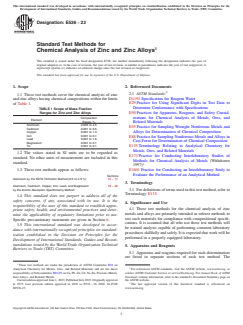
1.1 These test methods cover the chemical analysis of zinc and zinc alloys having chemical compositions within the limits of Table 1.
1.2 The values stated in SI units are to be regarded as standard. No other units of measurement are included in this standard.
1.3 These test methods appear as follows:
Sections
Aluminum by the EDTA Titrimetric Method (0.5 to 4.5 %)
10 – 17
Aluminum, Cadmium, Copper, Iron, Lead, and Magnesium
by the Atomic Absorption Spectrometry Method
18 – 28
1.4 This standard does not purport to address all of the safety concerns, if any, associated with its use. It is the responsibility of the user of this standard to establish appropriate safety, health, and environmental practices and determine the applicability of regulatory limitations prior to use. Specific precautionary statements are given in Section 6.
1.5 This international standard was developed in accordance with internationally recognized principles on standardization established in the Decision on Principles for the Development of International Standards, Guides and Recommendations issued by the World Trade Organization Technical Barriers to Trade (TBT) Committee.
- Status
- Published
- Publication Date
- 31-May-2023
- Technical Committee
- E01 - Analytical Chemistry for Metals, Ores, and Related Materials
Overview
ASTM E536-23: Standard Test Methods for Chemical Analysis of Zinc and Zinc Alloys is an internationally recognized reference for laboratories conducting precise and reliable chemical analysis of zinc metals and alloys. Published by ASTM International, this standard outlines established procedures for determining the composition of elements such as aluminum, cadmium, copper, iron, lead, magnesium, and tin in zinc and its alloys. The test methods are designed to verify compliance with compositional specifications in accordance with stringent industry and regulatory requirements.
Key Topics
Referee Analytical Methods
ASTM E536-23 acts as a referee standard, meaning it is suitable for resolving disputes and verifying results for the chemical composition of zinc and zinc alloys. It ensures test results meet the specified limits required by material standards.Scope of Elements and Ranges
The standard covers:- Aluminum: 0.005% to 4.5%
- Cadmium: 0.001% to 0.5%
- Copper: 0.001% to 1.3%
- Iron: 0.001% to 0.1%
- Lead: 0.001% to 1.6%
- Magnesium: 0.001% to 0.1%
- Tin: 0.001% to 0.1% Determinations must be conducted in SI units as mandated by the standard.
Test Methods Covered
- Aluminum by the EDTA Titrimetric Method (0.5% to 4.5%)
- Atomic Absorption Spectrometry Method for aluminum, cadmium, copper, iron, lead, and magnesium over specified ranges. Both methods require skilled laboratory analysts and fully equipped laboratory environments for accurate results.
Quality and Safety Considerations The standard emphasizes safe laboratory practice and mandates that users address all applicable safety, health, and environmental concerns. Proper laboratory apparatus, reagents, and sampling techniques are crucial for reliable data.
Applications
Quality Control in Metal Production
Essential for manufacturers and suppliers of zinc and zinc alloys to certify that materials meet compositional specifications for use in galvanizing, die-casting, and other industrial processes.Material Compliance Testing
Used as referee methods by quality assurance labs, governmental agencies, and third-party testing organizations to resolve any disputes regarding material chemistry.Research and Development
Supports the development and optimization of zinc alloys for specialized applications that require precise chemical composition.Sampling and Statistical Analysis
Provides standardized procedures for sampling both wrought and cast nonferrous metals, ensuring representative and repeatable test results across laboratories.
Related Standards
For achieving the best results and ensuring comprehensive compliance, ASTM E536-23 is frequently used in conjunction with related ASTM standards, including:
- ASTM D1193: Specification for Reagent Water
- ASTM E29: Practice for Using Significant Digits in Test Data
- ASTM E50: Practices for Apparatus, Reagents, and Safety Considerations for Chemical Analysis of Metals
- ASTM E60: Practice for Analysis of Metals by Spectrophotometry
- ASTM E55 / E88: Practices for Sampling Nonferrous Metals and Alloys
- ASTM E135: Terminology Relating to Analytical Chemistry for Metals
- ASTM E1601: Practice for Conducting an Interlaboratory Study to Evaluate Analytical Method Performance
Practical Value
Adopting and adhering to ASTM E536-23 ensures:
- Accurate, repeatable, and defensible chemical analysis of zinc and zinc alloys
- Harmonization of testing methods across organizations and borders
- Regulatory compliance and assurance of product quality in global markets
Keywords: chemical analysis of zinc, ASTM E536-23, zinc alloy composition, EDTA titrimetric method, atomic absorption spectrometry, metal testing standards, quality control, laboratory analysis, compositional compliance, zinc alloys standard
Relations
- Effective Date
- 01-Jan-2020
- Effective Date
- 01-Nov-2019
- Effective Date
- 15-May-2019
- Effective Date
- 01-Sep-2017
- Effective Date
- 01-Sep-2017
- Effective Date
- 01-Aug-2016
- Effective Date
- 15-May-2016
- Effective Date
- 01-Jul-2015
- Effective Date
- 15-May-2015
- Effective Date
- 15-Aug-2014
- Effective Date
- 01-Apr-2014
- Effective Date
- 15-Feb-2014
- Effective Date
- 01-Dec-2013
- Effective Date
- 15-Dec-2012
- Effective Date
- 15-Oct-2011
Get Certified
Connect with accredited certification bodies for this standard

Element Materials Technology
Materials testing and product certification.

Inštitut za kovinske materiale in tehnologije
Institute of Metals and Technology. Materials testing, metallurgical analysis, NDT.
Sponsored listings
Frequently Asked Questions
ASTM E536-23 is a standard published by ASTM International. Its full title is "Standard Test Methods for Chemical Analysis of Zinc and Zinc Alloys". This standard covers: SIGNIFICANCE AND USE 4.1 These test methods for the chemical analysis of zinc metals and alloys are primarily intended as referee methods to test such materials for compliance with compositional specifications. It is assumed that all who use these test methods will be trained analysts capable of performing common laboratory procedures skillfully and safely. It is expected that work will be performed in a properly equipped laboratory. SCOPE 1.1 These test methods cover the chemical analysis of zinc and zinc alloys having chemical compositions within the limits of Table 1. 1.2 The values stated in SI units are to be regarded as standard. No other units of measurement are included in this standard. 1.3 These test methods appear as follows: Sections Aluminum by the EDTA Titrimetric Method (0.5 to 4.5 %) 10 – 17 Aluminum, Cadmium, Copper, Iron, Lead, and Magnesium by the Atomic Absorption Spectrometry Method 18 – 28 1.4 This standard does not purport to address all of the safety concerns, if any, associated with its use. It is the responsibility of the user of this standard to establish appropriate safety, health, and environmental practices and determine the applicability of regulatory limitations prior to use. Specific precautionary statements are given in Section 6. 1.5 This international standard was developed in accordance with internationally recognized principles on standardization established in the Decision on Principles for the Development of International Standards, Guides and Recommendations issued by the World Trade Organization Technical Barriers to Trade (TBT) Committee.
SIGNIFICANCE AND USE 4.1 These test methods for the chemical analysis of zinc metals and alloys are primarily intended as referee methods to test such materials for compliance with compositional specifications. It is assumed that all who use these test methods will be trained analysts capable of performing common laboratory procedures skillfully and safely. It is expected that work will be performed in a properly equipped laboratory. SCOPE 1.1 These test methods cover the chemical analysis of zinc and zinc alloys having chemical compositions within the limits of Table 1. 1.2 The values stated in SI units are to be regarded as standard. No other units of measurement are included in this standard. 1.3 These test methods appear as follows: Sections Aluminum by the EDTA Titrimetric Method (0.5 to 4.5 %) 10 – 17 Aluminum, Cadmium, Copper, Iron, Lead, and Magnesium by the Atomic Absorption Spectrometry Method 18 – 28 1.4 This standard does not purport to address all of the safety concerns, if any, associated with its use. It is the responsibility of the user of this standard to establish appropriate safety, health, and environmental practices and determine the applicability of regulatory limitations prior to use. Specific precautionary statements are given in Section 6. 1.5 This international standard was developed in accordance with internationally recognized principles on standardization established in the Decision on Principles for the Development of International Standards, Guides and Recommendations issued by the World Trade Organization Technical Barriers to Trade (TBT) Committee.
ASTM E536-23 is classified under the following ICS (International Classification for Standards) categories: 77.120.60 - Lead, zinc, tin and their alloys. The ICS classification helps identify the subject area and facilitates finding related standards.
ASTM E536-23 has the following relationships with other standards: It is inter standard links to ASTM E135-20, ASTM E1601-19, ASTM E135-19, ASTM E88-11(2017), ASTM E50-17, ASTM E50-11(2016), ASTM E135-16, ASTM E135-15a, ASTM E135-15, ASTM E135-14b, ASTM E135-14a, ASTM E135-14, ASTM E135-13a, ASTM E1601-12, ASTM E50-11. Understanding these relationships helps ensure you are using the most current and applicable version of the standard.
ASTM E536-23 is available in PDF format for immediate download after purchase. The document can be added to your cart and obtained through the secure checkout process. Digital delivery ensures instant access to the complete standard document.
Standards Content (Sample)
This international standard was developed in accordance with internationally recognized principles on standardization established in the Decision on Principles for the
Development of International Standards, Guides and Recommendations issued by the World Trade Organization Technical Barriers to Trade (TBT) Committee.
Designation: E536 − 23
Standard Test Methods for
Chemical Analysis of Zinc and Zinc Alloys
This standard is issued under the fixed designation E536; the number immediately following the designation indicates the year of
original adoption or, in the case of revision, the year of last revision. A number in parentheses indicates the year of last reapproval. A
superscript epsilon (´) indicates an editorial change since the last revision or reapproval.
This standard has been approved for use by agencies of the U.S. Department of Defense.
1. Scope 2. Referenced Documents
2.1 ASTM Standards:
1.1 These test methods cover the chemical analysis of zinc
D1193 Specification for Reagent Water
and zinc alloys having chemical compositions within the limits
E29 Practice for Using Significant Digits in Test Data to
of Table 1.
Determine Conformance with Specifications
TABLE 1 Scope of Mass Fraction
Ranges for Zinc and Zinc Alloys E50 Practices for Apparatus, Reagents, and Safety Consid-
erations for Chemical Analysis of Metals, Ores, and
Composition
Element
Range, %
Related Materials
Aluminum 0.005 to 4.5
E55 Practice for Sampling Wrought Nonferrous Metals and
Cadmium 0.001 to 0.5
Alloys for Determination of Chemical Composition
Copper 0.001 to 1.3
Iron 0.001 to 0.1
E88 Practice for Sampling Nonferrous Metals and Alloys in
Lead 0.001 to 1.6
Cast Form for Determination of Chemical Composition
Magnesium 0.001 to 0.1
Tin 0.001 to 0.1 E135 Terminology Relating to Analytical Chemistry for
Metals, Ores, and Related Materials
1.2 The values stated in SI units are to be regarded as
E173 Practice for Conducting Interlaboratory Studies of
standard. No other units of measurement are included in this
Methods for Chemical Analysis of Metals (Withdrawn
standard.
1997)
1.3 These test methods appear as follows: E1601 Practice for Conducting an Interlaboratory Study to
Evaluate the Performance of an Analytical Method
Sections
Aluminum by the EDTA Titrimetric Method (0.5 to 4.5 %) 10 – 17
3. Terminology
Aluminum, Cadmium, Copper, Iron, Lead, and Magnesium 18 – 28
3.1 For definitions of terms used in this test method, refer to
by the Atomic Absorption Spectrometry Method
Terminology E135.
1.4 This standard does not purport to address all of the
safety concerns, if any, associated with its use. It is the
4. Significance and Use
responsibility of the user of this standard to establish appro-
4.1 These test methods for the chemical analysis of zinc
priate safety, health, and environmental practices and deter-
metals and alloys are primarily intended as referee methods to
mine the applicability of regulatory limitations prior to use.
test such materials for compliance with compositional specifi-
Specific precautionary statements are given in Section 6.
cations. It is assumed that all who use these test methods will
1.5 This international standard was developed in accor-
be trained analysts capable of performing common laboratory
dance with internationally recognized principles on standard-
procedures skillfully and safely. It is expected that work will be
ization established in the Decision on Principles for the
performed in a properly equipped laboratory.
Development of International Standards, Guides and Recom-
mendations issued by the World Trade Organization Technical
5. Apparatus and Reagents
Barriers to Trade (TBT) Committee.
5.1 Apparatus and reagents required for each determination
are listed in separate sections of each test method. The
These test methods are under the jurisdiction of ASTM Committee E01 on
Analytical Chemistry for Metals, Ores, and Related Materials and are the direct For referenced ASTM standards, visit the ASTM website, www.astm.org, or
responsibility of Subcommittee E01.05 on Cu, Pb, Zn, Cd, Sn, Be, Precious Metals, contact ASTM Customer Service at service@astm.org. For Annual Book of ASTM
their Alloys, and Related Metals. Standards volume information, refer to the standard’s Document Summary page on
Current edition approved June 1, 2023. Published July 2023. Originally approved the ASTM website.
in 1975. Last previous edition approved in 2016 as E536 – 16. DOI: 10.1520/ The last approved version of this historical standard is referenced on
E0536-23. www.astm.org.
Copyright © ASTM International, 100 Barr Harbor Drive, PO Box C700, West Conshohocken, PA 19428-2959. United States
E536 − 23
apparatus, standard solutions, and reagents shall conform to the 14.3 Methyl Red Indicator Solution (0.4 g/L)—Dissolve
requirements prescribed in Practices E50. 0.1 g of methyl red in 3.72 mL of 0.1 N NaOH solution and
dilute to 250 mL with water. Filter if necessary.
6. Safety Hazards
14.4 Sodium Acetate Buffer Solution (320 g/L)—Dissolve
6.1 For precautions to be observed in the use of certain 320 g of sodium acetate trihydrate in about 800 mL of water
reagents in these test methods, refer to Practices E50.
and filter. Using a pH meter, adjust the pH of the solution to 5.5
6 0.1 with NaOH solution or acetic acid and dilute to 1 L.
7. Sampling
NOTE 2—The user is not restricted to using the 0.1 N solution of NaOH
7.1 For procedures to sample the material, refer to Practices 14.5 Sodium Fluoride Solution (Saturated)—Dissolve 60 g
E55 and E88.
of sodium fluoride (NaF) in 1 L of boiling water. Cool and filter
through a coarse paper. Store in a polyethylene bottle.
8. Rounding Calculated Values
14.6 Xylenol Orange Indicator Solution (10 g/L)—Dissolve
8.1 Rounding of test results obtained using this test method
0.250 g of xylenol orange in 25 mL of water. Do not use a
shall be performed as directed in Practice E29, Rounding
solution that has stood more than 1 month.
Method, unless an alternative rounding method is specified by
14.7 Zinc Standard Solution (1 mL = 1.00 mg Al)—
the customer or applicable material specification.
Dissolve 2.423 g of zinc metal (purity: 99.99 % minimum) in
20 mL of HCl. Dilute to 100 mL. Add 3 drops of methyl red
9. Interlaboratory Studies
solution and neutralize with NH OH. Add HCl until the color
9.1 These test methods have been evaluated in accordance
changes to red. Transfer to a 1-L volumetric flask, dilute to
with Practice E173, unless otherwise noted in the precision
volume, and mix.
section.
14.8 Purity of Water—Unless otherwise indicated, reference
to water shall mean reagent water as defined by Type II of
ALUMINUM BY THE EDTA TITRIMETRIC METHOD
Specification D1193.
10. Scope
15. Procedure
10.1 This test method covers the determination of aluminum
from 0.5 % to 4.5 %. 15.1 Select and weigh a sample to the nearest 1 mg, as
follows:
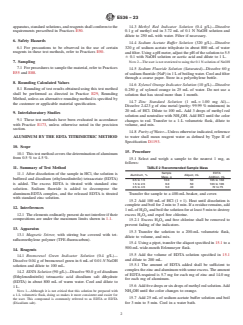
11. Summary of Test Method TABLE 2 Recommended Sample Mass
Sample EDTA
11.1 After dissolution of the sample in HCl, the solution is
Aluminum, % Aliquot, mL
Mass, g Addition, mL
buffered and disodium (ethylenedinitrilo) tetraacetate (EDTA)
0.5 to 1.5 10.0 50 165 to 168
1.5 to 2.5 6.0 50 103 to 106
is added. The excess EDTA is titrated with standard zinc
2.5 to 4.5 5.0 40 72 to 75
solution. Sodium fluoride is added to decompose the
aluminum-EDTA complex, and the released EDTA is titrated Transfer the sample to a 400-mL beaker, and cover.
with standard zinc solution.
15.2 Add 100 mL of HCl (1 + 1). Heat until dissolution is
complete and boil for 2 min to 3 min. If a residue remains, add
12. Interferences
1 mL of H O and boil the solution for at least 5 min to destroy
2 2
12.1 The elements ordinarily present do not interfere if their
excess H O and expel free chlorine.
2 2
compositions are under the maximum limits shown in 1.1.
15.2.1 Excess H O and free chlorine shall be removed to
2 2
prevent fading of the indicators.
13. Apparatus
15.3 Transfer the solution to a 200-mL volumetric flask,
13.1 Magnetic Stirrer, with stirring bar covered with tet-
dilute to volume, and mix.
rafluoroethylene polymer (TFE-fluorocarbon).
15.4 Using a pipet, transfer the aliquot specified in 15.1 to a
500-mL wide-mouth Erlenmeyer flask.
14. Reagents
15.5 Add the volume of EDTA solution specified in 15.1
14.1 Bromcresol Green Indicator Solution (0.4 g/L)—
and dilute to 200 mL.
Dissolve 0.04 g of bromcresol green in 6 mL of 0.01 N NaOH
15.5.1 The amount of EDTA added shall be sufficient to
solution and dilute to 100 mL.
complex the zinc and aluminum with some excess. The amount
14.2 EDTA Solution (90 g/L)—Dissolve 90.0 g of disodium
of EDTA required is 5.7 mg for each mg of zinc and 14.0 mg
(Ethylenedinitrilo) tetraacetic acid disodium salt dihydrate
for each mg of aluminum.
(EDTA) in about 800 mL of warm water. Cool and dilute to
15.6 Add five drops or six drops of methyl red solution. Add
1 L.
NOTE 1—Although it is not critical that this solution be prepared with NH OH until the color changes to orange.
a 1-L volumetric flask, doing so makes it more consistent and easier for
15.7 Add 25 mL of sodium acetate buffer solution and boil
the user. This compound is commonly referred to as EDTA or EDTA
(Disodium salt). for 3 min to 5 min. Cool in a water bath.
E536 − 23
15.8 Add four drops of xylenol orange solution and five the resonance wavelength energy from the spectrum of each
drops or six drops of bromcresol green solution. element is measured and compared with that of calibration
solutions of the same element. The wavelengths and other
15.9 Using a TFE-fluorocarbon-covered stirring bar and a
method parameters are tabulated in 22.1 for each element.
magnetic stirrer, stir the solution while adding standard zinc
solution from a 50-mL buret to complex the excess EDTA. Add
20. Composition Range
the solution dropwise as the end point is approached. Continue
20.1 The composition range for each element shall be
the titration until the color changes from green to red. Refill the
determined experimentally, because the optimum range will
buret.
depend upon the individual instrument. If the optimum com-
15.10 Add 25 mL of NaF solution and boil for 3 min to
position range and instrument parameters have been
5 min. Cool in a water bath.
determined, proceed in accordance with Section 26; otherwise,
15.11 Titrate with standard zinc solution as directed in 15.9
determine the composition range in accordance with Section
and record the volume to the nearest 0.01 mL.
22.
20.2 The composition range will depend on the instrument.
16. Calculation
Section 24.1 lists the typical calibration composition ranges
16.1 Calculate the percentage of aluminum as follows:
that most often will be acceptable, however this can be
Aluminum, % 5 AB/C × 100 (1)
~ !
determined by using the criteria in Section 22. The user may
find that different calibration composition ranges are required
where:
and must be adjusted accordingly to suit their instrument.
A = standard zinc solution used in 15.11, mL;
B = aluminum equivalent of the standard zinc solution,
21. Interferences
g/mL (noted in 14.7); and
21.1 The elements ordinarily present do not interfere if their
C = sample represented in the aliquot taken in 15.1, g.
compositions are under the maximum limits shown in 1.1.
17. Precision and Bias
22. Apparatus
17.1 Precision—Eight laboratories cooperated in testing this
test method and obtained the results summarized in Table 3.
22.1 Flame Atomic Absorption Spectrometer, equipped with
a premix burner, with facilities for using the oxidizer-fuel
17.2 Bias—No information concerning the accuracy of this
combinations listed in Table 4. Use hollow-cathode lamps
test method is available because certified reference materials
operated in accordance with manufacturer’s recommendations
suitable for chemical test methods were not available when the
as sources for the wavelengths. The instrument may be
interlaboratory test was performed. The user is urged to use an
considered suitable for this test method if a composition range
accepted reference material, if available, to determine that the
can be found for which the minimum response, calibration
accuracy of results is satisfactory.
variability, and reference variability tabulated in Table 4 can be
17.3 Practice E173 has been replaced by Practice E1601.
met.
The reproducibility Index R of Practice E173 corresponds to
22.1.1 Prepare the dilute standard solution, reference, and
the Reproducibility Index R of Practice E1601. The Repeat-
calibration solutions in accordance with Section 24. Refer to
ability Index R of Practice E173 corresponds to the Repeat-
Table 5. for suggested initial compositions.
ability Index r of Practice E1601.
22.1.2 Prepare the instrument for use in accordance with
26.1. Measure the instrument response while aspirating the
ALUMINUM, CADMIUM, COPPER, IRON, LEAD,
reference solution, the lowest, and the two highest calibration
AND MAGNESIUM BY THE ATOMIC ABSORPTION
solutions, performing the measurements in accordance with
SPECTROMETRY METHOD
26.2.2 and 26.2.3.
18. Scope
22.1.3 Minimum Response—Calculate the difference be-
tween the readings of the two highest of the five equally spaced
18.1 This test method covers the determination of aluminum
calibration solutions. This difference shall be equal to or
from 0.002 % to 0.5 %, cadmium from 0.001 % to 0.5 %,
greater than the number of response units specified in Table 4.
copper from 0.001 % to 1.3 %, iron from 0.003 % to 0.1 %,
For purposes of this test method, the response unit is defined as
lead from 0.002 % to 1.6 %, and magnesium from 0.001 % to
one in the least significant digit of the response reading of the
0.1 %.
most concentrated calibration solution.
19. Summary of Test Method
22.1.4 Curve Linearity—Calculate the difference between
the response units of the reference solution and the lowest of
19.1 An HCl solution of the sample is aspirated into the
the five equally spaced calibration solutions. If necessary,
flame of an atomic absorption spectrometer. The absorption of
convert this difference and the difference calculated in 22.1.3 to
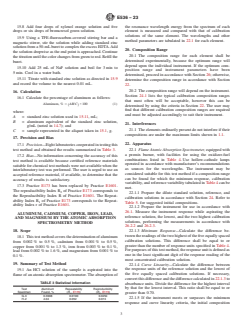
TABLE 3 Statistical Information
absorbance units. Divide the difference for the highest interval
Test Aluminum Repeatability Reproducibility by that for the lowest interval. This ratio shall be equal to or
Specimen Found, % (R , E173) (R , E173)
1 2
greater than 0.70.
G-3 0.3998 0.0190 0.0254
22.1.5 If the instrument meets or surpasses the minimum
H-2 4.04 0.052 0.074
response and curve linearity criteria, the initial composition
E536 − 23
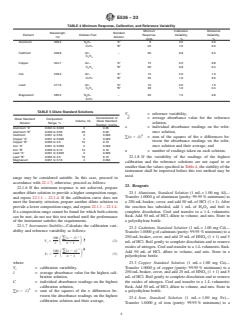
TABLE 4 Minimum Response, Calibration, and Ref
...
This document is not an ASTM standard and is intended only to provide the user of an ASTM standard an indication of what changes have been made to the previous version. Because
it may not be technically possible to adequately depict all changes accurately, ASTM recommends that users consult prior editions as appropriate. In all cases only the current version
of the standard as published by ASTM is to be considered the official document.
Designation: E536 − 16 E536 − 23
Standard Test Methods for
Chemical Analysis of Zinc and Zinc Alloys
This standard is issued under the fixed designation E536; the number immediately following the designation indicates the year of
original adoption or, in the case of revision, the year of last revision. A number in parentheses indicates the year of last reapproval. A
superscript epsilon (´) indicates an editorial change since the last revision or reapproval.
This standard has been approved for use by agencies of the U.S. Department of Defense.
1. Scope
1.1 These test methods cover the chemical analysis of zinc and zinc alloys having chemical compositions within the limits of Table
1.
TABLE 1 Scope of Mass Fraction
Ranges for Zinc and Zinc Alloys
Composition
Element
Range, %
Aluminum 0.005 to 4.5
Cadmium 0.001 to 0.5
Copper 0.001 to 1.3
Iron 0.001 to 0.1
Lead 0.001 to 1.6
Magnesium 0.001 to 0.1
Tin 0.001 to 0.1
1.2 The values stated in SI units are to be regarded as standard. No other units of measurement are included in this standard.
1.3 These test methods appear as follows:
Sections
Aluminum by the EDTA Titrimetric Method (0.5 to 4.5 %) 10 – 17
Aluminum, Cadmium, Copper, Iron, Lead, and Magnesium 18 – 28
by the Atomic Absorption Spectrometry Method
1.4 This standard does not purport to address all of the safety concerns, if any, associated with its use. It is the responsibility
of the user of this standard to establish appropriate safety and healthsafety, health, and environmental practices and determine
the applicability of regulatory limitations prior to use. Specific precautionary statements are given in Section 6.
1.5 This international standard was developed in accordance with internationally recognized principles on standardization
established in the Decision on Principles for the Development of International Standards, Guides and Recommendations issued
by the World Trade Organization Technical Barriers to Trade (TBT) Committee.
These test methods are under the jurisdiction of ASTM Committee E01 on Analytical Chemistry for Metals, Ores, and Related Materials and are the direct responsibility
of Subcommittee E01.05 on Cu, Pb, Zn, Cd, Sn, Be, Precious Metals, their Alloys, and Related Metals.
Current edition approved Feb. 1, 2016June 1, 2023. Published March 2016July 2023. Originally approved in 1975. Last previous edition approved in 20152016 as
E536 – 15.E536 – 16. DOI: 10.1520/E0536-16.10.1520/E0536-23.
Copyright © ASTM International, 100 Barr Harbor Drive, PO Box C700, West Conshohocken, PA 19428-2959. United States
E536 − 23
2. Referenced Documents
2.1 ASTM Standards:
D1193 Specification for Reagent Water
E29 Practice for Using Significant Digits in Test Data to Determine Conformance with Specifications
E50 Practices for Apparatus, Reagents, and Safety Considerations for Chemical Analysis of Metals, Ores, and Related Materials
E60 Practice for Analysis of Metals, Ores, and Related Materials by Spectrophotometry
E55 Practice for Sampling Wrought Nonferrous Metals and Alloys for Determination of Chemical Composition
E88 Practice for Sampling Nonferrous Metals and Alloys in Cast Form for Determination of Chemical Composition
E135 Terminology Relating to Analytical Chemistry for Metals, Ores, and Related Materials
E173 Practice for Conducting Interlaboratory Studies of Methods for Chemical Analysis of Metals (Withdrawn 1997)
E1601 Practice for Conducting an Interlaboratory Study to Evaluate the Performance of an Analytical Method
3. Terminology
3.1 For definitions of terms used in this test method, refer to Terminology E135.
4. Significance and Use
4.1 These test methods for the chemical analysis of zinc metals and alloys are primarily intended as referee methods to test such
materials for compliance with compositional specifications. It is assumed that all who use these test methods will be trained
analysts capable of performing common laboratory procedures skillfully and safely. It is expected that work will be performed in
a properly equipped laboratory.
5. Apparatus and Reagents
5.1 Apparatus and reagents required for each determination are listed in separate sections of each test method. The apparatus,
standard solutions, and reagents shall conform to the requirements prescribed in Practices E50. Spectrometers shall conform to the
requirements prescribed in Practice E60.
6. Safety Hazards
6.1 For precautions to be observed in the use of certain reagents in these test methods, refer to Practices E50.
7. Sampling
7.1 For procedures for samplingto sample the material, refer to Practices E55 and E88.
8. Rounding Calculated Values
8.1 Calculated values shall be rounded to the desired number of places Rounding of test results obtained using this test method
shall be performed as directed in Practice E29, Rounding Method. Method, unless an alternative rounding method is specified by
the customer or applicable material specification.
9. Interlaboratory Studies
9.1 These test methods have been evaluated in accordance with Practice E173, unless otherwise noted in the precision section.
ALUMINUM BY THE EDTA TITRIMETRIC METHOD
For referenced ASTM standards, visit the ASTM website, www.astm.org, or contact ASTM Customer Service at service@astm.org. For Annual Book of ASTM Standards
volume information, refer to the standard’s Document Summary page on the ASTM website.
The last approved version of this historical standard is referenced on www.astm.org.
E536 − 23
10. Scope
10.1 This test method covers the determination of aluminum in compositions from 0.5 % to 4.5 %.
10. Scope
10.1 This test method covers the determination of aluminum from 0.5 % to 4.5 %.
11. Summary of Test Method
11.1 After dissolution of the sample in HCl, the solution is buffered and disodium (ethylenedinitrilo) tetraacetate (EDTA) is added.
The excess EDTA is titrated with standard zinc solution. Sodium fluoride is added to decompose the aluminum-EDTA complex,
and the released EDTA is titrated with standard zinc solution.
12. Interferences
12.1 The elements ordinarily present do not interfere if their compositions are under the maximum limits shown in 1.1.
13. Apparatus
13.1 Magnetic Stirrer, with stirring bar covered with tetrafluoroethylene polymer (TFE-fluorocarbon).
14. Reagents
14.1 Bromcresol Green Indicator Solution (0.4 g/L)—Dissolve 0.04 g of bromcresol green in 6 mL of 0.01 N sodium hydroxide
(NaOH) NaOH solution and dilute to 100 mL.
14.2 EDTA Solution (90 g/L)—Dissolve 90.0 g of disodium (ethylenedinitrilo) tetraacetate dihydrate (Ethylenedinitrilo) tetraacetic
acid disodium salt dihydrate (EDTA) in about 800 mL of warm water. Cool and dilute to 1 L.1 L.
NOTE 1—Although it is not critical that this solution be prepared with a 1 L volumetric,1-L volumetric flask, doing so makes it more consistent and easier
for the analyst run to run.user. This compound is commonly referred to as EDTA or EDTA (Disodium salt).
14.3 Methyl Red Indicator Solution (0.4 g/L)—Dissolve 0.1 g 0.1 g of methyl red in 3.72 mL of 0.1 N NaOH solution and dilute
to 250 mL with water. Filter if necessary.
14.4 Sodium Acetate Buffer Solution (320 g/L)—Dissolve 320 g of sodium acetate trihydrate in about 800 mL of water and filter.
Using a pH meter, adjust the pH of the solution to 5.5 6 0.1 with NaOH solution or acetic acid and dilute to 1 L.
NOTE 2—The analystuser is not restricted to using the 0.1 N solution of NaOH
14.5 Sodium Fluoride Solution (Saturated)—Dissolve 60 g of sodium fluoride (NaF) in 1 L of boiling water. Cool and filter
through a coarse paper. Store in a polyethylene bottle.
14.6 Xylenol Orange Indicator Solution (10 g/L)—Dissolve 0.250 g of xylenol orange in 25 mL of water. Do not use a solution
that has stood more than 1 month.
14.7 Zinc Standard Solution (1 mL = 1.00 mg Al)—Dissolve 2.423 g of zinc metal (purity: 99.99 % minimum) in 20 mL of HCl.
Dilute to 100 mL. Add 3 drops of methyl red solution and neutralize with NH OH. Add HCl until the color changes to red. Transfer
to a 1-L volumetric flask, dilute to volume, and mix.
14.8 Purity of Water—Unless otherwise indicated, reference to water shall be understood to mean reagent water as defined by Type
II of Specification D1193.
E536 − 23
15. Procedure
15.1 Select and weigh a sample to the nearest 1 mg, in accordance as follows:
TABLE 2 Recommended Sample Mass
Sample EDTA
Aluminum, % Aliquot, mL
Mass, g Addition, mL
0.5 to 1.5 10.0 50 165 to 168
1.5 to 2.5 6.0 50 103 to 106
2.5 to 4.5 5.0 40 72 to 75
with Table 2.
Transfer the sample to a 400-mL beaker, and cover.
15.2 Add 100 mL of HCl (1 + 1). Heat until dissolution is complete and boil for 2 minutesmin to 3 minutes.min. If a residue
remains, add 1 mL of H O and boil the solution for at least 5 minutesmin to destroy excess H O and expel free chlorine.
2 2 2 2
NOTE 3—Excess peroxide and free chlorine shall be removed to prevent fading of the indicators.
15.2.1 Excess H O and free chlorine shall be removed to prevent fading of the indicators.
2 2
15.3 Transfer the solution to a 200-mL volumetric flask, dilute to volume, and mix.
15.4 Using a pipet, transfer the aliquot specified in 15.1 to a 500-mL wide-mouth Erlenmeyer flask.
15.5 Add the volume of EDTA solution specified in 15.1 and dilute to 200 mL.
NOTE 4—The amount of EDTA added shall be sufficient to complex the zinc and aluminum with some excess. The amount of EDTA required is 5.7 mg
for each milligram of zinc and 14.0 mg for each milligram of aluminum.
15.5.1 The amount of EDTA added shall be sufficient to complex the zinc and aluminum with some excess. The amount of EDTA
required is 5.7 mg for each mg of zinc and 14.0 mg for each mg of aluminum.
15.6 Add five drops or six drops of methyl red solution. Add NH OH until the color changes to orange.
15.7 Add 25 mL of sodium acetate buffer solution and boil for 3 minutesmin to 5 minutes.min. Cool in a water bath.
15.8 Add four drops of xylenol orange solution and five drops or six drops of bromcresol green solution.
15.9 Using a TFE-fluorocarbon-covered stirring bar and a magnetic stirrer, stir the solution while adding standard zinc solution
from a 50-mL buret to complex the excess EDTA. Add the solution dropwise as the end point is approached. Continue the titration
until the color changes from green to red. Refill the buret.
15.10 Add 25 mL of NaF solution and boil for 3 minutes to 5 minutes. 3 min to 5 min. Cool in a water bath.
15.11 Titrate with standard zinc solution as directed in 15.9 and record the volume to the nearest 0.01 mL.
16. Calculation
16.1 Calculate the percentage of aluminum as follows:
Aluminum, %5 AB/C ×100 (1)
~ !
where:
A = standard zinc solution used in 15.11, mL;
E536 − 23
B = aluminum equivalent of the standard zinc solution, g/mL (noted in 14.7); and
C = sample represented in the aliquot taken in 15.1, g.
17. Precision and Bias
17.1 Precision—Eight laboratories cooperated in testing this test method and obtained the results summarized in Table 3.
17.2 Bias—No information concerning the accuracy of this test method is available because certified reference materials suitable
for chemical test methods were not available when the interlaboratory test was performed. The analystuser is urged to use an
accepted reference material, if available, to determine that the accuracy of results is satisfactory.
17.3 Practice E173 has been replaced by Practice E1601. The reproducibility Index R , of Practice E173 corresponds to the
Reproducibility Index R of Practice E1601. Likewise the The Repeatability Index R of Practice E173 corresponds to the
Repeatability Index r of Practice E1601.
ALUMINUM, CADMIUM, COPPER, IRON, LEAD, AND MAGNESIUM BY THE ATOMIC ABSORPTION
METHOD SPECTROMETRY METHOD
18. Scope
18.1 This test method covers the determination of aluminum in compositions from 0.002 % to 0.5 %, cadmium from 0.001 % to
0.5 %, copper from 0.001 % to 1.3 %, iron from 0.003 % to 0.1 %, lead from 0.002 % to 1.6 %, and magnesium from 0.001 % to
0.1 %.
18. Scope
18.1 This test method covers the determination of aluminum from 0.002 % to 0.5 %, cadmium from 0.001 % to 0.5 %, copper
from 0.001 % to 1.3 %, iron from 0.003 % to 0.1 %, lead from 0.002 % to 1.6 %, and magnesium from 0.001 % to 0.1 %.
19. Summary of Test Method
19.1 An HCl solution of the sample is aspirated into the flame of an atomic absorption spectrometer. The absorption of the
resonance linewavelength energy from the spectrum of each element is measured and compared with that of calibration solutions
of the same element. The wavelengths of the spectral lines and other method parameters are tabulated in 22.1 for each element.
20. Composition Range
20.1 The composition range for each element shall be determined experimentally, because the optimum range will depend upon
the individual instrument. If the optimum composition range and instrument parameters have been determined, proceed in
accordance with Section 26; otherwise, determine the composition range in accordance with Section 22.
NOTE 5—The composition range will depend on the instrument. Section 24.1 lists the typical calibration composition ranges that most often will be
acceptable, however this can be determined by using the criteria in Section 22. The analyst may find that different calibration composition ranges are
required and must be adjusted accordingly to suit their instrument.
20.2 The composition range will depend on the instrument. Section 24.1 lists the typical calibration composition ranges that most
often will be acceptable, however this can be determined by using the criteria in Section 22. The user may find that different
calibration composition ranges are required and must be adjusted accordingly to suit their instrument.
TABLE 3 Statistical Information
Test Aluminum Repeatability Reproducibility
Specimen Found, % (R , E173) (R , E173)
1 2
G-3 0.3998 0.0190 0.0254
H-2 4.04 0.052 0.074
E536 − 23
21. Interferences
21.1 The elements ordinarily present do not interfere if their compositions are under the maximum limits shown in 1.1.
22. Apparatus
22.1 Flame Atomic Absorption Spectrometer, equipped with a premix burner, with facilities for using the oxidizer-fuel
combinations listed in Table 4. Use . Use hollow-cathode lamps operated in accordance with manufacturer’s recommendations as
sources for the spectral lines. wavelengths. The instrument may be considered suitable for this test method if a composition range
can be found for which the minimum response, calibration variability, and reference variability tabulated in Table 4 can be met.
22.1.1 Prepare the dilute standard solution, reference, and calibration solutions in accordance with Section 24. Refer to Table 5.
for suggested initial compositions.
22.1.2 Prepare the instrument for use in accordance with in 26.1. Measure the instrument response while aspirating the reference
solution, the lowest, and the two highest calibration solutions, performing the measurements in accordance with 26.2.2 and 26.2.3.
22.1.3 Minimum Response—Calculate the difference between the readings of the two highest of the five equally spaced calibration
solutions. This difference shall be equal to or greater than the number of scaleresponse units specified in Table 4. For purposes of
this test method, the scaleresponse unit is defined as one in the least significant digit of the scaleresponse reading of the most
concentrated calibration solution.
22.1.4 Curve Linearity—Calculate the difference between the scale readingsresponse units of the reference solution and the lowest
of the five equally spaced calibration solutions. If nece
...