

ASTM D7804-12(2017)
(Test Method)Standard Test Method for Fiber Shedding of Paint Roller Covers
General Information
- Abstract
SIGNIFICANCE AND USE
3.1 fibers that are released during painting can lead to a finish that is aesthetically unacceptable.
SCOPE
1.1 This test method describes a procedure for determining the amount of releasable fibers transferred from a paint roller cover to a surface being painted.
1.2 This test method is applicable to pile fabric paint roller covers.
1.3 Because both the application and panel evaluation are subjective, this test method should be used only for comparative testing within one facility using one operator for each set of applications, as the end result assigned by different facilities may not agree.
1.4 The values stated in inch-pound units are to be regarded as standard. The values given in parentheses are mathematical conversions to SI units that are provided for information only and are not considered standard.
1.5 This standard does not purport to address all of the safety concerns, if any, associated with its use. It is the responsibility of the user of this standard to establish appropriate safety and health practices and determine the applicability of regulatory limitations prior to use. Some specific hazards statements are given in Section 7 on Hazards.
1.6 This international standard was developed in accordance with internationally recognized principles on standardization established in the Decision on Principles for the Development of International Standards, Guides and Recommendations issued by the World Trade Organization Technical Barriers to Trade (TBT) Committee.
- Status
- Published
- Publication Date
- 31-May-2017
- Technical Committee
- D01 - Paint and Related Coatings, Materials, and Applications
- Drafting Committee
- D01.61 - Paint Application Tools


Overview
ASTM D7804-12(2017), Standard Test Method for Fiber Shedding of Paint Roller Covers, provides a standardized procedure to evaluate the fiber shedding tendency of pile fabric paint roller covers. Fiber release during painting can lead to imperfections and visually unacceptable finishes. This ASTM method enables manufacturers, quality control laboratories, and procurement teams to compare roller cover performance reliably within a controlled, single-operator environment.
By closely adhering to the defined test parameters, users can measure and compare linting behavior, supporting improved consistency in quality and end-user satisfaction for paint roller products.
Key Topics
- Test Method Scope: Focuses on measuring fibers shed from pile fabric roller covers when used to apply paint to sealed surfaces.
- Test Environment: All procedures are conducted under controlled conditions to limit variability.
- Sample Requirement: Utilizes three identical paint roller covers for a comparative assessment.
- Subjectivity and Limitations: Results are influenced by operator technique; intended for repeatable, in-house comparative testing, not absolute quantification across different facilities.
- Apparatus and Materials: Employs a standard roller frame, paint tray, sealed test paper, commercially available semi-gloss or gloss paint, tack cloth, and a lighted magnifying glass.
- Fiber Counting: After painting and drying, shed fibers (lint) within the dried paint film are identified and counted using 5× magnification.
- Data Interpretation: Results from three samples are averaged to determine shedding performance.
Applications
- Product Quality Control: Manufacturers utilize this test method to monitor fiber shedding, ensuring consistency in roller cover production and minimizing consumer complaints related to lint in painted surfaces.
- Product Comparison: R&D and QA teams can use the standard to bench test new roller fabrics or designs against existing products under uniform conditions.
- Procurement and Acceptance Criteria: Distributors, retailers, or professional painting firms can apply this procedure internally to validate supplier claims or select optimal products.
- Troubleshooting Production Issues: Helps isolate problems in manufacturing processes that may result in increased shedding, such as pile density, fiber type, or bonding inconsistencies.
Note: Because operator technique, pressure, and materials can greatly affect results, consistency of personnel and test setup is critical. The method is best applied for comparative purposes within a single facility.
Related Standards
- ASTM D344 - Standard Test Method for Relative Hiding Power of Paints
- ASTM D3924 - Standard Specification for Paint Sampling
- ISO 15528 - Paints, varnishes, and raw materials for paints and varnishes - Sampling
- ISO 787-2 - General methods of test for pigments and extenders - Determination of matter volatile at 105°C
Practical Value
Adopting ASTM D7804-12(2017) ensures that paint roller covers meet stringent quality expectations, reducing the risk of unsightly fiber contamination in finished painting projects. Reliable assessment of fiber shedding supports product development, boosts brand reputation, and enhances user satisfaction by helping to deliver a smooth, professional paint finish. Use this method as a key part of internal QA processes, supplier evaluation protocols, or as a tool for product differentiation in the competitive coatings and painting tools markets.
Keywords: ASTM D7804, paint roller shedding, fiber shedding test, roller cover lint, quality control, paint application tools, lint count, standard test methods
Relations
- Effective Date
- 01-Jun-2017
Frequently Asked Questions
ASTM D7804-12(2017) is a standard published by ASTM International. Its full title is "Standard Test Method for Fiber Shedding of Paint Roller Covers". This standard covers: SIGNIFICANCE AND USE 3.1 fibers that are released during painting can lead to a finish that is aesthetically unacceptable. SCOPE 1.1 This test method describes a procedure for determining the amount of releasable fibers transferred from a paint roller cover to a surface being painted. 1.2 This test method is applicable to pile fabric paint roller covers. 1.3 Because both the application and panel evaluation are subjective, this test method should be used only for comparative testing within one facility using one operator for each set of applications, as the end result assigned by different facilities may not agree. 1.4 The values stated in inch-pound units are to be regarded as standard. The values given in parentheses are mathematical conversions to SI units that are provided for information only and are not considered standard. 1.5 This standard does not purport to address all of the safety concerns, if any, associated with its use. It is the responsibility of the user of this standard to establish appropriate safety and health practices and determine the applicability of regulatory limitations prior to use. Some specific hazards statements are given in Section 7 on Hazards. 1.6 This international standard was developed in accordance with internationally recognized principles on standardization established in the Decision on Principles for the Development of International Standards, Guides and Recommendations issued by the World Trade Organization Technical Barriers to Trade (TBT) Committee.
SIGNIFICANCE AND USE 3.1 fibers that are released during painting can lead to a finish that is aesthetically unacceptable. SCOPE 1.1 This test method describes a procedure for determining the amount of releasable fibers transferred from a paint roller cover to a surface being painted. 1.2 This test method is applicable to pile fabric paint roller covers. 1.3 Because both the application and panel evaluation are subjective, this test method should be used only for comparative testing within one facility using one operator for each set of applications, as the end result assigned by different facilities may not agree. 1.4 The values stated in inch-pound units are to be regarded as standard. The values given in parentheses are mathematical conversions to SI units that are provided for information only and are not considered standard. 1.5 This standard does not purport to address all of the safety concerns, if any, associated with its use. It is the responsibility of the user of this standard to establish appropriate safety and health practices and determine the applicability of regulatory limitations prior to use. Some specific hazards statements are given in Section 7 on Hazards. 1.6 This international standard was developed in accordance with internationally recognized principles on standardization established in the Decision on Principles for the Development of International Standards, Guides and Recommendations issued by the World Trade Organization Technical Barriers to Trade (TBT) Committee.
ASTM D7804-12(2017) is classified under the following ICS (International Classification for Standards) categories: 87.100 - Paint coating equipment. The ICS classification helps identify the subject area and facilitates finding related standards.
ASTM D7804-12(2017) has the following relationships with other standards: It is inter standard links to ASTM D7804-12. Understanding these relationships helps ensure you are using the most current and applicable version of the standard.
ASTM D7804-12(2017) is available in PDF format for immediate download after purchase. The document can be added to your cart and obtained through the secure checkout process. Digital delivery ensures instant access to the complete standard document.
Standards Content (Sample)
This international standard was developed in accordance with internationally recognized principles on standardization established in the Decision on Principles for the
Development of International Standards, Guides and Recommendations issued by the World Trade Organization Technical Barriers to Trade (TBT) Committee.
Designation: D7804 − 12 (Reapproved 2017)
Standard Test Method for
Fiber Shedding of Paint Roller Covers
This standard is issued under the fixed designation D7804; the number immediately following the designation indicates the year of
original adoption or, in the case of revision, the year of last revision.Anumber in parentheses indicates the year of last reapproval.A
superscript epsilon (´) indicates an editorial change since the last revision or reapproval.
1. Scope 4. Test Specimen
1.1 This test method describes a procedure for determining 4.1 Threeidenticalpaintrollercovers,9by1.5in.(228.6by
the amount of releasable fibers transferred from a paint roller 38.1 mm) diameter core.
cover to a surface being painted.
5. Apparatus
1.2 This test method is applicable to pile fabric paint roller
covers. 5.1 Paint Roller Frame—designed for the paint roller cover
being tested.
1.3 Because both the application and panel evaluation are
subjective, this test method should be used only for compara- 5.2 Paint Tray—suitable for the paint roller cover being
tested.
tive testing within one facility using one operator for each set
of applications, as the end result assigned by different facilities
6. Materials
may not agree.
6.1 Test Paint—commercially available semi-gloss or gloss
1.4 The values stated in inch-pound units are to be regarded
paint, identified as to type, product number, and color. Paint to
as standard. The values given in parentheses are mathematical
be mixed to a uniform consistency. Results may vary when
conversions to SI units that are provided for information only
using different paint types.
and are not considered standard.
1.5 This standard does not purport to address all of the 6.2 Sealed Test Paper—tominimizeabsorptionoftestpaint,
which allows formation of paint film. Sections measuring 28
safety concerns, if any, associated with its use. It is the
in. (711.2 mm) wide by 20 in. (508 mm) long and have a
responsibility of the user of this standard to establish appro-
minimum 10-mil thickness with a basis weight of 50 lb/Mft
priate safety and health practices and determine the applica-
(250 g/m ).
bility of regulatory limitations prior to use. Some specific
hazards statements are given in Section 7 on Hazards.
6.3 Tack Cloth—commercially prepared cloth designed to
1.6 This international standard was developed in accor-
remove dust and lint.
dance with internationally recognized principles on standard-
6.4 Lighted Magnifying Glass—with 5× magnification.
ization established in the Decision on Principles for the
Development of International Standards, Guides and Recom-
7. Procedure
mendations issued by the World Trade Organization Technical
Barriers to Trade (TBT) Committee. 7.1 All tests are to be conducted in controlled environment.
7.2 Prepare a clean, dry paint tray by wiping clean with a
2. Summary of Test Method
tack cloth to remove all foreign material. Wipe paper surface
2.1 The paint roller cover that is to be evaluated is used to
and surrounding area with tack cloth also.
paint a section of sealed test paper. After the paint film has
7.3 Secure the two sections of sealed test paper to a flat
dried, the fibers are counted.
vertical surface creating a 28 by 40 in. (711.2 by 1.016 mm)
test surface.
3. Significance and Use
7.4 Pour fresh paint into tray. Depth of paint to be the same
3.1 fibers that are released during painting can lead to a
as the pile height of the paint roller covers being tested. For
finish that is aesthetically unacceptable.
1 1
example, ⁄2 in. (12.7 mm) pile height cover would use ⁄2 in.
(12.7 mm) of paint in tray. Do not use paint that has been
This test method is under the jurisdiction of ASTM Committee D01 on Paint
exposed to fibers.
and Related Coatings, Materials, andApplications and is the direct responsibility of
Subcommittee D01.61 on Paint Application Tools. 7.5 Place the paint roller cover on the frame.
Current edition approved June 1, 2017. Published June 2017. Originally
7.6 Load the paint roller cover by using twenty back and
approved in 2012. Last previous edition approved in 2012 as D7804 – 12. DOI:
10.1520/D7804-12R17. forthstrokes,tenstrokestotalthatgointothepainttraywellto
Copyright © ASTM International, 100 Barr Harbor Drive, PO Box C700, West Conshohocken, PA 19428-2959. United States
D7804 − 12 (2017)
7.10 Repeat procedure following instructions 7.1 – 7.9 two
moretimesontheremainingidenticalpaintrollercovers,being
sure to use fresh paint and new tray.
7.11 Place painted test panel on a flat horizontal surface in
a well-lighted area and wipe with a clean piece of tack cloth.
7.12 Circle and count each fiber (only lint) that is observed
in the dried paint film over the entire painted surface with a
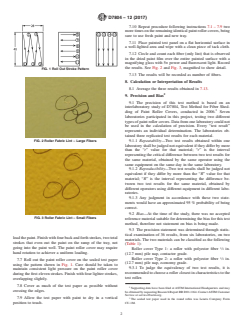
magnifying glass with 5× power and fluorescent light. Record
the results. See Fig. 2 and Fig. 3, magnified to show detail.
FIG. 1 Roll Out Stroke Pattern
7.13 The results will be recorded as number of fibers.
8. Calculation or Interpretation of Results
8.1 Average the three results obtained in 7.13.
9. Precision and Bias
9.1 The precision of this test method is based on an
interlaboratory study of D7804, Test Method for Fiber Shed-
ding of Paint Roller Covers, conducted in 2006. Seven
laboratories participated in this project, testing two different
typesofpaintrollercovers.Datafromonelaboratorycouldnot
be used in the calculation of precision. Every “test result”
represents an individual deter
...