


ASTM G34-01(2018)
(Test Method)Standard Test Method for Exfoliation Corrosion Susceptibility in 2XXX and 7XXX Series Aluminum Alloys (EXCO Test)
Standard Test Method for Exfoliation Corrosion Susceptibility in 2XXX and 7XXX Series Aluminum Alloys (EXCO Test)
SIGNIFICANCE AND USE
5.1 This test method was originally developed for research and development purposes; however, it is referenced, in specific material specifications, as applicable for evaluating production material (refer to Section 14 on Precision and Bias).
5.2 Use of this test method provides a useful prediction of the exfoliation corrosion behavior of these alloys in various types of outdoor service, especially in marine and industrial environments.5 The test solution is very corrosive and represents the more severe types of environmental service, excluding, of course, unusual chemicals not likely to be encountered in natural environments.
5.3 The exfoliation ratings were arbitrarily chosen to illustrate a wide range in resistance to exfoliation in this test. However, it remains to be determined whether correlations can be established between EXCO test ratings and realistic service conditions for a given alloy. It is an ongoing activity of the Task Group on Exfoliation Corrosion of Aluminum Alloys (G01.05.02.08) to maintain outdoor exposure tests for this purpose. For example, it has been reported6 that samples of Al-Zn-Mg-Cu alloys rated EA or P in a 48-h EXCO test did not develop more than a slight amount of incipient exfoliation (EA) during six- to nine-year exposures to seacoast atmospheres, whereas, ED rated materials in most cases developed severe exfoliation within a year in the seacoast atmosphere. It is anticipated that additional comparisons will become available as the outdoor tests are extended.
SCOPE
1.1 This test method covers a procedure for constant immersion exfoliation corrosion (EXCO) testing of high-strength 2XXX and 7XXX series aluminum alloys.
Note 1: This test method was originally developed for research and development purposes; however, it is referenced, in specific material specifications, as applicable for evaluating production material (refer to Section 14 on Precision and Bias).
1.2 This test method applies to all wrought products such as sheet, plate, extrusions, and forgings produced from conventional ingot metallurgy process.
1.3 This test method can be used with any form of specimen or part that can be immersed in the test solution.
1.4 This standard does not purport to address all of the safety concerns, if any, associated with its use. It is the responsibility of the user of this standard to establish appropriate safety, health, and environmental practices and determine the applicability of regulatory limitations prior to use.
1.5 This international standard was developed in accordance with internationally recognized principles on standardization established in the Decision on Principles for the Development of International Standards, Guides and Recommendations issued by the World Trade Organization Technical Barriers to Trade (TBT) Committee.
General Information
Buy Standard
Standards Content (Sample)
NOTICE: This standard has either been superseded and replaced by a new version or withdrawn.
Contact ASTM International (www.astm.org) for the latest information
Designation: G34 − 01 (Reapproved 2018)
Standard Test Method for
Exfoliation Corrosion Susceptibility in 2XXX and 7XXX
Series Aluminum Alloys (EXCO Test)
ThisstandardisissuedunderthefixeddesignationG34;thenumberimmediatelyfollowingthedesignationindicatestheyearoforiginal
adoption or, in the case of revision, the year of last revision.Anumber in parentheses indicates the year of last reapproval.Asuperscript
epsilon (´) indicates an editorial change since the last revision or reapproval.
This standard has been approved for use by agencies of the U.S. Department of Defense.
1. Scope ing (Withdrawn 2010)
G112 Guide for Conducting Exfoliation Corrosion Tests in
1.1 This test method covers a procedure for constant im-
Aluminum Alloys
mersion exfoliation corrosion (EXCO) testing of high-strength
2XXX and 7XXX series aluminum alloys.
2.2 ASTM Adjuncts:
Illustrations (Enlarged Glossy Prints)
NOTE 1—This test method was originally developed for research and
development purposes; however, it is referenced, in specific material
specifications, as applicable for evaluating production material (refer to
3. Terminology
Section 14 on Precision and Bias).
3.1 Definitions:
1.2 This test method applies to all wrought products such as
3.1.1 exfoliation—corrosion that proceeds laterally from the
sheet, plate, extrusions, and forgings produced from conven-
sites of initiation along planes parallel to the surface, generally
tional ingot metallurgy process.
at grain boundaries, forming corrosion products that force
1.3 Thistestmethodcanbeusedwithanyformofspecimen
metal away from the body of the material giving rise to a
or part that can be immersed in the test solution.
layered appearance (Terminology G15).
1.4 This standard does not purport to address all of the
safety concerns, if any, associated with its use. It is the
4. Summary of Test Method
responsibility of the user of this standard to establish appro-
priate safety, health, and environmental practices and deter- 4.1 This test method provides an accelerated exfoliation
mine the applicability of regulatory limitations prior to use.
corrosion test for 2XXX and 7XXX series aluminum alloys
1.5 This international standard was developed in accor-
that involves the continuous immersion of test materials in a
dance with internationally recognized principles on standard-
solution containing 4 M sodium chloride, 0.5 M potassium
ization established in the Decision on Principles for the
nitrate, and 0.1 M nitric acid at 25 6 3°C (77 6 5°F). The
Development of International Standards, Guides and Recom-
susceptibility to exfoliation is determined by visual
mendations issued by the World Trade Organization Technical
examination, with performance ratings established by refer-
Barriers to Trade (TBT) Committee.
ence to standard photographs.
2. Referenced Documents
5. Significance and Use
2.1 ASTM Standards:
5.1 This test method was originally developed for research
D1193 Specification for Reagent Water
and development purposes; however, it is referenced, in
E3 Guide for Preparation of Metallographic Specimens
specific material specifications, as applicable for evaluating
G15 Terminology Relating to Corrosion and Corrosion Test-
productionmaterial(refertoSection14onPrecisionandBias).
5.2 Use of this test method provides a useful prediction of
This test method is under the jurisdiction of ASTM Committee G01 on
the exfoliation corrosion behavior of these alloys in various
Corrosion of Metals and is the direct responsibility of Subcommittee G01.05 on
types of outdoor service, especially in marine and industrial
Laboratory Corrosion Tests.
Current edition approved Oct. 1, 2018. Published November 2018. Originally
approved in 1972. Last previous edition approved in 2013 as G34 – 01 (2013). DOI:
10.1520/G0034-01R18.
2 3
For referenced ASTM standards, visit the ASTM website, www.astm.org, or The last approved version of this historical standard is referenced on
contact ASTM Customer Service at service@astm.org. For Annual Book of ASTM www.astm.org.
Standards volume information, refer to the standard’s Document Summary page on Available from ASTM International Headquarters. Order Adjunct No.
the ASTM website. ADJG003402. Original adjunct produced in 1980.
Copyright © ASTM International, 100 Barr Harbor Drive, PO Box C700, West Conshohocken, PA 19428-2959. United States
G34 − 01 (2018)
environments. The test solution is very corrosive and repre- 7.4 The solution shall be maintained at a temperature of 25
sents the more severe types of environmental service, 6 3°C (77 6 5°F).
excluding, of course, unusual chemicals not likely to be
8. Sampling
encountered in natural environments.
8.1 Sampling procedures are not considered applicable to
5.3 The exfoliation ratings were arbitrarily chosen to illus-
this test method, as they are often covered by product specifi-
trate a wide range in resistance to exfoliation in this test.
cations. It is assumed that the test specimens are removed from
However, it remains to be determined whether correlations can
representative samples of materials.
be established between EXCO test ratings and realistic service
conditions for a given alloy. It is an ongoing activity of the
9. Test Specimens
Task Group on Exfoliation Corrosion of Aluminum Alloys
(G01.05.02.08) to maintain outdoor exposure tests for this
9.1 Specimens may be of any practical size or shape.
purpose. For example, it has been reported that samples of
Nevertheless, for the results to be of most significance a
Al-Zn-Mg-CualloysratedEAorPina48-hEXCOtestdidnot
specimen size of at least 50 by 100 mm (2 by 4 in.), or the
develop more than a slight amount of incipient exfoliation
equivalent, is recommended.
(EA) during six- to nine-year exposures to seacoast
9.2 The edges of sawed specimens need not be machined,
atmospheres, whereas, ED rated materials in most cases
but specimens obtained by blanking or shearing shall have
developed severe exfoliation within a year in the seacoast
edges dressed by machining or filling to a depth equal to the
atmosphere. It is anticipated that additional comparisons will
thickness of the specimen to remove cold-worked metal.
become available as the outdoor tests are extended.
9.3 Remove the cladding of alclad sheet by machining the
test surface; remove or mask the cladding on the back side
6. Apparatus
(non-test surface) also.
6.1 Any suitable glass, plastic, or similarly inert container
can be used to contain the solution and specimens during the 9.4 When removing test specimens from extrusions and
period of test. Depending upon the shape and size of the forgings, take care to avoid specimen locations underneath
specimens, rods or racks of glass, plastic, or any inert sub- flanges, ribs, etc., where the grain structure is usually variable.
stance shall be used to support the specimen above the bottom
10. Standardization
of the container. The container should be fitted with a loose-
fitting cover to reduce evaporation.
10.1 To provide an indication when some inadvertent de-
viation from the correct test conditions occurs, it is necessary
7. Reagents
to expose to the test at regular intervals a control specimen of
7.1 Purity of Reagents—The test solution shall be prepared a material with known resistance. This control should exhibit
with reagent grade sodium chloride (NaCl), potassium nitrate the same degree of exfoliation each time it is included in the
(KNO ), and nitric acid (HNO ). test.
3 3
7.2 Purity of Water—Distilled or deionized water shall be
10.2 The control may be any material of the alloy type
used to prepare test solution.The water purity must conform to included in the scope of this test method, preferably one with
Specification D1193, Type IV reagent water, except that for
an intermediate degree of susceptibility (Fig. 1 and Fig. 2).
this method, the values of chloride and sodium can be
disregarded. 11. Procedure
11.1 Degrease the specimens with a suitable solvent.
7.3 A test solution of the following composition shall be
used:
11.2 Mask the back surfaces of the specimens to minimize
NaCl (4.0 M)
corrosionofnon-testareas.Protectivecoatingsmusthavegood
KNO (0.5 M)
adherence to avoid crevice corrosion beneath the coating; also,
HNO (0.1 M)
they should not contain leachable ions or protective oils that
Dissolve 234 g of NaCl, 50 g of KNO in water, and add 6.3
willinfluencethecorrosionofthetestsurface.(SeeFigs.1-6.)
mL of concentrated HNO (70 weight %). Dilute to 1 L. This
11.3 Use the solution in sufficient quantity to provide a
solution has an apparent pH of 0.4.
volume-to-metal surface area ratio of 10 to 30 mL/cm (65 to
200 mL/in. ). Include all exposed metal area in the determina-
tion of total surface area.
Ketcham, S. J., and Jeffrey, P. W., “Exfoliation Corrosion Testing of 7178 and
7075AluminumAlloys” (Report ofASTM G01.05 Interlaboratory Testing Program
11.4 Use fresh solution at the start of each test. Do not
in Cooperation with the Aluminum Association); and Sprowls, D. O., Walsh, J. D.,
change the solution even though the pH increases during the
and Shumaker, M. B., “Simplified Exfoliation Testing of Aluminum Alloys,”
Localized Corrosion—Cause of Metal Failure, ASTM STP 516, ASTM, 1972.
test.ItisnormalforthepHtoincreasefromtheinitialapparent
Sprowls, D. O., Summerson, T. J., and Loftin, F. E., “Exfoliation Corrosion
value of 0.4 to about 3 during the first several hours depending
Testing of 7075 and 7178 Aluminum Alloys—Interim Report on Atmospheric
upon the amount of corrosion that occurs.
Exposure Tests” (Report of ASTM G01.05.02 Interlaboratory Testing Program in
Cooperation with theAluminumAssociation); and Lifka, B.W. and Sprowls, D. O.,
11.5 Immerse the specimens in the solution using rods or
“Relationship of Accelerated Test Methods for Exfoliation Resistance in 7XXX
racks of inert material to support the specimens above the
Series Aluminum Alloys With Exposure to a Seacoast Atmosphere,” Corrosion in
Natural Environments, ASTM STP 558, ASTM, 1974. bottom of the container. Place the test surface upward in a
G34 − 01 (2018)
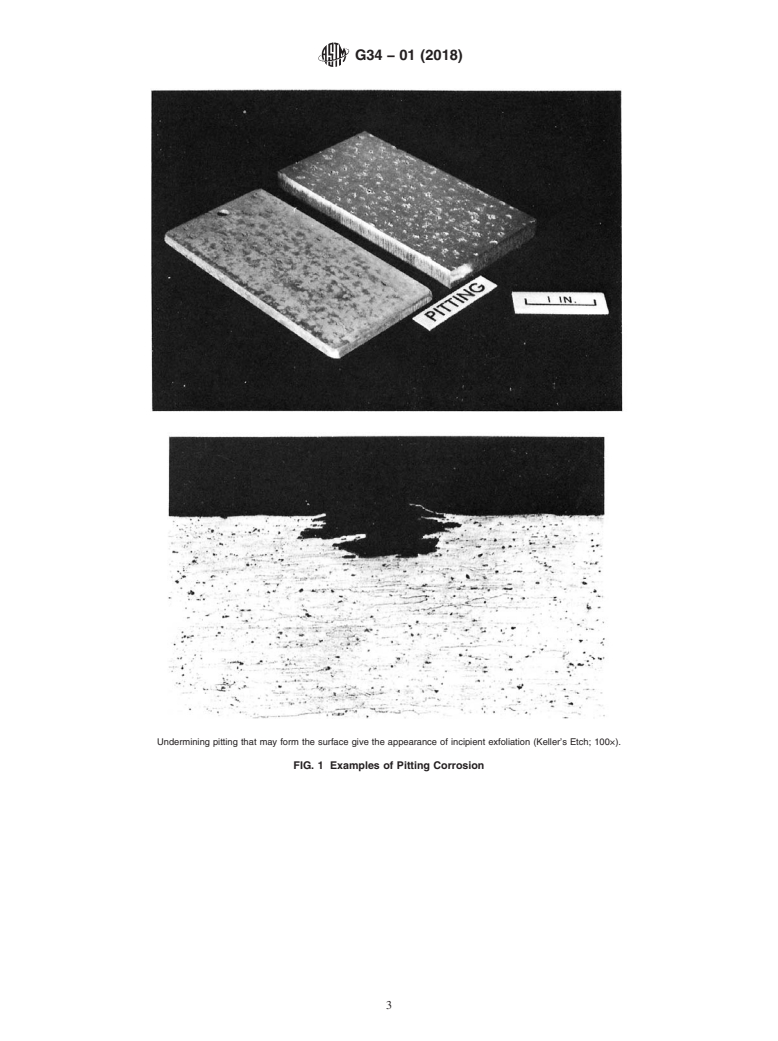
Undermining pitting that may form the surface give the appearance of incipient exfoliation (Keller’s Etch; 100×).
FIG. 1 Examples of Pitting Corrosion
...
This document is not an ASTM standard and is intended only to provide the user of an ASTM standard an indication of what changes have been made to the previous version. Because
it may not be technically possible to adequately depict all changes accurately, ASTM recommends that users consult prior editions as appropriate. In all cases only the current version
of the standard as published by ASTM is to be considered the official document.
Designation: G34 − 01 (Reapproved 2013) G34 − 01 (Reapproved 2018)
Standard Test Method for
Exfoliation Corrosion Susceptibility in 2XXX and 7XXX
Series Aluminum Alloys (EXCO Test)
This standard is issued under the fixed designation G34; the number immediately following the designation indicates the year of original
adoption or, in the case of revision, the year of last revision. A number in parentheses indicates the year of last reapproval. A superscript
epsilon (´) indicates an editorial change since the last revision or reapproval.
This standard has been approved for use by agencies of the U.S. Department of Defense.
1. Scope
1.1 This test method covers a procedure for constant immersion exfoliation corrosion (EXCO) testing of high-strength 2XXX
and 7XXX series aluminum alloys.
NOTE 1—This test method was originally developed for research and development purposes; however, it is referenced, in specific material
specifications, as applicable for evaluating production material (refer to Section 14 on Precision and Bias).
1.2 This test method applies to all wrought products such as sheet, plate, extrusions, and forgings produced from conventional
ingot metallurgy process.
1.3 This test method can be used with any form of specimen or part that can be immersed in the test solution.
1.4 This standard does not purport to address all of the safety concerns, if any, associated with its use. It is the responsibility
of the user of this standard to establish appropriate safety safety, health, and healthenvironmental practices and determine the
applicability of regulatory limitations prior to use.
1.5 This international standard was developed in accordance with internationally recognized principles on standardization
established in the Decision on Principles for the Development of International Standards, Guides and Recommendations issued
by the World Trade Organization Technical Barriers to Trade (TBT) Committee.
2. Referenced Documents
2.1 ASTM Standards:
D1193 Specification for Reagent Water
E3 Guide for Preparation of Metallographic Specimens
G15 Terminology Relating to Corrosion and Corrosion Testing (Withdrawn 2010)
G112 Guide for Conducting Exfoliation Corrosion Tests in Aluminum Alloys
2.2 ASTM Adjuncts:
Illustrations (Enlarged Glossy Prints)
3. Terminology
3.1 Definitions:
3.1.1 exfoliation—corrosion that proceeds laterally from the sites of initiation along planes parallel to the surface, generally at
grain boundaries, forming corrosion products that force metal away from the body of the material giving rise to a layered
appearance (Terminology G15).
4. Summary of Test Method
4.1 This test method provides an accelerated exfoliation corrosion test for 2XXX and 7XXX series aluminum alloys that
involves the continuous immersion of test materials in a solution containing 4 M sodium chloride, 0.5 M potassium nitrate, and
This test method is under the jurisdiction of ASTM Committee G01 on Corrosion of Metals and is the direct responsibility of Subcommittee G01.05 on Laboratory
Corrosion Tests.
Current edition approved May 1, 2013Oct. 1, 2018. Published July 2013November 2018. Originally approved in 1972. Last previous edition approved in 20072013 as
G34G34 – 01 (2013).–01 (2007). DOI: 10.1520/G0034-01R13.10.1520/G0034-01R18.
For referenced ASTM standards, visit the ASTM website, www.astm.org, or contact ASTM Customer Service at service@astm.org. For Annual Book of ASTM Standards
volume information, refer to the standard’s Document Summary page on the ASTM website.
The last approved version of this historical standard is referenced on www.astm.org.
Available from ASTM International Headquarters. Order Adjunct No. ADJG003402. Original adjunct produced in 1980.
Copyright © ASTM International, 100 Barr Harbor Drive, PO Box C700, West Conshohocken, PA 19428-2959. United States
G34 − 01 (2018)
0.1 M nitric acid at 25 6 3°C (77 6 5°F). The susceptibility to exfoliation is determined by visual examination, with performance
ratings established by reference to standard photographs.
5. Significance and Use
5.1 This test method was originally developed for research and development purposes; however, it is referenced, in specific
material specifications, as applicable for evaluating production material (refer to Section 14 on Precision and Bias).
5.2 Use of this test method provides a useful prediction of the exfoliation corrosion behavior of these alloys in various types
of outdoor service, especially in marine and industrial environments. The test solution is very corrosive and represents the more
severe types of environmental service, excluding, of course, unusual chemicals not likely to be encountered in natural
environments.
5.3 The exfoliation ratings were arbitrarily chosen to illustrate a wide range in resistance to exfoliation in this test. However,
it remains to be determined whether correlations can be established between EXCO test ratings and realistic service conditions for
a given alloy. It is an ongoing activity of the Task Group on Exfoliation Corrosion of Aluminum Alloys (G01.05.02.08) to maintain
outdoor exposure tests for this purpose. For example, it has been reported that samples of Al-Zn-Mg-Cu alloys rated EA or P in
a 48-h EXCO test did not develop more than a slight amount of incipient exfoliation (EA) during six- to nine-year exposures to
seacoast atmospheres, whereas, ED rated materials in most cases developed severe exfoliation within a year in the seacoast
atmosphere. It is anticipated that additional comparisons will become available as the outdoor tests are extended.
6. Apparatus
6.1 Any suitable glass, plastic, or similarly inert container can be used to contain the solution and specimens during the period
of test. Depending upon the shape and size of the specimens, rods or racks of glass, plastic, or any inert substance shall be used
to support the specimen above the bottom of the container. The container should be fitted with a loose-fitting cover to reduce
evaporation.
7. Reagents
7.1 Purity of Reagents—The test solution shall be prepared with reagent grade sodium chloride (NaCl), potassium nitrate
(KNO ), and nitric acid (HNO ).
3 3
7.2 Purity of Water—Distilled or deionized water shall be used to prepare test solution. The water purity must conform to
Specification D1193, Type IV reagent water, except that for this method, the values of chloride and sodium can be disregarded.
7.3 A test solution of the following composition shall be used:
NaCl (4.0 M)
KNO (0.5 M)
HNO (0.1 M)
Dissolve 234 g of NaCl, 50 g of KNO in water, and add 6.3 mL of concentrated HNO (70 weight %). Dilute to 1 L. This
3 3
solution has an apparent pH of 0.4.
7.4 The solution shall be maintained at a temperature of 25 6 3°C (77 6 5°F).
8. Sampling
8.1 Sampling procedures are not considered applicable to this test method, as they are often covered by product specifications.
It is assumed that the test specimens are removed from representative samples of materials.
9. Test Specimens
9.1 Specimens may be of any practical size or shape. Nevertheless, for the results to be of most significance a specimen size
of at least 50 by 100 mm (2 by 4 in.), or the equivalent, is recommended.
9.2 The edges of sawed specimens need not be machined, but specimens obtained by blanking or shearing shall have edges
dressed by machining or filling to a depth equal to the thickness of the specimen to remove cold-worked metal.
9.3 Remove the cladding of alclad sheet by machining the test surface; remove or mask the cladding on the back side (non-test
surface) also.
Ketcham, S. J., and Jeffrey, P. W., “Exfoliation Corrosion Testing of 7178 and 7075 Aluminum Alloys” (Report of ASTM G01.05 Interlaboratory Testing Program in
Cooperation with the Aluminum Association); and Sprowls, D. O., Walsh, J. D., and Shumaker, M. B., “Simplified Exfoliation Testing of Aluminum Alloys,” Localized
Corrosion—Cause of Metal Failure, ASTM STP 516, ASTM, 1972.
Sprowls, D. O., Summerson, T. J., and Loftin, F. E., “Exfoliation Corrosion Testing of 7075 and 7178 Aluminum Alloys—Interim Report on Atmospheric Exposure Tests”
(Report of ASTM G01.05.02 Interlaboratory Testing Program in Cooperation with the Aluminum Association); and Lifka, B. W. and Sprowls, D. O., “Relationship of
Accelerated Test Methods for Exfoliation Resistance in 7XXX Series Aluminum Alloys With Exposure to a Seacoast Atmosphere,” Corrosion in Natural Environments, ASTM
STP 558, ASTM, 1974.
G34 − 01 (2018)
9.4 When removing test specimens from extrusions and forgings, take care to avoid specimen locations underneath flanges, ribs,
etc., where the grain structure is usually variable.
10. Standardization
10.1 To provide an indication when some inadvertent deviation from the correct test conditions occurs, it is necessary to expose
to the test at regular intervals a control specimen of a material with known resistance. This control should exhibit the same degree
of exfoliation each time it is included in the test.
10.2 The control may be any material of the alloy type included in the scope of this test method, preferably one with an
intermediate degree of susceptibility (Fig. 1 and Fig. 2).
11. Procedure
11.1 Degrease the specimens with a suitable solvent.
11.2 Mask the back surfaces of the specimens to minimize corrosion of non-test areas. Protective coatings must have good
adherence to avoid crevice corrosion beneath the coating; also, they should not contain leachable ions or protective oils that will
influence the corrosion of the test surface. (See Figs. 1-6.)
11.3 Use the solution in sufficient quantity to provide a volume-to-metal surface area ratio of 10 to 30 mL/cm (65 to 200
mL/in. ). Include all exposed metal area in the determination of total surface area.
11.4 Use fresh solution at the start of each test. Do not change the solution even though the pH increases during the test. It is
normal for the pH to increase from the initial apparent value of 0.4 to about 3 during the first several hours depending upon the
amount of corrosion that occurs.
11.5 Immerse the specimens in the solution using rods or racks of inert material to support the specimens above the bottom of
the container. Place the test surface upward in a horizontal position to prevent loss of
...
Questions, Comments and Discussion
Ask us and Technical Secretary will try to provide an answer. You can facilitate discussion about the standard in here.