

ASTM F2238-20
(Test Method)Standard Test Method for Performance of Rapid Cook Ovens
General Information
- Abstract
SIGNIFICANCE AND USE
5.1 The energy input rate test is used to confirm that the rapid cook oven is operating properly prior to further testing.
5.2 Preheat energy and time can be useful to food service operators to manage power demands and to know how quickly the rapid cook oven can be ready for operation.
5.3 Idle energy rate and pilot energy rate can be used to estimate energy consumption during non-cooking periods.
5.4 Cooking-energy efficiency is a precise indicator of a rapid cook oven's energy performance while cooking a typical food product. If energy performance information is desired using a food product other than the specified test food, the test method could be adapted and applied. Energy performance information allows an end user to better understand the operating characteristics of a rapid cook oven.
5.5 Production capacity information can help an end user to better understand the production capabilities of a rapid cook oven as it is used to cook a typical food product and this could help in specifying the proper size and quantity of equipment. If production information is desired using a food product other than the specified test food, the test method could be adapted and applied.
SCOPE
1.1 This test method evaluates the energy consumption and cooking performance of rapid cook ovens. The food service operator can use this evaluation to select a rapid cook oven and understand its energy consumption.
1.2 This test method is applicable to gas and electric rapid cook ovens.
1.3 The rapid cook oven can be evaluated with respect to the following (where applicable):
1.3.1 Energy input rate (see 10.2),
1.3.2 Preheat energy consumption and time (see 10.3),
1.3.3 Idle energy rate (see 10.4),
1.3.4 Pilot energy rate (if applicable) (see 10.5), and
1.3.5 Cooking-energy efficiency, cooking energy rate, and production capacity (see 10.6).
1.4 The values stated in inch-pound units are to be regarded as standard. No other units of measurement are included in this standard.
1.5 This test method may involve hazardous materials, operations, and equipment. This test method does not purport to address all of the safety concerns, if any, associated with its use. It is the responsibility of the user of this test method to establish appropriate safety, health, and environmental practices and determine the applicability of regulatory limitations prior to use.
1.6 This international standard was developed in accordance with internationally recognized principles on standardization established in the Decision on Principles for the Development of International Standards, Guides and Recommendations issued by the World Trade Organization Technical Barriers to Trade (TBT) Committee.
- Status
- Published
- Publication Date
- 31-Aug-2020
- Technical Committee
- F26 - Food Service Equipment
- Drafting Committee
- F26.06 - Productivity and Energy Protocol
Overview
ASTM F2238-20: Standard Test Method for Performance of Rapid Cook Ovens provides a comprehensive procedure to evaluate the energy consumption and cooking performance of rapid cook ovens in commercial and institutional food service environments. This standard is designed for both gas and electric rapid cook ovens, offering a reliable approach for food service operators and equipment manufacturers to assess and compare oven efficiency, idle energy rates, preheat times, cooking-energy efficiency, and production capacity. The method uses a consistent test load, enabling a meaningful assessment of oven performance and energy usage during actual cooking operations.
Key Topics
Energy Input Rate
Confirms the rapid cook oven is operating properly and measures the peak rate of energy consumption.Preheat Energy and Time
Helps operators understand the amount of energy and time required to bring the oven to a ready-to-cook condition, which is key for managing power demands and operational readiness.Idle and Pilot Energy Rate
Determines ongoing energy consumption when the oven is not actively cooking but is maintaining temperature or operating pilots, useful for estimating "standby" energy costs.Cooking-Energy Efficiency
Measures how much of the oven’s energy is transferred into the food during the cooking process, providing an important indicator of overall performance.Production Capacity
Evaluates the maximum rate at which the oven can cook a standard food product, aiding in selection and specification of equipment based on throughput needs.Adaptability
While the standard specifies pizza as the test food, the procedure can be adapted for other products where energy performance information is needed.
Applications
This standard test method is widely applicable and valuable for the following stakeholders:
Food Service Operators
Evaluate and select rapid cook ovens based on standardized performance measurements, supporting informed purchasing decisions and operational planning in restaurants, cafeterias, catering, and institutional kitchens.Equipment Manufacturers
Benchmark product performance, support product development, and provide standardized data for marketing and compliance.Energy and Facility Managers
Analyze energy use and operating costs, optimize kitchen appliance deployment, and inform sustainability strategies by understanding preheat, idle, and cooking energy requirements.Regulatory Bodies and Certification Programs
Use a consistent methodology for compliance, energy efficiency labeling, or qualification to voluntary programs.Technical Assessments and R&D
Support research, laboratory testing, and product comparisons where reliable, reproducible results are necessary for effective product evaluation.
Related Standards
ASTM F2238-20 references several important standards and guidelines to ensure consistent and reliable measurements:
- ASTM D3588 - Practice for Calculating Heat Value, Compressibility Factor, and Relative Density of Gaseous Fuels.
- ASHRAE Handbooks - Provide guidance on fundamentals and thermal properties relevant to oven and food product testing.
- AOAC Procedure 984.25 - Methodology for moisture analysis in food products, used for the test food’s preparation and evaluation.
- ASHRAE Guideline 2 - Engineering Analysis of Experimental Data, supporting accurate test reporting.
By following ASTM F2238-20, stakeholders gain actionable insights into the performance and efficiency of rapid cook ovens, leading to more energy-efficient kitchen operations, informed equipment selection, and optimized food service delivery. This standard underpins energy management strategies, product development, and regulatory compliance within the commercial foodservice industry.
Relations
- Effective Date
- 01-Nov-2011
- Effective Date
- 10-May-2003
- Effective Date
- 10-May-1998
Frequently Asked Questions
ASTM F2238-20 is a standard published by ASTM International. Its full title is "Standard Test Method for Performance of Rapid Cook Ovens". This standard covers: SIGNIFICANCE AND USE 5.1 The energy input rate test is used to confirm that the rapid cook oven is operating properly prior to further testing. 5.2 Preheat energy and time can be useful to food service operators to manage power demands and to know how quickly the rapid cook oven can be ready for operation. 5.3 Idle energy rate and pilot energy rate can be used to estimate energy consumption during non-cooking periods. 5.4 Cooking-energy efficiency is a precise indicator of a rapid cook oven's energy performance while cooking a typical food product. If energy performance information is desired using a food product other than the specified test food, the test method could be adapted and applied. Energy performance information allows an end user to better understand the operating characteristics of a rapid cook oven. 5.5 Production capacity information can help an end user to better understand the production capabilities of a rapid cook oven as it is used to cook a typical food product and this could help in specifying the proper size and quantity of equipment. If production information is desired using a food product other than the specified test food, the test method could be adapted and applied. SCOPE 1.1 This test method evaluates the energy consumption and cooking performance of rapid cook ovens. The food service operator can use this evaluation to select a rapid cook oven and understand its energy consumption. 1.2 This test method is applicable to gas and electric rapid cook ovens. 1.3 The rapid cook oven can be evaluated with respect to the following (where applicable): 1.3.1 Energy input rate (see 10.2), 1.3.2 Preheat energy consumption and time (see 10.3), 1.3.3 Idle energy rate (see 10.4), 1.3.4 Pilot energy rate (if applicable) (see 10.5), and 1.3.5 Cooking-energy efficiency, cooking energy rate, and production capacity (see 10.6). 1.4 The values stated in inch-pound units are to be regarded as standard. No other units of measurement are included in this standard. 1.5 This test method may involve hazardous materials, operations, and equipment. This test method does not purport to address all of the safety concerns, if any, associated with its use. It is the responsibility of the user of this test method to establish appropriate safety, health, and environmental practices and determine the applicability of regulatory limitations prior to use. 1.6 This international standard was developed in accordance with internationally recognized principles on standardization established in the Decision on Principles for the Development of International Standards, Guides and Recommendations issued by the World Trade Organization Technical Barriers to Trade (TBT) Committee.
SIGNIFICANCE AND USE 5.1 The energy input rate test is used to confirm that the rapid cook oven is operating properly prior to further testing. 5.2 Preheat energy and time can be useful to food service operators to manage power demands and to know how quickly the rapid cook oven can be ready for operation. 5.3 Idle energy rate and pilot energy rate can be used to estimate energy consumption during non-cooking periods. 5.4 Cooking-energy efficiency is a precise indicator of a rapid cook oven's energy performance while cooking a typical food product. If energy performance information is desired using a food product other than the specified test food, the test method could be adapted and applied. Energy performance information allows an end user to better understand the operating characteristics of a rapid cook oven. 5.5 Production capacity information can help an end user to better understand the production capabilities of a rapid cook oven as it is used to cook a typical food product and this could help in specifying the proper size and quantity of equipment. If production information is desired using a food product other than the specified test food, the test method could be adapted and applied. SCOPE 1.1 This test method evaluates the energy consumption and cooking performance of rapid cook ovens. The food service operator can use this evaluation to select a rapid cook oven and understand its energy consumption. 1.2 This test method is applicable to gas and electric rapid cook ovens. 1.3 The rapid cook oven can be evaluated with respect to the following (where applicable): 1.3.1 Energy input rate (see 10.2), 1.3.2 Preheat energy consumption and time (see 10.3), 1.3.3 Idle energy rate (see 10.4), 1.3.4 Pilot energy rate (if applicable) (see 10.5), and 1.3.5 Cooking-energy efficiency, cooking energy rate, and production capacity (see 10.6). 1.4 The values stated in inch-pound units are to be regarded as standard. No other units of measurement are included in this standard. 1.5 This test method may involve hazardous materials, operations, and equipment. This test method does not purport to address all of the safety concerns, if any, associated with its use. It is the responsibility of the user of this test method to establish appropriate safety, health, and environmental practices and determine the applicability of regulatory limitations prior to use. 1.6 This international standard was developed in accordance with internationally recognized principles on standardization established in the Decision on Principles for the Development of International Standards, Guides and Recommendations issued by the World Trade Organization Technical Barriers to Trade (TBT) Committee.
ASTM F2238-20 is classified under the following ICS (International Classification for Standards) categories: 97.040.20 - Cooking ranges, working tables, ovens and similar appliances. The ICS classification helps identify the subject area and facilitates finding related standards.
ASTM F2238-20 has the following relationships with other standards: It is inter standard links to ASTM D3588-98(2011), ASTM D3588-98(2003), ASTM D3588-98. Understanding these relationships helps ensure you are using the most current and applicable version of the standard.
ASTM F2238-20 is available in PDF format for immediate download after purchase. The document can be added to your cart and obtained through the secure checkout process. Digital delivery ensures instant access to the complete standard document.
Standards Content (Sample)
This international standard was developed in accordance with internationally recognized principles on standardization established in the Decision on Principles for the
Development of International Standards, Guides and Recommendations issued by the World Trade Organization Technical Barriers to Trade (TBT) Committee.
Designation: F2238 − 20 An American National Standard
Standard Test Method for
Performance of Rapid Cook Ovens
This standard is issued under the fixed designation F2238; the number immediately following the designation indicates the year of
original adoption or, in the case of revision, the year of last revision.Anumber in parentheses indicates the year of last reapproval.A
superscript epsilon (´) indicates an editorial change since the last revision or reapproval.
1. Scope 2. Referenced Documents
1.1 This test method evaluates the energy consumption and 2.1 ASTM Standards:
cooking performance of rapid cook ovens. The food service D3588Practice for Calculating Heat Value, Compressibility
operatorcanusethisevaluationtoselectarapidcookovenand Factor, and Relative Density of Gaseous Fuels
understand its energy consumption.
2.2 ASHRAE Documents:
2013ASHRAE Handbook of FundamentalsChapter 1, Psy-
1.2 This test method is applicable to gas and electric rapid
chrometrics
cook ovens.
2014ASHRAEHandbook—RefrigerationChapter19,Ther-
1.3 Therapidcookovencanbeevaluatedwithrespecttothe
mal Properties of Foods
following (where applicable):
ASHRAE Guideline 2-1986 (RA90)Engineering Analysis
1.3.1 Energy input rate (see 10.2),
of Experimental Data
1.3.2 Preheat energy consumption and time (see 10.3),
2.3 AOAC Document:
1.3.3 Idle energy rate (see 10.4),
AOAC Procedure 984.25Moisture (Loss of Mass on Dry-
1.3.4 Pilot energy rate (if applicable) (see 10.5), and
ing) in Frozen French Fried Potatoes
1.3.5 Cooking-energy efficiency, cooking energy rate, and
production capacity (see 10.6).
3. Terminology
1.4 The values stated in inch-pound units are to be regarded
3.1 Definitions:
asstandard.Nootherunitsofmeasurementareincludedinthis
3.1.1 cooking-energy effıciency, n—quantity of energy im-
standard.
parted to the specified food product, expressed as a percentage
1.5 This test method may involve hazardous materials,
ofenergyconsumedbytherapidcookovenduringthecooking
operations, and equipment. This test method does not purport
event.
to address all of the safety concerns, if any, associated with its
3.1.2 cooking energy rate, n—average rate of energy con-
use. It is the responsibility of the user of this test method to
sumption (Btu/h or kW) during the cooking-energy efficiency
establish appropriate safety, health, and environmental prac-
test.
tices and determine the applicability of regulatory limitations
3.1.3 energy input rate, n—peak rate at which a rapid cook
prior to use.
oven consumes energy (Btu/h or kW).
1.6 This international standard was developed in accor-
dance with internationally recognized principles on standard-
3.1.4 idle energy rate, n—the rapid cook oven’s rate of
ization established in the Decision on Principles for the
energy consumption (Btu/h or kW), when empty, required to
Development of International Standards, Guides and Recom-
mendations issued by the World Trade Organization Technical
Barriers to Trade (TBT) Committee. For referenced ASTM standards, visit the ASTM website, www.astm.org, or
contact ASTM Customer Service at service@astm.org. For Annual Book of ASTM
Standards volume information, refer to the standard’s Document Summary page on
This test method is under the jurisdiction of ASTM Committee F26 on Food the ASTM website.
Service Equipment and is the direct responsibility of Subcommittee F26.06 on Available from American Society of Heating, Refrigerating, and Air-
Productivity and Energy Protocol. Conditioning Engineers, Inc. (ASHRAE), 1791 Tullie Circle, NE, Atlanta, GA
Current edition approved Sept. 1, 2020. Published October 2020. Originally 30329, http://www.ashrae.org.
approved in 2003. Last previous edition approved in 2016 as F2238–16. DOI: Available from AOAC International, 2275 Research Blvd., Suite 300,
10.1520/F2238-20. Rockville, MD 20850-3250, http://www.aoac.org.
Copyright © ASTM International, 100 Barr Harbor Drive, PO Box C700, West Conshohocken, PA 19428-2959. United States
F2238 − 20
maintain its cavity temperature at the specified thermostat set 5.2 Preheat energy and time can be useful to food service
point or to otherwise maintain the oven in a ready-to-cook operators to manage power demands and to know how quickly
condition. the rapid cook oven can be ready for operation.
3.1.5 oven cavity, n—that portion of the rapid cook oven in
5.3 Idle energy rate and pilot energy rate can be used to
which food products are heated or cooked.
estimate energy consumption during non-cooking periods.
3.1.5.1 Discussion—Cavity ≥ 12- ⁄2 in. test product 12 in.
5.4 Cooking-energy efficiency is a precise indicator of a
diameter nominal pizza. Cavity ≤ 12 in. test product 8 in.
rapid cook oven’s energy performance while cooking a typical
diameter pizza product.
food product. If energy performance information is desired
3.1.6 pilot energy rate, n—rate of energy consumption
using a food product other than the specified test food, the test
(Btu/h) by a rapid cook oven’s continuous pilot (if applicable).
method could be adapted and applied. Energy performance
information allows an end user to better understand the
3.1.7 preheat energy, n—amount of energy consumed (Btu
operating characteristics of a rapid cook oven.
or kWh), by the rapid cook oven while preheating its cavity
from ambient temperature to the specified thermostat set point
5.5 Production capacity information can help an end user to
or while preheating any other component of the oven, for
better understand the production capabilities of a rapid cook
example, an integral heat exchanger, to a ready-to-cook con-
oven as it is used to cook a typical food product and this could
dition.
helpinspecifyingthepropersizeandquantityofequipment.If
3.1.8 preheat time, n—time (min.) required for the rapid production information is desired using a food product other
cook oven cavity to preheat from ambient temperature to the than the specified test food, the test method could be adapted
specified thermostat set point or for the rapid cook oven to and applied.
achieve a ready-to-cook condition.
6. Apparatus
3.1.9 production capacity, n—maximumrate(lb/h)atwhich
an rapid cook oven can bring the specified food product to a
6.1 Analytical Balance Scale, for measuring weights up to
specified “cooked” condition.
20 lb (9.1 kg), with a resolution of 0.01 lb (0.005 kg) and an
uncertainty of 0.01 lb (0.005 kg).
3.1.10 production rate, n—rate (lb/h) at which a rapid cook
oven brings the specified food product to a specified “cooked”
6.2 Barometer, for measuring absolute atmospheric
condition. Does not necessarily refer to maximum rate. Pro-
pressure, to be used for adjustment of measured natural gas
duction rate varies with the amount of food being cooked.
volume to standard conditions. Shall have a resolution of 0.2
in. Hg (670 Pa) and an uncertainty of 0.2 in. Hg (670 Pa).
3.1.11 rapid cook oven, n—a cooking appliance that utilizes
one or more heat transfer technologies to cook food product
6.3 Canopy Exhaust Hood, 4 ft (1.2 m) in depth, wall-
within a chamber and which is capable of cooking the food
mounted with the lower edge of the hood 6 ft, 6 in. (1.98 m)
productsignificantlyfasterthanispossibleusingsolelyradiant
from the floor and with the capacity to operate at a nominal
oven or convection oven technologies. Heat transfer technolo-
exhaustventilationrateof200cfmperlinearfoot(94.4L/sper
gies which may be employed include microwave, quartz
linear meter) of active hood length. This hood shall extend a
halogen and high velocity or impingement convection, both
minimumof6in.(150mm)pastbothsidesandthefrontofthe
gas and electric.
cooking appliance and shall not incorporate side curtains or
3.1.12 uncertainty, n—measure of systematic and precision partitions.
errors in specified instrumentation or measure of repeatability
6.4 Convection Drying Oven,withtemperaturecontrolledat
of a reported test result.
220 6 5°F (100 6 3°C), to be used to determine moisture
content of pizza crust, pizza sauce and pizza cheese.
4. Summary of Test Method
6.5 GasMeter,formeasuringthegasconsumptionofarapid
4.1 Energyinputrateisdeterminedtoconfirmthattherapid
cook oven, shall be a positive displacement type with a
cook oven is operating within 5% of the nameplate energy 3
resolution of at least 0.01 ft and a maximum uncertainty no
input rate. For a gas rapid cook oven, the pilot energy rate and
greaterthan1%ofthemeasuredvalueforanydemandgreater
the fan and control energy rates are also determined. 3
than 2.2 ft /h. If the meter is used for measuring the gas
4.2 Preheat energy and time are determined. consumed by the pilot lights, it shall have a resolution of at
least 0.01 ft and a maximum uncertainty no greater than 2%
4.3 Idle energy rate is determined.
of the measured value.
4.4 Cooking-energy efficiency and production capacity are
6.6 Pressure Gage, for monitoring natural gas pressure.
determined during barreling-run cooking tests using pizza as
Shall have a range of 0 to 15 in. H O (0 to 3.7 kPa), a
the food product.
resolutionof0.5in.H O(125Pa),andamaximumuncertainty
4.4.1 Cooked product photo documented. Photos of cooked
of 1% of the measured value.
product for visual comparison.
6.7 Stop Watch, with a 1-s resolution.
5. Significance and Use
6.8 Temperature Sensor, for measuring natural gas tempera-
5.1 The energy input rate test is used to confirm that the ture in the range of 50 to 100°F (10 to 93°C) with an
rapid cook oven is operating properly prior to further testing. uncertainty of 6 2°F.
F2238 − 20
FIG. 1 Pizza Screen
6.9 Thermocouple, industry-standard, insulated, 24 gage, 7.1.1 Pizza Fully Prepared—Frozen nominal 12 in. (305
type T or Type K thermocouple wire, welded and calibrated, mm) diameter product for oven cavities 12 ⁄2 in. (317.5 mm)
with an uncertainty of 61°F. wide/depth or greater. Use nominal 8 in. (203 mm) diameter
product for cavities less than 12 in. (305 mm) wide/depth.
6.10 Thermocouple Probe,TypeTorTypeK,microneedle,
product probe with a response time from ambient to 200°F
7.2 Pizza Sauce—Shall be a simple, tomato based sauce
(93.3°C) of less than 20 s, and an uncertainty of 62°F.
withtomatoes,water,tomatopaste.Amoisturecontentof90 6
2 % by weight, based on a gravimetric moisture analysis.
6.11 Watt-Hour Meter, for measuring the electrical energy
Refrigerate to 38 6 2°F (3.3 6 1°C).
consumptionofarapidcookoven,shallhavearesolutionofat
least 10Wh and a maximum uncertainty no greater than 1.5%
7.3 Pizza Cheese—Shall be a part skim, low moisture,
of the measured value for any demand greater than 100W. For
shredded mozzarella cheese, parmesan cheese (pasteurized
any demand less than 100 W, the meter shall have a resolution
cultured part-skim milk, salt, enzymes), provolone cheese
of at least 10 Wh and a maximum uncertainty no greater than
10%.
TheFoodServiceTechnologyCenterhasfoundthatFreschetta–Frozen(25.85
7. Reagents and Materials
oz), 4 Cheese Pizza, Item # 73184 – complies with the 12 in. diameter pizza
7.1 Pizza Crust—Shall be a nominal 11.5 6 0.5 in. (292 6
specification requirements for this test method. The sole source of supply of the
pizza known to the committee at this time is Schwan’s Food Company Inc.,
13 mm) diameter, prebaked or parbaked (self-rising) crust,
Marshall, MN, 56258. If you are aware of alternative suppliers, please provide this
enrichedflour(wheatflour,maltedbarleyflour,niacin,reduced
information to ASTM International Headquarters. Your comments will receive
iron, thiamine mononitrated riboflavin, rolic acid). Refrigerate
careful consideration at a meeting of the responsible technical committee, which
to 38 6 2°F (3.3 6 1°C). you may attend.
F2238 − 20
(pasteurized milk, cheese cultures, salt, enzymes), white ched- within 62.5% of the operating voltage specified by the
dar cheese (pasteurized milk, cheese cultures, salt, enzymes). manufacturer. Record the test voltage for each test.
NOTE 3—It is the intent of the testing procedure herein to evaluate the
Refrigerate to 38 6 2°F (3.3 6 1°C).
performance of a rapid cook oven at its rated gas pressure or electric
7.4 Pizza—Shall be comprised of a pizza crust, pizza sauce,
voltage.Ifanelectricunitisrateddualvoltage(thatis,designedtooperate
and pizza cheese. Each uncooked pizza should have a weight ateither240or480Vwithnochangeincomponents),thevoltageselected
by the manufacturer or tester, or both, shall be reported. If a rapid cook
of 1.7 6 0.1 lb. Moisture content of the uncooked pizza shall
5 oven is designed to operate at two voltages without a change in the
be 48 6 3 % by weight, based on a gravimetric analysis.
resistance of the heating elements, the performance of the unit (for
example, preheat time) may differ at the two voltages.
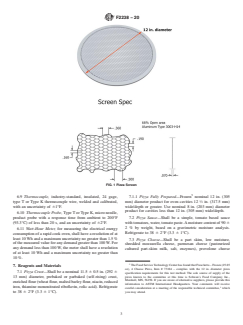
7.5 Pizza Screen—Shall be a 12 in. (305 mm) diameter,
aluminum pizza screen. Refrigerate to 38 6 2°F (3.3 6 1°C).
9.4 For a gas rapid cook oven, adjust (during maximum
(See Fig. 1.)
energy input) the gas supply pressure downstream from the
appliance’s pressure regulator to within 6 2.5% of the
7.6 Gravimetric moisture analysis shall be performed as
operating manifold pressure specified by the manufacturer.
follows: to determine moisture content, place a thawed, refrig-
Make adjustments to the appliance following the manufactur-
erated 38 6 2°F (3.3 6 1°C) pizza sample of the test food on
er’s recommendations for optimizing combustion.
a dry, aluminum sheet pan and place the pan in a convection
drying oven at a temperature of 220 6 5°F (104 6 –15°C) for
10. Procedure
a period of 24 h. Weigh the sample before it is placed in the
oven and after it is removed and determine the percent
10.1 General:
moisture content based on the percent weight loss of the
10.1.1 Forgasappliances,recordthefollowingforeachtest
sample. The sample must be thoroughly chopped ( ⁄8 in. or
run:
smallersquares)andspreadevenlyoverthesurfaceofthesheet
10.1.1.1 Higher heating value,
pan in order for all of the moisture to evaporate during drying
10.1.1.2 Standard gas pressure and temperature used to
and it is permissible to spread the sample on top of baking
correct measured gas volume to standard conditions,
paper in order to protect the sheet pan and simplify cleanup.
10.1.1.3 Measured gas temperature,
Typically moisture loss of 47 61%.
10.1.1.4 Measured gas pressure,
10.1.1.5 Barometric pressure, and
NOTE 1—The moisture content of pizza crust, pizza sauce, and pizza
10.1.1.6 Energy input rate during or immediately prior to
cheese can be determined by a qualified chemistry lab using the AOAC
Procedure 984.25.
test (for example, during the preheat for that days testing).
NOTE 4—Using a calorimeter or gas chromatograph in accordance with
8. Sampling and Test Units
accepted laboratory procedures is the preferred method for determining
the higher heating value of gas supplied to the rapid cook oven under test.
8.1 Rapid Cook Oven—Select a representative production
It is recommended that all testing be performed with gas having a higher
model for performance testing.
3 3
heating value of 1000 to 1075 Btu/ft (37300 to 40100 kJ/m ).
10.1.1.7 Energy if appliance uses a separate power supply
9. Preparation of Apparatus
for ventless hood operation, this energy is to be added to the
9.1 Install the appliance in a properly ventilated area in
total energy of appliance calculations.
accordance with the manufacturer’s instructions. The associ-
10.1.2 For gas rapid cook ovens, add electric energy con-
ated heating or cooling system shall be capable of maintaining
sumption to gas energy for all tests, with the exception of the
an ambient temperature of 75 6 5°F (24 6 3°C) within the
energy input rate test (see 10.3).
testing environment.
10.1.3 For electric rapid cook ovens, record the following
NOTE 2—The ambient temperature requirements are designed to simu-
for each test run:
laterealworldkitchentemperaturesandaremeanttoprovideareasonable
10.1.3.1 Voltage while elements are energized, and
guideline for the temperature requirements during testing. If a facility is
10.1.3.2 Energy input rate during or immediately prior to
not able to maintain the required temperatures, then it is reasonable to
expectthattheapplicationoftheproceduremaydeviatefromthespecified test (for example, during the preheat for that days testing).
requirements(ifitcannotbeavoided)aslongasthosedeviationsarenoted
10.1.4 For each test run, confirm that the peak input rate is
on the Results Reporting Sheets.
within 6 5% of the rated nameplate input. If the difference is
9.2 Connect the rapid cook oven to a calibrated energy test greater than 5%, terminate testing and contact the manufac-
meter. For gas installations, install a pressure regulator down- turer. The manufacturer may make appropriate changes or
stream from the meter to maintain a constant pressure of gas adjustments to the rapid cook oven.
for all tests. Install instrumentation to record both the pressure
10.2 Energy Input:
andtemperatureofthegassuppliedtotherapidcookovenand
10.2.1 Settherapidcookovencontrolssothattheovenwill
the barometric pressure during each test so that the measured
operate at the maximum input rate and turn the oven on.
gas flow can be corrected to standard conditions. For electric
10.2.2 Setmicrowaveenergyto100%,notethatcavitywill
installations,avoltageregulatormayberequiredduringtestsif
need glass beaker with 16 oz (473 Mil) of water to absorb
the voltage supply is not within 62.5% of the manufacturer’s
energy – do not run microwave without some media to absorb
nameplate voltage.
the energy.
9.3 Foranelectricrapidcookoven,confirm(whiletherapid 10.2.3 Record the time and energy consumption starting as
cook oven elements are energized) that the supply voltage is soon as the elements or burners cycle on and continuing over
F2238 − 20
aperiodthatislongenoughtoaccuratelydeterminetheenergy (3.3 6 1°C). Do not test with pizzas that have been in the
inputrateoftheoven.Theovenmustbefullyonovertheentire refrigerator more than 48 h. Each pizza will comprise a pizza
period and the test period must end when any of the burners or test load.
elements first cycle off.
NOTE7—Thetestpizzasshouldnotbestoredintherefrigeratorforlong
periods, more than 48 h, because the pizza crust may absorb excessive
NOTE 5—The rapid cook oven may be equipped with a high tempera-
moisturefromthesauceandevaporationmayreducethemoisturecontent
ture limit control which prematurely cycles the oven off if no food load is
of the sauce, changing the thermal characteristics of the pizza. The 48-h
present in the oven cavity. In this case, the researcher may select an
periodisapractical“time”specificationthatallowsthepreparationoftest
appropriatefoodloadwhichwillallowtheoventooperatefortheduration
pizzas on day one, overnight chilling and stabilization and application of
of the test period.
the procedure within two days.
10.2.4 Calculate and record the rapid cook oven’s energy
NOTE 8—In order to easily handle and store the pizzas, it is recom-
input rate and compare the result to the rated nameplate input. mendedthatthepreparedpizzasbeplacedonapizzascreenandplacedon
full size (18 by 26 in. (457 by 660 mm)) sheet pans, two pizzas per pan.
For gas rapid cook ovens, the burner energy consumption is
The entire pan can then be covered with food grade plastic wrap. When
used to compare the calculated energy input rate with the rated
stacking multiple pans in the refrigerator, spacers are necessary between
gas input and any electrical energy consumption shall be used
thepansinordertoprotectthepizzasfromdamage.ResearchersatPacific
to compare the calculated energy input rate with the rated
GasandElectricCompany’sFoodServiceTechnologyCenterhavefound
that sauce cups can be used as spacers.
electrical input.
NOTE9—Aminimumof3testrunsisspecified,however,moretestruns
10.2.5 In accordance with 11.4, calculate and report the
may be necessary if the results do not meet the uncertainty criteria
rapid cook oven energy input rate and rated nameplate input.
specified in Annex A1.
10.3 Preheat Energy Consumption and Time:
10.6.2 Prepare a minimum of 4 additional pizzas for use in
10.3.1 Determine whether the rapid cook oven requires
cook time determination. The actual number of pizzas needed
preheatinginordertoachieveaready-to-cookstate.Iftheoven
for the cook time determination will vary with the number of
requires preheating, verify that the oven cavity temperature is
trials needed to establish a cooking time that demonstrates a
75 6 5°F (24 6 3°C) and turn the rapid cook oven on.
195 6 3°F (90.5 6 1°C) final pizza temperature after cooking.
10.3.2 Record the time and energy consumption required to
10.7 Cook Time Determination:
preheat the rapid cook oven, from the time when the unit is
10.7.1 Turn the rapid cook oven on and allow it to achieve
turned on until the time when the rapid cook oven achieves a
a ready-to-cook state. If the oven requires preheating in order
ready-to-cook state.
to achieve a ready-to-cook state then allow the oven to idle for
10.3.3 In accordance with 11.5, calculate and report the
60 min after it is fully preheated. Set the rapid cook oven
preheat energy consumption and time.
controls to the manufacturer’s recommended setting for cook-
ing a parbaked pizza as specified in 7.3. Estimate a cook time
10.4 Idle Energy Rate:
for pizza.
10.4.1 Turn the rapid cook oven on and allow it to achieve
a ready-to-cook state. If the oven requires preheating in order
NOTE 10—The rapid cook oven may allow for several different recipes
to achieve a ready-to-cook state then allow the oven to idle for
or programs which will all cook the test pizza to an adequate doneness.
60 min after it is fully preheated. The researcher should choose the recipe or program that cooks the pizza
in the shortest amount of time and with the lowest energy consumption
10.4.2 Begin recording the rapid cook oven’s idle energy
while maintaining the highest quality of the finished pizza. The manufac-
consumption for a minimum of 2 h. Record the length of the
turer can be a valuable resource in optimizing this cooking process and
idle period.
should be consulted where possible.
10.4.3 In accordance with 11.6, calculate and report the
10.7.1.1 Record the cook recipe settings for all energy
rapid cook oven’s idle energy rate.
inputs. Add this recipe to the test report for reference.
NOTE 6—For a rapid cook oven that does not require preheat, the idle
10.7.2 Remove a single pizza from the refrigerator and
energyratewillconsistofthecomputercontrols,controlcircuits,fans,and
place the pizza directly on the manufacturer’s recommended
anyotherenergyconsumptionthatisrequiredtokeeptheunitinastandby
or ready-to-cook state. cooking surface or cooking container in the center of the oven.
If the manufacturer does not recommend a cooking surface or
10.5 Pilot Energy Rate (if applicable):
cooking container for cooking parbaked pizza then place the
10.5.1 For a gas rapid cook oven with a standing pilot, set
pizza directly on the oven deck. Do not allow more than 1 min
the gas valve at the “pilot” position and set the rapid cook
toelapsefromthetimeapizzaisremovedfromtherefrigerator
oven’s temperature control to the “off” position.
until it is placed in the oven.
10.5.2 Light and adjust the pilot according to the manufac-
10.7.3 Allow the pizza to cook for the duration of the
turer’s instructions.
estimated cook time and then remove the pizza from the rapid
10.5.3 Monitor gas consumption for a minimum of8hof
cook oven and place the pizza on an insulated, non-metallic
pilot operation.
surface such as corrugated cardboard. A standard cardboard
10.5.4 In accordance with 11.7, calculate and report the
pizza box is acceptable.
pilot energy rate.
10.7.4 Determine the final temperature of the pizza by
10.6 Pizza Preparation:
placing six thermocouple probes on the surface of the pizza.
10.6.1 Prepare 24 pizzas in accordance with 7.3. Cover the Locate the probes 3 in. from the center of the pizza and spaced
pizzas with plastic wrap (to inhibit moisture loss), place in a equidistant from each other as shown in Fig. 2. For smaller 8
refrigeratorandchillthepizzasuntiltheystabilizeat38 62°F in. diameter pizza the probes shall be 2 in. diameter from the
F2238 − 20
FIG. 2 Location of Thermocouple Probes on Pizza Surface
during temperature measurement.
centerofthepizza.Theprobesshouldpenetratethecheeseand
rest on the sauce-crust interface directly beneath the cheese.
10.7.5 Record the determined cook time and the recipe or
Allow no more than 10 s from the time the pizza is removed
program for optimized cooking of a pizza test load for use
from the oven to the time the probes are placed on the pizza.
during the cooking-energy efficiency and production capacity
Leave the probes in place on the pizza and record and average
tests.
thetemperaturesofallsixprobesevery5sovera1-minperiod
10.8 Cooking-Energy Effıciency and Production Capacity—
(for a total of 12 readings). The final pizza temperature is the
The cooking-energy efficiency and production capacity tests
highest average temperature of the six probes during the
are to be run a minimum of three times. Allow a minimum of
one-minute period. If the final pizza temperature is not 195 6
15 min between each test run. Additional test runs may be
3°F (90.5 6 1°C), adjust the cook time and repeat the cook
necessary to obtain the required precision for the reported test
time determination test as necessary to produce a 195 6 3°F
results (see Annex A1). The cooking-energy efficiency tests
(90.5 6 1°C) final temperature.
shall be performed in the following sequence:
NOTE 11—It is recommended that the six thermocouple probes be
10.8.1 Turn the rapid cook oven on and allow it to achieve
attached to a simple, lightweight, rigid structure which will maintain the
a ready-to-cook state. If the oven requires preheating in order
proper spacing and upright position of the probes and will therefore help
to achieve a ready-to-cook state then allow the oven to idle for
maintain the consistency of the temperature readings. Fig. 3 shows a
thermocouple structure that is made of Plexiglas and includes a simple 60 min after it is fully preheated.
handle for easy placemen
...
This document is not an ASTM standard and is intended only to provide the user of an ASTM standard an indication of what changes have been made to the previous version. Because
it may not be technically possible to adequately depict all changes accurately, ASTM recommends that users consult prior editions as appropriate. In all cases only the current version
of the standard as published by ASTM is to be considered the official document.
Designation: F2238 − 16 F2238 − 20 An American National Standard
Standard Test Method for
Performance of Rapid Cook Ovens
This standard is issued under the fixed designation F2238; the number immediately following the designation indicates the year of
original adoption or, in the case of revision, the year of last revision. A number in parentheses indicates the year of last reapproval. A
superscript epsilon (´) indicates an editorial change since the last revision or reapproval.
1. Scope
1.1 This test method evaluates the energy consumption and cooking performance of rapid cook ovens. The food service operator
can use this evaluation to select a rapid cook oven and understand its energy consumption.
1.2 This test method is applicable to gas and electric rapid cook ovens.
1.3 The rapid cook oven can be evaluated with respect to the following (where applicable):
1.3.1 Energy input rate (see 10.2),
1.3.2 Preheat energy consumption and time (see 10.3),
1.3.3 Idle energy rate (see 10.4),
1.3.4 Pilot energy rate (if applicable) (see 10.5), and
1.3.5 Cooking-energy efficiency, cooking energy rate, and production capacity (see 10.6).
1.4 The values stated in inch-pound units are to be regarded as standard. No other units of measurement are included in this
standard.
1.5 This test method may involve hazardous materials, operations, and equipment. This test method does not purport to address
all of the safety concerns, if any, associated with its use. It is the responsibility of the user of this test method to establish
appropriate safety safety, health, and healthenvironmental practices and determine the applicability of regulatory limitations prior
to use.
1.6 This international standard was developed in accordance with internationally recognized principles on standardization
established in the Decision on Principles for the Development of International Standards, Guides and Recommendations issued
by the World Trade Organization Technical Barriers to Trade (TBT) Committee.
2. Referenced Documents
2.1 ASTM Standards:
This test method is under the jurisdiction of ASTM Committee F26 on Food Service Equipment and is the direct responsibility of Subcommittee F26.06 on Productivity
and Energy Protocol.
Current edition approved March 15, 2016Sept. 1, 2020. Published April 2016October 2020. Originally approved in 2003. Last previous edition approved in 20092016 as
F2238 – 09.F2238 – 16. DOI: 10.1520/F2238-16.10.1520/F2238-20.
For referenced ASTM standards, visit the ASTM website, www.astm.org, or contact ASTM Customer Service at service@astm.org. For Annual Book of ASTM Standards
volume information, refer to the standard’s Document Summary page on the ASTM website.
Copyright © ASTM International, 100 Barr Harbor Drive, PO Box C700, West Conshohocken, PA 19428-2959. United States
F2238 − 20
D3588 Practice for Calculating Heat Value, Compressibility Factor, and Relative Density of Gaseous Fuels
2.2 ASHRAE Documents:
2013 ASHRAE Handbook of Fundamentals Chapter 1, Psychrometrics
2014 ASHRAE Handbook—Refrigeration Chapter 19, Thermal Properties of Foods
ASHRAE Guideline 2-1986 (RA90) Engineering Analysis of Experimental Data
2.3 AOAC Document:
AOAC Procedure 984.25 Moisture (Loss of Mass on Drying) in Frozen French Fried Potatoes
3. Terminology
3.1 Definitions:
3.1.1 cooking-energy effıciency, n—quantity of energy imparted to the specified food product, expressed as a percentage of energy
consumed by the rapid cook oven during the cooking event.
3.1.2 cooking energy rate, n—average rate of energy consumption (Btu/h or kW) during the cooking-energy efficiency test.
3.1.3 energy input rate, n—peak rate at which a rapid cook oven consumes energy (Btu/h or kW).
3.1.4 idle energy rate, n—the rapid cook oven’s rate of energy consumption (Btu/h or kW), when empty, required to maintain its
cavity temperature at the specified thermostat set point or to otherwise maintain the oven in a ready-to-cook condition.
3.1.5 oven cavity, n—that portion of the rapid cook oven in which food products are heated or cooked.
3.1.5.1 Discussion—
Cavity ≥ 12- ⁄2 in. test product 12 in. diameter nominal pizza. Cavity ≤ 12 in. test product 8 in. diameter pizza product.
3.1.6 pilot energy rate, n—rate of energy consumption (Btu/h) by a rapid cook oven’s continuous pilot (if applicable).
3.1.7 preheat energy, n—amount of energy consumed (Btu or kWh), by the rapid cook oven while preheating its cavity from
ambient temperature to the specified thermostat set point or while preheating any other component of the oven, for example, an
integral heat exchanger, to a ready-to-cook condition.
3.1.8 preheat time, n—time (min.) required for the rapid cook oven cavity to preheat from ambient temperature to the specified
thermostat set point or for the rapid cook oven to achieve a ready-to-cook condition.
3.1.9 production capacity, n—maximum rate (lb/h) at which an rapid cook oven can bring the specified food product to a specified
“cooked” condition.
3.1.10 production rate, n—rate (lb/h) at which a rapid cook oven brings the specified food product to a specified “cooked”
condition. Does not necessarily refer to maximum rate. Production rate varies with the amount of food being cooked.
3.1.11 rapid cook oven, n—a cooking appliance that utilizes one or more heat transfer technologies to cook food product within
a chamber and which is capable of cooking the food product significantly faster than is possible using solely radiant oven or
convection oven technologies. Heat transfer technologies which may be employed include microwave, quartz halogen and high
velocity or impingement convection, both gas and electric.
3.1.12 uncertainty, n—measure of systematic and precision errors in specified instrumentation or measure of repeatability of a
reported test result.
4. Summary of Test Method
4.1 Energy input rate is determined to confirm that the rapid cook oven is operating within 5 % of the nameplate energy input rate.
For a gas rapid cook oven, the pilot energy rate and the fan and control energy rates are also determined.
Available from American Society of Heating, Refrigerating, and Air-Conditioning Engineers, Inc. (ASHRAE), 1791 Tullie Circle, NE, Atlanta, GA 30329,
http://www.ashrae.org.
Available from AOAC International, 2275 Research Blvd., Suite 300, Rockville, MD 20850-3250, http://www.aoac.org.
F2238 − 20
4.2 Preheat energy and time are determined.
4.3 Idle energy rate is determined.
4.4 Cooking-energy efficiency and production capacity are determined during barreling-run cooking tests using pizza as the food
product.
4.4.1 Cooked product photo documented. Photos of cooked product for visual comparison.
5. Significance and Use
5.1 The energy input rate test is used to confirm that the rapid cook oven is operating properly prior to further testing.
5.2 Preheat energy and time can be useful to food service operators to manage power demands and to know how quickly the rapid
cook oven can be ready for operation.
5.3 Idle energy rate and pilot energy rate can be used to estimate energy consumption during non-cooking periods.
5.4 Cooking-energy efficiency is a precise indicator of a rapid cook oven’s energy performance while cooking a typical food
product. If energy performance information is desired using a food product other than the specified test food, the test method could
be adapted and applied. Energy performance information allows an end user to better understand the operating characteristics of
a rapid cook oven.
5.5 Production capacity information can help an end user to better understand the production capabilities of a rapid cook oven as
it is used to cook a typical food product and this could help in specifying the proper size and quantity of equipment. If production
information is desired using a food product other than the specified test food, the test method could be adapted and applied.
6. Apparatus
6.1 Analytical Balance Scale, for measuring weights up to 20 lb, lb (9.1 kg), with a resolution of 0.01 lb (0.005 kg) and an
uncertainty of 0.01 lb.lb (0.005 kg).
6.2 Barometer, for measuring absolute atmospheric pressure, to be used for adjustment of measured natural gas volume to standard
conditions. Shall have a resolution of 0.2 in. Hg (670 Pa) and an uncertainty of 0.2 in. Hg.Hg (670 Pa).
6.3 Canopy Exhaust Hood, 4 ft (1.2 m) in depth, wall-mounted with the lower edge of the hood 6 ft, 6 in. (1.98 m) from the floor
and with the capacity to operate at a nominal exhaust ventilation rate of 300200 cfm per linear foot (94.4 L/s per linear meter) of
active hood length. This hood shall extend a minimum of 6 in. (150 mm) past both sides and the front of the cooking appliance
and shall not incorporate side curtains or partitions.
6.4 Convection Drying Oven, with temperature controlled at 220 6 5°F, 5°F (100 6 3°C), to be used to determine moisture
content of pizza crust, pizza sauce and pizza cheese.
6.5 Gas Meter, for measuring the gas consumption of a rapid cook oven, shall be a positive displacement type with a resolution
3 3
of at least 0.01 ft and a maximum uncertainty no greater than 1 % of the measured value for any demand greater than 2.2 ft /h.
If the meter is used for measuring the gas consumed by the pilot lights, it shall have a resolution of at least 0.01 ft and a maximum
uncertainty no greater than 2 % of the measured value.
6.6 Pressure Gage, for monitoring natural gas pressure. Shall have a range of zero0 to 1015 in. H O, O (0 to 3.7 kPa), a resolution
of 0.5 in. H O, O (125 Pa), and a maximum uncertainty of 1 % of the measured value.
6.7 Stop Watch, with a 1-s resolution.
F2238 − 20
6.8 Temperature Sensor, for measuring natural gas temperature in the range of 50 to 100°F (10 to 93°C) with an uncertainty of
6 1°F.2°F.
6.9 Thermocouple, industry-standard, insulated, 24 gage, type T or Type K thermocouple wire, welded and calibrated, with an
uncertainty of 61°F.
6.10 Thermocouple Probe, Type T or Type K, micro needle, product probe with a response time from ambient to 200°F (93.3°C)
of less than 20 s, and an uncertainty of 61°F.62°F.
6.11 Watt-Hour Meter, for measuring the electrical energy consumption of a rapid cook oven, shall have a resolution of at least
10 Wh and a maximum uncertainty no greater than 1.5 % of the measured value for any demand greater than 100 W. For any
demand less than 100 W, the meter shall have a resolution of at least 10 Wh and a maximum uncertainty no greater than 10 %.
7. Reagents and Materials
7.1 Pizza Crust—Shall be a nominal 11.5 6 0.5 in. (292 6 13 mm) diameter, prebaked or parbaked (self-rising) crust, enriched
flour (wheat flour, malted barley flour, niacin, reduced iron, thiamine mononitrated riboflavin, rolic acid). Refrigerate to 38 6
2°F.2°F (3.3 6 1°C).
FIG. 1 Pizza Screen
F2238 − 20
7.1.1 Pizza Fully Prepared—Frozen nominal 12 in. (305 mm) diameter product for oven cavities 12 ⁄2 in. (317.5 mm) wide/depth
or greater. Use nominal 8 in. (203 mm) diameter product for cavities less than 12 in. (305 mm) wide/depth.
7.2 Pizza Sauce—Shall be a simple, tomato based sauce with tomatoes, water, tomato paste. A moisture content of 90 6 2 % by
weight, based on a gravimetric moisture analysis. Refrigerate to 38 6 2°F.2°F (3.3 6 1°C).
7.3 Pizza Cheese—Shall be a part skim, low moisture, shredded mozzarella cheese, parmesan cheese (pasteurized cultured
part-skim milk, salt, enzymes), provolone cheese (pasteurized milk, cheese cultures, salt, enzymes), white cheddar cheese
(pasteurized milk, cheese cultures, salt, enzymes). Refrigerate to 38 6 2°F.2°F (3.3 6 1°C).
7.4 Pizza—Shall be comprised of a pizza crust, pizza sauce, and pizza cheese. Each uncooked pizza should have a weight of 1.7
6 0.1 lb. Moisture content of the uncooked pizza shall be 48 6 3 % by weight, based on a gravimetric analysis.
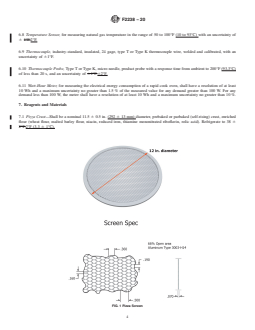
7.5 Pizza Screen—Shall be a 12 in. (305 mm) diameter, aluminum pizza screen. Refrigerate to 38 6 2°F. 2°F (3.3 6 1°C). (See
Fig. 1.)
7.6 Gravimetric moisture analysis shall be performed as follows: to determine moisture content, place a thawed, refrigerated 38
6 2°F (3.3 6 1°C) pizza sample of the test food on a dry, aluminum sheet pan and place the pan in a convection drying oven at
a temperature of 220 6 5°F (104 6 –15°C) for a period of 24 h. Weigh the sample before it is placed in the oven and after it is
removed and determine the percent moisture content based on the percent weight loss of the sample. The sample must be
thoroughly chopped ( ⁄8 in. or smaller squares) and spread evenly over the surface of the sheet pan in order for all of the moisture
to evaporate during drying and it is permissible to spread the sample on top of baking paper in order to protect the sheet pan and
simplify cleanup. Typically moisture loss of 47 6 1 %.
NOTE 1—The moisture content of pizza crust, pizza sauce, and pizza cheese can be determined by a qualified chemistry lab using the AOAC Procedure
984.25.
8. Sampling and Test Units
8.1 Rapid Cook Oven—Select a representative production model for performance testing.
9. Preparation of Apparatus
9.1 Install the appliance in a properly ventilated area in accordance with the manufacturer’s instructions. The associated heating
or cooling system shall be capable of maintaining an ambient temperature of 75 6 5°F (24 6 3°C) within the testing environment.
NOTE 2—The ambient temperature requirements are designed to simulate real world kitchen temperatures and are meant to provide a reasonable guideline
for the temperature requirements during testing. If a facility is not able to maintain the required temperatures, then it is reasonable to expect that the
application of the procedure may deviate from the specified requirements (if it cannot be avoided) as long as those deviations are noted on the Results
Reporting Sheets.
9.2 Connect the rapid cook oven to a calibrated energy test meter. For gas installations, install a pressure regulator downstream
from the meter to maintain a constant pressure of gas for all tests. Install instrumentation to record both the pressure and
temperature of the gas supplied to the rapid cook oven and the barometric pressure during each test so that the measured gas flow
can be corrected to standard conditions. For electric installations, a voltage regulator may be required during tests if the voltage
supply is not within 62.5 % of the manufacturer’s nameplate voltage.
9.3 For an electric rapid cook oven, confirm (while the rapid cook oven elements are energized) that the supply voltage is within
62.5 % of the operating voltage specified by the manufacturer. Record the test voltage for each test.
NOTE 3—It is the intent of the testing procedure herein to evaluate the performance of a rapid cook oven at its rated gas pressure or electric voltage. If
The Food Service Technology Center has found that Freschetta – Frozen (25.85 oz), 4 Cheese Pizza, Item # 73184 – complies with the 12 in. diameter pizza specification
requirements for this test method. The sole source of supply of the pizza known to the committee at this time is Schwan’s Food Company Inc., Marshall, MN, 56258. If you
are aware of alternative suppliers, please provide this information to ASTM International Headquarters. Your comments will receive careful consideration at a meeting of
the responsible technical committee, which you may attend.
F2238 − 20
an electric unit is rated dual voltage (that is, designed to operate at either 240 or 480 V with no change in components), the voltage selected by the
manufacturer or tester, or both, shall be reported. If a rapid cook oven is designed to operate at two voltages without a change in the resistance of the
heating elements, the performance of the unit (for example, preheat time) may differ at the two voltages.
9.4 For a gas rapid cook oven, adjust (during maximum energy input) the gas supply pressure downstream from the appliance’s
pressure regulator to within 6 2.5 % of the operating manifold pressure specified by the manufacturer. Make adjustments to the
appliance following the manufacturer’s recommendations for optimizing combustion.
10. Procedure
10.1 General:
10.1.1 For gas appliances, record the following for each test run:
10.1.1.1 Higher heating value,
10.1.1.2 Standard gas pressure and temperature used to correct measured gas volume to standard conditions,
10.1.1.3 Measured gas temperature,
10.1.1.4 Measured gas pressure,
10.1.1.5 Barometric pressure, and
10.1.1.6 Energy input rate during or immediately prior to test (for example, during the preheat for that days testing).
NOTE 4—Using a calorimeter or gas chromatograph in accordance with accepted laboratory procedures is the preferred method for determining the higher
heating value of gas supplied to the rapid cook oven under test. It is recommended that all testing be performed with gas having a higher heating value
3 3
of 1000 to 1075 Btu/ft (37 300 to 40 100 kJ/m ).
10.1.1.7 Energy if appliance uses a separate power supply for ventless hood operation, this energy is to be added to the total energy
of appliance calculations.
NOTE 4—Using a calorimeter or gas chromatograph in accordance with accepted laboratory procedures is the preferred method for determining the higher
heating value of gas supplied to the rapid cook oven under test. It is recommended that all testing be performed with gas having a higher heating value
of 1000 to 1075 Btu/ft .
10.1.2 For gas rapid cook ovens, add electric energy consumption to gas energy for all tests, with the exception of the energy input
rate test (see 10.3).
10.1.3 For electric rapid cook ovens, record the following for each test run:
10.1.3.1 Voltage while elements are energized, and
10.1.3.2 Energy input rate during or immediately prior to test (for example, during the preheat for that days testing).
10.1.4 For each test run, confirm that the peak input rate is within 6 5 % of the rated nameplate input. If the difference is greater
than 5 %, terminate testing and contact the manufacturer. The manufacturer may make appropriate changes or adjustments to the
rapid cook oven.
10.2 Energy Input:
10.2.1 Set the rapid cook oven controls so that the oven will operate at the maximum input rate and turn the oven on.
10.2.2 Set microwave energy to 100 %, note that cavity will need glass beaker with 16 oz (473 Mil) of water to absorb energy
– do not run microwave without some media to absorb the energy.
10.2.3 Record the time and energy consumption starting as soon as the elements or burners cycle on and continuing over a period
F2238 − 20
that is long enough to accurately determine the energy input rate of the oven. The oven must be fully on over the entire period
and the test period must end when any of the burners or elements first cycle off.
NOTE 5—The rapid cook oven may be equipped with a high temperature limit control which prematurely cycles the oven off if no food load is present
in the oven cavity. In this case, the researcher may select an appropriate food load which will allow the oven to operate for the duration of the test period.
10.2.4 Calculate and record the rapid cook oven’s energy input rate and compare the result to the rated nameplate input. For gas
rapid cook ovens, the burner energy consumption is used to compare the calculated energy input rate with the rated gas input and
any electrical energy consumption shall be used to compare the calculated energy input rate with the rated electrical input.
10.2.5 In accordance with 11.4, calculate and report the rapid cook oven energy input rate and rated nameplate input.
10.3 Preheat Energy Consumption and Time:
10.3.1 Determine whether the rapid cook oven requires preheating in order to achieve a ready-to-cook state. If the oven requires
preheating, verify that the oven cavity temperature is 75 6 5°F (24 6 3°C) and turn the rapid cook oven on.
10.3.2 Record the time and energy consumption required to preheat the rapid cook oven, from the time when the unit is turned
on until the time when the rapid cook oven achieves a ready-to-cook state.
10.3.3 In accordance with 11.5, calculate and report the preheat energy consumption and time.
10.4 Idle Energy Rate:
10.4.1 Turn the rapid cook oven on and allow it to achieve a ready-to-cook state. If the oven requires preheating in order to achieve
a ready-to-cook state then allow the oven to idle for 60 min after it is fully preheated.
10.4.2 Begin recording the rapid cook oven’s idle energy consumption for a minimum of 2 h. Record the length of the idle period.
10.4.3 In accordance with 11.6, calculate and report the rapid cook oven’s idle energy rate.
NOTE 6—For a rapid cook oven that does not require preheat, the idle energy rate will consist of the computer controls, control circuits, fans, and any
other energy consumption that is required to keep the unit in a standby or ready-to-cook state.
10.5 Pilot Energy Rate (if applicable):
10.5.1 For a gas rapid cook oven with a standing pilot, set the gas valve at the “pilot” position and set the rapid cook oven’s
temperature control to the “off” position.
10.5.2 Light and adjust the pilot according to the manufacturer’s instructions.
10.5.3 Monitor gas consumption for a minimum of 8 h of pilot operation.
10.5.4 In accordance with 11.7, calculate and report the pilot energy rate.
10.6 Pizza Preparation:
10.6.1 Prepare 24 pizzas in accordance with 7.3. Cover the pizzas with plastic wrap (to inhibit moisture loss), place in a
refrigerator and chill the pizzas until they stabilize at 38 6 2°F. 2°F (3.3 6 1°C). Do not test with pizzas that have been in the
refrigerator more than 48 h. Each pizza will comprise a pizza test load.
NOTE 7—The test pizzas should not be stored in the refrigerator for long periods, more than 48 h, because the pizza crust may absorb excessive moisture
from the sauce and evaporation may reduce the moisture content of the sauce, changing the thermal characteristics of the pizza. The 48-h period is a
practical “time” specification that allows the preparation of test pizzas on day one, overnight chilling and stabilization and application of the procedure
within two days.
NOTE 8—In order to easily handle and store the pizzas, it is recommended that the prepared pizzas be placed on a pizza screen and placed on full size
(18 by 26 in.) in. (457 by 660 mm)) sheet pans, two pizzas per pan. The entire pan can then be covered with food grade plastic wrap. When stacking
F2238 − 20
multiple pans in the refrigerator, spacers are necessary between the pans in order to protect the pizzas from damage. Researchers at Pacific Gas and
Electric Company’s Food Service Technology Center have found that sauce cups can be used as spacers.
NOTE 9—A minimum of 3 test runs is specified, however, more test runs may be necessary if the results do not meet the uncertainty criteria specified
in Annex A1.
10.6.2 Prepare a minimum of 4 additional pizzas for use in cook time determination. The actual number of pizzas needed for the
cook time determination will vary with the number of trials needed to establish a cooking time that demonstrates a 195 6 3°F (90.5
6 1°C) final pizza temperature after cooking.
10.7 Cook Time Determination:
10.7.1 Turn the rapid cook oven on and allow it to achieve a ready-to-cook state. If the oven requires preheating in order to achieve
a ready-to-cook state then allow the oven to idle for 60 min after it is fully preheated. Set the rapid cook oven controls to the
manufacturer’s recommended setting for cooking a parbaked pizza as specified in 7.3. Estimate a cook time for pizza.
NOTE 10—The rapid cook oven may allow for several different recipes or programs which will all cook the test pizza to an adequate doneness. The
researcher should choose the recipe or program that cooks the pizza in the shortest amount of time and with the lowest energy consumption while
maintaining the highest quality of the finished pizza. The manufacturer can be a valuable resource in optimizing this cooking process and should be
consulted where possible.
10.7.1.1 Record the cook recipe settings for all energy inputs. Add this recipe to the test report for reference.
NOTE 10—The rapid cook oven may allow for several different recipes or programs which will all cook the test pizza to an adequate doneness. The
researcher should choose the recipe or program that cooks the pizza in the shortest amount of time and with the lowest energy consumption while
maintaining the highest quality of the finished pizza. The manufacturer can be a valuable resource in optimizing this cooking process and should be
consulted where possible.
10.7.2 Remove a single pizza from the refrigerator and place the pizza directly on the manufacturer’s recommended cooking
surface or cooking container in the center of the oven. If the manufacturer does not recommend a cooking surface or cooking
container for cooking parbaked pizza then place the pizza directly on the oven deck. Do not allow more than 1 min to elapse from
the time a pizza is removed from the refrigerator until it is placed in the oven.
10.7.3 Allow the pizza to cook for the duration of the estimated cook time and then remove the pizza from the rapid cook oven
and place the pizza on an insulated, non-metallic surface such as corrugated cardboard. A standard cardboard pizza box is
acceptable.
10.7.4 Determine the final temperature of the pizza by placing six thermocouple probes on the surface of the pizza. Locate the
probes 3 in. from the center of the pizza and spaced equidistant from each other as shown in Fig. 2. For smaller 8 in. diameter
pizza the probes shall be 2 in. diameter from the center of the pizza. The probes should penetrate the cheese and rest on the
sauce-crust interface directly beneath the cheese. Allow no more than 10 s from the time the pizza is removed from the oven to
the time the probes are placed on the pizza. Leave the probes in place on the pizza and record and average the temperatures of
all six probes every five seconds5 s over a one-minute1-min period (for a total of 12 readings). The final pizza temperature is the
highest average temperature of the six probes during the one-minute period. If the final pizza temperature is not 195 6 3°F, 3°F
(90.5 6 1°C), adjust the cook time and repeat the cook time determination test as necessary to produce a 195 6 3°F (90.5 6 1°C)
final temperature.
NOTE 11—It is recommended that the six thermocouple probes be attached to a simple, lightweight, rigid structure which will maintain the proper spacing
and upright position of the probes and will therefore help maintain the consistency of the temperature readings. Fig. 3 shows a thermocouple structure
that is made of Plexiglas and includes a simple handle for easy placement of the structure on the pizza. This structure can be gently set on top of the
pizza during cook time determination with just enough force to penetrate the cheese but not enough to push the probes beyond the sauce-crust interface.
Because the sauce migrates into the crust during cooking, it is relatively easy to remain in the sauce-crust interface during temperature measurement.
10.7.5 Record the determined cook time and the recipe or program for optimized cooking of a pizza test load fo
...