

ASTM B631-93(2021)
(Specification)Standard Specification for Silver-Tungsten Electrical Contact Materials
General Information
- Abstract
ABSTRACT
This specification covers electrical contact components made from silver-tungsten by powder-metallurgical procedures. The material shall conform to composition limits specified. The material shall be finished by braze alloy backing, tumbling to polish surfaces, special surface finish, silver-rich surface layer, cleaning, etc. Chemical analysis and physical test shall be made to conform to the specified requirements.
SIGNIFICANCE AND USE
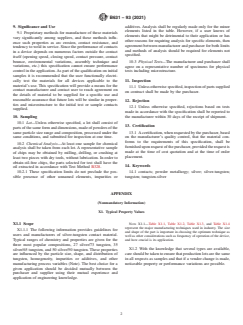
9.1 Proprietary methods for manufacture of these materials vary significantly among suppliers, and these methods influence such properties as arc erosion, contact resistance, and tendency to weld in service. Since the performance of contacts in a device depends on numerous factors outside the contact itself (opening speed, closing speed, contact pressure, contact bounce, environmental variations, assembly technique and variations, etc.) this specification cannot ensure performance control in the application. As part of the qualification on initial samples it is recommended that the user functionally electrically test the materials for all devices applicable to the material's use. This specification will provide a means for the contact manufacturer and contact user to reach agreement on the details of material to be supplied for a specific use and reasonable assurance that future lots will be similar in properties and microstructure to the initial test or sample contacts supplied.
SCOPE
1.1 This specification covers electrical contact components made from silver-tungsten by powder-metallurgical procedures.
1.2 This specification covers compositions within the silver-tungsten system normally specified by users of contacts.
1.3 This standard does not purport to address all of the safety concerns, if any, associated with its use. It is the responsibility of the user of this standard to become familiar with all hazards including those identified in the appropriate Data Safety Sheet (SDS) for this product/material as provided by the manufacturer, to establish appropriate safety, health, and environmental practices, and determine the applicability of regulatory limitations prior to use.
1.4 This international standard was developed in accordance with internationally recognized principles on standardization established in the Decision on Principles for the Development of International Standards, Guides and Recommendations issued by the World Trade Organization Technical Barriers to Trade (TBT) Committee.
- Status
- Published
- Publication Date
- 31-Oct-2021
- Technical Committee
- B02 - Nonferrous Metals and Alloys

Overview
ASTM B631-93(2021), Standard Specification for Silver-Tungsten Electrical Contact Materials, provides requirements for the composition, manufacture, and quality of electrical contacts made from silver-tungsten composites using powder-metallurgical methods. These contact materials are widely used in electrical switching devices due to their unique combination of electrical conductivity and resistance to arc erosion. The standard ensures a common understanding between manufacturers and users regarding product quality and performance characteristics.
Key Topics
- Material Composition: The standard specifies that silver-tungsten composite contacts must conform to agreed-upon composition limits, ensuring consistency across production batches.
- Manufacturing Methods: Silver-tungsten electrical contact materials are produced by various powder-metallurgical procedures, including infiltration, pressing, sintering, and repressing. The chosen method influences the material’s properties.
- Physical and Chemical Requirements: Regular chemical analyses and physical property tests are required to assure conformity with agreed specifications. Both parties must agree on testing criteria and sample selection.
- Finishing and Quality: Finished contacts may require additional processes such as surface polishing, braze alloy backing, or the application of a silver-rich surface layer to meet final application needs.
- Ordering and Certification: Clear communication on dimensions, performance criteria, and specific property needs must be included in orders. Manufacturers provide certifications upon request.
- Inspection and Rejection: Parts are inspected for defects that could affect performance. Any rejections due to nonconformance must be reported within defined timelines.
Applications
Silver-tungsten electrical contacts specified under ASTM B631 are essential in a range of electrical and electronic devices requiring reliable, durable switching performance. Typical application areas include:
- Circuit Breakers and Contactors: Silver-tungsten’s resistance to arc erosion and welding makes it ideal for high-fluctuation electrical circuits.
- Relays and Switches: Frequent operation and the need for consistent conductivity are well served by silver-tungsten composites.
- Industrial Controls: Used in heavy-duty switching gear and automation systems, these contacts deliver stability and longevity even under harsh conditions.
- Power Distribution: Silver-tungsten contacts support critical infrastructure where safety and performance are paramount.
The performance of these contacts in service is influenced not only by the material composition but also by operational variables like opening speed, pressure, and environmental conditions. Therefore, functional tests are recommended for new applications.
Related Standards
For further guidance and compatibility, ASTM B631 references several other industry standards:
- ASTM B328: Test Method for Density, Oil Content, and Interconnected Porosity of Sintered Metal Structural Parts and Oil-Impregnated Bearings (withdrawn, but relevant for legacy context).
- Relevant Safety Data Sheets (SDS): Proper handling, safety, and environmental practices should follow manufacturer-provided SDS to ensure compliance with regulatory requirements.
- World Trade Organization (WTO) Principles: This standard aligns with international trade practices, facilitating global commerce of electrical contact materials.
Other related ASTM standards cover materials, properties, and methods relevant to the production and application of electrical contacts and precious metal alloys.
By following ASTM B631-93(2021), manufacturers and users achieve alignment on quality, reliability, and safety for silver-tungsten electrical contact materials. This standard supports efficient sourcing, ensures product performance, and helps maintain trust in critical electrical components across industries.
Keywords: ASTM B631, silver-tungsten contacts, electrical contact materials, powder metallurgy, arc erosion resistance, electrical conductivity, standard specification, switching devices, industrial controls.
Relations
- Effective Date
- 10-Apr-2003
- Effective Date
- 10-Apr-2003
- Effective Date
- 10-Sep-1996
Get Certified
Connect with accredited certification bodies for this standard

Element Materials Technology
Materials testing and product certification.

Inštitut za kovinske materiale in tehnologije
Institute of Metals and Technology. Materials testing, metallurgical analysis, NDT.
Sponsored listings
Frequently Asked Questions
ASTM B631-93(2021) is a technical specification published by ASTM International. Its full title is "Standard Specification for Silver-Tungsten Electrical Contact Materials". This standard covers: ABSTRACT This specification covers electrical contact components made from silver-tungsten by powder-metallurgical procedures. The material shall conform to composition limits specified. The material shall be finished by braze alloy backing, tumbling to polish surfaces, special surface finish, silver-rich surface layer, cleaning, etc. Chemical analysis and physical test shall be made to conform to the specified requirements. SIGNIFICANCE AND USE 9.1 Proprietary methods for manufacture of these materials vary significantly among suppliers, and these methods influence such properties as arc erosion, contact resistance, and tendency to weld in service. Since the performance of contacts in a device depends on numerous factors outside the contact itself (opening speed, closing speed, contact pressure, contact bounce, environmental variations, assembly technique and variations, etc.) this specification cannot ensure performance control in the application. As part of the qualification on initial samples it is recommended that the user functionally electrically test the materials for all devices applicable to the material's use. This specification will provide a means for the contact manufacturer and contact user to reach agreement on the details of material to be supplied for a specific use and reasonable assurance that future lots will be similar in properties and microstructure to the initial test or sample contacts supplied. SCOPE 1.1 This specification covers electrical contact components made from silver-tungsten by powder-metallurgical procedures. 1.2 This specification covers compositions within the silver-tungsten system normally specified by users of contacts. 1.3 This standard does not purport to address all of the safety concerns, if any, associated with its use. It is the responsibility of the user of this standard to become familiar with all hazards including those identified in the appropriate Data Safety Sheet (SDS) for this product/material as provided by the manufacturer, to establish appropriate safety, health, and environmental practices, and determine the applicability of regulatory limitations prior to use. 1.4 This international standard was developed in accordance with internationally recognized principles on standardization established in the Decision on Principles for the Development of International Standards, Guides and Recommendations issued by the World Trade Organization Technical Barriers to Trade (TBT) Committee.
ABSTRACT This specification covers electrical contact components made from silver-tungsten by powder-metallurgical procedures. The material shall conform to composition limits specified. The material shall be finished by braze alloy backing, tumbling to polish surfaces, special surface finish, silver-rich surface layer, cleaning, etc. Chemical analysis and physical test shall be made to conform to the specified requirements. SIGNIFICANCE AND USE 9.1 Proprietary methods for manufacture of these materials vary significantly among suppliers, and these methods influence such properties as arc erosion, contact resistance, and tendency to weld in service. Since the performance of contacts in a device depends on numerous factors outside the contact itself (opening speed, closing speed, contact pressure, contact bounce, environmental variations, assembly technique and variations, etc.) this specification cannot ensure performance control in the application. As part of the qualification on initial samples it is recommended that the user functionally electrically test the materials for all devices applicable to the material's use. This specification will provide a means for the contact manufacturer and contact user to reach agreement on the details of material to be supplied for a specific use and reasonable assurance that future lots will be similar in properties and microstructure to the initial test or sample contacts supplied. SCOPE 1.1 This specification covers electrical contact components made from silver-tungsten by powder-metallurgical procedures. 1.2 This specification covers compositions within the silver-tungsten system normally specified by users of contacts. 1.3 This standard does not purport to address all of the safety concerns, if any, associated with its use. It is the responsibility of the user of this standard to become familiar with all hazards including those identified in the appropriate Data Safety Sheet (SDS) for this product/material as provided by the manufacturer, to establish appropriate safety, health, and environmental practices, and determine the applicability of regulatory limitations prior to use. 1.4 This international standard was developed in accordance with internationally recognized principles on standardization established in the Decision on Principles for the Development of International Standards, Guides and Recommendations issued by the World Trade Organization Technical Barriers to Trade (TBT) Committee.
ASTM B631-93(2021) is classified under the following ICS (International Classification for Standards) categories: 77.120.99 - Other non-ferrous metals and their alloys. The ICS classification helps identify the subject area and facilitates finding related standards.
ASTM B631-93(2021) has the following relationships with other standards: It is inter standard links to ASTM B328-96(2003)e1, ASTM B328-96(2003), ASTM B328-96. Understanding these relationships helps ensure you are using the most current and applicable version of the standard.
ASTM B631-93(2021) is available in PDF format for immediate download after purchase. The document can be added to your cart and obtained through the secure checkout process. Digital delivery ensures instant access to the complete standard document.
Standards Content (Sample)
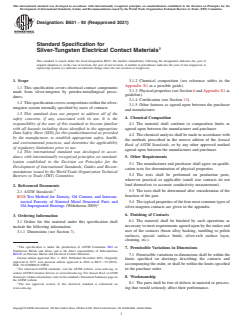
This international standard was developed in accordance with internationally recognized principles on standardization established in the Decision on Principles for the
Development of International Standards, Guides and Recommendations issued by the World Trade Organization Technical Barriers to Trade (TBT) Committee.
Designation: B631 −93 (Reapproved 2021)
Standard Specification for
Silver-Tungsten Electrical Contact Materials
This standard is issued under the fixed designation B631; the number immediately following the designation indicates the year of
original adoption or, in the case of revision, the year of last revision. A number in parentheses indicates the year of last reapproval. A
superscript epsilon (´) indicates an editorial change since the last revision or reapproval.
1. Scope 3.1.2 Chemical composition (see reference tables in the
Appendix X1 as a possible guide).
1.1 This specification covers electrical contact components
3.1.3 Physicalproperties(seeSection6andAppendixX1as
made from silver-tungsten by powder-metallurgical proce-
guideline).
dures.
3.1.4 Certification (see Section 13).
1.2 This specification covers compositions within the silver-
3.1.5 Other features as agreed upon between the purchaser
tungsten system normally specified by users of contacts.
and manufacturer.
1.3 This standard does not purport to address all of the
4. Chemical Composition
safety concerns, if any, associated with its use. It is the
responsibility of the user of this standard to become familiar 4.1 The material shall conform to composition limits as
with all hazards including those identified in the appropriate
agreed upon between the manufacturer and purchaser.
Data Safety Sheet (SDS) for this product/material as provided
4.2 The chemical analysis shall be made in accordance with
by the manufacturer, to establish appropriate safety, health,
the methods prescribed in the newest edition of the Annual
and environmental practices, and determine the applicability
Book of ASTM Standards, or by any other approved method
of regulatory limitations prior to use.
agreed upon between the manufacturer and purchaser.
1.4 This international standard was developed in accor-
dance with internationally recognized principles on standard- 5. Other Requirements
ization established in the Decision on Principles for the
5.1 The manufacturer and purchaser shall agree on qualifi-
Development of International Standards, Guides and Recom-
cation tests for determination of physical properties.
mendations issued by the World Trade Organization Technical
5.2 The tests shall be performed on production parts,
Barriers to Trade (TBT) Committee.
wherever practical or applicable (small size contacts do not
lend themselves to accurate conductivity measurement).
2. Referenced Documents
5.3 The tests shall be determined after consideration of the
2.1 ASTM Standards:
function of the part.
B328 Test Method for Density, Oil Content, and Intercon-
nected Porosity of Sintered Metal Structural Parts and
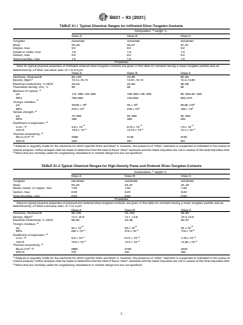
5.4 The typical properties of the four most common types of
Oil-Impregnated Bearings (Withdrawn 2009)
silver-tungsten contacts are given in the appendix.
6. Finishing of Contacts
3. Ordering Information
6.1 The material shall be finished by such operations as
3.1 Orders for this material under this specification shall
necessary to meet requirements agreed upon by the maker and
include the following information:
user of the contacts (braze alloy backing, tumbling to polish
3.1.1 Dimensions (see Section 7).
surfaces, special surface finish, silver-rich surface layer,
cleaning, etc.).
This specification is under the jurisdiction of ASTM Committee B02 on
7. Permissible Variations in Dimensions
Nonferrous Metals and Alloys and is the direct responsibility of Subcommittee
B02.05 on Precious Metals and Electrical Contact Materials.
7.1 Permissible variations in dimensions shall be within the
Current edition approved Nov. 1, 2021. Published December 2021. Originally
limits specified on drawings describing the contacts and
approved in 1977. Last previous edition approved in 2016 as B631 – 93 (2016).
accompanying the order, or shall be within the limits specified
DOI: 10.1520/B0631-93R21.
For referenced ASTM standards, visit the ASTM website, www.astm.org, or in the purchase order.
contact ASTM Customer Service at service@astm.org. For Annual Book of ASTM
Standards volume information, refer to the standard’s Document Summary page on 8. Workmanship
the ASTM website.
8.1 The parts shall be free of defects in material or process-
The last approved version of this historical standard is referenced on
www.astm.org. ing that would seriously affect their performance.
Copyright © ASTM International, 100 Barr Harbor Drive, PO Box C700, West Conshohocken, PA 19428-2959. United States
B631 − 93 (2021)
9. Significance and Use additives. Analysis shall be regularly made only for the minor
elements listed in the table. However, if a user knows of
9.1 Proprietary methods for manufacture of these materials
elements that might be detrimental to their application or has
vary significantly among suppliers, and these methods influ-
other reasons for requiring analysis for specific elements, then
ence such properties as arc erosion, contact resistance, and
agreement between manufacturer and purchaser for both limits
tendency to weld in service. Since the performance of contacts
and methods of analysis should be required for elements not
in a device depends on numerous factors outside the contact
specified.
itself (opening speed, closing speed, contact pressure, contact
bounce, environmental variations, assembly technique and
10.3 Physical Tests—The manufacturer and purchaser shall
variations, etc.) this specification cannot ensure performance agree on a representative number of specimens for physical
control in the application.As part of the qualification on initial
tests including microstructure.
samples it is recommended that the user functionally electri-
cally test the materials for all devices applicable to the 11. Inspection
material’s use. This specification will provide a means for the
11.1 Unlessotherwisespecified,inspectionofpartssupplied
contact manufacturer and contact user to reach agreement on
on contract shall be made by the purchaser.
the details of material to be supplied for a specific use and
reasonable assurance that future lots will be similar in proper-
12. Rejection
ties and microstructure to the initial test or sample contacts
12.1 Unless otherwise specified, rejections based on tests
supplied.
made in accordance with the specification shall be reported to
10. Sampling the manufacturer within 30 days of the receipt of shipment.
10.1 Lot—Unless otherwise specified, a lot shall consist of
13. Certification
partsofthesameformanddimensions,madeofpowdersofthe
same particle size range and composition, processed under the 13.1 Acertification, when requested by the purchaser, based
same conditions, and submitted for inspection at one time.
on the manufacturer’s quality control, that the material con-
forms to the requirements of this specification, shall be
10.2 Chemical Analysis—At least one sample for chemical
furnisheduponrequestofthepurchaser,providedtherequestis
analysis shall be taken from each lot. A representative sample
made at the time of cost quotation and at the time of order
of chips may be obtained by milling, drilling, or crushing at
placement.
least two pieces with dry tools, without lubrication. In order to
obtain oil-free chips, the parts selected for test shall have the
14. Keywords
oil extracted in accordance with Test Method B328.
10.2.1 These specification limits do not preclude the pos- 14.1 contacts; powder metallurgy; silver; silver-tungsten;
sible presence of other unnamed elements, impurities or tungsten; tungsten-silver
APPENDIX
(Nonmandatory Information)
X1. Typical Property Values
NOTE X1.1—Table X1.1, Table X1.2, Table X1.3, and Table X1.4
X1.1 Scope
represent the major manufacturing techniques used in industry. The size
X1.1.1 The following information provides guidelines for
and shape of the part is important in choosing the optimum techn
...