

ASTM B717-23
(Specification)Standard Specification for Refined Ruthenium
General Information
- Abstract
ABSTRACT
This specification covers refined ruthenium as sponge and powder in one grade as follows: Grade 99.80 and Grade 99.90. The material may be produced by any refining process that yields a product capable of meeting the chemical requirements of this specification. The material should conform to the requirements for chemical composition as prescribed.
SCOPE
1.1 This specification covers refined ruthenium as sponge and powder in one grade as follows:
1.1.1 Grade 99.80—Ruthenium having a purity of 99.80 %.
1.1.2 Grade 99.90—Ruthenium having a purity of 99.90 %.
Note 1: For the purposes of determining conformance with this specification, an observed value obtained from analysis shall be rounded to the nearest unit in the last right-hand place of figures used in expressing the limiting value in accordance with the rounding method of Practice E29.
1.2 The values stated in inch-pound units are to be regarded as standard. The values given in parentheses are mathematical conversions to SI units that are provided for information only and are not considered standard.
1.3 This standard does not purport to address all of the safety concerns, if any, associated with its use. It is the responsibility of the user of this standard to become familiar with all hazards including those identified in the appropriate Safety Data Sheet (SDS) for this product/material as provided by the manufacturer, to establish appropriate safety, health, and environmental practices, and determine the applicability of regulatory limitations prior to use.
1.4 This international standard was developed in accordance with internationally recognized principles on standardization established in the Decision on Principles for the Development of International Standards, Guides and Recommendations issued by the World Trade Organization Technical Barriers to Trade (TBT) Committee.
- Status
- Published
- Publication Date
- 31-Mar-2023
- Technical Committee
- B02 - Nonferrous Metals and Alloys




Overview
ASTM B717-23: Standard Specification for Refined Ruthenium defines the requirements for refined ruthenium metal, presented as sponge or powder. This specification ensures consistency, high purity, and precise identification for industrial applications that rely on ruthenium's unique properties. The standard covers two grades based on purity: Grade 99.80 (minimum 99.80% Ru) and Grade 99.90 (minimum 99.90% Ru).
Key Topics
Grades and Purity Levels
- Grade 99.80: Minimum 99.80% ruthenium content
- Grade 99.90: Minimum 99.90% ruthenium content
Physical Forms
- Refined ruthenium may be supplied as sponge or powder depending on production method and end-use requirements.
Chemical Composition
- Strict controls on impurities, with specified maximum allowable limits for elements such as platinum, palladium, iridium, rhodium, osmium, iron, silicon, copper, calcium, tin, silver, sodium, and gold.
- Analytical methods used must be agreed upon by both manufacturer and purchaser.
Manufacturing Process
- Any refining process may be used as long as the final product meets the standard’s chemical composition requirements.
Sampling and Testing
- Emphasis on proper sampling procedures due to the high value of material.
- In cases of disagreement about testing results, a systematic process for retesting and arbitration is prescribed.
Product Marking
- Each lot must be marked or labeled with ruthenium grade, lot or melt number, and net weight to the nearest 0.001 troy ounce (0.03 g).
Applications
Ruthenium's unique chemical and physical properties make refined ruthenium covered by ASTM B717 highly valuable across several high-tech industries:
- Electronics
- Used in precision components, thick-film resistors, and chip resistors due to its high stability and corrosion resistance.
- Catalysts
- Essential for chemical production as a catalyst in ammonia synthesis, hydrogenation, and various organic reactions.
- Electrical Contacts
- Utilized in electrical contact materials for its superior conductivity and durability.
- Alloys
- Added to platinum and palladium alloys to improve hardness and wear resistance, especially in jewelry and industrial applications.
- Research
- Used in scientific studies and development of new materials due to its rarity and specialized properties.
Compliance with ASTM B717-23 ensures users receive ruthenium with predictable performance and minimal contamination, critical for advanced processes and product reliability.
Related Standards
Understanding ASTM B717-23 is enhanced by familiarity with several referenced and related standards:
- ASTM E29 - Practice for Using Significant Digits in Test Data to Determine Conformance with Specifications.
- ASTM B542 - Terminology Relating to Electrical Contacts and Their Use.
- ASTM B899 - Terminology Relating to Non-Ferrous Metals and Alloys.
Additionally, adherence to internationally recognized standardization principles, as set by the World Trade Organization’s TBT Committee, ensures global relevance and acceptance.
Keywords: refined ruthenium, ASTM B717-23, ruthenium powder, ruthenium sponge, high-purity ruthenium, platinum group metals, ruthenium catalysts, industrial ruthenium, ruthenium specification, precious metals standard
Relations
- Effective Date
- 01-Nov-2019
- Effective Date
- 01-Oct-2016
- Effective Date
- 01-Oct-2015
- Effective Date
- 01-Oct-2014
- Effective Date
- 01-Feb-2013
- Effective Date
- 01-Feb-2013
- Effective Date
- 01-Oct-2009
- Effective Date
- 01-Oct-2009
- Effective Date
- 01-Oct-2008
- Effective Date
- 01-May-2007
- Effective Date
- 01-Dec-2006
- Effective Date
- 15-Nov-2006
- Effective Date
- 15-Sep-2006
- Effective Date
- 01-May-2006
- Effective Date
- 01-Nov-2005
Get Certified
Connect with accredited certification bodies for this standard

Element Materials Technology
Materials testing and product certification.

Inštitut za kovinske materiale in tehnologije
Institute of Metals and Technology. Materials testing, metallurgical analysis, NDT.
Sponsored listings
Frequently Asked Questions
ASTM B717-23 is a technical specification published by ASTM International. Its full title is "Standard Specification for Refined Ruthenium". This standard covers: ABSTRACT This specification covers refined ruthenium as sponge and powder in one grade as follows: Grade 99.80 and Grade 99.90. The material may be produced by any refining process that yields a product capable of meeting the chemical requirements of this specification. The material should conform to the requirements for chemical composition as prescribed. SCOPE 1.1 This specification covers refined ruthenium as sponge and powder in one grade as follows: 1.1.1 Grade 99.80—Ruthenium having a purity of 99.80 %. 1.1.2 Grade 99.90—Ruthenium having a purity of 99.90 %. Note 1: For the purposes of determining conformance with this specification, an observed value obtained from analysis shall be rounded to the nearest unit in the last right-hand place of figures used in expressing the limiting value in accordance with the rounding method of Practice E29. 1.2 The values stated in inch-pound units are to be regarded as standard. The values given in parentheses are mathematical conversions to SI units that are provided for information only and are not considered standard. 1.3 This standard does not purport to address all of the safety concerns, if any, associated with its use. It is the responsibility of the user of this standard to become familiar with all hazards including those identified in the appropriate Safety Data Sheet (SDS) for this product/material as provided by the manufacturer, to establish appropriate safety, health, and environmental practices, and determine the applicability of regulatory limitations prior to use. 1.4 This international standard was developed in accordance with internationally recognized principles on standardization established in the Decision on Principles for the Development of International Standards, Guides and Recommendations issued by the World Trade Organization Technical Barriers to Trade (TBT) Committee.
ABSTRACT This specification covers refined ruthenium as sponge and powder in one grade as follows: Grade 99.80 and Grade 99.90. The material may be produced by any refining process that yields a product capable of meeting the chemical requirements of this specification. The material should conform to the requirements for chemical composition as prescribed. SCOPE 1.1 This specification covers refined ruthenium as sponge and powder in one grade as follows: 1.1.1 Grade 99.80—Ruthenium having a purity of 99.80 %. 1.1.2 Grade 99.90—Ruthenium having a purity of 99.90 %. Note 1: For the purposes of determining conformance with this specification, an observed value obtained from analysis shall be rounded to the nearest unit in the last right-hand place of figures used in expressing the limiting value in accordance with the rounding method of Practice E29. 1.2 The values stated in inch-pound units are to be regarded as standard. The values given in parentheses are mathematical conversions to SI units that are provided for information only and are not considered standard. 1.3 This standard does not purport to address all of the safety concerns, if any, associated with its use. It is the responsibility of the user of this standard to become familiar with all hazards including those identified in the appropriate Safety Data Sheet (SDS) for this product/material as provided by the manufacturer, to establish appropriate safety, health, and environmental practices, and determine the applicability of regulatory limitations prior to use. 1.4 This international standard was developed in accordance with internationally recognized principles on standardization established in the Decision on Principles for the Development of International Standards, Guides and Recommendations issued by the World Trade Organization Technical Barriers to Trade (TBT) Committee.
ASTM B717-23 is classified under the following ICS (International Classification for Standards) categories: 77.120.99 - Other non-ferrous metals and their alloys. The ICS classification helps identify the subject area and facilitates finding related standards.
ASTM B717-23 has the following relationships with other standards: It is inter standard links to ASTM B542-13(2019), ASTM B899-16, ASTM B899-15, ASTM B899-14, ASTM B542-13, ASTM B899-13, ASTM B899-09, ASTM B899-09e1, ASTM E29-08, ASTM B542-07, ASTM B899-06, ASTM E29-06b, ASTM E29-06a, ASTM E29-06, ASTM B899-05. Understanding these relationships helps ensure you are using the most current and applicable version of the standard.
ASTM B717-23 is available in PDF format for immediate download after purchase. The document can be added to your cart and obtained through the secure checkout process. Digital delivery ensures instant access to the complete standard document.
Standards Content (Sample)
This international standard was developed in accordance with internationally recognized principles on standardization established in the Decision on Principles for the
Development of International Standards, Guides and Recommendations issued by the World Trade Organization Technical Barriers to Trade (TBT) Committee.
Designation: B717 − 23
Standard Specification for
Refined Ruthenium
This standard is issued under the fixed designation B717; the number immediately following the designation indicates the year of
original adoption or, in the case of revision, the year of last revision. A number in parentheses indicates the year of last reapproval. A
superscript epsilon (´) indicates an editorial change since the last revision or reapproval.
1. Scope B542 Terminology Relating to Electrical Contacts and Their
Use
1.1 This specification covers refined ruthenium as sponge
B899 Terminology Relating to Non-ferrous Metals and Al-
and powder in one grade as follows:
loys
1.1.1 Grade 99.80—Ruthenium having a purity of 99.80 %.
1.1.2 Grade 99.90—Ruthenium having a purity of 99.90 %.
3. Terminology
NOTE 1—For the purposes of determining conformance with this
3.1 For definitions of the terms pertaining to this standard,
specification, an observed value obtained from analysis shall be rounded
reference shall be made to Terminology B542 and B899.
to the nearest unit in the last right-hand place of figures used in expressing
the limiting value in accordance with the rounding method of Practice
E29.
4. Manufacture
1.2 The values stated in inch-pound units are to be regarded
4.1 The material may be produced by any refining process
as standard. The values given in parentheses are mathematical
that yields a product capable of meeting the chemical require-
conversions to SI units that are provided for information only
ments of this specification. The purchaser, upon request, shall
and are not considered standard.
be informed of the refining process used.
1.3 This standard does not purport to address all of the
5. Chemical Composition
safety concerns, if any, associated with its use. It is the
responsibility of the user of this standard to become familiar
5.1 The material should conform to the requirements for
with all hazards including those identified in the appropriate
chemical composition as prescribed in Table 1.
Safety Data Sheet (SDS) for this product/material as provided
5.2 Analysis shall be made using the manufacturer’s stan-
by the manufacturer, to establish appropriate safety, health,
dard methods. In the event of disagreement as to the chemical
and environmental practices, and determine the applicability
composition of the metal, methods of chemical analysis for
of regulatory limitations prior to use.
reference purposes shall be determined by a mutually accept-
1.4 This international standard was developed in accor-
able laboratory.
dance with internationally recognized principles on standard-
ization established in the Decision on Principles for the
6. Sampling
Development of International Standards, Guides and Recom-
6.1 The value of this material is such that special attention
mendations issued by the World Trade Organization Technical
must be paid to the sampling procedures. The purchaser and
Barriers to Trade (TBT) Committee.
manufacturer shall agree upon the sampling procedures used.
2. Referenced Documents
6.2 Lot Size—Sampling lots shall consist of the following:
6.2.1 Sponge—A single refining lot.
2.1 ASTM Standards:
6.2.2 Powder—A single refining lot.
E29 Practice for Using Significant Digits in Test Data to
Determine Conformance with Specifications
7. Rejection and Rehearing
7.1 Material that fails to conform to the requirements of this
specification may be rejected. Rejection should be reported to
This specification is under the jurisdiction of ASTM Committee B02 on
the manufacturer or supplier promptly and in writing. In case
Nonferrous Metals and Alloys and is the direct responsibility of
...
This document is not an ASTM standard and is intended only to provide the user of an ASTM standard an indication of what changes have been made to the previous version. Because
it may not be technically possible to adequately depict all changes accurately, ASTM recommends that users consult prior editions as appropriate. In all cases only the current version
of the standard as published by ASTM is to be considered the official document.
Designation: B717 − 96 (Reapproved 2018) B717 − 23
Standard Specification for
Refined Ruthenium
This standard is issued under the fixed designation B717; the number immediately following the designation indicates the year of
original adoption or, in the case of revision, the year of last revision. A number in parentheses indicates the year of last reapproval. A
superscript epsilon (´) indicates an editorial change since the last revision or reapproval.
1. Scope
1.1 This specification covers refined ruthenium as sponge and powder in one grade as follows:
1.1.1 Grade 99.80—Ruthenium having a purity of 99.80 %.
1.1.2 Grade 99.90—Ruthenium having a purity of 99.90 %.
NOTE 1—For the purposes of determining conformance with this specification, an observed value obtained from analysis shall be rounded to the nearest
unit in the last right-hand place of figures used in expressing the limiting value in accordance with the rounding method of Practice E29.
1.2 The values stated in inch-pound units are to be regarded as standard. The values given in parentheses are mathematical
conversions to SI units that are provided for information only and are not considered standard.
1.3 This standard does not purport to address all of the safety concerns, if any, associated with its use. It is the responsibility
of the user of this standard to become familiar with all hazards including those identified in the appropriate Safety Data Sheet
(SDS) for this product/material as provided by the manufacturer, to establish appropriate safety, health, and environmental
practices, and determine the applicability of regulatory limitations prior to use.
1.4 This international standard was developed in accordance with internationally recognized principles on standardization
established in the Decision on Principles for the Development of International Standards, Guides and Recommendations issued
by the World Trade Organization Technical Barriers to Trade (TBT) Committee.
2. Referenced Documents
2.1 ASTM Standards:
E29 Practice for Using Significant Digits in Test Data to Determine Conformance with Specifications
B542 Terminology Relating to Electrical Contacts and Their Use
B899 Terminology Relating to Non-ferrous Metals and Alloys
3. Terminology
3.1 For definitions of the terms pertaining to this standard, reference shall be made to Terminology B542 and B899.
This specification is under the jurisdiction of ASTM Committee B02 on Nonferrous Metals and Alloys and is the direct responsibility of Subcommittee B02.05 on
Precious Metals and Electrical Contact Materials and Test Methods.
Current edition approved Nov. 1, 2018April 1, 2023. Published November 2018May 2023. Originally approved in 1983. Last previous edition approved in 20122018 as
B717 – 96 (2012).(2018). DOI: 10.1520/B0717-96R18.10.1520/B0717-23.
For referenced ASTM standards, visit the ASTM website, www.astm.org, or contact ASTM Customer Service at service@astm.org. For Annual Book of ASTM Standards
volume information, refer to the standard’s Document Summary page on the ASTM website.
Copyright © ASTM International, 100 Barr Harbor Drive, PO Box C700, West Conshohocken, PA 19428-2959. United States
B717 − 23
4. Manufacture
4.1 The material may be produced by any refining process that yields a product capable of meeting the chemical requirements of
this specification. The purchaser, upon request, shall be informed of the refining process used.
5. Chemical Composition
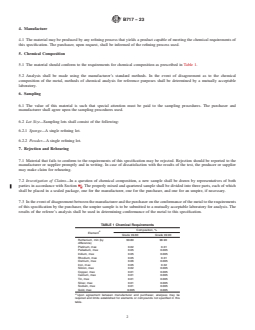
5.1 The material should conform to the requirements for chemical composition as prescribed in Table 1.
5.2 Analysis shall be made using th
...