


ASTM F1233-08(2019)
(Test Method)Standard Test Method for Security Glazing Materials And Systems
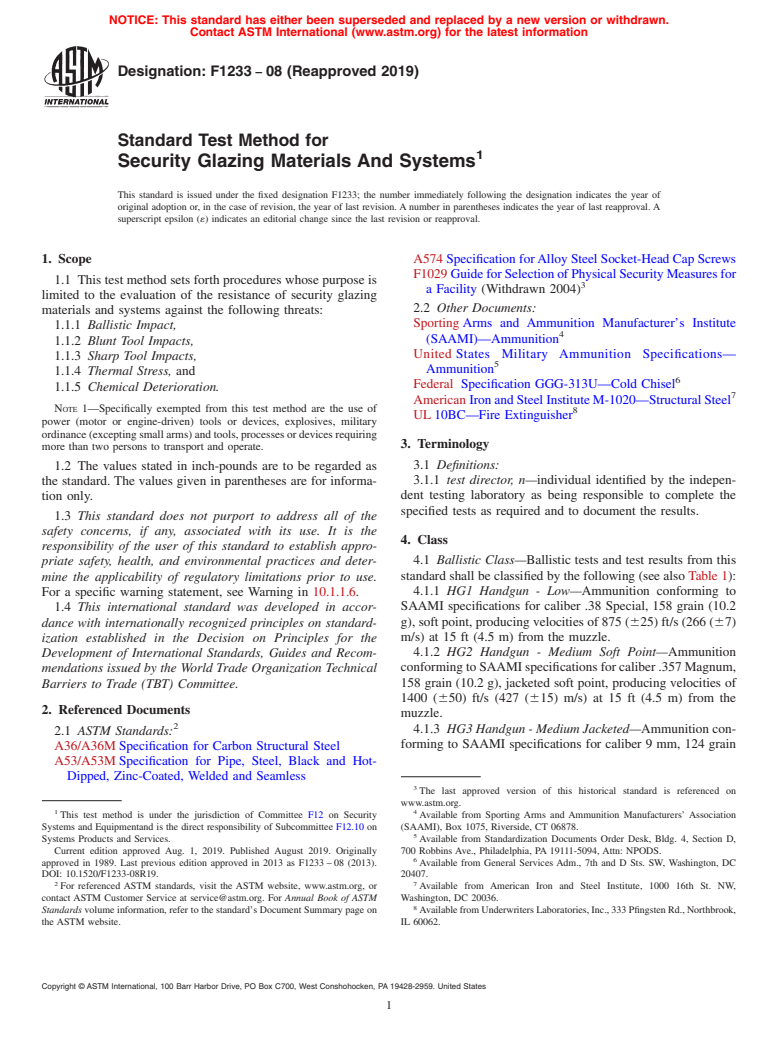
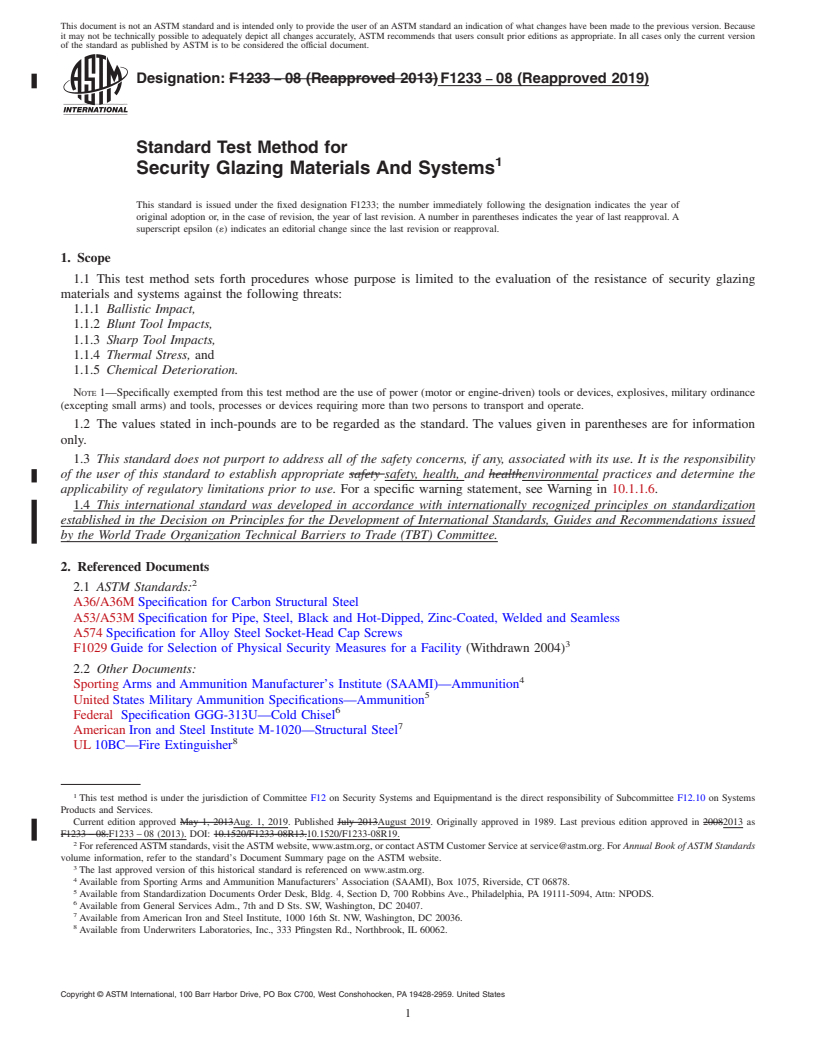
Standard Test Method for Security Glazing Materials And Systems
SIGNIFICANCE AND USE
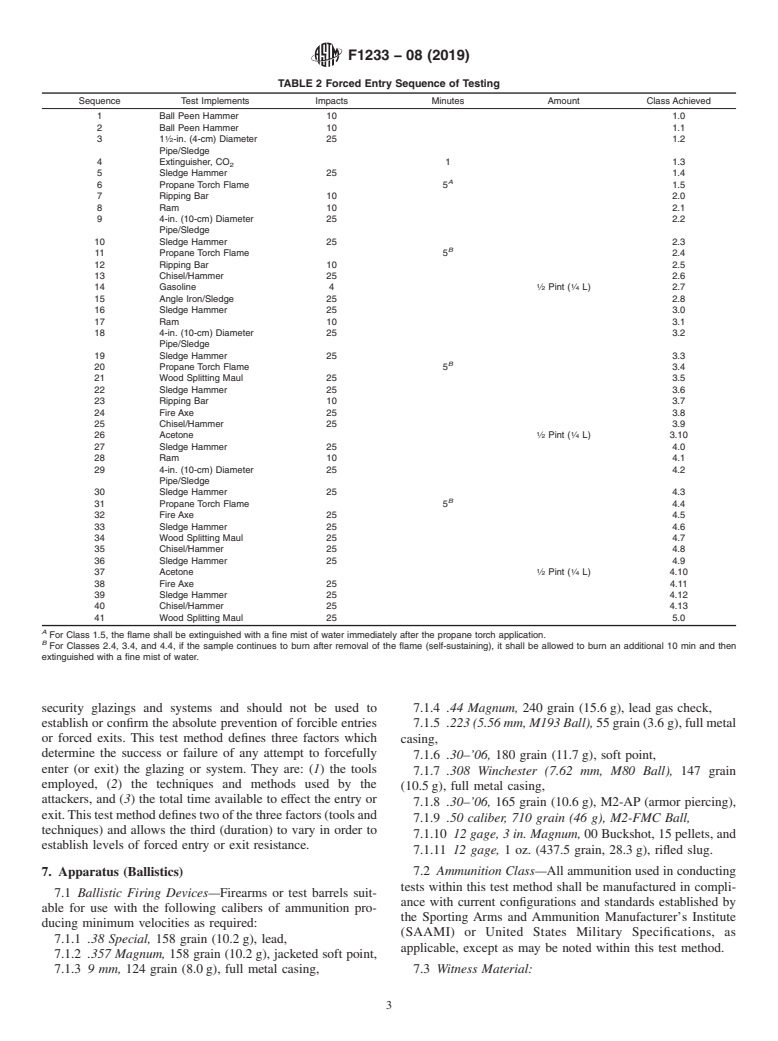
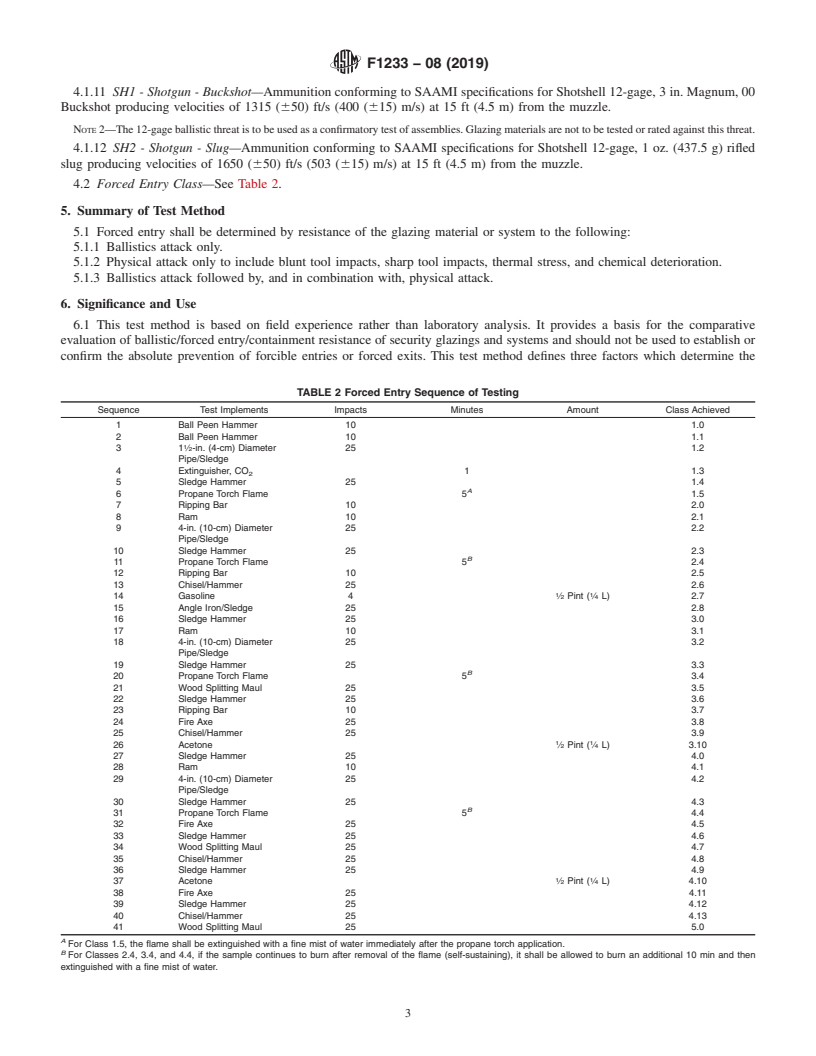
6.1 This test method is based on field experience rather than laboratory analysis. It provides a basis for the comparative evaluation of ballistic/forced entry/containment resistance of security glazings and systems and should not be used to establish or confirm the absolute prevention of forcible entries or forced exits. This test method defines three factors which determine the success or failure of any attempt to forcefully enter (or exit) the glazing or system. They are: (1) the tools employed, (2) the techniques and methods used by the attackers, and (3) the total time available to effect the entry or exit. This test method defines two of the three factors (tools and techniques) and allows the third (duration) to vary in order to establish levels of forced entry or exit resistance.
SCOPE
1.1 This test method sets forth procedures whose purpose is limited to the evaluation of the resistance of security glazing materials and systems against the following threats:
1.1.1 Ballistic Impact,
1.1.2 Blunt Tool Impacts,
1.1.3 Sharp Tool Impacts,
1.1.4 Thermal Stress, and
1.1.5 Chemical Deterioration.
Note 1: Specifically exempted from this test method are the use of power (motor or engine-driven) tools or devices, explosives, military ordinance (excepting small arms) and tools, processes or devices requiring more than two persons to transport and operate.
1.2 The values stated in inch-pounds are to be regarded as the standard. The values given in parentheses are for information only.
1.3 This standard does not purport to address all of the safety concerns, if any, associated with its use. It is the responsibility of the user of this standard to establish appropriate safety, health, and environmental practices and determine the applicability of regulatory limitations prior to use. For a specific warning statement, see Warning in 10.1.1.6.
1.4 This international standard was developed in accordance with internationally recognized principles on standardization established in the Decision on Principles for the Development of International Standards, Guides and Recommendations issued by the World Trade Organization Technical Barriers to Trade (TBT) Committee.
General Information
Buy Standard
Standards Content (Sample)
NOTICE: This standard has either been superseded and replaced by a new version or withdrawn.
Contact ASTM International (www.astm.org) for the latest information
Designation: F1233 − 08 (Reapproved 2019)
Standard Test Method for
Security Glazing Materials And Systems
This standard is issued under the fixed designation F1233; the number immediately following the designation indicates the year of
original adoption or, in the case of revision, the year of last revision.Anumber in parentheses indicates the year of last reapproval.A
superscript epsilon (´) indicates an editorial change since the last revision or reapproval.
1. Scope A574SpecificationforAlloySteelSocket-HeadCapScrews
F1029GuideforSelectionofPhysicalSecurityMeasuresfor
1.1 This test method sets forth procedures whose purpose is
a Facility (Withdrawn 2004)
limited to the evaluation of the resistance of security glazing
2.2 Other Documents:
materials and systems against the following threats:
SportingArms and Ammunition Manufacturer’s Institute
1.1.1 Ballistic Impact,
(SAAMI)—Ammunition
1.1.2 Blunt Tool Impacts,
United States Military Ammunition Specifications—
1.1.3 Sharp Tool Impacts,
Ammunition
1.1.4 Thermal Stress, and
Federal Specification GGG-313U—Cold Chisel
1.1.5 Chemical Deterioration.
AmericanIronandSteelInstituteM-1020—StructuralSteel
NOTE 1—Specifically exempted from this test method are the use of
UL10BC—Fire Extinguisher
power (motor or engine-driven) tools or devices, explosives, military
ordinance(exceptingsmallarms)andtools,processesordevicesrequiring
3. Terminology
more than two persons to transport and operate.
3.1 Definitions:
1.2 The values stated in inch-pounds are to be regarded as
3.1.1 test director, n—individual identified by the indepen-
the standard. The values given in parentheses are for informa-
dent testing laboratory as being responsible to complete the
tion only.
specified tests as required and to document the results.
1.3 This standard does not purport to address all of the
safety concerns, if any, associated with its use. It is the
4. Class
responsibility of the user of this standard to establish appro-
4.1 Ballistic Class—Ballistic tests and test results from this
priate safety, health, and environmental practices and deter-
standard shall be classified by the following (see also Table 1):
mine the applicability of regulatory limitations prior to use.
4.1.1 HG1 Handgun - Low—Ammunition conforming to
For a specific warning statement, see Warning in 10.1.1.6.
1.4 This international standard was developed in accor- SAAMI specifications for caliber .38 Special, 158 grain (10.2
g),softpoint,producingvelocitiesof875(625)ft/s(266(67)
dance with internationally recognized principles on standard-
ization established in the Decision on Principles for the m/s) at 15 ft (4.5 m) from the muzzle.
4.1.2 HG2 Handgun - Medium Soft Point—Ammunition
Development of International Standards, Guides and Recom-
mendations issued by the World Trade Organization Technical conformingtoSAAMIspecificationsforcaliber.357Magnum,
158 grain (10.2 g), jacketed soft point, producing velocities of
Barriers to Trade (TBT) Committee.
1400 (650) ft/s (427 (615) m/s) at 15 ft (4.5 m) from the
2. Referenced Documents
muzzle.
4.1.3 HG3 Handgun - Medium Jacketed—Ammunitioncon-
2.1 ASTM Standards:
forming to SAAMI specifications for caliber 9 mm, 124 grain
A36/A36MSpecification for Carbon Structural Steel
A53/A53MSpecification for Pipe, Steel, Black and Hot-
Dipped, Zinc-Coated, Welded and Seamless
The last approved version of this historical standard is referenced on
www.astm.org.
1 4
This test method is under the jurisdiction of Committee F12 on Security Available from Sporting Arms and Ammunition Manufacturers’ Association
Systems and Equipmentand is the direct responsibility of Subcommittee F12.10 on (SAAMI), Box 1075, Riverside, CT 06878.
Systems Products and Services. Available from Standardization Documents Order Desk, Bldg. 4, Section D,
Current edition approved Aug. 1, 2019. Published August 2019. Originally 700 Robbins Ave., Philadelphia, PA 19111-5094, Attn: NPODS.
approved in 1989. Last previous edition approved in 2013 as F1233–08 (2013). Available from General Services Adm., 7th and D Sts. SW, Washington, DC
DOI: 10.1520/F1233-08R19. 20407.
2 7
For referenced ASTM standards, visit the ASTM website, www.astm.org, or Available from American Iron and Steel Institute, 1000 16th St. NW,
contact ASTM Customer Service at service@astm.org. For Annual Book of ASTM Washington, DC 20036.
Standards volume information, refer to the standard’s Document Summary page on AvailablefromUnderwritersLaboratories,Inc.,333PfingstenRd.,Northbrook,
the ASTM website. IL 60062.
Copyright © ASTM International, 100 Barr Harbor Drive, PO Box C700, West Conshohocken, PA 19428-2959. United States
F1233 − 08 (2019)
TABLE 1 Ballistic Criteria
C
Velocity , ft/s
A B D
Class Weapon Description Caliber Bullet Mass /Type Minimum No. of Impacts
(m/s)
HG1 Handgun - Low .38 Special 158 gr (10.2 g), 850–900 3
lead (259–274)
HG2 Handgun - Medium, Soft Point .357 Magnum 158 gr (10.2 g), 1350–1450 3
JSP (411–442)
HG3 Handgun - Medium, Jacketed 9 mm 124 gr (8.0 g), FMC 1200–1300 3
(365–396)
HG4 Handgun - High .44 Magnum 240 gr (15.6 g), 1400–1500 3
LGC (427–442)
SMG Submachine-gun 9 mm 124 gr (8.0 g), FMC 1350–1450 3
(411–442)
R1 Rifle - Light .223 (5.56 mm) 55 gr (3.6 g), M193 3200–3300 3
Ball, FMC (975–1006)
R2 Rifle - Heavy, Soft Point .30-’06 180 gr (11.7 g), SP 2850–3000 3
(867–914)
R3 Rifle - Heavy, Jacketed .308 Winchester 147 gr (9.5 g), M80 2700–2800 3
(7.62 mm) Ball, FMC (823–853)
R4-AP Rifle - Armor Piercing .30-’06 166 gr (10.8 g), 2715–2850 1
M2-AP (828–867)
R5 Rifle - Jacketed .50 709.5 gr (45.9 g) 2760–2860 1
Ball, FMC (841–867)
E F
SH1 Shotgun - Buckshot 12 gage, 00 buckshot, 1150–1250 1
3 in. Magnum 15 pellets (350–381)
SH2 Shotgun - Slug 12 gage 1 oz. (437.5 gr, 28.3 g) 1600–1700 3
rifled slug (487–518)
A −4
gr denotes grain as a unit of mass: 1 gr = 1.429 × 10 lb (0.0647981 g)
B
FMC = Full Metal Casing, JSP = Jacketed Soft Point, LGC = Lead Gas-Check, and SP = Soft Point.
C
Velocity measured at a distance of 10 ft (3 m) from the strike face of the sample. Muzzle of the barrel is positioned at a distance of 25 ft (7.6 m) from the strike face of
the sample.
D
Minimum number of shots required on glazed features plus additional shots to examine other features of the assembly. Prior to testing the intended impact location(s)
shall be marked in the approximate center of the target area. Where 3 impacts are specified, they are to be located at the corners ofa5in. (127 mm) equilateral triangle.
The minimum spacing between impact locations is 4 in. (102 mm).
E
This ammunition is to be used as an adjunct to the primary test to further evaluate the ability of designed assembly details to resist fragmentary threats.
F
The shot pattern of the pellets shall be such that they all impact within an 8 in. (203 mm) diameter circle at a distance of 25 ft (7.62 m) from the muzzle of the weapon.
(8.0 g), full metal casing, producing velocities of 1250 (650) casingproducingvelocitiesof2810(650)ft/s(856(615)m/s)
ft/s (381 (615) m/s) at 15 ft (4.5 m) from the muzzle. at 15 ft (4.5 m) from the muzzle.
4.1.4 HG4 Handgun - High—Ammunition conforming to 4.1.11 SH1 - Shotgun - Buckshot—Ammunitionconforming
SAAMIspecificationsforcaliber.44Magnum,240grain,lead toSAAMIspecificationsforShotshell12-gage,3in.Magnum,
gas check producing velocities of 1450 (650) ft/s (442 (615) 00 Buckshot producing velocities of 1315 (650) ft/s (400
m/s) at 15 ft (4.5 m) from the muzzle. (615) m/s) at 15 ft (4.5 m) from the muzzle.
4.1.5 SMG Submachine Gun—Ammunition conforming to
NOTE2—The12-gageballisticthreatistobeusedasaconfirmatorytest
SAAMI specifications for caliber 9 mm, 124 grain (8.0 g), full
of assemblies. Glazing materials are not to be tested or rated against this
metal casing producing velocities of 1400 (650) ft/s (427
threat.
(615) m/s) at 15 ft (4.5 m) from the muzzle.
4.1.12 SH2 - Shotgun - Slug—Ammunition conforming to
4.1.6 R1 Rifle - Light—Ammunition conforming to U.S.
SAAMI specifications for Shotshell 12-gage, 1 oz. (437.5 g)
Military specifications for caliber .223 (5.56 mm) NATO,
rifled slug producing velocities of 1650 (650) ft/s (503 (615)
M193 ball producing velocities of 3250 (650) ft/s (991 (615)
m/s) at 15 ft (4.5 m) from the muzzle.
m/s) at 15 ft (4.5 m) from the muzzle.
4.2 Forced Entry Class—See Table 2.
4.1.7 R2 Rifle - Heavy Soft Point—Ammunitionconforming
toSAAMIspecificationsforcaliber.30-’06,180grain(11.7g)
5. Summary of Test Method
soft point producing velocities of 2925 (675) ft/s (991 (615)
5.1 Forced entry shall be determined by resistance of the
m/s) at 15 ft (4.5 m) from the muzzle.
glazing material or system to the following:
4.1.8 R3 Rifle - Heavy Jacketed—Ammunition conforming
5.1.1 Ballistics attack only.
to SAAMI specifications for caliber .308 Winchester (7.62
5.1.2 Physical attack only to include blunt tool impacts,
mm), 147 grain (9.5 g), M80 Ball, full metal casing producing
sharp tool impacts, thermal stress, and chemical deterioration.
velocities of 2800 (650) ft/s (853 (615) m/s) at 15 ft (4.5 m)
5.1.3 Ballisticsattackfollowedby,andincombinationwith,
from the muzzle.
physical attack.
4.1.9 R4-AP - Armor Piercing—Ammunition conforming to
U.S.Militaryspecificationsforcaliber.30–’06,M2APproduc-
6. Significance and Use
ing velocities of 2775 (650) ft/s (846 (615) m/s) at 15 ft (4.5
m) from the muzzle. 6.1 Thistestmethodisbasedonfieldexperienceratherthan
4.1.10 R5 - Ball Jacketed—AmmunitionconformingtoU.S. laboratory analysis. It provides a basis for the comparative
Military specifications for caliber .50 M2 Ball, full metal evaluation of ballistic/forced entry/containment resistance of
F1233 − 08 (2019)
TABLE 2 Forced Entry Sequence of Testing
Sequence Test Implements Impacts Minutes Amount Class Achieved
1 Ball Peen Hammer 10 1.0
2 Ball Peen Hammer 10 1.1
31 ⁄2-in. (4-cm) Diameter 25 1.2
Pipe/Sledge
4 Extinguisher, CO 11.3
5 Sledge Hammer 25 1.4
A
6 Propane Torch Flame 5 1.5
7 Ripping Bar 10 2.0
8 Ram 10 2.1
9 4-in. (10-cm) Diameter 25 2.2
Pipe/Sledge
10 Sledge Hammer 25 2.3
B
11 Propane Torch Flame 5 2.4
12 Ripping Bar 10 2.5
13 Chisel/Hammer 25 2.6
1 1
14 Gasoline 4 ⁄2 Pint ( ⁄4 L) 2.7
15 Angle Iron/Sledge 25 2.8
16 Sledge Hammer 25 3.0
17 Ram 10 3.1
18 4-in. (10-cm) Diameter 25 3.2
Pipe/Sledge
19 Sledge Hammer 25 3.3
B
20 Propane Torch Flame 5 3.4
21 Wood Splitting Maul 25 3.5
22 Sledge Hammer 25 3.6
23 Ripping Bar 10 3.7
24 Fire Axe 25 3.8
25 Chisel/Hammer 25 3.9
1 1
26 Acetone ⁄2 Pint ( ⁄4 L) 3.10
27 Sledge Hammer 25 4.0
28 Ram 10 4.1
29 4-in. (10-cm) Diameter 25 4.2
Pipe/Sledge
30 Sledge Hammer 25 4.3
B
31 Propane Torch Flame 5 4.4
32 Fire Axe 25 4.5
33 Sledge Hammer 25 4.6
34 Wood Splitting Maul 25 4.7
35 Chisel/Hammer 25 4.8
36 Sledge Hammer 25 4.9
1 1
37 Acetone ⁄2 Pint ( ⁄4 L) 4.10
38 Fire Axe 25 4.11
39 Sledge Hammer 25 4.12
40 Chisel/Hammer 25 4.13
41 Wood Splitting Maul 25 5.0
A
For Class 1.5, the flame shall be extinguished with a fine mist of water immediately after the propane torch application.
B
For Classes 2.4, 3.4, and 4.4, if the sample continues to burn after removal of the flame (self-sustaining), it shall be allowed to burn an additional 10 min and then
extinguished with a fine mist of water.
security glazings and systems and should not be used to 7.1.4 .44 Magnum, 240 grain (15.6g), lead gas check,
establish or confirm the absolute prevention of forcible entries
7.1.5 .223 (5.56 mm, M193 Ball),55grain(3.6g),fullmetal
or forced exits. This test method defines three factors which casing,
determine the success or failure of any attempt to forcefully
7.1.6 .30–’06, 180 grain (11.7g), soft point,
enter (or exit) the glazing or system. They are: (1) the tools
7.1.7 .308 Winchester (7.62 mm, M80 Ball), 147 grain
employed, (2) the techniques and methods used by the
(10.5g), full metal casing,
attackers, and (3) the total time available to effect the entry or
7.1.8 .30–’06, 165 grain (10.6g), M2-AP (armor piercing),
exit.Thistestmethoddefinestwoofthethreefactors(toolsand
7.1.9 .50 caliber, 710 grain (46 g), M2-FMC Ball,
techniques) and allows the third (duration) to vary in order to
7.1.10 12 gage, 3 in. Magnum, 00 Buckshot, 15 pellets, and
establish levels of forced entry or exit resistance.
7.1.11 12 gage, 1 oz. (437.5 grain, 28.3g), rifled slug.
7. Apparatus (Ballistics) 7.2 Ammunition Class—All ammunition used in conducting
tests within this test method shall be manufactured in compli-
7.1 Ballistic Firing Devices—Firearms or test barrels suit-
ance with current configurations and standards established by
able for use with the following calibers of ammunition pro-
the Sporting Arms and Ammunition Manufacturer’s Institute
ducing minimum velocities as required:
(SAAMI) or United States Military Specifications, as
7.1.1 .38 Special, 158 grain (10.2g), lead,
applicable, except as may be noted within this test method.
7.1.2 .357 Magnum, 158 grain (10.2g), jacketed soft point,
7.1.3 9 mm, 124 grain (8.0g), full metal casing, 7.3 Witness Material:
F1233 − 08 (2019)
7.3.1 Aluminumfoil,kitchenfoil,orequivalent,0.00094in. partially through the thickness of the glazing to examine all
(0.024 mm) 610% thick. Alloy may be 8111 or 1100, “0” possible penetration paths. Not only shall the primary weapon/
temper. ammunition be used, but the 12-gage shotgun (as defined
within this test method as an adjunct to the primary test) as
7.4 Instrumentation:
9 well. The 12-gage ballistic threat is to be used as a confirma-
7.4.1 Photosensitive Triggering Screens,
torytestofassemblies.Glazingmaterialsarenottobetestedor
7.4.2 Chronograph,
rated against this threat.
7.4.3 Thermometer—Temperature ranges from +120 to
7.6.4.1 Due to chronograph/triggering screen accessibility,
−30°F (+49 to −34°C).
thetestdirectormayelectnottoelectronicallymeasuremuzzle
7.5 Test Frame and Stand:
velocities of certain oblique firings.
7.5.1 Samples of glazing submitted for testing shall be in
sizes that would be encountered during normal use, but in no
8. Apparatus (Physical Attack)
casesmallerthan12by12in.(30by30cm)orlargerthan29 ⁄4
8.1 Test Stand—Thetestglazingsampleswillbemountedin
by 29 ⁄4in. (75 by 75 cm). The size and configuration of each
a vertical test stand of rigid, 6 in. (15 cm) steel wide flange
sample will be such that it can be mounted in a structurally
beams as in Fig. 1. The wide flange beam stand will be
sound, rigid test fixture capable of accommodating a variety of
anchored in, or rigidly fixed to, a substantial concrete structure
sizes of rectangular samples. The framing must be affixed to
at each of its four corners (minimum requirements), and no
the glazing sample in a manner which does not enhance or
linear dimension between
...
This document is not an ASTM standard and is intended only to provide the user of an ASTM standard an indication of what changes have been made to the previous version. Because
it may not be technically possible to adequately depict all changes accurately, ASTM recommends that users consult prior editions as appropriate. In all cases only the current version
of the standard as published by ASTM is to be considered the official document.
Designation: F1233 − 08 (Reapproved 2013) F1233 − 08 (Reapproved 2019)
Standard Test Method for
Security Glazing Materials And Systems
This standard is issued under the fixed designation F1233; the number immediately following the designation indicates the year of
original adoption or, in the case of revision, the year of last revision. A number in parentheses indicates the year of last reapproval. A
superscript epsilon (´) indicates an editorial change since the last revision or reapproval.
1. Scope
1.1 This test method sets forth procedures whose purpose is limited to the evaluation of the resistance of security glazing
materials and systems against the following threats:
1.1.1 Ballistic Impact,
1.1.2 Blunt Tool Impacts,
1.1.3 Sharp Tool Impacts,
1.1.4 Thermal Stress, and
1.1.5 Chemical Deterioration.
NOTE 1—Specifically exempted from this test method are the use of power (motor or engine-driven) tools or devices, explosives, military ordinance
(excepting small arms) and tools, processes or devices requiring more than two persons to transport and operate.
1.2 The values stated in inch-pounds are to be regarded as the standard. The values given in parentheses are for information
only.
1.3 This standard does not purport to address all of the safety concerns, if any, associated with its use. It is the responsibility
of the user of this standard to establish appropriate safety safety, health, and healthenvironmental practices and determine the
applicability of regulatory limitations prior to use. For a specific warning statement, see Warning in 10.1.1.6.
1.4 This international standard was developed in accordance with internationally recognized principles on standardization
established in the Decision on Principles for the Development of International Standards, Guides and Recommendations issued
by the World Trade Organization Technical Barriers to Trade (TBT) Committee.
2. Referenced Documents
2.1 ASTM Standards:
A36/A36M Specification for Carbon Structural Steel
A53/A53M Specification for Pipe, Steel, Black and Hot-Dipped, Zinc-Coated, Welded and Seamless
A574 Specification for Alloy Steel Socket-Head Cap Screws
F1029 Guide for Selection of Physical Security Measures for a Facility (Withdrawn 2004)
2.2 Other Documents:
Sporting Arms and Ammunition Manufacturer’s Institute (SAAMI)—Ammunition
United States Military Ammunition Specifications—Ammunition
Federal Specification GGG-313U—Cold Chisel
American Iron and Steel Institute M-1020—Structural Steel
UL 10BC—Fire Extinguisher
This test method is under the jurisdiction of Committee F12 on Security Systems and Equipmentand is the direct responsibility of Subcommittee F12.10 on Systems
Products and Services.
Current edition approved May 1, 2013Aug. 1, 2019. Published July 2013August 2019. Originally approved in 1989. Last previous edition approved in 20082013 as
F1233 – 08.F1233 – 08 (2013). DOI: 10.1520/F1233-08R13.10.1520/F1233-08R19.
For referenced ASTM standards, visit the ASTM website, www.astm.org, or contact ASTM Customer Service at service@astm.org. For Annual Book of ASTM Standards
volume information, refer to the standard’s Document Summary page on the ASTM website.
The last approved version of this historical standard is referenced on www.astm.org.
Available from Sporting Arms and Ammunition Manufacturers’ Association (SAAMI), Box 1075, Riverside, CT 06878.
Available from Standardization Documents Order Desk, Bldg. 4, Section D, 700 Robbins Ave., Philadelphia, PA 19111-5094, Attn: NPODS.
Available from General Services Adm., 7th and D Sts. SW, Washington, DC 20407.
Available from American Iron and Steel Institute, 1000 16th St. NW, Washington, DC 20036.
Available from Underwriters Laboratories, Inc., 333 Pfingsten Rd., Northbrook, IL 60062.
Copyright © ASTM International, 100 Barr Harbor Drive, PO Box C700, West Conshohocken, PA 19428-2959. United States
F1233 − 08 (2019)
3. Terminology
3.1 Definitions:
3.1.1 test director, n—individual identified by the independent testing laboratory as being responsible to complete the specified
tests as required and to document the results.
4. Class
4.1 Ballistic Class—Ballistic tests and test results from this standard shall be classified by the following (see also Table 1):
4.1.1 HG1 Handgun - Low—Ammunition conforming to SAAMI specifications for caliber .38 Special, 158 grain (10.2 g), soft
point, producing velocities of 875 (625) ft/s (266 (67) m/s) at 15 ft (4.5 m) from the muzzle.
4.1.2 HG2 Handgun - Medium Soft Point—Ammunition conforming to SAAMI specifications for caliber .357 Magnum, 158
grain (10.2 g), jacketed soft point, producing velocities of 1400 (650) ft/s (427 (615) m/s) at 15 ft (4.5 m) from the muzzle.
4.1.3 HG3 Handgun - Medium Jacketed—Ammunition conforming to SAAMI specifications for caliber 9 mm, 124 grain (8.0
g), full metal casing, producing velocities of 1250 (650) ft/s (381 (615) m/s) at 15 ft (4.5 m) from the muzzle.
4.1.4 HG4 Handgun - High—Ammunition conforming to SAAMI specifications for caliber .44 Magnum, 240 grain, lead gas
check producing velocities of 1450 (650) ft/s (442 (615) m/s) at 15 ft (4.5 m) from the muzzle.
4.1.5 SMG Submachine Gun—Ammunition conforming to SAAMI specifications for caliber 9 mm, 124 grain (8.0 g), full metal
casing producing velocities of 1400 (650) ft/s (427 (615) m/s) at 15 ft (4.5 m) from the muzzle.
4.1.6 R1 Rifle - Light—Ammunition conforming to U.S. Military specifications for caliber .223 (5.56 mm) NATO, M193 ball
producing velocities of 3250 (650) ft/s (991 (615) m/s) at 15 ft (4.5 m) from the muzzle.
4.1.7 R2 Rifle - Heavy Soft Point—Ammunition conforming to SAAMI specifications for caliber .30-’06, 180 grain (11.7 g) soft
point producing velocities of 2925 (675) ft/s (991 (615) m/s) at 15 ft (4.5 m) from the muzzle.
4.1.8 R3 Rifle - Heavy Jacketed—Ammunition conforming to SAAMI specifications for caliber .308 Winchester (7.62 mm), 147
grain (9.5 g), M80 Ball, full metal casing producing velocities of 2800 (650) ft/s (853 (615) m/s) at 15 ft (4.5 m) from the muzzle.
4.1.9 R4-AP - Armor Piercing—Ammunition conforming to U.S. Military specifications for caliber .30–’06, M2AP producing
velocities of 2775 (650) ft/s (846 (615) m/s) at 15 ft (4.5 m) from the muzzle.
4.1.10 R5 - Ball Jacketed—Ammunition conforming to U.S. Military specifications for caliber .50 M2 Ball, full metal casing
producing velocities of 2810 (650) ft/s (856 (615) m/s) at 15 ft (4.5 m) from the muzzle.
TABLE 1 Ballistic Criteria
C
Velocity , ft/s
A B D
Class Weapon Description Caliber Bullet Mass /Type Minimum No. of Impacts
(m/s)
HG1 Handgun - Low .38 Special 158 gr (10.2 g), 850–900 3
lead (259–274)
HG2 Handgun - Medium, Soft Point .357 Magnum 158 gr (10.2 g), 1350–1450 3
JSP (411–442)
HG3 Handgun - Medium, Jacketed 9 mm 124 gr (8.0 g), FMC 1200–1300 3
(365–396)
HG4 Handgun - High .44 Magnum 240 gr (15.6 g), 1400–1500 3
LGC (427–442)
SMG Submachine-gun 9 mm 124 gr (8.0 g), FMC 1350–1450 3
(411–442)
R1 Rifle - Light .223 (5.56 mm) 55 gr (3.6 g), M193 3200–3300 3
Ball, FMC (975–1006)
R2 Rifle - Heavy, Soft Point .30-’06 180 gr (11.7 g), SP 2850–3000 3
(867–914)
R3 Rifle - Heavy, Jacketed .308 Winchester 147 gr (9.5 g), M80 2700–2800 3
(7.62 mm) Ball, FMC (823–853)
R4-AP Rifle - Armor Piercing .30-’06 166 gr (10.8 g), 2715–2850 1
M2-AP (828–867)
R5 Rifle - Jacketed .50 709.5 gr (45.9 g) 2760–2860 1
Ball, FMC (841–867)
E F
SH1 Shotgun - Buckshot 12 gage, 00 buckshot, 1150–1250 1
3 in. Magnum 15 pellets (350–381)
SH2 Shotgun - Slug 12 gage 1 oz. (437.5 gr, 28.3 g) 1600–1700 3
rifled slug (487–518)
A −4
gr denotes grain as a unit of mass: 1 gr = 1.429 × 10 lb (0.0647981 g)
B
FMC = Full Metal Casing, JSP = Jacketed Soft Point, LGC = Lead Gas-Check, and SP = Soft Point.
C
Velocity measured at a distance of 10 ft (3 m) from the strike face of the sample. Muzzle of the barrel is positioned at a distance of 25 ft (7.6 m) from the strike face of
the sample.
D
Minimum number of shots required on glazed features plus additional shots to examine other features of the assembly. Prior to testing the intended impact location(s)
shall be marked in the approximate center of the target area. Where 3 impacts are specified, they are to be located at the corners of a 5 in. (127 mm) equilateral triangle.
The minimum spacing between impact locations is 4 in. (102 mm).
E
This ammunition is to be used as an adjunct to the primary test to further evaluate the ability of designed assembly details to resist fragmentary threats.
F
The shot pattern of the pellets shall be such that they all impact within an 8 in. (203 mm) diameter circle at a distance of 25 ft (7.62 m) from the muzzle of the weapon.
F1233 − 08 (2019)
4.1.11 SH1 - Shotgun - Buckshot—Ammunition conforming to SAAMI specifications for Shotshell 12-gage, 3 in. Magnum, 00
Buckshot producing velocities of 1315 (650) ft/s (400 (615) m/s) at 15 ft (4.5 m) from the muzzle.
NOTE 2—The 12-gage ballistic threat is to be used as a confirmatory test of assemblies. Glazing materials are not to be tested or rated against this threat.
4.1.12 SH2 - Shotgun - Slug—Ammunition conforming to SAAMI specifications for Shotshell 12-gage, 1 oz. (437.5 g) rifled
slug producing velocities of 1650 (650) ft/s (503 (615) m/s) at 15 ft (4.5 m) from the muzzle.
4.2 Forced Entry Class—See Table 2.
5. Summary of Test Method
5.1 Forced entry shall be determined by resistance of the glazing material or system to the following:
5.1.1 Ballistics attack only.
5.1.2 Physical attack only to include blunt tool impacts, sharp tool impacts, thermal stress, and chemical deterioration.
5.1.3 Ballistics attack followed by, and in combination with, physical attack.
6. Significance and Use
6.1 This test method is based on field experience rather than laboratory analysis. It provides a basis for the comparative
evaluation of ballistic/forced entry/containment resistance of security glazings and systems and should not be used to establish or
confirm the absolute prevention of forcible entries or forced exits. This test method defines three factors which determine the
TABLE 2 Forced Entry Sequence of Testing
Sequence Test Implements Impacts Minutes Amount Class Achieved
1 Ball Peen Hammer 10 1.0
2 Ball Peen Hammer 10 1.1
3 1 ⁄2-in. (4-cm) Diameter 25 1.2
Pipe/Sledge
4 Extinguisher, CO 1 1.3
5 Sledge Hammer 25 1.4
A
6 Propane Torch Flame 5 1.5
7 Ripping Bar 10 2.0
8 Ram 10 2.1
9 4-in. (10-cm) Diameter 25 2.2
Pipe/Sledge
10 Sledge Hammer 25 2.3
B
11 Propane Torch Flame 5 2.4
12 Ripping Bar 10 2.5
13 Chisel/Hammer 25 2.6
1 1
14 Gasoline 4 ⁄2 Pint ( ⁄4 L) 2.7
15 Angle Iron/Sledge 25 2.8
16 Sledge Hammer 25 3.0
17 Ram 10 3.1
18 4-in. (10-cm) Diameter 25 3.2
Pipe/Sledge
19 Sledge Hammer 25 3.3
B
20 Propane Torch Flame 5 3.4
21 Wood Splitting Maul 25 3.5
22 Sledge Hammer 25 3.6
23 Ripping Bar 10 3.7
24 Fire Axe 25 3.8
25 Chisel/Hammer 25 3.9
1 1
26 Acetone ⁄2 Pint ( ⁄4 L) 3.10
27 Sledge Hammer 25 4.0
28 Ram 10 4.1
29 4-in. (10-cm) Diameter 25 4.2
Pipe/Sledge
30 Sledge Hammer 25 4.3
B
31 Propane Torch Flame 5 4.4
32 Fire Axe 25 4.5
33 Sledge Hammer 25 4.6
34 Wood Splitting Maul 25 4.7
35 Chisel/Hammer 25 4.8
36 Sledge Hammer 25 4.9
1 1
37 Acetone ⁄2 Pint ( ⁄4 L) 4.10
38 Fire Axe 25 4.11
39 Sledge Hammer 25 4.12
40 Chisel/Hammer 25 4.13
41 Wood Splitting Maul 25 5.0
A
For Class 1.5, the flame shall be extinguished with a fine mist of water immediately after the propane torch application.
B
For Classes 2.4, 3.4, and 4.4, if the sample continues to burn after removal of the flame (self-sustaining), it shall be allowed to burn an additional 10 min and then
extinguished with a fine mist of water.
F1233 − 08 (2019)
success or failure of any attempt to forcefully enter (or exit) the glazing or system. They are: (1) the tools employed, (2) the
techniques and methods used by the attackers, and (3) the total time available to effect the entry or exit. This test method defines
two of the three factors (tools and techniques) and allows the third (duration) to vary in order to establish levels of forced entry
or exit resistance.
7. Apparatus (Ballistics)
7.1 Ballistic Firing Devices—Firearms or test barrels suitable for use with the following calibers of ammunition producing
minimum velocities as required:
7.1.1 .38 Special, 158 grain (10.2 g), lead,
7.1.2 .357 Magnum, 158 grain (10.2 g), jacketed soft point,
7.1.3 9 mm, 124 grain (8.0 g), full metal casing,
7.1.4 .44 Magnum, 240 grain (15.6 g), lead gas check,
7.1.5 .223 (5.56 mm, M193 Ball), 55 grain (3.6 g), full metal casing,
7.1.6 .30–’06, 180 grain (11.7 g), soft point,
7.1.7 .308 Winchester (7.62 mm, M80 Ball), 147 grain (10.5 g), full metal casing,
7.1.8 .30–’06, 165 grain (10.6 g), M2-AP (armor piercing),
7.1.9 .50 caliber, 710 grain (46 g), M2-FMC Ball,
7.1.10 12 gage, 3 in. Magnum, 00 Buckshot, 15 pellets, and
7.1.11 12 gage, 1 oz. (437.5 grain, 28.3 g), rifled slug.
7.2 Ammunition Class—All ammunition used in conducting tests within this test method shall be manufactured in compliance
with current configurations and standards established by the Sporting Arms and Ammunition Manufacturer’s Institute (SAAMI)
or United States Military Specifications, as applicable, except as may be noted within this test method.
7.3 Witness Material:
7.3.1 Aluminum foil, kitchen foil, or equivalent, 0.00094 in. (0.024 mm) 6 10 % thick. Alloy may be 8111 or 1100, “0” temper.
7.4 Instrumentation:
7.4.1 Photosensitive Triggering Screens,
7.4.2 Chronograph,
7.4.3 Thermometer—Temperature ranges from +120 to −30°F (+49 to −34°C).
7.5 Test Frame and Stand:
7.5.1 Samples of glazing submitted for testing shall be in sizes that would be encountered during normal use, but in no case
3 3
smaller than 12 by 12 in. (30 by 30 cm) or larger than 29 ⁄4 by 29 ⁄4 in. (75 by 75 cm). The size and configuration of each sample
will be such that it can be mounted in a structurally sound, rigid test fixture capable of accommodating a variety of sizes of
rectangular samples. The framing must be affixed to the glazing sample in a manner which does not enhance or detract from the
ballistic resistance of any portion of the sample to be ballistically impacted. For testing of glazing materials only, the mounting
method is not subject to any tests herein.
7.6 Test Set-Up:
7.6.1 The sample shall be mounted rigidly (bolted) to the test fixture to produce a zero degree (63°) obliquity (ZDO) to the
path of the bull
...
Questions, Comments and Discussion
Ask us and Technical Secretary will try to provide an answer. You can facilitate discussion about the standard in here.