

ASTM C794-18(2022)
(Test Method)Standard Test Method for Adhesion-in-Peel of Elastomeric Joint Sealants
General Information
- Abstract
SIGNIFICANCE AND USE
5.1 There are differences in opinion among those concerned with sealant technology whether or not this adhesion-in-peel test simulates the type of strain and e-tensile stresses encountered by a sealant in normal use. Nevertheless, this test provides a valuable measurement of the ability of the cured sealant to maintain a bond to the substrate under severe peel conditions.
5.2 Many sealant manufacturers utilize the adhesion-in-peel test for determining the adhesive characteristics of sealant/primer combinations with unusual or proprietary substrates. This test is especially useful for quality measurements comparing batches of the same sealant relative to adhesion or for studying adhesion of a given sealant to a variety of substrates.
5.3 This test method alone is not appropriate for comparing the overall performance of different sealants in a given application. The adhesive force that determines if a given sealant is useful in a given application also depends on the modulus of elasticity and the degree to which the sealant will be strained. This test, as it exists, does not consider the modulus of elasticity, nor amount of stress that will be produced by a given strain in an actual sealant in a moving joint. No known correlations are given to relate and apply modulus values to the peel values.
5.4 This test requires that the results indicate whether the failure mode is primarily adhesive or cohesive. It is important to note that a cohesive failure is not necessarily better than an adhesive failure, if the adhesive value is sufficient for the application. Having adhesive failure allows one to study the change of adhesion with time and with the various stress conditions.
SCOPE
1.1 This test method covers a laboratory procedure for determining the strength and characteristics of the peel properties of a cured-in-place elastomeric joint sealant, single- or multicomponent, for use in building construction.
1.2 The values stated in SI units are to be regarded as standard. The values given in parentheses after SI units are provided for information only and are not considered standard.
1.3 The committee with jurisdiction over this standard is not aware of any comparable standards published by other organizations.
1.4 This standard does not purport to address all of the safety concerns, if any, associated with its use. It is the responsibility of the user of this standard to establish appropriate safety, health, and environmental practices and determine the applicability of regulatory limitations prior to use.
1.5 This international standard was developed in accordance with internationally recognized principles on standardization established in the Decision on Principles for the Development of International Standards, Guides and Recommendations issued by the World Trade Organization Technical Barriers to Trade (TBT) Committee.
- Status
- Published
- Publication Date
- 31-May-2022
- Technical Committee
- C24 - Building Seals and Sealants
- Drafting Committee
- C24.30 - Adhesion
Overview
ASTM C794-18(2022) is an internationally recognized standard published by ASTM International. This standard specifies a laboratory test method for assessing the adhesion-in-peel properties of cured elastomeric joint sealants used in building construction. The procedure is designed to provide a reliable measurement of a sealant’s ability to adhere to various substrates under severe peel conditions, offering critical insights for product development, quality assurance, and field performance analysis.
This test is especially important for manufacturers, quality control laboratories, and building professionals who need to evaluate how well a joint sealant maintains its bond after curing, especially when exposed to potential separation forces in real-world construction applications.
Key Topics
- Adhesion-in-Peel Testing: This method determines the strength and characteristics of the bond formed by single- or multicomponent elastomeric joint sealants after curing in place on a substrate.
- Sample Preparation and Test Conditions: The procedure involves applying the sealant to standard substrates, embedding a mesh (usually wire mesh), and curing specimens before conducting peel tests at a specified angle and rate.
- Substrate Variability: The method accommodates a broad range of substrates, making it valuable for evaluating sealant performance on different construction materials such as brick, stone, metal, glass, and plastics.
- Quality Control and Batch Comparison: This standard is widely used to monitor differences in adhesion between batches of the same product as well as to compare adhesion performance on various substrates.
- Failure Modes: The procedure includes assessment and reporting of adhesive and cohesive failure modes, critical for understanding sealant performance over time and under stress.
- Limitations: The test does not measure overall sealant performance or how a sealant will react under all environmental conditions. It does not consider the modulus of elasticity or actual joint movement.
Applications
ASTM C794-18(2022) is instrumental across multiple stages in the lifecycle of elastomeric joint sealants:
- Product Development and Research: Manufacturers use this standard to evaluate new sealant formulations and primer combinations, focusing on adhesion bonding performance with proprietary or unusual substrates.
- Quality Assurance: Regular batch-to-batch comparisons help ensure consistent product quality and identify deviations in adhesive properties.
- Substrate Compatibility Studies: The method enables assessment of sealant adhesion across a variety of building materials, supporting both routine selection of sealants and problem resolution in the field.
- Regulatory and Specification Compliance: This test method supports compliance with building codes, project specifications, and procurement criteria that require documented evidence of sealant performance.
- Performance Monitoring: Insights from adhesive or cohesive failure modes assist in predicting durability, maintenance needs, and potential field failures.
Related Standards
- ASTM C717: Terminology relating to building seals and sealants, providing definitions used in C794-18(2022).
- ASTM C1375: Guide for substrates used in testing building seals and sealants, relevant for selecting and preparing test materials.
- ASTM E177: Practice for use of precision and bias terms in ASTM methods.
- ASTM E691: Practice for conducting interlaboratory studies to determine method precision.
These related ASTM standards provide necessary context, definitions, and methodological guidance to ensure accurate and repeatable adhesion-in-peel testing.
Keywords: adhesion-in-peel, elastomeric joint sealant, ASTM C794, sealant test, building sealants, substrate adhesion, quality control, sealant failure mode, laboratory test method
Relations
- Refers
ASTM C1375-00(2020) - Standard Guide for Substrates Used in Testing Building Seals and Sealants - Effective Date
- 01-Jan-2020
- Effective Date
- 01-Mar-2019
- Effective Date
- 01-Mar-2018
- Effective Date
- 01-Nov-2017
- Effective Date
- 01-Jan-2017
- Effective Date
- 15-Nov-2016
- Effective Date
- 01-Sep-2016
- Effective Date
- 01-May-2014
- Effective Date
- 01-May-2014
- Effective Date
- 01-Feb-2014
- Refers
ASTM C1375-00(2014) - Standard Guide for Substrates Used in Testing Building Seals and Sealants - Effective Date
- 01-Jan-2014
- Effective Date
- 01-Nov-2013
- Effective Date
- 01-May-2013
- Effective Date
- 01-May-2013
- Effective Date
- 01-Dec-2012
Get Certified
Connect with accredited certification bodies for this standard

DIN CERTCO
DIN Group product certification.
DIBt (Deutsches Institut für Bautechnik)
German Institute for Building Technology.

Aboma Certification B.V.
Specialized in construction, metal, and transport sectors.
Sponsored listings
Frequently Asked Questions
ASTM C794-18(2022) is a standard published by ASTM International. Its full title is "Standard Test Method for Adhesion-in-Peel of Elastomeric Joint Sealants". This standard covers: SIGNIFICANCE AND USE 5.1 There are differences in opinion among those concerned with sealant technology whether or not this adhesion-in-peel test simulates the type of strain and e-tensile stresses encountered by a sealant in normal use. Nevertheless, this test provides a valuable measurement of the ability of the cured sealant to maintain a bond to the substrate under severe peel conditions. 5.2 Many sealant manufacturers utilize the adhesion-in-peel test for determining the adhesive characteristics of sealant/primer combinations with unusual or proprietary substrates. This test is especially useful for quality measurements comparing batches of the same sealant relative to adhesion or for studying adhesion of a given sealant to a variety of substrates. 5.3 This test method alone is not appropriate for comparing the overall performance of different sealants in a given application. The adhesive force that determines if a given sealant is useful in a given application also depends on the modulus of elasticity and the degree to which the sealant will be strained. This test, as it exists, does not consider the modulus of elasticity, nor amount of stress that will be produced by a given strain in an actual sealant in a moving joint. No known correlations are given to relate and apply modulus values to the peel values. 5.4 This test requires that the results indicate whether the failure mode is primarily adhesive or cohesive. It is important to note that a cohesive failure is not necessarily better than an adhesive failure, if the adhesive value is sufficient for the application. Having adhesive failure allows one to study the change of adhesion with time and with the various stress conditions. SCOPE 1.1 This test method covers a laboratory procedure for determining the strength and characteristics of the peel properties of a cured-in-place elastomeric joint sealant, single- or multicomponent, for use in building construction. 1.2 The values stated in SI units are to be regarded as standard. The values given in parentheses after SI units are provided for information only and are not considered standard. 1.3 The committee with jurisdiction over this standard is not aware of any comparable standards published by other organizations. 1.4 This standard does not purport to address all of the safety concerns, if any, associated with its use. It is the responsibility of the user of this standard to establish appropriate safety, health, and environmental practices and determine the applicability of regulatory limitations prior to use. 1.5 This international standard was developed in accordance with internationally recognized principles on standardization established in the Decision on Principles for the Development of International Standards, Guides and Recommendations issued by the World Trade Organization Technical Barriers to Trade (TBT) Committee.
SIGNIFICANCE AND USE 5.1 There are differences in opinion among those concerned with sealant technology whether or not this adhesion-in-peel test simulates the type of strain and e-tensile stresses encountered by a sealant in normal use. Nevertheless, this test provides a valuable measurement of the ability of the cured sealant to maintain a bond to the substrate under severe peel conditions. 5.2 Many sealant manufacturers utilize the adhesion-in-peel test for determining the adhesive characteristics of sealant/primer combinations with unusual or proprietary substrates. This test is especially useful for quality measurements comparing batches of the same sealant relative to adhesion or for studying adhesion of a given sealant to a variety of substrates. 5.3 This test method alone is not appropriate for comparing the overall performance of different sealants in a given application. The adhesive force that determines if a given sealant is useful in a given application also depends on the modulus of elasticity and the degree to which the sealant will be strained. This test, as it exists, does not consider the modulus of elasticity, nor amount of stress that will be produced by a given strain in an actual sealant in a moving joint. No known correlations are given to relate and apply modulus values to the peel values. 5.4 This test requires that the results indicate whether the failure mode is primarily adhesive or cohesive. It is important to note that a cohesive failure is not necessarily better than an adhesive failure, if the adhesive value is sufficient for the application. Having adhesive failure allows one to study the change of adhesion with time and with the various stress conditions. SCOPE 1.1 This test method covers a laboratory procedure for determining the strength and characteristics of the peel properties of a cured-in-place elastomeric joint sealant, single- or multicomponent, for use in building construction. 1.2 The values stated in SI units are to be regarded as standard. The values given in parentheses after SI units are provided for information only and are not considered standard. 1.3 The committee with jurisdiction over this standard is not aware of any comparable standards published by other organizations. 1.4 This standard does not purport to address all of the safety concerns, if any, associated with its use. It is the responsibility of the user of this standard to establish appropriate safety, health, and environmental practices and determine the applicability of regulatory limitations prior to use. 1.5 This international standard was developed in accordance with internationally recognized principles on standardization established in the Decision on Principles for the Development of International Standards, Guides and Recommendations issued by the World Trade Organization Technical Barriers to Trade (TBT) Committee.
ASTM C794-18(2022) is classified under the following ICS (International Classification for Standards) categories: 83.060 - Rubber; 91.100.50 - Binders. Sealing materials. The ICS classification helps identify the subject area and facilitates finding related standards.
ASTM C794-18(2022) has the following relationships with other standards: It is inter standard links to ASTM C1375-00(2020), ASTM C717-19, ASTM C717-18, ASTM C717-17a, ASTM C717-17, ASTM C717-16a, ASTM C717-16, ASTM C717-14a, ASTM E177-14, ASTM C717-14, ASTM C1375-00(2014), ASTM C717-13, ASTM E177-13, ASTM E691-13, ASTM C717-12b. Understanding these relationships helps ensure you are using the most current and applicable version of the standard.
ASTM C794-18(2022) is available in PDF format for immediate download after purchase. The document can be added to your cart and obtained through the secure checkout process. Digital delivery ensures instant access to the complete standard document.
Standards Content (Sample)
This international standard was developed in accordance with internationally recognized principles on standardization established in the Decision on Principles for the
Development of International Standards, Guides and Recommendations issued by the World Trade Organization Technical Barriers to Trade (TBT) Committee.
Designation: C794 − 18 (Reapproved 2022)
Standard Test Method for
Adhesion-in-Peel of Elastomeric Joint Sealants
This standard is issued under the fixed designation C794; the number immediately following the designation indicates the year of
original adoption or, in the case of revision, the year of last revision. A number in parentheses indicates the year of last reapproval. A
superscript epsilon (´) indicates an editorial change since the last revision or reapproval.
This standard has been approved for use by agencies of the U.S. Department of Defense.
1. Scope 3. Terminology
1.1 This test method covers a laboratory procedure for 3.1 For the definitions used in this test method, see Termi-
determining the strength and characteristics of the peel prop- nology C717, standard conditions.
erties of a cured-in-place elastomeric joint sealant, single- or
4. Summary of Test Method
multicomponent, for use in building construction.
1.2 The values stated in SI units are to be regarded as 4.1 This test method consists of preparing test specimens by
embedding a wire mesh screen between two thin layers of the
standard. The values given in parentheses after SI units are
provided for information only and are not considered standard. sealant being tested, on test substrates, curing these specimens
under specified time and conditions, then placing the specimen
1.3 Thecommitteewithjurisdictionoverthisstandardisnot
in a tension-testing machine in such a way that the embedded
aware of any comparable standards published by other orga-
wire mesh screen is peeled back from the substrate at 180°,
nizations.
while measuring the force exerted as well as the mode of
1.4 This standard does not purport to address all of the
failure of the sealant from the substrate.
safety concerns, if any, associated with its use. It is the
responsibility of the user of this standard to establish appro-
5. Significance and Use
priate safety, health, and environmental practices and deter-
5.1 There are differences in opinion among those concerned
mine the applicability of regulatory limitations prior to use.
with sealant technology whether or not this adhesion-in-peel
1.5 This international standard was developed in accor-
test simulates the type of strain and e-tensile stresses encoun-
dance with internationally recognized principles on standard-
tered by a sealant in normal use. Nevertheless, this test
ization established in the Decision on Principles for the
provides a valuable measurement of the ability of the cured
Development of International Standards, Guides and Recom-
sealant to maintain a bond to the substrate under severe peel
mendations issued by the World Trade Organization Technical
conditions.
Barriers to Trade (TBT) Committee.
5.2 Many sealant manufacturers utilize the adhesion-in-peel
2. Referenced Documents
test for determining the adhesive characteristics of sealant/
primer combinations with unusual or proprietary substrates.
2.1 ASTM Standards:
This test is especially useful for quality measurements com-
C717 Terminology of Building Seals and Sealants
paring batches of the same sealant relative to adhesion or for
C1375 Guide for Substrates Used in Testing Building Seals
studying adhesion of a given sealant to a variety of substrates.
and Sealants
E177 Practice for Use of the Terms Precision and Bias in
5.3 This test method alone is not appropriate for comparing
ASTM Test Methods
the overall performance of different sealants in a given appli-
E691 Practice for Conducting an Interlaboratory Study to
cation. The adhesive force that determines if a given sealant is
Determine the Precision of a Test Method
useful in a given application also depends on the modulus of
elasticity and the degree to which the sealant will be strained.
This test, as it exists, does not consider the modulus of
ThistestmethodisunderthejurisdictionofASTMCommitteeC24onBuilding
elasticity, nor amount of stress that will be produced by a given
Seals and Sealants and is the direct responsibility of Subcommittee C24.30 on
Adhesion.
strain in an actual sealant in a moving joint. No known
CurrenteditionapprovedJune1,2022.PublishedJuly2022.Originallyapproved
correlations are given to relate and apply modulus values to the
in 1975. Last previous edition approved in 2018 as C794 – 18. DOI: 10.1520/
peel values.
C0794-18R22.
For referenced ASTM standards, visit the ASTM website, www.astm.org, or
5.4 This test requires that the results indicate whether the
contact ASTM Customer Service at service@astm.org. For Annual Book of ASTM
failure mode is primarily adhesive or cohesive. It is important
Standards volume information, refer to the standard’s Document Summary page on
the ASTM website. to note that a cohesive failure is not necessarily better than an
Copyright © ASTM International, 100 Barr Harbor Drive, PO Box C700, West Conshohocken, PA 19428-2959. United States
C794 − 18 (2022)
adhesive failure, if the adhesive value is sufficient for the
application. Having adhesive failure allows one to study the
change of adhesion with time and with the various stress
conditions.
6. Apparatus and Materials
6.1 Tensile Testing Machine with tension grips capable of
pulling at the rate of separation of approximately 50 mm (2
in.)/min, and having a chart indicator calibrated in 0.45 N
(0.1-lbf) units.
6.2 Standard Substrates—This test method may be per-
formed on a wide variety of substrates. See Guide C1375 for a
description of standard substrates and recommended surface
preparation. Since adhesive properties of a joint sealant are
related to the nature of the substrate, it is strongly recom-
mendedthatwheneverpossiblethatadhesion-in-peeltestingbe
performed on substrate samples that are representative of the
building materials. Examples of such substrates include brick,
marble, limestone, granite, aluminum, stainless steel, plastic,
ceramic tile, and others.
6.3 Masking Tape, paper, roll, 25 mm (1 in.) wide.
NOTE 1—A – 25 mm by 2 mm (1 in. by 0.08 in.) indentation
6.4 Wire Mesh Screen, stainless steel or aluminum, 20-
B – 25 mm by 4 mm (1 in. by 0.16 in.) indentation
mesh, 0.4 mm (0.016 in.) wire thickness, cut to a width of 25
FIG. 1 Special Tooling Device
mm + 0 mm, -2 mm (1.0 in. + 0 in., -0.08 in.) by a minimum
length of 250 mm (10 in.).The wire mesh screen selected must
7.1.1 Condition a minimum of 250 g of sealant for 24 h at
be flexible yet strong enough to not tear during adhesion-in-
standard conditions. Multi-component sealants will require
peel testing. The wire mesh screen must be flat and free of
mixing for 5 min or as recommended by the sealant manufac-
kinks.To ensure adhesion of the joint sealant to the wire mesh,
turer. Specific mixing equipment and mixing procedures may
thoroughly clean the screen prior to use. Sealant primer on the
be recommended by the sealant manufacturer.
wire mesh screen is generally recommended by the sealant
7.1.2 Clean and prepare the substrate samples as described
manufacturer to enhance adhesion of the joint sealant to the
in Guide C1375. Substrate materials not described in C1375
screen. Sealant may also be pre-applied to the screen to
should be prepared in accordance with the sealant manufactur-
enhance adhesion.
er’s recommendations.
6.4.1 Discussion—Adhesion of the joint sealant to the mesh
7.1.3 Applyprimer(s)tothesubstrate(s)ifrecommendedby
screen is essential to evaluate adhesion-in-peel properties of
the sealant manufacturer.
the sealant to the substrate. Due to the unique characteristics of
7.1.4 Masking tape can be applied to the substrate surfaces
each sealant, the sealant manufacturer must determine for each
adjacent to the test area to allow easy removal of excess joint
sealant the appropriate screen composition, mesh dimension,
sealant.
wire diameter and screen cleaning and priming procedure.
7.1.5 Wire mesh screens must be thoroughly cleaned and
Polyester mesh, fiberglass mesh, airplane cloth, fabric, plastic
primed, if required, as recommended by the sealant manufac-
film or similar material can be used in lieu of a wire mesh
turer.
provided that the material is pliable, of a thickness no greater
7.1.6 For each substrate preparation/cleaning condition to
than 0.5 mm (0.02 in.), does not adversely affect sealant cure
be tested, apply a bead of sealant at least 100 mm (4 in.) in
and does not rupture during adhesion-in-peel testing.
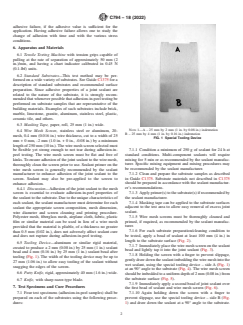
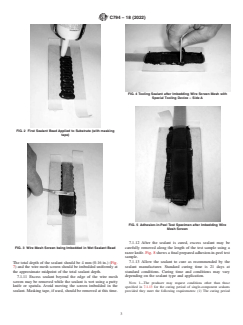
length to the substrate surface (Fig. 2).
6.5 Tooling Device—aluminum or similar rigid material,
7.1.7 Immediately place the wire mesh screen on the sealant
created to producea2mm (0.08 in.) by 25 mm (1 in.) sealant
bead and lightly tap it into the joint sealant (Fig. 3).
bead and 4 mm (0.16 in.) by 25 mm (1 in.) sealant bead after
7.1.8 Holding the screen with a finger to prevent slippage,
tooling (Fig. 1). The width of the tooling device may be up to
gentlydrawdownthesealantimbeddingthewiremeshintothe
27 mm (1.06 in.) to allow easy tooling of the sealant without
wet sealant, using the special tooling device – side A (Fig. 1)
snagging the edges of the screen.
at an 90° angle to the substrate (Fig. 4). The wire mesh screen
6.6 Putty Knife, rigid, approximately 40 mm (1.6 in.) wide.
shouldbeimbeddedtoauniformdepthof2mm(0.08in.)from
the substrate surface (Fig. 5).
6.7 Knife, with sharp razor-type blade.
7.1.9 Immediately apply a second bead of joint sealant over
7. Test Specimens and Cure Procedures
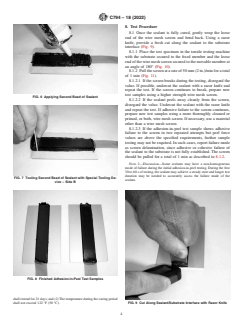
the first bead of sealant and wire mesh screen (Fig. 6).
7.1 Four test specimens (adhesion-in-peel samples) shall be 7.1.10 Again holding down the screen with a finger to
prepared on each of the substrates using the following proce- prevent slippage, use the special tooling device – side B (Fig.
dures: 1) and draw down the sealant at a 90° angle to the substrate.
C794 − 18 (2022)
FIG. 4 Tooling Sealant after Imbedding Wire Screen Mesh with
Special Tooling Device – Side A
FIG. 2 First Sealant Bead Applied to Substrate (with masking
tape)
FIG. 5 Adhesion-in-Peel Test Specimen after Imbedding Wire
Mesh Screen
7.1.12 After the sealant is cured, excess sealant may be
carefully removed along the length of the test sample using a
FIG. 3 Wire Mesh Screen being Imbedded in Wet Sealant Bead
razor knife. Fig. 8 shows a final prepared adhesion-in-peel test
sample.
7.1.13 Allow the sealant to cure as recommended by the
The total depth of the sealant should be 4 mm (0.16 in.) (Fig.
sealant manufacturer. Standard curing time is 21 days at
7) and the wire mesh screen should be imbedded uniformly at
standard conditions. Curing time and conditions may vary
the approximate midpoint of the total sealant depth.
depending on the sealant type and application.
7.1.11 Excess sealant beyond the edge of the wire mesh
screen may be removed while the sealant is wet using a putty
NOTE 1—The producer may request conditions other than those
knife or spatula. Avoid moving the screen imbedded in the
specified in 7.1.13 for the curing period of single-component sealants
sealant. Masking tape, if used, should be removed at this time. provided they meet the following requirements: (1) The curing period
C794
...