

ASTM E2865-12(2022)
(Guide)Standard Guide for Measurement of Electrophoretic Mobility and Zeta Potential of Nanosized Biological Materials
General Information
- Abstract
SCOPE
1.1 This guide deals with the measurement of mobility and zeta potential in systems containing biological material such as proteins, DNA, liposomes and other similar organic materials that possess particle sizes in the nanometer scale (
1.2 The values stated in SI units are to be regarded as standard. No other units of measurement are included in this standard.
1.3 This standard does not purport to address all of the safety concerns, if any, associated with its use. It is the responsibility of the user of this standard to establish appropriate safety, health, and environmental practices and determine the applicability of regulatory limitations prior to use.
1.4 This international standard was developed in accordance with internationally recognized principles on standardization established in the Decision on Principles for the Development of International Standards, Guides and Recommendations issued by the World Trade Organization Technical Barriers to Trade (TBT) Committee.
- Status
- Published
- Publication Date
- 31-Aug-2022
- Technical Committee
- E56 - Nanotechnology
- Drafting Committee
- E56.02 - Physical and Chemical Characterization
Overview
ASTM E2865-12(2022) provides comprehensive guidance for the measurement of electrophoretic mobility and zeta potential in nanosized biological materials. Developed by ASTM Committee E56 on Nanotechnology, this standard focuses on systems containing proteins, DNA, liposomes, and other organic materials with particle sizes typically under 100 nm. Such measurements are critical for understanding surface charge properties, stability, and the behavior of nanomaterials in biological and pharmaceutical applications.
This guide standardizes terminology, outlines key measurement considerations, and reinforces best practices for ensuring accuracy and consistency. All measurements are to be reported in SI units. As an internationally recognized standard, ASTM E2865-12(2022) assists researchers and industry professionals in reliably characterizing nanoscale biological materials, which is essential for quality control, formulation stability, and regulatory compliance.
Key Topics
- Electrophoretic Mobility: Describes the movement of dispersed nanoparticles under an applied electric field, a fundamental property for characterizing colloidal stability and interaction in biological matrices.
- Zeta Potential: Defines the electrical potential at the slipping plane of a nanoparticle and its surrounding medium, serving as an indicator of particle stability in suspension.
- Sample Preparation: Covers aspects such as pH adjustment, concentration management, and the use of appropriate buffers and reagents for biological samples.
- Instrument Verification: Emphasizes the importance of calibrating equipment according to traceable standards, such as those provided by NIST, to ensure reliable results.
- Data Reporting: Guides users on documenting measurement conditions (pH, temperature, composition, etc.) to ensure reproducibility and meaningful data interpretation.
- Safety and Good Laboratory Practice: Encourages adherence to health, safety, and environmental protocols due to the complex nature of biological nanomaterials and measurement procedures.
Applications
The ASTM E2865-12(2022) standard has wide applicability in industries and research settings working with biological nanomaterials, including:
- Biopharmaceutical Development: Assessing charge and stability of protein drugs, antibody formulations, or nucleic acid-based therapies at the nanoscale.
- Biomedical Research: Investigating interactions of DNA, liposomes, and proteins with other biomolecules, which influence aggregation, transport, and therapeutic efficacy.
- Nanotechnology and Materials Science: Quality control of nanocarriers, biosensors, and nanostructured drug delivery systems.
- Food and Cosmetic Industries: Characterizing emulsions, dispersions, and nanoparticles to enhance product stability and performance.
- Environmental Science: Evaluating the mobility and fate of nanoparticles in environmental or biological systems.
Routine measurement of zeta potential and electrophoretic mobility supports formulation optimization and provides insight into colloidal stability, helping mitigate issues like aggregation and precipitation in product development.
Related Standards
For an integrated approach to zeta potential characterization and nanoparticle analysis, ASTM E2865-12(2022) should be used alongside these standards and guides:
- ISO 13099-1 & ISO 13099-2: Colloidal Systems - Methods for Zeta-Potential Determination (covering electroacoustic, electrokinetic, and optical methods)
- ISO 13321: Particle Size Analysis - Photon Correlation Spectroscopy for nanoparticle sizing and mobility
- ASTM E2456: Standard Terminology Relating to Nanotechnology
- NIST SRM 1980: Positive Electrophoretic Mobility Standard for instrument calibration and quality assurance
These documents collectively reinforce best practices for accurate nanomaterial characterization, enabling reproducibility and global comparability of zeta potential and electrophoretic mobility data.
Keywords: electrophoretic mobility, zeta potential, nanosized biological materials, protein mobility, nanotechnology standard, nanoparticle characterization, colloidal stability, ASTM E2865, biological sample analysis, SI units
Relations
- Effective Date
- 01-Nov-2006
- Effective Date
- 01-Oct-2006
- Effective Date
- 10-Apr-1998
Frequently Asked Questions
ASTM E2865-12(2022) is a guide published by ASTM International. Its full title is "Standard Guide for Measurement of Electrophoretic Mobility and Zeta Potential of Nanosized Biological Materials". This standard covers: SCOPE 1.1 This guide deals with the measurement of mobility and zeta potential in systems containing biological material such as proteins, DNA, liposomes and other similar organic materials that possess particle sizes in the nanometer scale ( 1.2 The values stated in SI units are to be regarded as standard. No other units of measurement are included in this standard. 1.3 This standard does not purport to address all of the safety concerns, if any, associated with its use. It is the responsibility of the user of this standard to establish appropriate safety, health, and environmental practices and determine the applicability of regulatory limitations prior to use. 1.4 This international standard was developed in accordance with internationally recognized principles on standardization established in the Decision on Principles for the Development of International Standards, Guides and Recommendations issued by the World Trade Organization Technical Barriers to Trade (TBT) Committee.
SCOPE 1.1 This guide deals with the measurement of mobility and zeta potential in systems containing biological material such as proteins, DNA, liposomes and other similar organic materials that possess particle sizes in the nanometer scale ( 1.2 The values stated in SI units are to be regarded as standard. No other units of measurement are included in this standard. 1.3 This standard does not purport to address all of the safety concerns, if any, associated with its use. It is the responsibility of the user of this standard to establish appropriate safety, health, and environmental practices and determine the applicability of regulatory limitations prior to use. 1.4 This international standard was developed in accordance with internationally recognized principles on standardization established in the Decision on Principles for the Development of International Standards, Guides and Recommendations issued by the World Trade Organization Technical Barriers to Trade (TBT) Committee.
ASTM E2865-12(2022) is classified under the following ICS (International Classification for Standards) categories: 07.120 - Nanotechnologies. The ICS classification helps identify the subject area and facilitates finding related standards.
ASTM E2865-12(2022) has the following relationships with other standards: It is inter standard links to ASTM E1470-92(2006), ASTM E2456-06, ASTM E1470-92(1998). Understanding these relationships helps ensure you are using the most current and applicable version of the standard.
ASTM E2865-12(2022) is available in PDF format for immediate download after purchase. The document can be added to your cart and obtained through the secure checkout process. Digital delivery ensures instant access to the complete standard document.
Standards Content (Sample)
This international standard was developed in accordance with internationally recognized principles on standardization established in the Decision on Principles for the
Development of International Standards, Guides and Recommendations issued by the World Trade Organization Technical Barriers to Trade (TBT) Committee.
Designation: E2865 − 12 (Reapproved 2022)
Standard Guide for
Measurement of Electrophoretic Mobility and Zeta Potential
of Nanosized Biological Materials
This standard is issued under the fixed designation E2865; the number immediately following the designation indicates the year of
original adoption or, in the case of revision, the year of last revision.Anumber in parentheses indicates the year of last reapproval.A
superscript epsilon (´) indicates an editorial change since the last revision or reapproval.
1. Scope ISO 13099-2 Colloidal Systems — Methods for Zeta-
Potential Determination — Part 2: Optical Methods
1.1 This guide deals with the measurement of mobility and
ISO 13321Particle Size Analysis — Photon Correlation
zetapotentialinsystemscontainingbiologicalmaterialsuchas
Spectroscopy
proteins, DNA, liposomes and other similar organic materials
that possess particle sizes in the nanometer scale (<100 nm).
3. Terminology
1.2 The values stated in SI units are to be regarded as
3.1 Definitions—Definitions of nanotechnology terms can
standard. No other units of measurement are included in this
be found in Terminology E2456.
standard.
3.2 Definitions of Terms Specific to This Standard:
3.2.1 Brownian motion, n—is the random movement of
1.3 This standard does not purport to address all of the
particles suspended in a fluid caused by external bombardment
safety concerns, if any, associated with its use. It is the
by dispersant atoms or molecules.
responsibility of the user of this standard to establish appro-
priate safety, health, and environmental practices and deter-
3.2.2 dielectric constant, n—the relative permittivity of a
mine the applicability of regulatory limitations prior to use.
material for a frequency of zero is known as its dielectric
1.4 This international standard was developed in accor-
constant (or static relative permittivity).
dance with internationally recognized principles on standard-
3.2.2.1 Discussion—Technically,itistheratiooftheamount
ization established in the Decision on Principles for the
of electrical energy stored in a material by an applied voltage,
Development of International Standards, Guides and Recom-
relative to that stored in a vacuum.
mendations issued by the World Trade Organization Technical
3.2.3 electrophoretic mobility, n—the motion of dispersed
Barriers to Trade (TBT) Committee.
particles relative to a fluid under the influence of an electrical
field (usually considered to be uniform).
2. Referenced Documents
3.2.4 isoelectric point, n—point of zero electrophoretic
2.1 ASTM Standards:
mobility.
E1470Test Method for Characterization of Proteins by
3.2.5 mobility—see electrophoretic mobility.
Electrophoretic Mobility (Withdrawn 2014)
E2456Terminology Relating to Nanotechnology
3.2.6 redox reaction, n—achemicalreactioninwhichatoms
2.2 ISO Standards: have their oxidation number (oxidation state) changed.
ISO 13099-1 Colloidal Systems — Methods for Zeta-
3.2.7 stability, n—the tendency for a dispersion to remain in
Potential Determination — Part 1: Electroacoustic and
the same form for an appropriate timescale (for example, the
Electrokinetic Phenomena
experiment duration; on storage at 358K).
3.2.7.1 Discussion—In certain circumstances (for example
water colloid flocculation) instability may be the desired
This guide is under the jurisdiction of ASTM Committee E56 on Nanotech-
property.
nology and is the direct responsibility of Subcommittee E56.02 on Physical and
Chemical Characterization.
3.2.8 van der Waals forces, n—in broad terms the forces
Current edition approved Sept. 1, 2022. Published October 2022. Originally
between particles or molecules.
approved in 2012. Last previous edition approved in 2018 as E2865 – 12 (2018).
DOI: 10.1520/E2865-12R22.
3.2.8.1 Discussion—These forces tend to be attractive in
For referenced ASTM standards, visit the ASTM website, www.astm.org, or
nature (because such attractions lead to reduced energy in the
contact ASTM Customer Service at service@astm.org. For Annual Book of ASTM
system) unless specific steps are undertaken to prevent this
Standards volume information, refer to the standard’s Document Summary page on
attraction.
the ASTM website.
The last approved version of this historical standard is referenced on
3.2.9 zeta potential, n—the potential difference between the
www.astm.org.
dispersion medium and the stationary layer of fluid attached to
Available from International Organization for Standardization (ISO), 1, ch. de
la Voie-Creuse, CP 56, CH-1211 Geneva 20, Switzerland, http://www.iso.org. the dispersed particle.
Copyright © ASTM International, 100 Barr Harbor Drive, PO Box C700, West Conshohocken, PA 19428-2959. United States
E2865 − 12 (2022)
3.2.10 zwitterionic, n—a molecule with a positive and a movement may be hindered. In this circumstance, although a
negative electrical charge. movement can be detected and measured, it may provide
3.2.10.1 Discussion—Amino acids are the best known ex-
interpretation issues when a conversion to zeta potential is
amples of zwitterions.
attempted.
4.3.3 Zeta potential tends only to be important in the sub-5
4. Summary of Practice
µm (and thus relevant to the sub-100 nm region considered in
4.1 Introduction—It is not the intention of this guide to
this text) region where van der Waals attractive forces are of a
spend any significant time on the theory of zeta potential and
similar order of magnitude as inertial forces. Thus if sedimen-
the routes by which a particle acquires charge within a system.
tation (function of size and density of the particle with respect
Indeed it may be more appropriate to deal only with the
to the medium it resides) is occurring or has occurred, the
movement or mobility of particles under an electrical field
system is clearly not ideal for a zeta potential or mobility
where conversion to zeta potential is not even attempted. The
measurement. With significant settling the measurement of
relevant text books (for example, see Hunter (1) ) should be
mobility is obviously compromised. The lower limit for
consulted along with the more academic ISO references (ISO
measurement of electrophoretic mobility is in effect deter-
13099-1 and ISO 13099-2). The IUAPC report (2) is also very
mined by the signal to noise which is a complex function of
useful, albeit fairly theoretical, but it does contain a section
size, concentration and relative refractive index of the particu-
(4.1.2) entitled ‘How and under which conditions the electro-
late system. An unambiguous statement of the lower size is
phoretic mobility can be converted into ζ-potential’. The
therefore not possible.
Corbett and Jack paper (3) contains excellent practical advice
4.3.4 Zeta potential and its (assumed) relation to system
for measurement of protein mobility and is recommended.
stability are reasonably well understood in aqueous systems.
4.2 Test Method E1470 is based around a sole vendor’s
The classic examples are indicated in Thomas Riddick’s text
equipment, but this does not deal with the basis of the
(4). The obvious or stated link with formulation or product
measurement or provide guidance in the practice of the
stability is not obvious for organic media where the counter-
measurement. It is one intention of this guide to address those
ions will be strongly bound to the particle surface and the
deficits.
position of the diffuse layer will be difficult to identify in an
4.3 The following aspects need emphasis:
(effectively) insulating external medium. Again, what is often
4.3.1 Zetapotentialisafunctionoftheparticulatesystemas
forgotten, is that conductivity is required in the ‘background’
-1
a whole – so the environment that the particle resides in (pH,
solution (typically 0.001 molL sodium chloride (NaCl) is
concentration, ionic strength, polyvalent ions) will directly
utilized) so that an electrical field can be correctly applied
influence the magnitude and, in certain circumstances, the sign
without effects such as electrode polarization (causing voltage
of the acquired charge. In particular, small quantities (parts per
irregularities) occurring. Mobility or zeta potential measure-
2+
million) of polyvalent ions (for example calcium ions (Ca ),
ments should not be made in de-ionized water. In non-polar
3+
iron(III)ions(Fe ))orotherimpuritiescansignificantlyaffect
dispersant liquids, conversion of observed mobility to zeta
the magnitude of the zeta potential. It is obvious, but often
potential may need some understanding of the position and
ignored, that there is no such concept of the zeta potential of a
thickness (single atom or molecule?) of the double layer, but
powder.
this is not relevant to measurements in (aqueous) biological
4.3.2 The calculation of zeta potential from mobility mea-
media.
surement typically refers to the unrestricted mobility of a
4.3.5 Itismobility(movement)thatisusuallymeasuredand
particle in suspension. In crowded environments (that is high
the conversion to zeta potential relies on application of the
concentration) particle-particle interactions occur and the
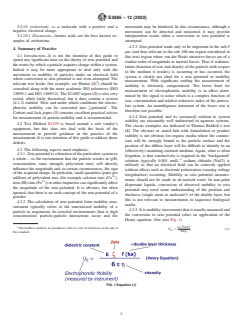
Henry equation. (See also Fig. 1).
5 εζ f~κα!
The boldface numbers in parentheses refer to a list of references at the end of
U 5 (1)
E
6πη
this standard.
FIG. 1 Equation (1)
E2865 − 12 (2022)
where: et al. (6)). 1/κ can be envisioned as the "thickness" of the
electrical double layer (the Debye length) and thus the units of
U = the electrophoretic mobility (measured by
E
κarereciprocallength.Thusf(κα)isdimensionlessandusually
instrument),
assignedthevalue1.00or1.50.Forparticlesinpolarmediathe
ε = the dielectric constant of the dispersion medium,
maximum value of f(κα) is taken to be 1.5 (Smoluchowski
ζ = the (calculated) zeta potential,
f(κα) = Henry’s function (see below), and
approximation) and for particles in non-polar media the mini-
η = theviscosityofthemedium(measuredorassumed).
mum value of f(κα) is 1 (Hückel approximation). It is the
former that we are considering in this text. The literature does
4.3.5.1 Itisimportanttospecifytheunitsofmeasurementas
indicate intermediate values for f(κα) but in most biologically
failure to get these correct will lead incompatibility of units on
relevant media the value of 1.5 is the most appropriate.
the right and left hand side of the above equation. The normal
4.3.5.4 In terms of viscosity, η, the SI physical unit of
SI units (metre, kilogram, second) are not often utilized in this
dynamic viscosity is the pascal-second (Pa·s), (equivalent to
area as they are too large for practical purposes (diffusion
N·s/m , or kg/(m·s)). Water at 293K has a viscosity of
distances of one metre are not routinely encountered!) — see
0.001002 Pa·s. The cgs physical unit for dynamic viscosity is
additional unit information in Ref. (5). We need to remember
the poise (P). It is more commonly expressed, particularly in
that the mobility and diffusion coefficient are a flux (and thus
ASTM standards, as centipoise (cP). Water at 293K has a
area) per unit time. The mobility will be scaled by the field
viscosity of 1.0020 cP.
(volts/distance). Ref. (5) recommended units for electropho-
2 -1 -1 -1
retic mobility are m s V . This can be expressed as (ms )/
NOTE 1—At room temperature (assumed 298K) in water, all of the
-1
(Vm ) or a velocity per unit field. In practice, the electropho- expressions are constants except for the (measured) mobility and the
equation defers to:
retic mobility, U , has more convenient units of µm /Vs Often
E
mobilities are expressed in confused units (for example, the
Zetapotential 5 K*electrophoreticmobility, U ; 12.85*U (2)
E E
-1
oft-utilized µmcm /Vs because this gives rise to mobility
where the value of K (collective proportionality constant) is ~12.85 if
thezetapotentialistobestatedinmVandthisfallsoutnaturallyfromthe
values in the convenient 610 region). Mobilities expressed
-1
Henry equation if the deprecated µmcm /Vs unit is used for electropho-
with a negative sign imply a negative zeta potential.
retic mobility.
4.3.5.2 ε is the dielectric constant of the dispersion medium
dimensionless/nounitsasitisaratiooftherelativepermittivity 4.3.5.5 As well as movement under the constraint of an
ofthematerialtovacuumwhoserelativepermittivityisdefined electric field, some degree of Brownian motion will also occur
as 1. and may need to be considered. In biological media of
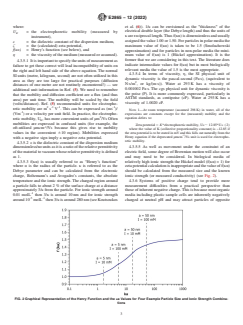
4.3.5.3 f(κα) is usually referred to as “Henry’s function” relatively high ionic strength the Hückel model (f(κα)=1)for
where α is the radius of the particle. κ is referred to as the zetapotentialcalculationisinappropriateandthevalueoff(κα)
Debye parameter and can be calculated from the electronic should be calculated from the measured size and the known
charge, Boltzmann’s and Avogadro’s constants, the absolute ionic strength (or measured conductivity) (see Fig. 2).
temperature and the ionic strength. The charged region around 4.3.6 Systems of positive charge tend to provide more
a particle falls to about 2% of the surface charge at a distance measurement difficulties from a practical perspective than
approximately 3/κ from the particle. For ionic strength around thoseofinherentnegativecharge.Thisisbecausemostorganic
-1
0.01 molL then 3/κ is around 10nm and for ionic strength media including plastic sample cells are inherently negatively
-5 -1
around10 molL then3/κisaround280nm(seeKoutsoukos charged at neutral pH and may attract particles of opposite
FIG. 2 Graphical Representation of the Henry Function and the κa Values for Four Example Particle Size and Ionic Strength Combina-
tions
E2865 − 12 (2022)
charge removing them from suspension and altering the wall measure a few µLof sample with specific experimental set-ups
potential. It is useful to have some form of automation for pH as the electrodes need to be of a finite size and distance apart.
adjustment – for example a titrator. This eases the adjustment In many instances a few millilitres of solution or suspension
of pH and additive concentration. will make life easy, especially if flushing of a cell is needed,
but this is not always available. If the material can be held as
4.3.7 It is of no value to state a zeta potential value without
a ‘plug’ it may be possible to work with considerably less
description of the manner in which it was measured together
quantity.
with vital measurement parameters. Zeta potential without a
4.4.4 Biological material is often contained in buffered
stated pH, ionic compostion, and electrolyte concentration
solutions of relatively high ionic concentration. For example,
value is close to meaningless.
phosphate buffered saline (PBS) is constituted of
4.4 Biological Molecules and Entities—Again, a few obvi-
-1
0.0032 molL disodium hydrogen phosphate (Na HPO ),
2 4
ous points will need mentioning:
-1
0.005 molL monopotassium phosphate (KH PO ,
2 4
4.4.1 Many materials such as proteins contain charges and -1 -1
0.0013molL potassium chloride (KCl), 0.135molL NaCl,
may be zwitterionic (contain both positive and negative
and is adjusted to pH 7.4. This has implications of Joule
charges). These molecules can be quite labile and may absorb
heating when voltage is applied across such a solution and the
anddecomposereadilyunderanelectricalfieldattheelectrode
propensity of decomposition is increased in such
with the deposition of carbon (shown as electrode darkening)
scenarios—60 s between measurements is often recommended
and gas evolution. This is a conventional redox reaction and is
to allow appropriate cooling. Chloride ions often present as
virtually impossible to eliminate if organic materials interact -1
NaCl (say 0.9molL ) can be aggressive to some electrode
with or contact metal electrodes—the electrical field over the
systems (especially the platinum group metals) and the elec-
length of an adsorbed molecule is enormous in relation to that
trode material may need investigation. The current passing
between the electrodes themselves. Protocols need to be aware
through the measurement zone can be reduced by appropriate
of this possibility and seek to minimize it after appropriate
reduction of voltage or by reducing the distance between the
investigation of the magnitude of the phenomenon. It may be
electrodes but this is not a universal panacea.
virtually impossible to eliminate such decomposition for some
molecules unless specific routes are taken—for example,
5. Significance and Use
isolation of the electrodes from the biological molecules with
5.1 The magnitude of zeta potential of a system in aqueous
aporousmembranethatallowsionsbutnotlargermoleculesto
media is often an indicator of formulation stability or a means
pass through. Measurements taken quickly and at lower volt-
to understanding protein charge of the system and this is the
ages in combination with a reduced electrode spacing (thus
usual reason for measurement. Oft-quoted values of stability
reducing the field) may also help in this regard but resolution
when a threshold of +30mV or –30mV is reached are
will almost certainly be lost. Many hours are required in order
common. This arises from Riddick’s text (4) and it is worth
for proteins to diffuse a few tens of millimeters; a distance
reproducing his table in full:
between detection point and electrodes somewhat typical of
Stability Characteristics Average ZP, mV
many capillary based laser Doppler electrophoresis systems. It
Maximum agglomeration and precipitation 0 to +3
is the slow timescales associated with the diffusion coupled
Range of strong agglomeration and precipitation +5 to –5
with measurement times of the order of minutes to tens of
Threshold of agglomeration –10 to –15
Threshold of delicate dispersion –16 to –30
minutes associated with laser Doppler electrophoresis that is
Moderate stability –31 to –40
the enabling factor for the implementation of any diffusion
Fairly good stability –41 to –60
barrier technique. Detection of aggregates by measurement in Very good stability –61 to –80
Extremely good stability –81 to –100
the forward scattering direction combined with visual inspec-
5.2 It is noted that –30mV represents only ‘moderate
tion of (polished metal) electrodes for blackening will be good
indicators of sample degradation. Obviously on a blackened stability’—nowhere in Riddick’s text (4) are these qualitative
terms further defined: for example what is ‘delicate disper-
oxide surface such ‘deposits’ will not be evident. The conse-
quenceinthemeasurementistypicallyadrifttomorenegative sion?’. It is also noted that positive values greater than +5mV
values and instability in the measurements themselves. Rapid are not noted in the table, the assumption being that it is the
modulus rather than the sign of the charge that is responsible
measurements and those avoiding Joule heating may alleviate
the problem somewhat but the only real solution is to prevent for the qualitative stability terms listed above. For smaller
systems typically <1µm, a higher magnitude of charge may be
the protein in
...