


ASTM B115-10(2016)
(Specification)Standard Specification for Electrolytic Copper Cathode
Standard Specification for Electrolytic Copper Cathode
ABSTRACT
This specification establishes the requirements for electrolytic copper cathode; electrorefined and electrowon. The cathode furnished shall conform to the chemical composition requirements specified. Cathodes shall withstand ordinary handling without breakage or excessive separation of nodules. They shall be substantially free of all foreign material; for example, copper sulfate, dirt, grease, and oil. Electrical resistivity of the cathodes shall be determined as the mean of results from four specimens.
SIGNIFICANCE AND USE
13.1 Calculated values shall be rounded to the desired number of places as directed in Practice E29.
SCOPE
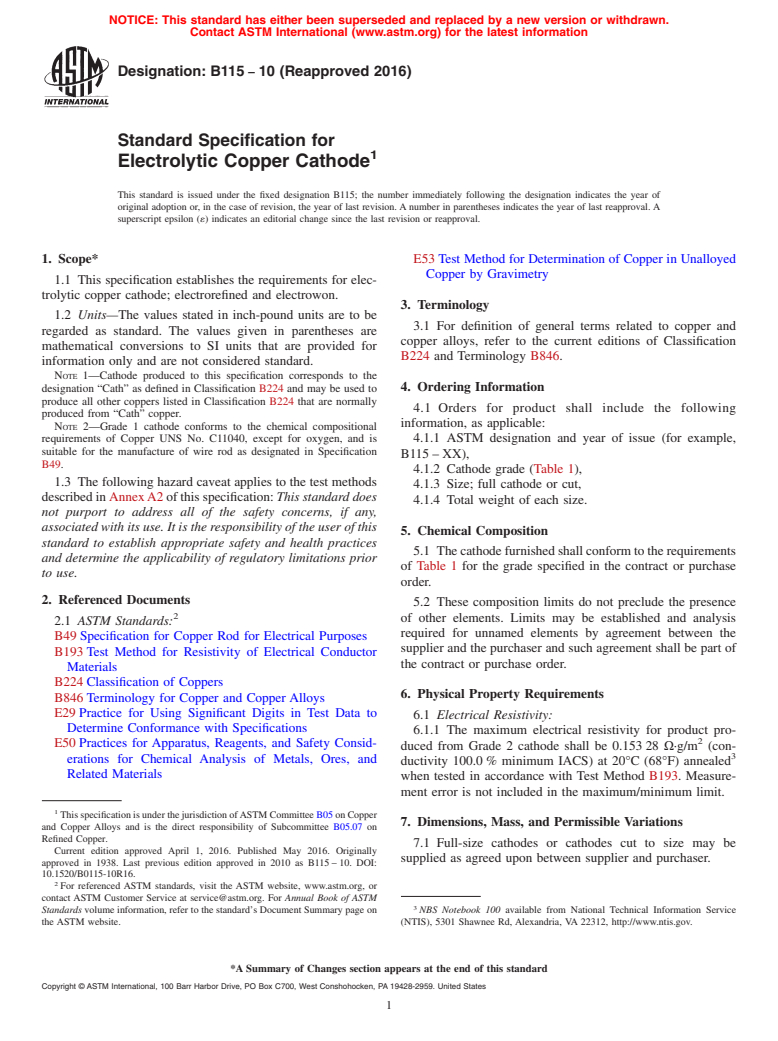
1.1 This specification establishes the requirements for electrolytic copper cathode; electrorefined and electrowon.
1.2 Units—The values stated in inch-pound units are to be regarded as standard. The values given in parentheses are mathematical conversions to SI units that are provided for information only and are not considered standard.
Note 1: Cathode produced to this specification corresponds to the designation “Cath” as defined in Classification B224 and may be used to produce all other coppers listed in Classification B224 that are normally produced from “Cath” copper.
Note 2: Grade 1 cathode conforms to the chemical compositional requirements of Copper UNS No. C11040, except for oxygen, and is suitable for the manufacture of wire rod as designated in Specification B49.
1.3 The following hazard caveat applies to the test methods described in Annex A2 of this specification: This standard does not purport to address all of the safety concerns, if any, associated with its use. It is the responsibility of the user of this standard to establish appropriate safety and health practices and determine the applicability of regulatory limitations prior to use.
General Information
Buy Standard
Standards Content (Sample)
NOTICE: This standard has either been superseded and replaced by a new version or withdrawn.
Contact ASTM International (www.astm.org) for the latest information
Designation:B115 −10 (Reapproved 2016)
Standard Specification for
Electrolytic Copper Cathode
This standard is issued under the fixed designation B115; the number immediately following the designation indicates the year of
original adoption or, in the case of revision, the year of last revision. A number in parentheses indicates the year of last reapproval. A
superscript epsilon (´) indicates an editorial change since the last revision or reapproval.
1. Scope* E53 Test Method for Determination of Copper in Unalloyed
Copper by Gravimetry
1.1 This specification establishes the requirements for elec-
trolytic copper cathode; electrorefined and electrowon.
3. Terminology
1.2 Units—The values stated in inch-pound units are to be
3.1 For definition of general terms related to copper and
regarded as standard. The values given in parentheses are
copper alloys, refer to the current editions of Classification
mathematical conversions to SI units that are provided for
B224 and Terminology B846.
information only and are not considered standard.
NOTE 1—Cathode produced to this specification corresponds to the
4. Ordering Information
designation “Cath” as defined in Classification B224 and may be used to
produce all other coppers listed in Classification B224 that are normally
4.1 Orders for product shall include the following
produced from “Cath” copper.
information, as applicable:
NOTE 2—Grade 1 cathode conforms to the chemical compositional
requirements of Copper UNS No. C11040, except for oxygen, and is 4.1.1 ASTM designation and year of issue (for example,
suitable for the manufacture of wire rod as designated in Specification
B115 – XX),
B49.
4.1.2 Cathode grade (Table 1),
1.3 The following hazard caveat applies to the test methods
4.1.3 Size; full cathode or cut,
describedinAnnexA2ofthisspecification: This standard does
4.1.4 Total weight of each size.
not purport to address all of the safety concerns, if any,
associated with its use. It is the responsibility of the user of this
5. Chemical Composition
standard to establish appropriate safety and health practices
5.1 Thecathodefurnishedshallconformtotherequirements
and determine the applicability of regulatory limitations prior
of Table 1 for the grade specified in the contract or purchase
to use.
order.
2. Referenced Documents
5.2 These composition limits do not preclude the presence
of other elements. Limits may be established and analysis
2.1 ASTM Standards:
required for unnamed elements by agreement between the
B49 Specification for Copper Rod for Electrical Purposes
supplier and the purchaser and such agreement shall be part of
B193 Test Method for Resistivity of Electrical Conductor
the contract or purchase order.
Materials
B224 Classification of Coppers
6. Physical Property Requirements
B846 Terminology for Copper and Copper Alloys
E29 Practice for Using Significant Digits in Test Data to
6.1 Electrical Resistivity:
Determine Conformance with Specifications
6.1.1 The maximum electrical resistivity for product pro-
E50 Practices for Apparatus, Reagents, and Safety Consid-
duced from Grade 2 cathode shall be 0.153 28 Ω·g/m (con-
erations for Chemical Analysis of Metals, Ores, and
ductivity 100.0 % minimum IACS) at 20°C (68°F) annealed
Related Materials
when tested in accordance with Test Method B193. Measure-
ment error is not included in the maximum/minimum limit.
ThisspecificationisunderthejurisdictionofASTMCommitteeB05onCopper
7. Dimensions, Mass, and Permissible Variations
and Copper Alloys and is the direct responsibility of Subcommittee B05.07 on
Refined Copper.
7.1 Full-size cathodes or cathodes cut to size may be
Current edition approved April 1, 2016. Published May 2016. Originally
supplied as agreed upon between supplier and purchaser.
approved in 1938. Last previous edition approved in 2010 as B115 – 10. DOI:
10.1520/B0115-10R16.
For referenced ASTM standards, visit the ASTM website, www.astm.org, or
contact ASTM Customer Service at service@astm.org. For Annual Book of ASTM
Standards volume information, refer to the standard’s Document Summary page on NBS Notebook 100 available from National Technical Information Service
the ASTM website. (NTIS), 5301 Shawnee Rd, Alexandria, VA 22312, http://www.ntis.gov.
*A Summary of Changes section appears at the end of this standard
Copyright © ASTM International, 100 Barr Harbor Drive, PO Box C700, West Conshohocken, PA 19428-2959. United States
B115−10 (2016)
TABLE 1 Chemical Composition
11.3 In the case of dispute concerning specimen preparation
A A
Element Grade 1 Grade 2 for chemical composition specified in Table 1 or electrical
Percent,% resistivity, specimen preparation shall be in accordance with
B
Copper 99.95, min
Annex A1.
C
ppm
Selenium, max 2 10
12. Test Methods
Tellurium, max 2 5
Bismuth, max 1.0 3
12.1 Chemical Composition:
Group total, max 3 .
12.1.1 For routine analysis of Grade 1 and Grade 2 cathode,
Antimony, max 4 15
the methods of analysis used shall be at the discretion of the
Lead, max 5 40
analyst.
Arsenic, max 5 15
Iron, max 10 25 12.1.2 In the case of dispute concerning the chemical
Nickel, max 10 20
composition, the methods of analysis shall be in accordance
Tin, max 5 10
with Annex A2, except for copper in Grade 2 cathode.
Sulfur, max 15 25
Silver, max 25 70 12.1.3 In the case of dispute concerning copper content of
Maximum allowable total 65 .
Grade 2 cathode, the method of analysis shall be in accordance
A
Measurement error is not incorporated in the maximum limits, refer to 10.1.1.
with Test Methods E53.
B
Including silver.
C 12.1.4 In the case of dispute concerning special require-
Determined from a melted sample.
ments stated in the purchase order or contract, the methods of
analysis used shall be as agreed between the supplier and the
purchaser.
8. Workmanship, Finish, and Appearance
12.2 Electrical Resistivity:
8.1 Cathodes shall withstand ordinary handling without
12.2.1 In the case of dispute concerning electrical
breakage or excessive separation of nodules. They shall be
resistivity, the method of testing shall be in accordance with
substantially free of all foreign material; for example, copper
Test Method B193.
sulfate, dirt, grease, and oil.
13. Significance of Numerical Limits
9. Sampling
13.1 Calculated values shall be rounded to the desired
9.1 For routine sampling of cathodes for analysis, the
number of places as directed in Practice E29.
method of sampling shall be at the discretion of the sampler.
9.2 In case of dispute concerning sampling for chemical
14. Inspection
composition, or electrical resistivity, or both, the method of
14.1 The producer shall inspect the product and conduct
sampling shall be in accordance with Annex A1.
such tests as are necessary to verify that the requirements of
9.3 In case of special requirements specified in the purchase
this specification are met.
order or contract, the method of sampling shall be as agreed
between the supplier and the purchaser.
15. Rejection and Rehearing
15.1 Rejection:
10. Number of Tests and Retests
15.1.1 Product that fails to conform to the requirements of
10.1 Tests:
this specification may be rejected.
10.1.1 Chemical composition shall be determined as the per
15.1.2 Rejection shall be reported to the producer or sup-
element mean of at least two replicate analyses of each sample.
plier promptly and in writing.
10.1.2 Electrical resistivity shall be determined as the mean
15.1.3 Inthecaseofdisagreementordissatisfactionwiththe
of results from four specimens.
resultsofthetestuponwhichrejectionwasbased,theproducer
10.2 Retests:
or supplier may make claim for a rehearing.
10.2.1 In the case of compositional or resistivity dispute,
15.2 Rehearing:
retests may be made under the conditions of 9.2.
15.2.1 As a result of product rejection, the supplier may
10.3 Umpire Test:
make claim for retest to be conducted by the producer or
10.3.1 In the case in which retest does not settle the dispute,
supplier and the purchaser. Samples of the rejected product
further retest may be made by a qualified third-party laboratory
shall be taken in accordance with this specification and tested
agreeable to both parties. This provision does not preclude
by both parties as directed in this specification, or,
other contractual agreements.
alternatively, upon agreement between both parties, an inde-
pendent laboratory may be selected for the tests using the test
11. Specimen Preparation
methods prescribed in this specification.
11.1 Forroutinetesting,specimenpreparationshallbeatthe
discretion of the preparer. 16. Packaging and Package Marking
11.2 In the case of special requirements specified in the 16.1 Packaging:
purchaser order or contract, specimen preparation shall be as 16.1.1 Cathodes,whetherfullsizeorcut,shallbeassembled
agreed between the supplier and the purchaser. in bundles or containers of suitable weight for handling and
B115−10 (2016)
shall be prepared for shipment in such a manner as to ensure 16.2.2 When used, metallic identifying markers shall be
acceptance by common carrier for transportation and to afford firmly attached only to the strapping or shipping container.
protection from normal hazards of transportation.
17. Keywords
16.2 Package Marking:
16.2.1 Each cathode bundle or container shall be marked to 17.1 cathode; copper; electrolytic copper; electrorefined
identify source and grade. copper; electrowon copper
ANNEXES
(Mandatory Information)
A1. SAMPLING AND SPECIMEN PREPARATION OF ELECTROLYTIC CATHODE COPPER FOR
DETERMINATION OF COMPLIANCE WITH SPECIFICATION REQUIREMENTS
A1.1 Scope A1.3.2.3 All cathode bundles shall be numbered and a
random number generator shall be used to determine which
A1.1.1 This practice establishes a procedure for the sam-
bundles shall be selected for the gross sample.
plingandspecimenpreparationofelectrolyticcoppercathodes,
A1.3.2.4 Should there be an insufficient quantity of cath-
Grades 1 and 2, for the determination of conformance with
odes to comply with A1.3.2.2, then the procedure described in
specification requirements.
A1.3.3 shall apply.
A1.1.2 Units—The values stated in inch-pound units are the
A1.3.3 Cathodes for Other Uses:
standard. The values given in parentheses are mathematical
A1.3.3.1 Not less than 25 % of the original lot weight or 25
conversions to SI units that are provided for information only
tons, whichever is the larger, shall be available in the original
and are not considered standard.
packing for examination.
A1.1.3 This standard does not purport to address the safety
A1.3.3.2 Agrosssampleof24cathodes,ortheequivalentin
concerns, if any, associated with its use. It is the responsibility
sheared cathode pieces, shall be selected from a lot. To
of the user of this standard to establish appropriate safety and
guarantee random selection, all cathodes, or sheared cathode
health practices and determine the applicability of regulatory
pieces, of the lot shall be individually numbered, and a random
limitations prior to use.
number generator shall be used to select the individual test
pieces.
A1.2 Terminology
A1.3.3.3 In the case of sheared cathodes, 24 full cathodes;
A1.2.1 Definitions of Terms Specific to This Standard: 48 half-plate cathodes, 24 each of tops and bottoms; 96
quarter-plate cathodes, and 24 each of the four quarters, shall
A1.2.1.1 lot—One shipment, or part of one shipment, pro-
be selected.
duced by one refiner. For use other than continuous cast rod
A1.3.3.4 The selection of test pieces of cathode sheared
production, shipments greater than 200 tons short shall be
smaller than quarter plate shall be by agreement between the
subdivided into lots not exceeding 200 tons each for sampling
producer, or the supplier, and the purchaser.
purposes.
A1.3.3.5 Alternatively, to avoid individual numbering of
A1.2.1.2 gross sample—The total number of test pieces
cathodes, or sheared cathode pieces, in the case of large lots,
selected from a lot and considered representative of the lot.
provided both parties agree, individual bundles, or containers,
A1.2.1.3 test piece—An individual cathode, or cathode part,
may be selected on a random basis, and then individual
randomly selected from the lot.
cathodes, or sheared cathode pieces, within each bundle, or
A1.2.1.4 sample—Aportionpreparedfromthegrosssample
container, shall be numbered and test pieces selected, using a
and considered representative of the gross sample.
random number generator as just described.
A1.2.1.5 specimen—Representative fraction taken from the
sample for test.
A1.4 Sample Preparation
A1.4.1 Cathode for Continuous Rod Casting:
A1.3 Selection of Cathode
A1.4.1.1 The portion used for flushing the system shall not
A1.3.1 Nodules shall not be considered a sample represen-
be used for sampling.
tative of the lot.
A1.4.1.2 The remaining gross sample, minimum of one
A1.3.2 Cathodes for Continuous Rod Casting:
hour’s cast, shall be charged to the melting furnace. The rod
A1.3.2.1 The cathodes shall be available in the original
coils produced from the caster shall be sequentially numbered,
packing for examination.
excluding any coils with obvious defects normally attributed to
A1.3.2.2 The quantity of cathodes required shall be that the rod casting process.
necessary to flush the system plus 1 hour of melting furnace A1.4.1.3 Chemical Composition—Each party shall select 2
operation. coils from which a segment of rod approximately 16 in.
B115−10 (2016)
(406 mm) in length shall be cut at the trailing ends of the coils. diameter (2.0 mm) and at least 160 in. in length (4 m). Each
Each rod segment shall be cut into 4 portions of approximate wire coil shall be cut into 4 portions of approximately equal
equal lengths. The 16 portions shall be divided into 4 groups;
length, and the 16 portions shall be individually identified.The
eachgroupshallcontainoneportionfromeachofthe4original
16 wires shall be divided into 4 groups of 4 wires each, one
rod segments. The 4 groups of rod portions shall be placed in
from each of the 4 original rod segments; one group each for
separate noncontaminating containers, then sealed and identi-
the producer, the purchaser, and the umpire, if necessary.
fied for the supplier, the purchaser, contingency, and umpire if
A1.4.2 Cathodes for Other Uses:
necessary.
A1.4.2.1 Chemical Composition:
A1.4.1.4 Electrical Resistivity—Each party shall select 2
(a) From each cathode, or sheared cathode piece, of the
coils from which a rod segment of sufficient length for test
shall be taken from the trailing ends of the coils. Each rod gross sample a vertical strip shall be cut in such a position (see
segment shall be cold drawn into a wire about 0.080 in. Fig. A1.1) that the collection
...
This document is not an ASTM standard and is intended only to provide the user of an ASTM standard an indication of what changes have been made to the previous version. Because
it may not be technically possible to adequately depict all changes accurately, ASTM recommends that users consult prior editions as appropriate. In all cases only the current version
of the standard as published by ASTM is to be considered the official document.
Designation: B115 − 10 B115 − 10 (Reapproved 2016)
Standard Specification for
Electrolytic Copper Cathode
This standard is issued under the fixed designation B115; the number immediately following the designation indicates the year of
original adoption or, in the case of revision, the year of last revision. A number in parentheses indicates the year of last reapproval. A
superscript epsilon (´) indicates an editorial change since the last revision or reapproval.
1. Scope*
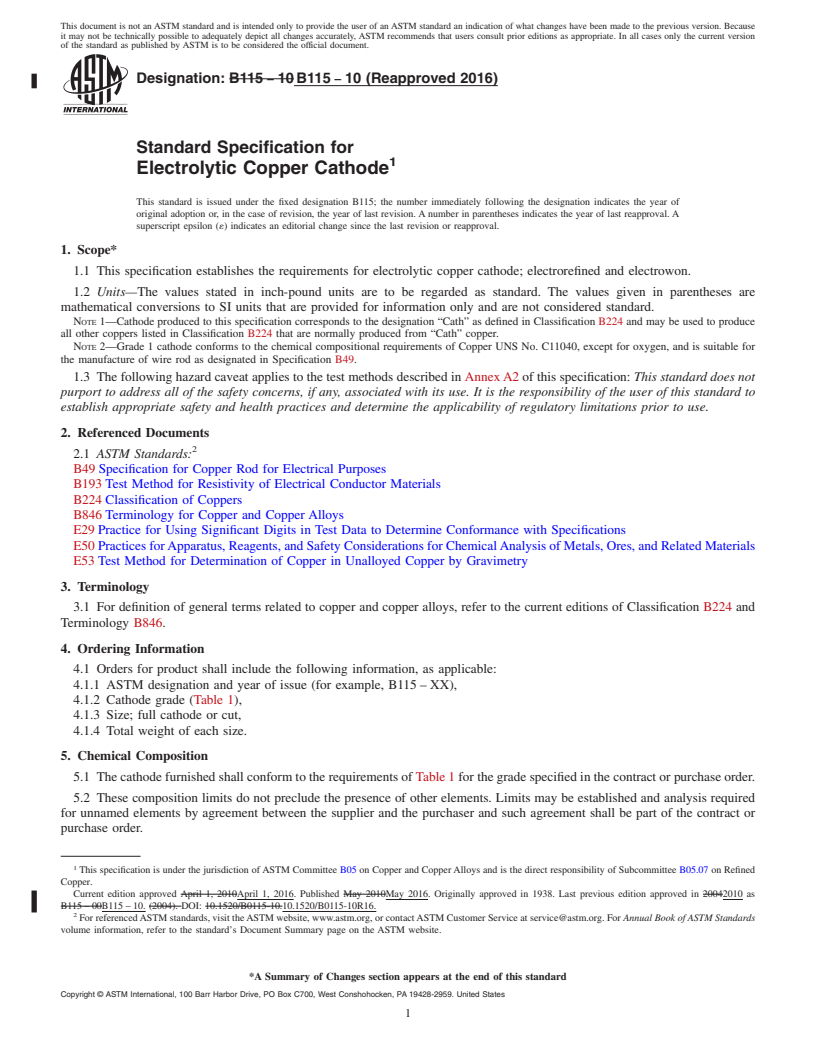
1.1 This specification establishes the requirements for electrolytic copper cathode; electrorefined and electrowon.
1.2 Units—The values stated in inch-pound units are to be regarded as standard. The values given in parentheses are
mathematical conversions to SI units that are provided for information only and are not considered standard.
NOTE 1—Cathode produced to this specification corresponds to the designation “Cath” as defined in Classification B224 and may be used to produce
all other coppers listed in Classification B224 that are normally produced from “Cath” copper.
NOTE 2—Grade 1 cathode conforms to the chemical compositional requirements of Copper UNS No. C11040, except for oxygen, and is suitable for
the manufacture of wire rod as designated in Specification B49.
1.3 The following hazard caveat applies to the test methods described in Annex A2 of this specification: This standard does not
purport to address all of the safety concerns, if any, associated with its use. It is the responsibility of the user of this standard to
establish appropriate safety and health practices and determine the applicability of regulatory limitations prior to use.
2. Referenced Documents
2.1 ASTM Standards:
B49 Specification for Copper Rod for Electrical Purposes
B193 Test Method for Resistivity of Electrical Conductor Materials
B224 Classification of Coppers
B846 Terminology for Copper and Copper Alloys
E29 Practice for Using Significant Digits in Test Data to Determine Conformance with Specifications
E50 Practices for Apparatus, Reagents, and Safety Considerations for Chemical Analysis of Metals, Ores, and Related Materials
E53 Test Method for Determination of Copper in Unalloyed Copper by Gravimetry
3. Terminology
3.1 For definition of general terms related to copper and copper alloys, refer to the current editions of Classification B224 and
Terminology B846.
4. Ordering Information
4.1 Orders for product shall include the following information, as applicable:
4.1.1 ASTM designation and year of issue (for example, B115 – XX),
4.1.2 Cathode grade (Table 1),
4.1.3 Size; full cathode or cut,
4.1.4 Total weight of each size.
5. Chemical Composition
5.1 The cathode furnished shall conform to the requirements of Table 1 for the grade specified in the contract or purchase order.
5.2 These composition limits do not preclude the presence of other elements. Limits may be established and analysis required
for unnamed elements by agreement between the supplier and the purchaser and such agreement shall be part of the contract or
purchase order.
This specification is under the jurisdiction of ASTM Committee B05 on Copper and Copper Alloys and is the direct responsibility of Subcommittee B05.07 on Refined
Copper.
Current edition approved April 1, 2010April 1, 2016. Published May 2010May 2016. Originally approved in 1938. Last previous edition approved in 20042010 as
B115 – 00B115 – 10. (2004). DOI: 10.1520/B0115-10.10.1520/B0115-10R16.
For referenced ASTM standards, visit the ASTM website, www.astm.org, or contact ASTM Customer Service at service@astm.org. For Annual Book of ASTM Standards
volume information, refer to the standard’s Document Summary page on the ASTM website.
*A Summary of Changes section appears at the end of this standard
Copyright © ASTM International, 100 Barr Harbor Drive, PO Box C700, West Conshohocken, PA 19428-2959. United States
B115 − 10 (2016)
TABLE 1 Chemical Composition
A A
Element Grade 1 Grade 2
Percent,%
B
Copper 99.95, min
C
ppm
Selenium, max 2 10
Tellurium, max 2 5
Bismuth, max 1.0 3
Group total, max 3 .
Antimony, max 4 15
Lead, max 5 40
Arsenic, max 5 15
Iron, max 10 25
Nickel, max 10 20
Tin, max 5 10
Sulfur, max 15 25
Silver, max 25 70
Maximum allowable total 65 .
A
Measurement error is not incorporated in the maximum limits, refer to 10.1.1.
B
Including silver.
C
Determined from a melted sample.
6. Physical Property Requirements
6.1 Electrical Resistivity:
6.1.1 The maximum electrical resistivity for product produced from Grade 2 cathode shall be 0.153 28 Ω·g/m (conductivity
100.0 % minimum IACS) at 20°C (68°F) annealed when tested in accordance with Test Method B193. Measurement error is not
included in the maximum/minimum limit.
7. Dimensions, Mass, and Permissible Variations
7.1 Full-size cathodes or cathodes cut to size may be supplied as agreed upon between supplier and purchaser.
8. Workmanship, Finish, and Appearance
8.1 Cathodes shall withstand ordinary handling without breakage or excessive separation of nodules. They shall be substantially
free of all foreign material; for example, copper sulfate, dirt, grease, and oil.
9. Sampling
9.1 For routine sampling of cathodes for analysis, the method of sampling shall be at the discretion of the sampler.
9.2 In case of dispute concerning sampling for chemical composition, or electrical resistivity, or both, the method of sampling
shall be in accordance with Annex A1.
9.3 In case of special requirements specified in the purchase order or contract, the method of sampling shall be as agreed
between the supplier and the purchaser.
10. Number of Tests and Retests
10.1 Tests:
10.1.1 Chemical composition shall be determined as the per element mean of at least two replicate analyses of each sample.
10.1.2 Electrical resistivity shall be determined as the mean of results from four specimens.
10.2 Retests:
10.2.1 In the case of compositional or resistivity dispute, retests may be made under the conditions of 9.2.
10.3 Umpire Test:
10.3.1 In the case in which retest does not settle the dispute, further retest may be made by a qualified third-party laboratory
agreeable to both parties. This provision does not preclude other contractual agreements.
11. Specimen Preparation
11.1 For routine testing, specimen preparation shall be at the discretion of the preparer.
11.2 In the case of special requirements specified in the purchaser order or contract, specimen preparation shall be as agreed
between the supplier and the purchaser.
NBS Notebook 100 available from National Technical Information Service (NTIS), 5301 Shawnee Rd, Alexandria, VA 22312, http://www.ntis.gov.
B115 − 10 (2016)
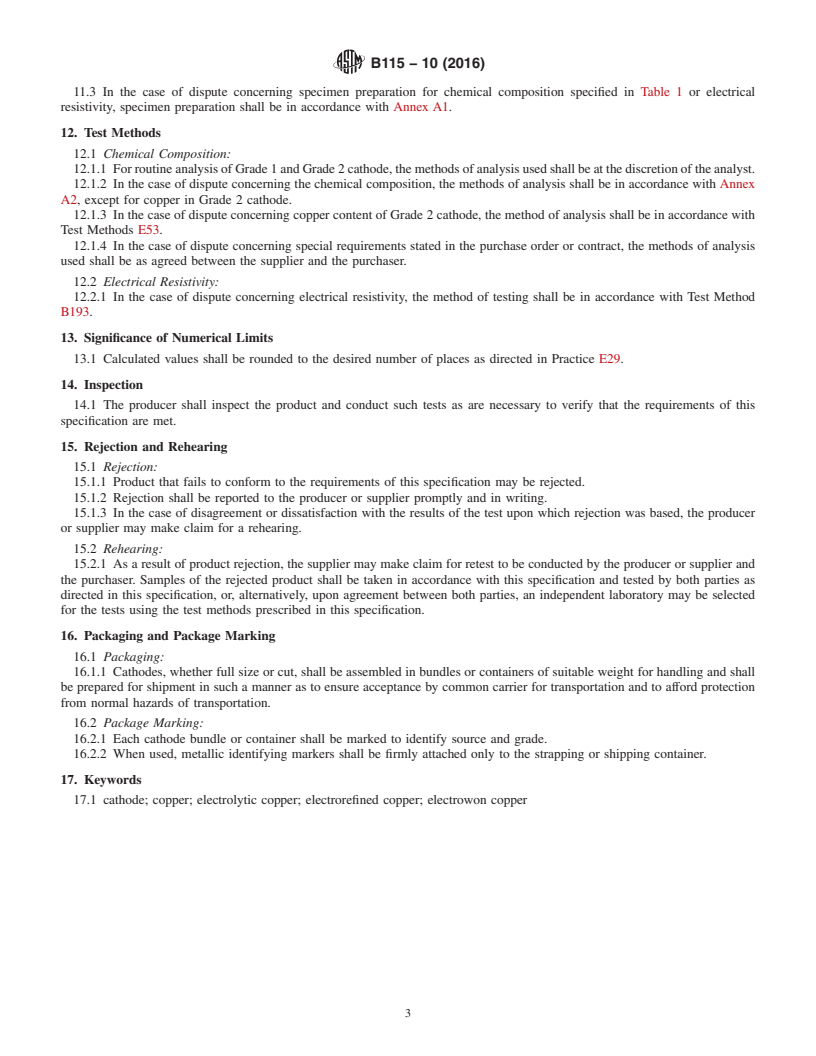
11.3 In the case of dispute concerning specimen preparation for chemical composition specified in Table 1 or electrical
resistivity, specimen preparation shall be in accordance with Annex A1.
12. Test Methods
12.1 Chemical Composition:
12.1.1 For routine analysis of Grade 1 and Grade 2 cathode, the methods of analysis used shall be at the discretion of the analyst.
12.1.2 In the case of dispute concerning the chemical composition, the methods of analysis shall be in accordance with Annex
A2, except for copper in Grade 2 cathode.
12.1.3 In the case of dispute concerning copper content of Grade 2 cathode, the method of analysis shall be in accordance with
Test Methods E53.
12.1.4 In the case of dispute concerning special requirements stated in the purchase order or contract, the methods of analysis
used shall be as agreed between the supplier and the purchaser.
12.2 Electrical Resistivity:
12.2.1 In the case of dispute concerning electrical resistivity, the method of testing shall be in accordance with Test Method
B193.
13. Significance of Numerical Limits
13.1 Calculated values shall be rounded to the desired number of places as directed in Practice E29.
14. Inspection
14.1 The producer shall inspect the product and conduct such tests as are necessary to verify that the requirements of this
specification are met.
15. Rejection and Rehearing
15.1 Rejection:
15.1.1 Product that fails to conform to the requirements of this specification may be rejected.
15.1.2 Rejection shall be reported to the producer or supplier promptly and in writing.
15.1.3 In the case of disagreement or dissatisfaction with the results of the test upon which rejection was based, the producer
or supplier may make claim for a rehearing.
15.2 Rehearing:
15.2.1 As a result of product rejection, the supplier may make claim for retest to be conducted by the producer or supplier and
the purchaser. Samples of the rejected product shall be taken in accordance with this specification and tested by both parties as
directed in this specification, or, alternatively, upon agreement between both parties, an independent laboratory may be selected
for the tests using the test methods prescribed in this specification.
16. Packaging and Package Marking
16.1 Packaging:
16.1.1 Cathodes, whether full size or cut, shall be assembled in bundles or containers of suitable weight for handling and shall
be prepared for shipment in such a manner as to ensure acceptance by common carrier for transportation and to afford protection
from normal hazards of transportation.
16.2 Package Marking:
16.2.1 Each cathode bundle or container shall be marked to identify source and grade.
16.2.2 When used, metallic identifying markers shall be firmly attached only to the strapping or shipping container.
17. Keywords
17.1 cathode; copper; electrolytic copper; electrorefined copper; electrowon copper
B115 − 10 (2016)
ANNEXES
(Mandatory Information)
A1. SAMPLING AND SPECIMEN PREPARATION OF ELECTROLYTIC CATHODE COPPER FOR
DETERMINATION OF COMPLIANCE WITH SPECIFICATION REQUIREMENTS
A1.1 Scope
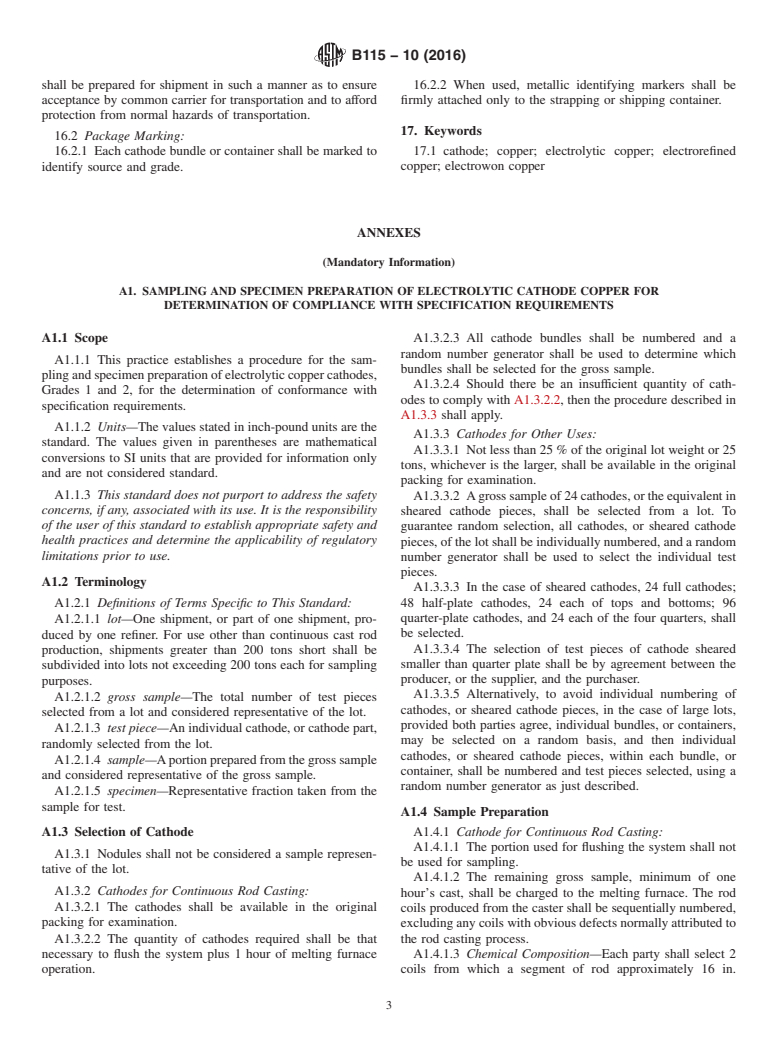
A1.1.1 This practice establishes a procedure for the sampling and specimen preparation of electrolytic copper cathodes, Grades
1 and 2, for the determination of conformance with specification requirements.
A1.1.2 Units—The values stated in inch-pound units are the standard. The values given in parentheses are mathematical
conversions to SI units that are provided for information only and are not considered standard.
A1.1.3 This standard does not purport to address the safety concerns, if any, associated with its use. It is the responsibility of the
user of this standard to establish appropriate safety and health practices and determine the applicability of regulatory limitations
prior to use.
A1.2 Terminology
A1.2.1 Definitions of Terms Specific to This Standard:
A1.2.1.1 lot—One shipment, or part of one shipment, produced by one refiner. For use other than continuous cast rod production,
shipments greater than 200 tons short shall be subdivided into lots not exceeding 200 tons each for sampling purposes.
A1.2.1.2 gross sample—The total number of test pieces selected from a lot and considered representative of the lot.
A1.2.1.3 test piece—An individual cathode, or cathode part, randomly selected from the lot.
A1.2.1.4 sample—A portion prepared from the gross sample and considered representative of the gross sample.
A1.2.1.5 specimen—Representative fraction taken from the sample for test.
A1.3 Selection of Cathode
A1.3.1 Nodules shall not be considered a sample representative of the lot.
A1.3.2 Cathodes for Continuous Rod Casting:
A1.3.2.1 The cathodes shall be available in the original packing for examination.
A1.3.2.2 The quantity of cathodes required shall be that necessary to flush the system plus 1 hour of melting furnace operation.
A1.3.2.3 All cathode bundles shall be numbered and a random number generator shall be used to determine which bundles shall
be selected for the gross sample.
A1.3.2.4 Should there be an insufficient quantity of cathodes to comply with A1.3.2.2, then the procedure described in A1.3.3 shall
apply.
A1.3.3 Cathodes for Other Uses:
A1.3.3.1 Not less than 25 % of the original lot weight or 25 tons, whichever is the larger, shall be available in the original packing
for examination.
B115 − 10 (2016)
A1.3.3.2 A gross sample of 24 cathodes, or the equivalent in sheared cathode pieces, shall be selected from a lot. To guarantee
random selection, all cathodes, or sheared cathode pieces, of the lot shall be individually numbered, and a random number
generator shall be used to select the individual test pieces.
A1.3.3.3 In the case of sheared cathodes, 24 full cathodes; 48 half-plate cathodes, 24 each of tops and bottoms; 96 quarter-plate
cathodes, and 24 each of the four quarters, shall be selected.
A1.3.3.4 The selection of test pieces of cathode sheared smaller than quarter plate shall be by agreement between the producer,
or the supplier, and the purchaser.
A1.3.3.5 Alternatively, to avoid individual numbering of cathodes, or sheared cathode pieces, in the case of large lots, provided
both parties agree, individual bundles, or containers, may be selected on a random basis, and then individual cathodes, or sheared
cathode pieces, within each bundle, or container, shall be numbered and test pieces selected, using a random number generator as
just described.
A1.4 Sample Preparation
A1.4.1 Cathode for Continuous Rod Casting:
A1.4.1.1 The portion used for flushing the system shall not be used for sampling.
A1.4.1.2 The remaining gross sample, minimum of one hour’s cast, shall be charged to the melting furnace. The rod coils
produced from the caster shall be sequentially numbered, excluding any coils with obvious defects normally attributed to the rod
casting process.
A1.4.1.3 Chemical Composition—Each party shall select 2 coils from which a segment of rod approximately 16 in. (406 mm)
(406 mm) in length shall be cut at the trailing ends of the coils. Each rod segment shall be cut into 4 portions of approximate equal
lengths. The 16 portions shall be divided into 4 groups; each group shall contain one portion from each of the 4 original rod
segments. The 4 groups of rod portions shall be placed in separate noncontaminating containers, then sealed and identified for the
supplier, the purchaser, contingency, and umpire if necessary.
A1.4.1.4 Electrical Resistivity—Each party shall select 2 coils from which a rod segment of sufficient length for test shall be taken
from the trailing ends of the coils. Each rod segment shall be cold drawn into a wire about 0.080 in. diameter (2.0 mm) and at
least 160 in. in length (4 m). Each wire coil shall
...
Questions, Comments and Discussion
Ask us and Technical Secretary will try to provide an answer. You can facilitate discussion about the standard in here.