

ASTM D5665/D5665M-99a(2021)
(Specification)Standard Specification for Thermoplastic Fabrics Used in Cold-Applied Roofing and Waterproofing
General Information
- Abstract
ABSTRACT
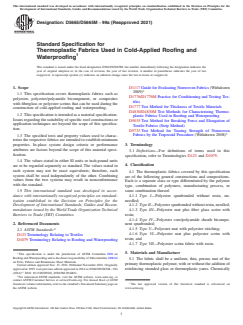
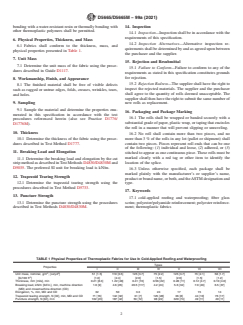
This specification covers thermoplastic fabrics such as polyester, polyester/polyamide bicomponent, or composites with fiberglass or polyester scrims that can be used during the construction of cold-applied roofing and waterproofing. The thermoplastic fabrics shall be classified as: Type I; Type II; Type III; Type IV; Type V; Type VI; and Type VII. Fabrics shall conform to the thickness, mass, and physical properties specified. Tests shall be performed to determine the properties of the material in accordance with the following test methods: unit mass; thickness; breaking load and elongation; trapezoid tearing strength; and puncture strength.
SCOPE
1.1 This specification covers thermoplastic fabrics such as polyester, polyester/polyamide bicomponent, or composites with fiberglass or polyester scrims that can be used during the construction of cold-applied roofing and waterproofing.
1.2 This specification is intended as a material specification. Issues regarding the suitability of specific roof constructions or application techniques are beyond the scope of this specification.
1.3 The specified tests and property values used to characterize the respective fabrics are intended to establish minimum properties. In-place system design criteria or performance attributes are factors beyond the scope of this material specification.
1.4 The values stated in either SI units or inch-pound units are to be regarded separately as standard. The values stated in each system may not be exact equivalents; therefore, each system shall be used independently of the other. Combining values from the two systems may result in nonconformance with the standard.
1.5 This international standard was developed in accordance with internationally recognized principles on standardization established in the Decision on Principles for the Development of International Standards, Guides and Recommendations issued by the World Trade Organization Technical Barriers to Trade (TBT) Committee.
- Status
- Published
- Publication Date
- 14-Nov-2021
- Technical Committee
- D08 - Roofing and Waterproofing
- Drafting Committee
- D08.04 - Felts, Fabrics and Bituminous Sheet Materials


Overview
ASTM D5665/D5665M-99a(2021) is a comprehensive standard issued by ASTM International that specifies requirements for thermoplastic fabrics used in cold-applied roofing and waterproofing systems. This specification covers various fabric types, including those made from polyester, polyester/polyamide bicomponent materials, and composites containing fiberglass or polyester scrims. The standard outlines essential material properties and test methods to ensure the quality, durability, and performance of these thermoplastic fabrics within construction projects, particularly where cold-applied systems are used for roofing or waterproofing.
Key Topics
- Material Types: The standard classifies thermoplastic fabrics into seven distinct types based on construction and composition, including spunbonded polyester, bicomponent polyester/polyamide, and composite fabrics with scrims and resins.
- Performance Requirements: Fabrics must meet specified minimum values for unit mass, thickness, breaking load, elongation, tearing strength, and puncture strength.
- Testing Procedures: Physical properties are measured according to referenced ASTM test methods, ensuring standardized evaluation of material performance.
- Workmanship and Appearance: The final fabric must be free of visible defects such as ragged edges, tears, wrinkles, or holes to guarantee reliability in application.
- Inspection and Rejection: Procedures for inspection, alternative inspection requirements, and criteria for rejection and resubmittal are detailed to maintain quality control.
- Packaging and Marking: Guidance is provided for securely packaging and clearly marking rolls, including requirements for identifying rolls with splices.
Applications
Thermoplastic fabrics specified under ASTM D5665/D5665M-99a(2021) are primarily used in:
- Cold-Applied Roofing Systems: Serving as a core reinforcement layer, these fabrics enhance membrane strength, durability, and resistance to weathering in cold-applied roofing applications.
- Waterproofing Membranes: Providing structural reinforcement within cold-applied waterproofing systems, the fabrics help prevent water ingress and improve the longevity of waterproof barriers in various construction settings.
- Commercial and Industrial Construction: Essential for projects requiring robust, reliable, and standardized waterproofing or roofing membranes that perform under various environmental conditions.
- Retrofit and Repair Applications: Used in restoration or overlay of existing roofing or waterproofing systems, offering additional reinforcement and improved performance characteristics.
Related Standards
ASTM D5665/D5665M-99a(2021) references several other important ASTM standards and resources, including:
- ASTM D123: Terminology Relating to Textiles
- ASTM D1079: Terminology Relating to Roofing and Waterproofing
- ASTM D1776/D1776M: Practice for Conditioning and Testing Textiles
- ASTM D1777: Test Method for Thickness of Textile Materials
- ASTM D4830/D4830M: Test Methods for Characterizing Thermoplastic Fabrics Used in Roofing and Waterproofing
- ASTM D5035: Test Method for Breaking Force and Elongation of Textile Fabrics (Strip Method)
- ASTM D5733: Test Method for Tearing Strength of Nonwoven Fabrics by the Trapezoid Procedure (withdrawn)
These standards collectively establish a framework for ensuring product consistency, safety, and performance in the construction and roofing industries.
Keywords: ASTM D5665, thermoplastic fabrics, cold-applied roofing, waterproofing, roofing reinforcement, polyester fabrics, fiberglass scrim, fabric testing, construction standards, ASTM roofing standards.
Relations
- Effective Date
- 01-May-2020
- Effective Date
- 01-Feb-2020
- Effective Date
- 01-Jul-2019
- Effective Date
- 01-Jul-2019
- Effective Date
- 15-Dec-2018
- Effective Date
- 15-Dec-2018
- Effective Date
- 01-Mar-2017
- Effective Date
- 01-Feb-2016
- Effective Date
- 01-Jan-2016
- Effective Date
- 15-Sep-2015
- Effective Date
- 01-Sep-2015
- Effective Date
- 01-Jul-2015
- Effective Date
- 01-Apr-2015
- Effective Date
- 01-Feb-2015
- Effective Date
- 15-Jun-2013
Get Certified
Connect with accredited certification bodies for this standard

DIBt (Deutsches Institut für Bautechnik)
German Institute for Building Technology.
DIN CERTCO
DIN Group product certification.

Aboma Certification B.V.
Specialized in construction, metal, and transport sectors.
Sponsored listings
Frequently Asked Questions
ASTM D5665/D5665M-99a(2021) is a technical specification published by ASTM International. Its full title is "Standard Specification for Thermoplastic Fabrics Used in Cold-Applied Roofing and Waterproofing". This standard covers: ABSTRACT This specification covers thermoplastic fabrics such as polyester, polyester/polyamide bicomponent, or composites with fiberglass or polyester scrims that can be used during the construction of cold-applied roofing and waterproofing. The thermoplastic fabrics shall be classified as: Type I; Type II; Type III; Type IV; Type V; Type VI; and Type VII. Fabrics shall conform to the thickness, mass, and physical properties specified. Tests shall be performed to determine the properties of the material in accordance with the following test methods: unit mass; thickness; breaking load and elongation; trapezoid tearing strength; and puncture strength. SCOPE 1.1 This specification covers thermoplastic fabrics such as polyester, polyester/polyamide bicomponent, or composites with fiberglass or polyester scrims that can be used during the construction of cold-applied roofing and waterproofing. 1.2 This specification is intended as a material specification. Issues regarding the suitability of specific roof constructions or application techniques are beyond the scope of this specification. 1.3 The specified tests and property values used to characterize the respective fabrics are intended to establish minimum properties. In-place system design criteria or performance attributes are factors beyond the scope of this material specification. 1.4 The values stated in either SI units or inch-pound units are to be regarded separately as standard. The values stated in each system may not be exact equivalents; therefore, each system shall be used independently of the other. Combining values from the two systems may result in nonconformance with the standard. 1.5 This international standard was developed in accordance with internationally recognized principles on standardization established in the Decision on Principles for the Development of International Standards, Guides and Recommendations issued by the World Trade Organization Technical Barriers to Trade (TBT) Committee.
ABSTRACT This specification covers thermoplastic fabrics such as polyester, polyester/polyamide bicomponent, or composites with fiberglass or polyester scrims that can be used during the construction of cold-applied roofing and waterproofing. The thermoplastic fabrics shall be classified as: Type I; Type II; Type III; Type IV; Type V; Type VI; and Type VII. Fabrics shall conform to the thickness, mass, and physical properties specified. Tests shall be performed to determine the properties of the material in accordance with the following test methods: unit mass; thickness; breaking load and elongation; trapezoid tearing strength; and puncture strength. SCOPE 1.1 This specification covers thermoplastic fabrics such as polyester, polyester/polyamide bicomponent, or composites with fiberglass or polyester scrims that can be used during the construction of cold-applied roofing and waterproofing. 1.2 This specification is intended as a material specification. Issues regarding the suitability of specific roof constructions or application techniques are beyond the scope of this specification. 1.3 The specified tests and property values used to characterize the respective fabrics are intended to establish minimum properties. In-place system design criteria or performance attributes are factors beyond the scope of this material specification. 1.4 The values stated in either SI units or inch-pound units are to be regarded separately as standard. The values stated in each system may not be exact equivalents; therefore, each system shall be used independently of the other. Combining values from the two systems may result in nonconformance with the standard. 1.5 This international standard was developed in accordance with internationally recognized principles on standardization established in the Decision on Principles for the Development of International Standards, Guides and Recommendations issued by the World Trade Organization Technical Barriers to Trade (TBT) Committee.
ASTM D5665/D5665M-99a(2021) is classified under the following ICS (International Classification for Standards) categories: 91.100.50 - Binders. Sealing materials. The ICS classification helps identify the subject area and facilitates finding related standards.
ASTM D5665/D5665M-99a(2021) has the following relationships with other standards: It is inter standard links to ASTM D1079-20, ASTM D1776/D1776M-20, ASTM D5035-11(2019), ASTM D1777-96(2019), ASTM D1079-18e1, ASTM D1079-18, ASTM D123-17, ASTM D1079-16, ASTM D1776/D1776M-16, ASTM D123-15b, ASTM D123-15a, ASTM D1777-96(2015), ASTM D123-15, ASTM D1776/D1776M-15, ASTM D123-13a. Understanding these relationships helps ensure you are using the most current and applicable version of the standard.
ASTM D5665/D5665M-99a(2021) is available in PDF format for immediate download after purchase. The document can be added to your cart and obtained through the secure checkout process. Digital delivery ensures instant access to the complete standard document.
Standards Content (Sample)
This international standard was developed in accordance with internationally recognized principles on standardization established in the Decision on Principles for the
Development of International Standards, Guides and Recommendations issued by the World Trade Organization Technical Barriers to Trade (TBT) Committee.
Designation:D5665/D5665M −99a (Reapproved 2021)
Standard Specification for
Thermoplastic Fabrics Used in Cold-Applied Roofing and
Waterproofing
This standard is issued under the fixed designation D5665/D5665M; the number immediately following the designation indicates the
year of original adoption or, in the case of revision, the year of last revision. A number in parentheses indicates the year of last
reapproval. A superscript epsilon (´) indicates an editorial change since the last revision or reapproval.
1. Scope D1117 Guide for Evaluating Nonwoven Fabrics (Withdrawn
2009)
1.1 This specification covers thermoplastic fabrics such as
D1776/D1776M Practice for Conditioning and Testing Tex-
polyester, polyester/polyamide bicomponent, or composites
tiles
with fiberglass or polyester scrims that can be used during the
D1777 Test Method for Thickness of Textile Materials
construction of cold-applied roofing and waterproofing.
D4830/D4830M Test Methods for Characterizing Thermo-
1.2 This specification is intended as a material specification.
plastic Fabrics Used in Roofing and Waterproofing
Issues regarding the suitability of specific roof constructions or
D5035 Test Method for Breaking Force and Elongation of
application techniques are beyond the scope of this specifica-
Textile Fabrics (Strip Method)
tion.
D5733 Test Method for Tearing Strength of Nonwoven
1.3 The specified tests and property values used to charac- Fabrics by the Trapezoid Procedure (Withdrawn 2008)
terize the respective fabrics are intended to establish minimum
3. Terminology
properties. In-place system design criteria or performance
attributes are factors beyond the scope of this material speci-
3.1 Definitions—For definitions of terms used in this
fication.
specification, refer to Terminologies D123 and D1079.
1.4 The values stated in either SI units or inch-pound units
4. Classification
are to be regarded separately as standard. The values stated in
each system may not be exact equivalents; therefore, each
4.1 The thermoplastic fabrics covered by this specification
system shall be used independently of the other. Combining
are of the following general constructions and compositions.
values from the two systems may result in nonconformance
Each is a separate class or type differentiated by the polymer
with the standard.
type, combination of polymers, manufacturing process, or
1.5 This international standard was developed in accor- some combination thereof.
dance with internationally recognized principles on standard- 4.1.1 Type I—Polyester spunbonded without resin, un-
ization established in the Decision on Principles for the needled;
Development of International Standards, Guides and Recom- 4.1.2 Type II—Polyesterspunbondedwithoutresin,needled;
mendations issued by the World Trade Organization Technical 4.1.3 Type III—Polyester mat plus fiber glass scrim with
Barriers to Trade (TBT) Committee. resin;
4.1.4 Type IV—Polyester core/polyamide sheath bicompo-
2. Referenced Documents
nent spunbonded;
4.1.5 Type V—Polyester mat with polyester stitching;
2.1 ASTM Standards:
4.1.6 Type VI—Polyester mat plus polyester scrim with
D123 Terminology Relating to Textiles
resin; and
D1079 Terminology Relating to Roofing and Waterproofing
4.1.7 Type VII—Polyester scrim fabric with resin.
5. Materials and Manufacture
This specification is under the jurisdiction of ASTM Committee D08 on
Roofing and Waterproofing and is the direct responsibility of Subcommittee D08.04
5.1 The fabric shall be a uniform, thin, porous mat of the
on Felts, Fabrics and Bituminous Sheet Materials.
primary thermoplastic polymer, with or without the addition of
Current edition approved Nov. 15, 2021. Published November 2021. Originally
approved in 1995. Last previous edition approved in 2014 as D5665/D5665M – 99a reinforcing stranded glass or thermoplastic yarns. Chemically
ɛ1
(2014) . DOI: 10.1520/D5665_D5665M-99AR21.
For referenced ASTM standards, visit the ASTM website, www.astm.org, or
contact ASTM Customer Service at service@astm.org. For Annual Book of ASTM
Standards volume information, refer to the standard’s Document Summary page on The last approved version of this historical standard is referenced on
the ASTM website. www.astm.org.
Copyright © ASTM International, 100 Barr Harbor Drive, PO Box C700, West Conshohocken, PA 19428-2959. United States
D5665/D5665M−99a (2021)
bonding with a water-resistant resin or thermally bonding with 14. Inspection
other thermoplastic polymers shall be permitted.
14.1 Inspection—Inspection shall be in accordance with the
requirements of this specification.
6. Physical Properties, Thickness, and Mass
14.2 Inspection Alternatives—Alternative insp
...