


ASTM C719-14(2019)
(Test Method)Standard Test Method for Adhesion and Cohesion of Elastomeric Joint Sealants Under Cyclic Movement (Hockman Cycle)
Standard Test Method for Adhesion and Cohesion of Elastomeric Joint Sealants Under Cyclic Movement (Hockman Cycle)
SIGNIFICANCE AND USE
5.1 The failure of a building sealant in an active joint is usually manifested by cohesive failure in the sealant or adhesive failure between the sealant and the substrate, or both. The method described in this test method relates only to the performance of the sealant when properly installed with recommended primers, and does not evaluate sealant failures caused by improper joint design, excessive joint movement, improper application practices, and other factors known to cause sealant failure in buildings and building areas.
SCOPE
1.1 This test method is an accelerated laboratory procedure for evaluating the performance of a building sealant in a test configuration that is subjected to water immersion, cyclic movement, and temperature change.3
1.2 The values stated in inch-pound units are to be regarded as standard. The values given in parentheses are mathematical conversions to SI units that are provided for information only and are not considered standard.
1.3 This standard does not purport to address all of the safety concerns, if any, associated with its use. It is the responsibility of the user of this standard to establish appropriate safety, health, and environmental practices and determine the applicability of regulatory limitations prior to use.
1.4 This international standard was developed in accordance with internationally recognized principles on standardization established in the Decision on Principles for the Development of International Standards, Guides and Recommendations issued by the World Trade Organization Technical Barriers to Trade (TBT) Committee.
General Information
Buy Standard
Standards Content (Sample)
NOTICE: This standard has either been superseded and replaced by a new version or withdrawn.
Contact ASTM International (www.astm.org) for the latest information
Designation: C719 − 14 (Reapproved 2019)
Standard Test Method for
Adhesion and Cohesion of Elastomeric Joint Sealants
1,2
Under Cyclic Movement (Hockman Cycle)
This standard is issued under the fixed designation C719; the number immediately following the designation indicates the year of
original adoption or, in the case of revision, the year of last revision.Anumber in parentheses indicates the year of last reapproval.A
superscript epsilon (´) indicates an editorial change since the last revision or reapproval.
This standard has been approved for use by agencies of the U.S. Department of Defense.
1. Scope C109/C109MTest Method for Compressive Strength of
Hydraulic Cement Mortars (Using 2-in. or [50-mm] Cube
1.1 This test method is an accelerated laboratory procedure
Specimens)
for evaluating the performance of a building sealant in a test
C150Specification for Portland Cement
configuration that is subjected to water immersion, cyclic
3 C717Terminology of Building Seals and Sealants
movement, and temperature change.
1.2 The values stated in inch-pound units are to be regarded
3. Terminology
as standard. The values given in parentheses are mathematical
3.1 Definitions—For definitions of terms used in this test
conversions to SI units that are provided for information only
method, refer to Terminology C717.
and are not considered standard.
1.3 This standard does not purport to address all of the 4. Summary of Test Method
safety concerns, if any, associated with its use. It is the
4.1 This test method consists of subjecting standard joint
responsibility of the user of this standard to establish appro-
specimens to a series of treatments as follows: (a) immersion
priate safety, health, and environmental practices and deter-
inwaterforsevendays;(b)exposureinanovenforsevendays
mine the applicability of regulatory limitations prior to use.
while under compression; (c) automatic compression and
1.4 This international standard was developed in accor-
extension cycling at room temperature at a specified rate and
dance with internationally recognized principles on standard-
amount of joint movement; and (d) alternate compression and
ization established in the Decision on Principles for the
extension of the joint at high and low temperatures,
Development of International Standards, Guides and Recom-
respectively, under specified conditions described herein.
mendations issued by the World Trade Organization Technical
4.2 The effects of the test shall be evaluated by visual
Barriers to Trade (TBT) Committee.
inspection for cohesive and adhesive failures, sealant
2. Referenced Documents
deformation, and bubble formation within the sealant.
2.1 ASTM Standards:
4.3 This test method is applicable to any joint movement.
C33Specification for Concrete Aggregates
The most common test movements are 612.5 and 625% as
used in the examples.
ThistestmethodisunderthejurisdictionofASTMCommitteeC24onBuilding
Seals and Sealants and is the direct responsibility of Subcommittee C24.30 on
5. Significance and Use
Adhesion.
5.1 The failure of a building sealant in an active joint is
Current edition approved Jan. 1, 2019. Published January 2019. Originally
approved in 1972. Last previous edition approved in 2014 as C719–14. DOI:
usually manifested by cohesive failure in the sealant or
10.1520/C0719-14R19.
adhesive failure between the sealant and the substrate, or both.
This test method is also known as the Hockman Cycle in recognition ofArthur
The method described in this test method relates only to the
Hockman who originated the method at the National Bureau of Standards.
performance of the sealant when properly installed with
Supporting data are available fromASTM International Headquarters. Request
RR:C24-1013.
recommended primers, and does not evaluate sealant failures
For referenced ASTM standards, visit the ASTM website, www.astm.org, or
caused by improper joint design, excessive joint movement,
contact ASTM Customer Service at service@astm.org. For Annual Book of ASTM
improper application practices, and other factors known to
Standards volume information, refer to the standard’s Document Summary page on
the ASTM website. cause sealant failure in buildings and building areas.
Copyright © ASTM International, 100 Barr Harbor Drive, PO Box C700, West Conshohocken, PA 19428-2959. United States
C719 − 14 (2019)
6. Apparatus each block by wet grinding either with a belt sander using No.
5 60aluminumcarbidesandingbeltorusinganironlapwithNo.
6.1 Compression-Extension Machine, designedtoautomati-
60 silicon carbide (or aluminum oxide) grain until the aggre-
cally compress the joint width of the test specimen from 0.500
gate is uniformly exposed. Return blocks to saturated lime
in. (12.7 mm) to the minimum dimension desired (Table 1,
water storage until needed.
Column C) and extend the specimen from 0.500 in. to the
7.1.1.1 Blocks may be prepared and shipped to other loca-
maximum extension desired (Table 1, Column E) at a constant
tions for use. The blocks may be shipped dry and shall be
rateof ⁄8in./h(3.2mm/h).Themachineshallbeequippedwith
returned to lime water storage on arrival until needed.
grips of sufficient strength to withstand, without bending, the
7.1.1.2 Prior to use, wet grind the previously ground face to
resistance of high tensile strength sealants (see Figs. 1-3).
remove any laitance, rinse thoroughly under running tap water
6.2 Cold Box or Chamber, maintained at−15 6 3°F (−26.1
and dry the blocks overnight at 220 to 230°F (105 to 110°C).
6 1.7°C).
Clean the blocks of film or powder by vigorous brushing with
a stiff-bristled fiber brush. Condition the blocks at standard
6.3 Forced-Draft Oven, controlled at 158 6 3.6°F (70 6
2°C). conditions for not less than one day and not more than seven
days.
6.4 C-clamps, or other device for maintaining the specimen
7.1.2 Float Glass—Glass plates shall be 3 by 1 by ⁄4 in.
under compression.
(76.2 by 25.4 by 6.4 mm) clear float glass. Prior to use, the
6.5 Spacer Blocks.
glass shall be cleaned by wiping the surface with methyl ethyl
ketone or similar solvent. Then dip the surface in a detergent
6.6 Room or Chamber, maintained at standard conditions as
solution.Thisshouldbea0.04%solutionofanalcoholethoxy
noted in Terminology C717.
sulfate. An alternative would be a 0.1% solution of a clear
7. Test Specimens
hand dishwashing detergent. These solutions should be made
up in distilled or deionized water. Rinse the surface (without
7.1 The standard substrate used in the test shall be portland
touching it) in distilled or deionized water and allow it to air
cement mortar, float glass, and aluminum alloy.
dry.Thefloatglassrequiresreinforcementtosurvivetherigors
NOTE 1—When requested, only one or two of the standard materials
of the subsequent testing procedures. This must be done prior
may be tested with the sample. Likewise other substrates such as brick,
to the compression-extension cycling performed in 9.4. Rein-
marble, wood, etc., may be specified by the purchaser in place of or in
forcement is provided by adhering 3 by 1 by ⁄4 in. (76.2 by
addition to the standard substrate for test with the sealant sample.
25.4 by 6.4 mm) aluminum plates to the two outside surfaces
7.1.1 Mortar Block—Prepare cement mortar blocks, each 3
of the formed test specimen. Any adhesive may be used.
by 1 by 1 in. (75 by 25 by 25 mm) in size, using one part of
Commercially available two part epoxies have been found
high early strength portland cement conforming to Type III of
suitable. Although the time of reinforcement is not critical,
Specification C150 to two parts by weight of clean uniformly
application of the aluminum plates to the glass before prepar-
graded, concrete fine aggregate (sand) conforming to Specifi-
ing the test specimens has been found convenient.
cation C33. Use sufficient water to produce a flow of 100 6 5
7.1.3 Aluminum—The aluminum plates shall be 3 by 1 by
% when tested in accordance with the procedure for the
⁄4in. (76.2 by 25.4 by 6.4 mm) aluminum alloy, 6063-T5, or
determination of consistency of cement mortar described in
6061-T6 with anodizing process AA-M10C22A31. Prior to
Test Method C109/C109M. After curing one day in moist air
use, the aluminum (and other metallic substrates, when speci-
and six days in saturated lime water at 73 6 3°F (23 6 2°C),
fied) shall be cleaned as specified for float glass (7.1.2)(Notes
prepare the surface of one face, 1 by 3 in. (25 by 75 mm), of
2 and 3).
NOTE 2—Methyl ethyl ketone and similar solvents are both toxic and
Series 520 Sealing Compound Tester, manufactured by Applied Test Systems
flammable and should be handled with caution in a well ventilated hood.
Inc.,348NewCastleRd.,Butler,PA16001,andadurabilitytestermanufacturedby
NOTE 3—At the request of the sealant producer, the detergent cleaning
Ambard, Inc., 269-11 81st Ave., New Hyde Park, NY 11040, have been found
step shall be omitted.
suitable for this purpose (Fig. 1(a)). For extension of the joint at cold temperature,
the machine may be designed for extension only (Fig. 3).
7.2 Primers—Where use of primer is recommended by the
The sole source of supply of the apparatus known to the committee at this time
sealant manufacturer, substrate materials shall be primed with
is Applied Test Systems Inc. and Ambard Inc. If you are aware of alternative
the recommended primer or primers.
suppliers, please provide this information to ASTM International Headquarters.
Your comments will receive careful consideration at a meeting of the responsible
7.3 Preparation of Test Speci
...
This document is not an ASTM standard and is intended only to provide the user of an ASTM standard an indication of what changes have been made to the previous version. Because
it may not be technically possible to adequately depict all changes accurately, ASTM recommends that users consult prior editions as appropriate. In all cases only the current version
of the standard as published by ASTM is to be considered the official document.
Designation: C719 − 14 C719 − 14 (Reapproved 2019)
Standard Test Method for
Adhesion and Cohesion of Elastomeric Joint Sealants
1,2
Under Cyclic Movement (Hockman Cycle)
This standard is issued under the fixed designation C719; the number immediately following the designation indicates the year of
original adoption or, in the case of revision, the year of last revision. A number in parentheses indicates the year of last reapproval. A
superscript epsilon (´) indicates an editorial change since the last revision or reapproval.
This standard has been approved for use by agencies of the U.S. Department of Defense.
1. Scope
1.1 This test method is an accelerated laboratory procedure for evaluating the performance of a building sealant in a test
configuration that is subjected to water immersion, cyclic movement, and temperature change.
1.2 The values stated in inch-pound units are to be regarded as standard. The values given in parentheses are mathematical
conversions to SI units that are provided for information only and are not considered standard.
1.3 This standard does not purport to address all of the safety concerns, if any, associated with its use. It is the responsibility
of the user of this standard to establish appropriate safety safety, health, and healthenvironmental practices and determine the
applicability of regulatory limitations prior to use.
1.4 This international standard was developed in accordance with internationally recognized principles on standardization
established in the Decision on Principles for the Development of International Standards, Guides and Recommendations issued
by the World Trade Organization Technical Barriers to Trade (TBT) Committee.
2. Referenced Documents
2.1 ASTM Standards:
C33 Specification for Concrete Aggregates
C109/C109M Test Method for Compressive Strength of Hydraulic Cement Mortars (Using 2-in. or [50-mm] Cube Specimens)
C150 Specification for Portland Cement
C717 Terminology of Building Seals and Sealants
3. Terminology
3.1 Definitions—For definitions of terms used in this test method, refer to Terminology C717.
4. Summary of Test Method
4.1 This test method consists of subjecting standard joint specimens to a series of treatments as follows: (a) immersion in water
for seven days; (b) exposure in an oven for seven days while under compression; (c) automatic compression and extension cycling
at room temperature at a specified rate and amount of joint movement; and (d) alternate compression and extension of the joint
at high and low temperatures, respectively, under specified conditions described herein.
4.2 The effects of the test shall be evaluated by visual inspection for cohesive and adhesive failures, sealant deformation, and
bubble formation within the sealant.
4.3 This test method is applicable to any joint movement. The most common test movements are 612.5 and 625 % as used
in the examples.
This test method is under the jurisdiction of ASTM Committee C24 on Building Seals and Sealants and is the direct responsibility of Subcommittee C24.30 on Adhesion.
Current edition approved July 15, 2014Jan. 1, 2019. Published August 2014January 2019. Originally approved in 1972. Last previous edition approved in 20132014 as
C719 – 13.C719 – 14. DOI: 10.1520/C0719-14.10.1520/C0719-14R19.
This test method is also known as the Hockman Cycle in recognition of Arthur Hockman who originated the method at the National Bureau of Standards.
Supporting data are available from ASTM International Headquarters. Request RR:C24-1013.
For referenced ASTM standards, visit the ASTM website, www.astm.org, or contact ASTM Customer Service at service@astm.org. For Annual Book of ASTM Standards
volume information, refer to the standard’s Document Summary page on the ASTM website.
Copyright © ASTM International, 100 Barr Harbor Drive, PO Box C700, West Conshohocken, PA 19428-2959. United States
C719 − 14 (2019)
5. Significance and Use
5.1 The failure of a building sealant in an active joint is usually manifested by cohesive failure in the sealant or adhesive failure
between the sealant and the substrate, or both. The method described in this test method relates only to the performance of the
sealant when properly installed with recommended primers, and does not evaluate sealant failures caused by improper joint design,
excessive joint movement, improper application practices, and other factors known to cause sealant failure in buildings and
building areas.
6. Apparatus
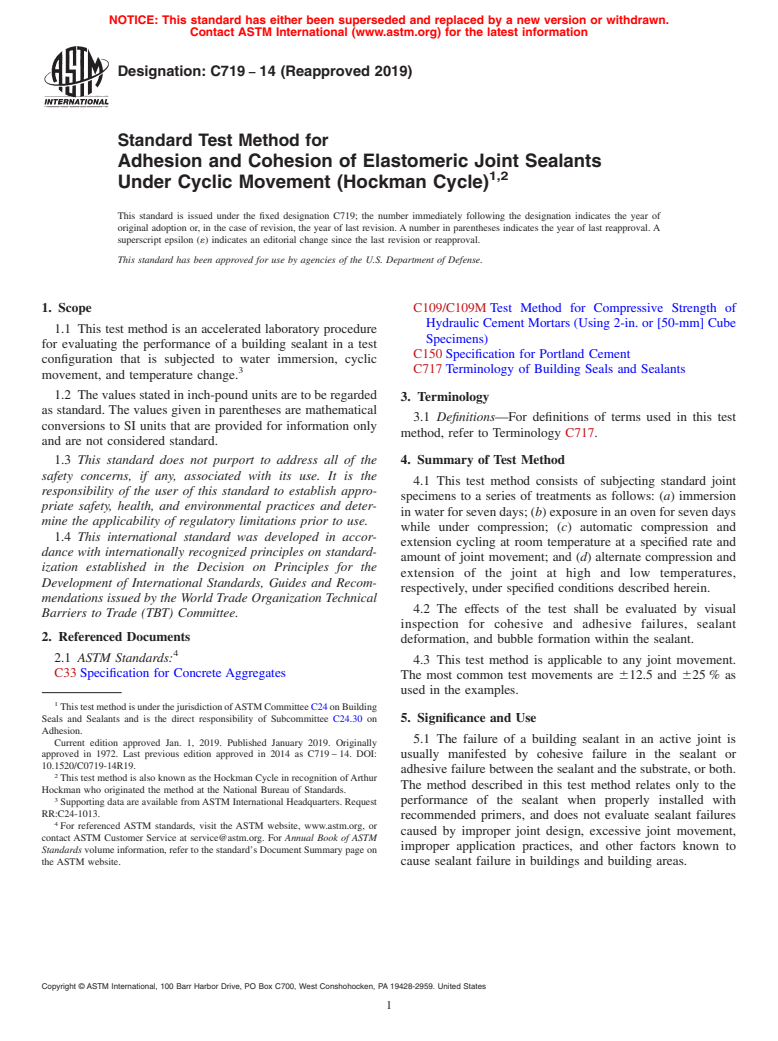
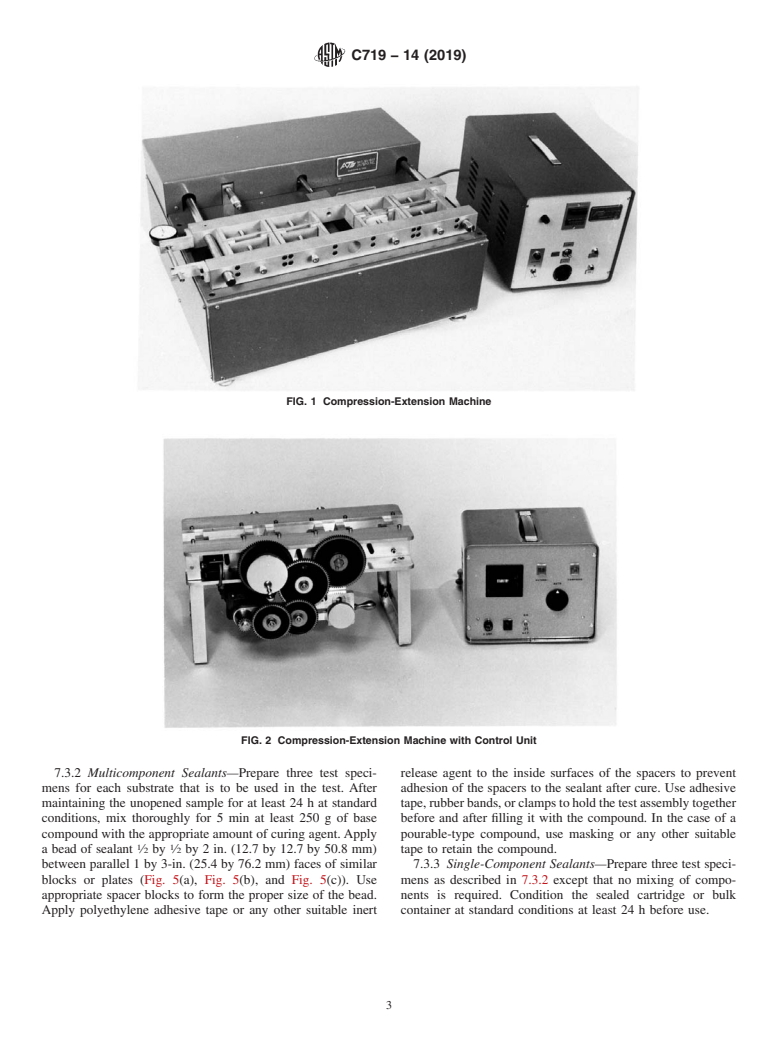
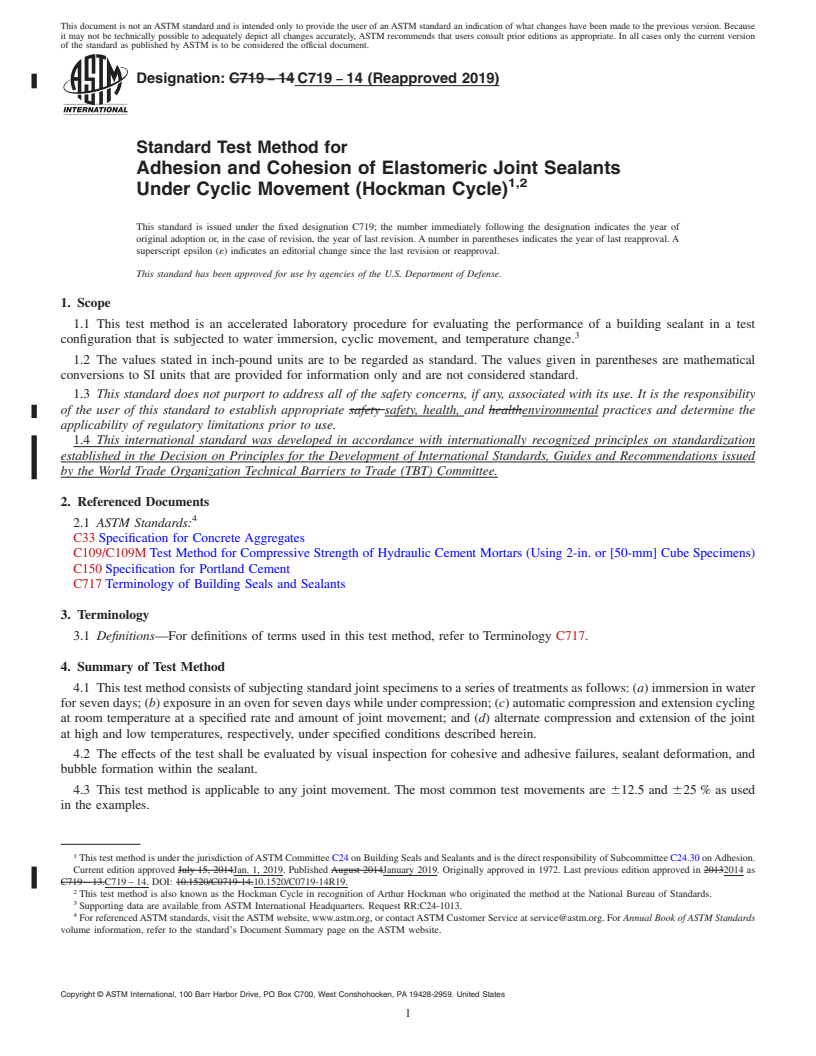
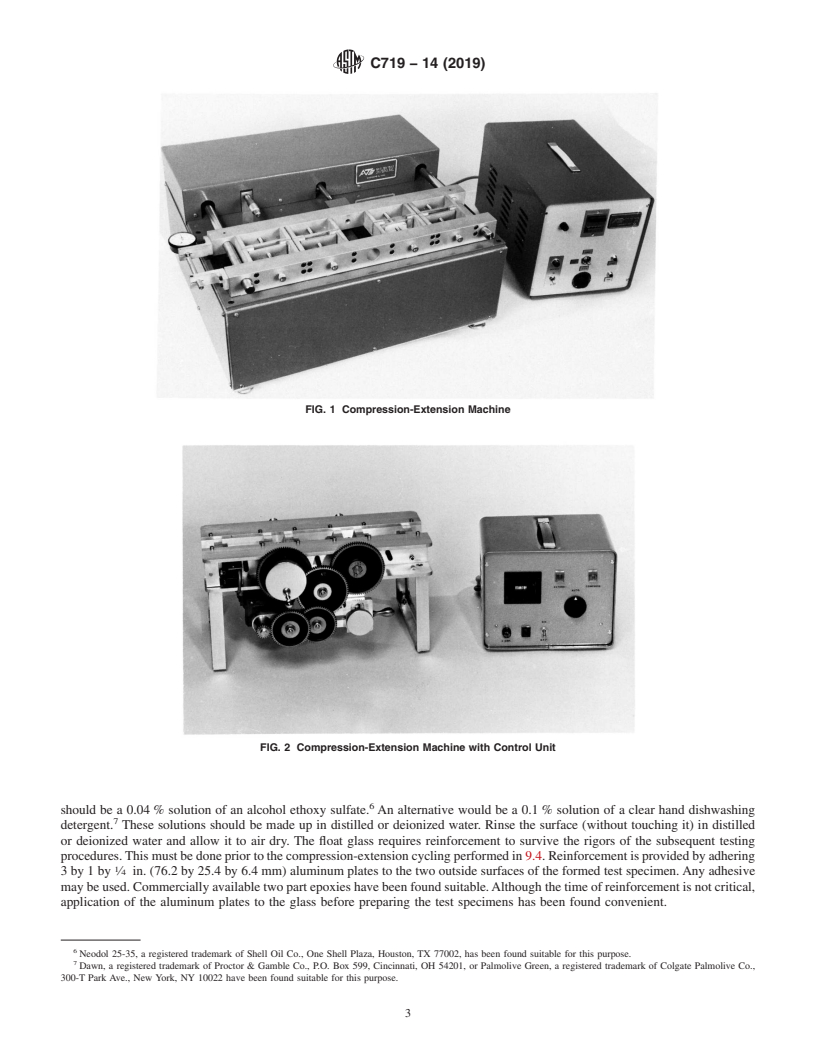
6.1 Compression-Extension Machine, designed to automatically compress the joint width of the test specimen from 0.500 in.
(12.7 mm) to the minimum dimension desired (Table 1, Column C) and extend the specimen from 0.500 in. to the maximum
extension desired (Table 1, Column E) at a constant rate of ⁄8 in./h (3.2 mm/h). The machine shall be equipped with grips of
sufficient strength to withstand, without bending, the resistance of high tensile strength sealants (see Figs. 1-3).
6.2 Cold Box or Chamber, maintained at −15 6 3°F (−26.1 6 1.7°C).
6.3 Forced-Draft Oven, controlled at 158 6 3.6°F (70 6 2°C).
6.4 C-clamps, or other device for maintaining the specimen under compression.
6.5 Spacer Blocks.
6.6 Room or Chamber, maintained at standard conditions as noted in Terminology C717.
7. Test Specimens
7.1 The standard substrate used in the test shall be portland cement mortar, float glass, and aluminum alloy.
NOTE 1—When requested, only one or two of the standard materials may be tested with the sample. Likewise other substrates such as brick, marble,
wood, etc., may be specified by the purchaser in place of or in addition to the standard substrate for test with the sealant sample.
7.1.1 Mortar Block— Prepare cement mortar blocks, each 3 by 1 by 1 in. (75 by 25 by 25 mm) in size, using one part of high
early strength portland cement conforming to Type III of Specification C150 to two parts by weight of clean uniformly graded,
concrete fine aggregate (sand) conforming to Specification C33. Use sufficient water to produce a flow of 100 6 5 % when tested
in accordance with the procedure for the determination of consistency of cement mortar described in Test Method C109/C109M.
After curing one day in moist air and six days in saturated lime water at 73 6 3°F (23 6 2°C), prepare the surface of one face,
1 by 3 in. (25 by 75 mm), of each block by wet grinding either with a belt sander using No. 60 aluminum carbide sanding belt
or using an iron lap with No. 60 silicon carbide (or aluminum oxide) grain until the aggregate is uniformly exposed. Return blocks
to saturated lime water storage until needed.
7.1.1.1 Blocks may be prepared and shipped to other locations for use. The blocks may be shipped dry and shall be returned
to lime water storage on arrival until needed.
7.1.1.2 Prior to use, wet grind the previously ground face to remove any laitance, rinse thoroughly under running tap water and
dry the blocks overnight at 220 to 230°F (105 to 110°C). Clean the blocks of film or powder by vigorous brushing with a
stiff-bristled fiber brush. Condition the blocks at standard conditions for not less than one day and not more than seven days.
7.1.2 Float Glass— Glass plates shall be 3 by 1 by ⁄4 in. (76.2 by 25.4 by 6.4 mm) clear float glass. Prior to use, the glass shall
be cleaned by wiping the surface with methyl ethyl ketone or similar solvent. Then dip the surface in a detergent solution. This
TABLE 1 Examples of Dimensions in Compression and
Extension
Dimension
Class C—Width of Joint in E—Width of Joint in
Compression, in. (mm) Extension, in. (mm)
12.5 0.438 (11.1) 0.563 (14.3)
25 0.375 (9.5) 0.625 (15.9)
35 0.325 (8.3) 0.675 (17.1)
50 0.250 (6.4) 0.750 (19.1)
50/100 0.250 (6.4) 1.000 (25.4)
Series 520 Sealing Compound Tester, manufactured by Applied Test Systems Inc., 348 New Castle Rd., Butler, PA 16001, and a durability tester manufactured by
Ambard, Inc., 269-11 81st Ave., New Hyde Park, NY 11040, have been found suitable for this purpose (Fig. 1(a)). For extension of the joint at cold temperature, the machine
may be designed for extension only (Fig. 3).
The sole source of supply of the apparatus known to the committee at this time is Applied Test Systems Inc. and Ambard Inc. If you are aware of alternative suppliers,
please provide this information to ASTM International Headquarters. Your comments will receive careful consideration at a meeting of the responsible technical committee
, which you may attend.
C719 − 14 (2019)
FIG. 1 Compression-Extension Machine
FIG. 2 Compression-Extension Machine with Control Unit
should be a 0.04 % solution of an alcohol ethoxy sulfate. An alternative would be a 0.1 % solution of a clear hand dishwashing
detergent. These solutions should be made up in distilled or deionized water. Rinse the surface (without touching it) in distilled
or deionized water and allow it to air dry. The float glass requires reinforcement to survive the rigors of the subsequent testing
procedures. This must be done prior to the compression-extension cycling performed in 9.4. Reinforcement is provided by adhering
3 by 1 by ⁄4 in. (76.2 by 25.4 by 6.4 mm) aluminum plates to the two outside surfaces of the formed test specimen. Any adhesive
may be used. Commercially available two part epoxies have been found suitable. Although the time of reinforcement is not critical,
application of the aluminum plates to the glass before preparing the test specimens has been found convenient.
Neodol 25-35, a registered trademark of Shell Oil Co., One Shell Plaza, Houston
...
Questions, Comments and Discussion
Ask us and Technical Secretary will try to provide an answer. You can facilitate discussion about the standard in here.