

ASTM D5635/D5635M-18(2022)
(Test Method)Standard Test Method for Dynamic Puncture Resistance of Roofing Membrane Specimens
General Information
- Abstract
SIGNIFICANCE AND USE
5.1 An important factor affecting the performance of membrane roofing systems is their ability to resist dynamic puncture impacts. This test method provides a means to assess dynamic puncture resistance.
5.2 This test method can be used to compare the dynamic puncture resistance of a single type of membrane as a function of a variety of insulation substrates or, conversely, to compare the resistance of a number of membrane specimens set on a single type of insulation.
5.3 The effect of temperature on puncture resistance can be studied by conducting the test under controlled conditions using such equipment as an environmental chamber, oven, or freezer.
5.4 The test method can be useful in developing performance criteria for membrane roofing systems.
5.5 The test method can be useful in developing classifications of dynamic puncture resistance of membrane roofing systems.
5.6 While it is considered that the results obtained by this laboratory test can afford a measure of the dynamic puncture resistance of membrane roofing systems in the field (provided that service loads and temperature conditions are known), no direct correlation has yet been established.
5.7 This test method can be useful for evaluating the dynamic puncture resistance of membranes used in vegetative roof systems.
SCOPE
1.1 This test method covers the evaluation of the dynamic puncture energy that roofing membrane specimens can withstand, without allowing the passage of water, when subjected to impact from a rigid object having a sharp edge.
1.2 This laboratory test can be conducted at any desired temperature using membrane specimens manufactured in a factory or prepared in a laboratory.
1.3 Roof membrane specimens to which the test method is applicable include bituminous built-up, polymer-modified bitumens, vulcanized rubbers, non-vulcanized polymeric, and thermoplastic materials.
1.3.1 The applicability of this test method to these membrane specimens includes their use in vegetative roof systems.
1.4 This test method is not applicable to aggregate-surfaced membrane specimens; however, it is applicable to specimens having factory-applied granules.
1.5 The values stated in either SI units or inch-pound units are to be regarded separately as standard. The values stated in each system may not be exact equivalents; therefore, each system shall be used independently of the other. Combining values from the two systems may result in nonconformance with the standard.
1.6 This standard does not purport to address all of the safety concerns, if any, associated with its use. It is the responsibility of the user of this standard to establish appropriate safety, health, and environmental practices and determine the applicability of regulatory limitations prior to use.
1.7 This international standard was developed in accordance with internationally recognized principles on standardization established in the Decision on Principles for the Development of International Standards, Guides and Recommendations issued by the World Trade Organization Technical Barriers to Trade (TBT) Committee.
- Status
- Published
- Publication Date
- 31-Oct-2022
- Technical Committee
- D08 - Roofing and Waterproofing
- Drafting Committee
- D08.20 - Roofing Membrane Systems
Overview
ASTM D5635/D5635M-18(2022) is an internationally recognized standard developed by ASTM International that specifies a laboratory test method to evaluate the dynamic puncture resistance of roofing membrane specimens. The ability of roofing membranes to withstand puncture from sharp, rigid impacts is critical for the durability and waterproofing integrity of membrane roofing systems. This standard provides an objective, reproducible method to assess and compare the performance of various roofing membrane types, both as manufactured and as applied over insulation substrates under controlled conditions.
Key Topics
- Dynamic Puncture Resistance: The core focus is on evaluating how much dynamic, or impact, energy a roofing membrane can tolerate before being punctured, using a falling mass test device.
- Membrane Types: Applicable to bituminous built-up, polymer-modified bitumens, vulcanized rubbers, non-vulcanized polymeric, and thermoplastic roofing membranes. Excludes aggregate-surfaced membranes but includes factory-applied granule surfaces.
- Testing Conditions: The test can be performed at various controlled temperatures, helping to account for environmental factors that affect membrane performance.
- Comparative Assessment: Enables comparison among different membrane types on the same insulation or the same membrane over various insulations, supporting material selection and system design.
- Performance Criteria Development: The standard supports the development of performance classifications and criteria for roofing membranes, including those for vegetative (green) roofing systems.
- Non-quantitative Result: The outcome is a pass/fail depending on whether the specimen withstands the selected impact energy without water passage.
Applications
The ASTM D5635/D5635M-18(2022) test method is used in a range of practical scenarios, including:
- Material Evaluation: Manufacturers, designers, and contractors can assess and compare the puncture resistance of membrane roofing products under different conditions and insulation types.
- Product Classification: Supports developing specifications and classifications for roofing materials based on resistance to dynamic puncture impacts.
- Quality Assurance: Used by laboratories and quality control teams to verify that roofing membranes conform to project requirements or product standards for puncture resistance.
- Performance Specification: Designers can require minimum dynamic puncture resistance in project documentation, particularly for roofs subject to mechanical abuse, foot traffic, or installation of equipment.
- Vegetative Roof Systems: Especially relevant for green roofs, where membrane layers must withstand mechanical impacts from landscaping activities or heavy plant containers.
- Research and Development: Valuable for R&D purposes to optimize membrane formulations and roofing system designs for impact resistance.
Related Standards
For a holistic assessment and specification of roofing membranes, ASTM D5635/D5635M-18(2022) is typically referenced alongside other key industry standards, such as:
- ASTM C578: Standard Specification for Rigid, Cellular Polystyrene Thermal Insulation, often used as the insulation substrate in dynamic puncture tests.
- ASTM D1079: Terminology Relating to Roofing and Waterproofing, ensuring common language and definitions in roofing practice.
- Other ASTM roofing test methods: Including standards covering tensile strength, elongation, water-tightness, and weather resistance.
Adopting and referencing ASTM D5635/D5635M in roofing projects supports compliance with international best practices and promotes long-term roof system performance.
Keywords: dynamic puncture resistance, roofing membrane, ASTM D5635, impact energy, insulation substrate, waterproofing, performance testing, vegetative roof systems, roofing standards, roof system durability
Relations
- Effective Date
- 01-Sep-2023
- Effective Date
- 01-May-2020
- Effective Date
- 15-Dec-2018
- Effective Date
- 15-Dec-2018
- Effective Date
- 15-Apr-2018
- Effective Date
- 01-Sep-2017
- Effective Date
- 01-Jun-2017
- Effective Date
- 15-Nov-2016
- Effective Date
- 01-Feb-2016
- Effective Date
- 15-Dec-2015
- Effective Date
- 01-Dec-2015
- Effective Date
- 01-May-2015
- Effective Date
- 15-Oct-2014
- Effective Date
- 01-Jan-2014
- Effective Date
- 01-Nov-2013
Get Certified
Connect with accredited certification bodies for this standard

DIBt (Deutsches Institut für Bautechnik)
German Institute for Building Technology.
DIN CERTCO
DIN Group product certification.

Aboma Certification B.V.
Specialized in construction, metal, and transport sectors.
Sponsored listings
Frequently Asked Questions
ASTM D5635/D5635M-18(2022) is a standard published by ASTM International. Its full title is "Standard Test Method for Dynamic Puncture Resistance of Roofing Membrane Specimens". This standard covers: SIGNIFICANCE AND USE 5.1 An important factor affecting the performance of membrane roofing systems is their ability to resist dynamic puncture impacts. This test method provides a means to assess dynamic puncture resistance. 5.2 This test method can be used to compare the dynamic puncture resistance of a single type of membrane as a function of a variety of insulation substrates or, conversely, to compare the resistance of a number of membrane specimens set on a single type of insulation. 5.3 The effect of temperature on puncture resistance can be studied by conducting the test under controlled conditions using such equipment as an environmental chamber, oven, or freezer. 5.4 The test method can be useful in developing performance criteria for membrane roofing systems. 5.5 The test method can be useful in developing classifications of dynamic puncture resistance of membrane roofing systems. 5.6 While it is considered that the results obtained by this laboratory test can afford a measure of the dynamic puncture resistance of membrane roofing systems in the field (provided that service loads and temperature conditions are known), no direct correlation has yet been established. 5.7 This test method can be useful for evaluating the dynamic puncture resistance of membranes used in vegetative roof systems. SCOPE 1.1 This test method covers the evaluation of the dynamic puncture energy that roofing membrane specimens can withstand, without allowing the passage of water, when subjected to impact from a rigid object having a sharp edge. 1.2 This laboratory test can be conducted at any desired temperature using membrane specimens manufactured in a factory or prepared in a laboratory. 1.3 Roof membrane specimens to which the test method is applicable include bituminous built-up, polymer-modified bitumens, vulcanized rubbers, non-vulcanized polymeric, and thermoplastic materials. 1.3.1 The applicability of this test method to these membrane specimens includes their use in vegetative roof systems. 1.4 This test method is not applicable to aggregate-surfaced membrane specimens; however, it is applicable to specimens having factory-applied granules. 1.5 The values stated in either SI units or inch-pound units are to be regarded separately as standard. The values stated in each system may not be exact equivalents; therefore, each system shall be used independently of the other. Combining values from the two systems may result in nonconformance with the standard. 1.6 This standard does not purport to address all of the safety concerns, if any, associated with its use. It is the responsibility of the user of this standard to establish appropriate safety, health, and environmental practices and determine the applicability of regulatory limitations prior to use. 1.7 This international standard was developed in accordance with internationally recognized principles on standardization established in the Decision on Principles for the Development of International Standards, Guides and Recommendations issued by the World Trade Organization Technical Barriers to Trade (TBT) Committee.
SIGNIFICANCE AND USE 5.1 An important factor affecting the performance of membrane roofing systems is their ability to resist dynamic puncture impacts. This test method provides a means to assess dynamic puncture resistance. 5.2 This test method can be used to compare the dynamic puncture resistance of a single type of membrane as a function of a variety of insulation substrates or, conversely, to compare the resistance of a number of membrane specimens set on a single type of insulation. 5.3 The effect of temperature on puncture resistance can be studied by conducting the test under controlled conditions using such equipment as an environmental chamber, oven, or freezer. 5.4 The test method can be useful in developing performance criteria for membrane roofing systems. 5.5 The test method can be useful in developing classifications of dynamic puncture resistance of membrane roofing systems. 5.6 While it is considered that the results obtained by this laboratory test can afford a measure of the dynamic puncture resistance of membrane roofing systems in the field (provided that service loads and temperature conditions are known), no direct correlation has yet been established. 5.7 This test method can be useful for evaluating the dynamic puncture resistance of membranes used in vegetative roof systems. SCOPE 1.1 This test method covers the evaluation of the dynamic puncture energy that roofing membrane specimens can withstand, without allowing the passage of water, when subjected to impact from a rigid object having a sharp edge. 1.2 This laboratory test can be conducted at any desired temperature using membrane specimens manufactured in a factory or prepared in a laboratory. 1.3 Roof membrane specimens to which the test method is applicable include bituminous built-up, polymer-modified bitumens, vulcanized rubbers, non-vulcanized polymeric, and thermoplastic materials. 1.3.1 The applicability of this test method to these membrane specimens includes their use in vegetative roof systems. 1.4 This test method is not applicable to aggregate-surfaced membrane specimens; however, it is applicable to specimens having factory-applied granules. 1.5 The values stated in either SI units or inch-pound units are to be regarded separately as standard. The values stated in each system may not be exact equivalents; therefore, each system shall be used independently of the other. Combining values from the two systems may result in nonconformance with the standard. 1.6 This standard does not purport to address all of the safety concerns, if any, associated with its use. It is the responsibility of the user of this standard to establish appropriate safety, health, and environmental practices and determine the applicability of regulatory limitations prior to use. 1.7 This international standard was developed in accordance with internationally recognized principles on standardization established in the Decision on Principles for the Development of International Standards, Guides and Recommendations issued by the World Trade Organization Technical Barriers to Trade (TBT) Committee.
ASTM D5635/D5635M-18(2022) is classified under the following ICS (International Classification for Standards) categories: 91.100.50 - Binders. Sealing materials. The ICS classification helps identify the subject area and facilitates finding related standards.
ASTM D5635/D5635M-18(2022) has the following relationships with other standards: It is inter standard links to ASTM C578-23, ASTM D1079-20, ASTM D1079-18, ASTM D1079-18e1, ASTM C578-18, ASTM C578-17a, ASTM C578-17, ASTM C578-16, ASTM D1079-16, ASTM C578-15b, ASTM C578-15a, ASTM C578-15, ASTM C578-14a, ASTM C578-14, ASTM C578-13. Understanding these relationships helps ensure you are using the most current and applicable version of the standard.
ASTM D5635/D5635M-18(2022) is available in PDF format for immediate download after purchase. The document can be added to your cart and obtained through the secure checkout process. Digital delivery ensures instant access to the complete standard document.
Standards Content (Sample)
This international standard was developed in accordance with internationally recognized principles on standardization established in the Decision on Principles for the
Development of International Standards, Guides and Recommendations issued by the World Trade Organization Technical Barriers to Trade (TBT) Committee.
Designation: D5635/D5635M −18 (Reapproved 2022)
Standard Test Method for
Dynamic Puncture Resistance of Roofing Membrane
Specimens
This standard is issued under the fixed designation D5635/D5635M; the number immediately following the designation indicates the
year of original adoption or, in the case of revision, the year of last revision. A number in parentheses indicates the year of last
reapproval. A superscript epsilon (´) indicates an editorial change since the last revision or reapproval.
1. Scope 2. Referenced Documents
1.1 This test method covers the evaluation of the dynamic 2.1 ASTM Standards:
puncture energy that roofing membrane specimens can C578 Specification for Rigid, Cellular Polystyrene Thermal
withstand, without allowing the passage of water, when sub- Insulation
jected to impact from a rigid object having a sharp edge. D1079 Terminology Relating to Roofing and Waterproofing
1.2 This laboratory test can be conducted at any desired
3. Terminology
temperature using membrane specimens manufactured in a
factory or prepared in a laboratory. 3.1 Definitions:
3.1.1 For definitions of terms used in this test method, refer
1.3 Roof membrane specimens to which the test method is
to Terminology D1079.
applicable include bituminous built-up, polymer-modified
bitumens, vulcanized rubbers, non-vulcanized polymeric, and
4. Summary of Test Method
thermoplastic materials.
4.1 The roofing membrane test specimen, set on a thermal
1.3.1 The applicability of this test method to these mem-
brane specimens includes their use in vegetative roof systems. insulation substrate, is subjected to a predetermined dynamic
impact energy created by a rigid falling puncture head. The
1.4 This test method is not applicable to aggregate-surfaced
head falls through a quarter-circle trajectory from a vertical
membrane specimens; however, it is applicable to specimens
position to horizontal position under gravitational acceleration.
having factory-applied granules.
4.2 The predetermined dynamic puncture energy is selected
1.5 The values stated in either SI units or inch-pound units
as follows:
are to be regarded separately as standard. The values stated in
4.2.1 In accordance with a performance requirement given
each system may not be exact equivalents; therefore, each
in a standard specification in which this test method is cited, or
system shall be used independently of the other. Combining
4.2.2 Through agreement between the party requesting the
values from the two systems may result in nonconformance
test and the testing laboratory.
with the standard.
4.3 Puncture of the test specimen is assessed by visual
1.6 This standard does not purport to address all of the
examination and, if necessary, verified by conducting a water-
safety concerns, if any, associated with its use. It is the
tightness test.
responsibility of the user of this standard to establish appro-
priate safety, health, and environmental practices and deter-
5. Significance and Use
mine the applicability of regulatory limitations prior to use.
1.7 This international standard was developed in accor-
5.1 An important factor affecting the performance of mem-
dance with internationally recognized principles on standard- braneroofingsystemsistheirabilitytoresistdynamicpuncture
ization established in the Decision on Principles for the
impacts. This test method provides a means to assess dynamic
Development of International Standards, Guides and Recom- puncture resistance.
mendations issued by the World Trade Organization Technical
5.2 This test method can be used to compare the dynamic
Barriers to Trade (TBT) Committee.
puncture resistance of a single type of membrane as a function
of a variety of insulation substrates or, conversely, to compare
This test method is under the jurisdiction ofASTM Committee D08 on Roofing
and Waterproofing and is the direct responsibility of Subcommittee D08.20 on
Roofing Membrane Systems. For referenced ASTM standards, visit the ASTM website, www.astm.org, or
Current edition approved Nov. 1, 2022. Published November 2022. Originally contact ASTM Customer Service at service@astm.org. For Annual Book of ASTM
approved in 1994. Last previous edition approved in 2018 as D5635/D5635M – 18. Standards volume information, refer to the standard’s Document Summary page on
DOI: 10.1520/D5635_D5635M-18R22. the ASTM website.
Copyright © ASTM International, 100 Barr Harbor Drive, PO Box C700, West Conshohocken, PA 19428-2959. United States
D5635/D5635M − 18 (2022)
the resistance of a number of membrane specimens set on a 0.5 kg [1.1 lb] increments. The mass of the puncture head shall
single type of insulation. be within 60.5 % of that selected.
5.3 The effect of temperature on puncture resistance can be
NOTE 1—It is suggested that the puncture head be fabricated from 1018
studied by conducting the test under controlled conditions mild steel to minimize risk of damage during its use. No matter the metal
from which the puncture head is made, users of the test device should
using such equipment as an environmental chamber, oven, or
periodically examine the puncture head to check that damage has not
freezer.
occurred during use.
5.4 The test method can be useful in developing perfor-
6.1.3 Acounterweight, equivalent to the mass of the falling
mance criteria for membrane roofing systems.
arm, is placed on the arm on the side of the axis of rotation
5.5 The test method can be useful in developing classifica-
opposite to that holding the puncture head. The presence of the
tions of dynamic puncture resistance of membrane roofing
counterweight eliminates the need to include the mass of the
systems.
arm in the determination of the puncture energy.Alternatively,
if a counterweight is not used, then the mass of the arm shall
5.6 While it is considered that the results obtained by this
be included in the determination of the impact energy.
laboratory test can afford a measure of the dynamic puncture
6.1.4 The device shall incorporate a mechanism that allows
resistance of membrane roofing systems in the field (provided
the puncture head to be kept stationary in an upright position,
that service loads and temperature conditions are known), no
forming an angle from the vertical not exceeding 5°. This
direct correlation has yet been established.
mechanism shall allow release of the arm so that it falls freely
5.7 This test method can be useful for evaluating the
without any additional motion imposed.
dynamic puncture resistance of membranes used in vegetative
roof systems. NOTE 2—Avacuum release mechanism has been found suitable for this
purpose.
6. Apparatus
6.1.5 The base of the device, supporting the arm and
6.1 Dynamic Puncture Device—The dynamic puncture de-
puncture head, is placed on a horizontal surface that is
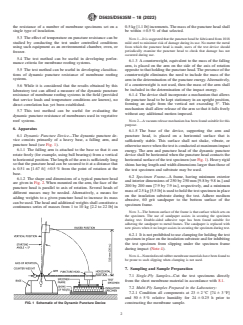
vice consists primarily of a heavy base, a falling arm, and
sufficiently stable. This surface shall not shake, vibrate, or
puncture head (see Fig. 1).
otherwisemovewhenthetestisconductedatmaximumimpact
6.1.1 The falling arm is attached to the base so that it can
energy. The arm and puncture head of the dynamic puncture
rotate freely (for example, using ball bearings) from a vertical
device shall be horizontal when the puncture head contacts the
to horizontal position.The length of the arm is sufficiently long
horizontalsurfaceofthetestspecimen(seeFig.1).Heavyrigid
so that the puncture head can be secured to it at a distance that
shims having length and width dimensions larger than those of
is 0.51 m [1.67 ft] 60.5 % from the point of rotation at the
the test specimen and substrate may be used.
base.
6.2 Specimen Frame—A frame, having minimum exterior
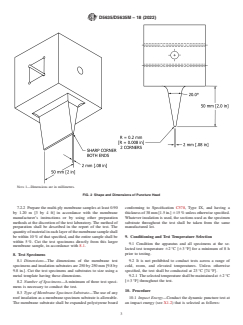
6.1.2 The shape and dimensions of a typical puncture head
and interior dimensions of 250 by 250 mm [9.8 by 9.8 in.] and
are given in Fig. 2. When mounted on the arm, the face of the
200 by 200 mm [7.9 by 7.9 in.], respectively, and a minimum
puncture head is parallel to axis of rotation. Several heads of
massof2.5kg[5.5lb]isusedtoholdthetestspecimeninplace
different masses may be needed. Alternatively, a means for
on the insulation substrate during the test. Adhere medium
adding weights to a given puncture head to increase its mass
abrasive, 60 grit sandpaper to the bottom surface of the
can be used. The head and additional weights shall constitute a
specimen frame.
continuous series of masses from 1 to 10 kg [2.2 to 22 lb] in
NOTE 3—The bottom surface of the frame is that surface which sets on
the specimen. The use of sandpaper assists in securing the specimen
during test. Double-sided adhesive tape has been found suitable for
adhering the sandpaper to metal frames. The sandpaper is replaced with
new pieces when it no longer assists in securing the specimen during test.
6.2.1 It is not prohibited to use clamping for holding the test
specimen in place on the insulation substrate and for inhibiting
the test specimen from slipping under the specimen frame
during impact (Note 4).
NOTE4—Nonreinforcedrubbermembranematerialshavebeenfoundto
be prone to such slipping when clamping is not used.
7. Sampling and Sample Preparation
7.1 Single-Ply Samples—Cut the test specimens directly
from the sheet membrane material in accordance with 8.1.
7.2 Multi-Ply Samples Prepared in the Laboratory:
7.2.1 Condition all components at 23 6 2 °C [74 6 3 °F]
and 50 6 5 % relative humidity for 24 6 0.25 h prior to
FIG. 1 Schematic of the Dynamic Puncture Device constructing the membrane sample.
D5635/D5635M − 18 (2022)
NOTE 1—Dimensions are in millimetres.
FIG. 2 Shape and Dimensions of Puncture Head
7.2.2 Prepare the multi-ply membrane samples at least 0.90 conforming to Specification C578, Type IX, and having a
by 1.20 m [3 by 4 ft] in accordance with the membrane thicknessof38mm[1.5in.] 615 %unlessotherwisespecified.
manufacturer’s instructions or by using other preparation Whatever insulation is used, the sections used as the specimen
methods at the discretion of the test laboratory. The method of substrate throughout the test shall be taken from the same
preparation shall be described in the report of the test. The manufactured lot.
quantityofmaterialineachlayerofthemembranesampleshall
be within 10 % of that specified, and the entire sample shall be
9. Conditioning and Test Temperature Selection
within 5 %. Cut the test specimens directly from this larger
9.1 Condition the apparatus and all specimens at the se-
membrane sample, in accordance with 8.1.
lected test temperature 62°C[63 °F] for a minimum of 8 h
prior to testing.
8. Test Specimens
8.1 Dimensions—The dimensions of the membrane test 9.2 It is not prohibited to conduct tests across a range of
cold, room, and elevated temperatures. Unless otherwise
specimens and insulation substrates are 250 by 250 mm [9.8 by
9.8 in.]. Cut the test specimens and substrates to size using a specified, the test shall be conducted at 23 °C [74 °F].
metal template having these dimensions.
9.2.1 Theselectedtemperatureshallbemaintainedat 62°C
[63 °F] throughout the test.
8.2 Number of Specimens—A minimum of three test speci-
mens is necessary to conduct the test.
10. Procedure
8.3 Type of Membrane Specimen Subs
...