


ASTM B101-12(2019)
(Specification)Standard Specification for Lead-Coated Copper Sheet and Strip for Building Construction
Standard Specification for Lead-Coated Copper Sheet and Strip for Building Construction
ABSTRACT
This specification covers ounce-weight thick lead-coated copper sheets and strips in flat lengths or in coils. These materials are recommended for use in roofing, flashing, gutters, downspouts and general sheet metalwork in building constructions but not for electrical applications. This standard contains information on acceptable chemical compositions and mechanical properties of the copper sheets or strips and the lead coating deposited by hot dipping.
SCOPE
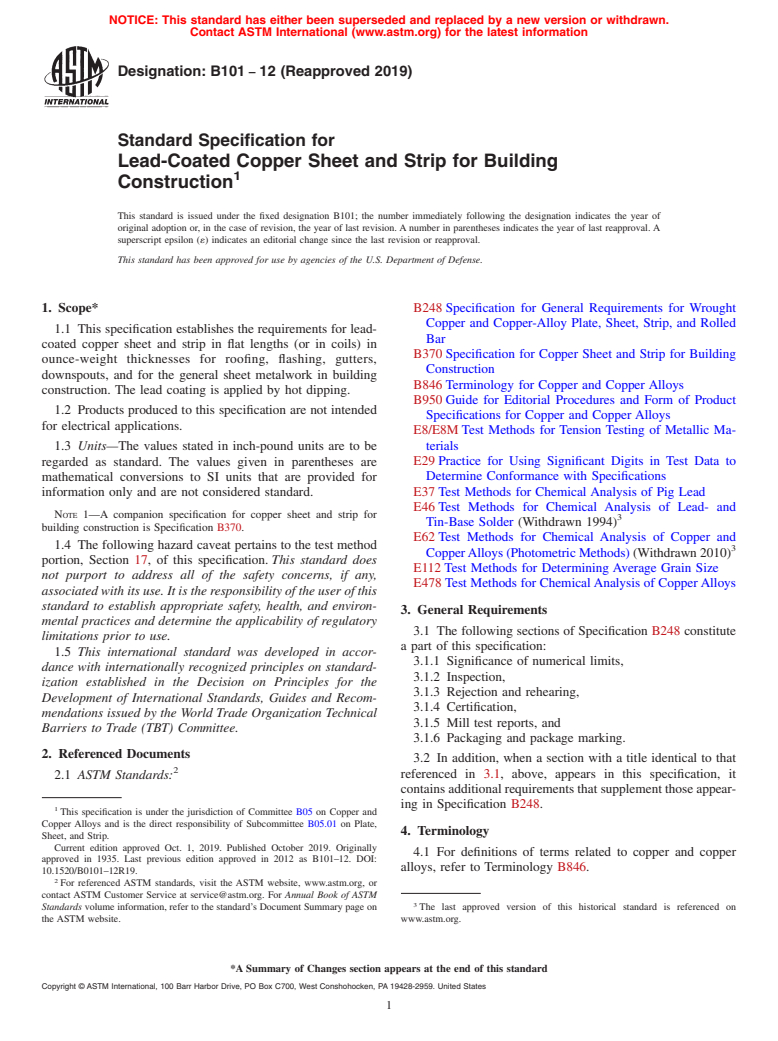
1.1 This specification establishes the requirements for lead-coated copper sheet and strip in flat lengths (or in coils) in ounce-weight thicknesses for roofing, flashing, gutters, downspouts, and for the general sheet metalwork in building construction. The lead coating is applied by hot dipping.
1.2 Products produced to this specification are not intended for electrical applications.
1.3 Units—The values stated in inch-pound units are to be regarded as standard. The values given in parentheses are mathematical conversions to SI units that are provided for information only and are not considered standard.
Note 1: A companion specification for copper sheet and strip for building construction is Specification B370.
1.4 The following hazard caveat pertains to the test method portion, Section 17, of this specification. This standard does not purport to address all of the safety concerns, if any, associated with its use. It is the responsibility of the user of this standard to establish appropriate safety, health, and environmental practices and determine the applicability of regulatory limitations prior to use.
1.5 This international standard was developed in accordance with internationally recognized principles on standardization established in the Decision on Principles for the Development of International Standards, Guides and Recommendations issued by the World Trade Organization Technical Barriers to Trade (TBT) Committee.
General Information
Buy Standard
Standards Content (Sample)
NOTICE: This standard has either been superseded and replaced by a new version or withdrawn.
Contact ASTM International (www.astm.org) for the latest information
Designation:B101 −12 (Reapproved 2019)
Standard Specification for
Lead-Coated Copper Sheet and Strip for Building
Construction
This standard is issued under the fixed designation B101; the number immediately following the designation indicates the year of
original adoption or, in the case of revision, the year of last revision. A number in parentheses indicates the year of last reapproval. A
superscript epsilon (´) indicates an editorial change since the last revision or reapproval.
This standard has been approved for use by agencies of the U.S. Department of Defense.
1. Scope* B248 Specification for General Requirements for Wrought
Copper and Copper-Alloy Plate, Sheet, Strip, and Rolled
1.1 This specification establishes the requirements for lead-
Bar
coated copper sheet and strip in flat lengths (or in coils) in
B370 Specification for Copper Sheet and Strip for Building
ounce-weight thicknesses for roofing, flashing, gutters,
Construction
downspouts, and for the general sheet metalwork in building
B846 Terminology for Copper and Copper Alloys
construction. The lead coating is applied by hot dipping.
B950 Guide for Editorial Procedures and Form of Product
1.2 Products produced to this specification are not intended
Specifications for Copper and Copper Alloys
for electrical applications.
E8/E8M Test Methods for Tension Testing of Metallic Ma-
terials
1.3 Units—The values stated in inch-pound units are to be
regarded as standard. The values given in parentheses are E29 Practice for Using Significant Digits in Test Data to
Determine Conformance with Specifications
mathematical conversions to SI units that are provided for
information only and are not considered standard. E37 Test Methods for Chemical Analysis of Pig Lead
E46 Test Methods for Chemical Analysis of Lead- and
NOTE 1—A companion specification for copper sheet and strip for
Tin-Base Solder (Withdrawn 1994)
building construction is Specification B370.
E62 Test Methods for Chemical Analysis of Copper and
1.4 The following hazard caveat pertains to the test method
CopperAlloys (Photometric Methods)(Withdrawn 2010)
portion, Section 17, of this specification. This standard does
E112 Test Methods for Determining Average Grain Size
not purport to address all of the safety concerns, if any,
E478 Test Methods for ChemicalAnalysis of CopperAlloys
associated with its use. It is the responsibility of the user of this
standard to establish appropriate safety, health, and environ-
3. General Requirements
mental practices and determine the applicability of regulatory
3.1 The following sections of Specification B248 constitute
limitations prior to use.
a part of this specification:
1.5 This international standard was developed in accor-
3.1.1 Significance of numerical limits,
dance with internationally recognized principles on standard-
3.1.2 Inspection,
ization established in the Decision on Principles for the
3.1.3 Rejection and rehearing,
Development of International Standards, Guides and Recom-
3.1.4 Certification,
mendations issued by the World Trade Organization Technical
3.1.5 Mill test reports, and
Barriers to Trade (TBT) Committee.
3.1.6 Packaging and package marking.
2. Referenced Documents
3.2 In addition, when a section with a title identical to that
referenced in 3.1, above, appears in this specification, it
2.1 ASTM Standards:
contains additional requirements that supplement those appear-
ing in Specification B248.
This specification is under the jurisdiction of Committee B05 on Copper and
Copper Alloys and is the direct responsibility of Subcommittee B05.01 on Plate,
4. Terminology
Sheet, and Strip.
Current edition approved Oct. 1, 2019. Published October 2019. Originally
4.1 For definitions of terms related to copper and copper
approved in 1935. Last previous edition approved in 2012 as B101–12. DOI:
alloys, refer to Terminology B846.
10.1520/B0101–12R19.
For referenced ASTM standards, visit the ASTM website, www.astm.org, or
contact ASTM Customer Service at service@astm.org. For Annual Book of ASTM
Standards volume information, refer to the standard’s Document Summary page on The last approved version of this historical standard is referenced on
the ASTM website. www.astm.org.
*A Summary of Changes section appears at the end of this standard
Copyright © ASTM International, 100 Barr Harbor Drive, PO Box C700, West Conshohocken, PA 19428-2959. United States
B101−12 (2019)
TABLE 1 Mechanical Properties of Uncoated Sheet
B
Yield Strength, at Approximate Rockwell Hardness
A
Temper Designation Tensile Strength, ksi (MPa)
(for Information Only)
0.5 % Extension
F Scale Superficial 30 T
Under Load, min,
Standard Former Min Max
ksi (MPa) Min Max Min Max
O60 soft 30 (205) 38 (260) . . 65 . 31
H00 cold-rolled 32 (220) 40 (275) 20 (140) 54 82 15 49
H01 cold-rolled (high yield) 34 (235) 42 (290) 28 (195) 60 84 18 51
A
ksi = 100 psi.
B
Rockwell hardness values apply as follows: The F scale applies to metal 0.020 in. (0.508 mm) and over in thickness; the superficial 30T scale applies to metal 0.012
in. (0.305 mm) to 0.020 in. (0.508 mm) in thickness.
4.2 Definitions of Terms Specific to This Standard: 5.1.8 Mill test report, where required (see 5.1.5), and
4.2.1 coil—a length of the product wound into a series of 5.1.9 If the material being purchased is intended for use by
connected turns. agencies of the U.S. Government, refer to Section 11.
4.2.1.1 Discussion—The unqualified term “coil” as applied 5.1.10 Other variations in coating or texture shall be fur-
to “flat product” usually refers to a coil in which the product is nished by agreement in writing between the purchaser and the
spirally wound, with the successive layers on top of one manufacturer or supplier.
another. (Sometimes called a “roll.”)
6. Materials and Manufacture
4.2.2 lead-coated copper sheet (for building construction),
6.1 Materials:
n—a rolled flat product over 24 in. (610 mm) in width and of
6.1.1 The lead coating shall conform to the chemical re-
ounce-weight thickness from 8 oz (227 g) to 48 oz (1361 g).
quirements of Table 3.
4.2.3 lead-coated strip (for building construction), n—a
6.1.2 The copper sheet or strip to be lead coated shall be
rolledflatproductuptoandincluding24in.(610mm)inwidth
manufactured by any process that provides a finished product
and of ounce-weight thickness from 8 oz (227 g) to 48 oz
that conforms to the requirements of Specification B370.
(1361 g).
6.2 Manufacture:
4.2.4 lengths, mill, n—straight lengths, including ends, that
6.2.1 Theleadcoatingshallbeappliedtothecoppersheetor
are conveniently manufactured in the mills.
strip by hot dipping in a bath of molten lead.
4.2.4.1 Discussion—Full length pieces are usually 8, 10, or
6.2.2 Unless otherwise specified, the lead coating shall be
12 ft (2.44, 3.05, or 3.66 m) and subject to established length
applied to the copper sheet or strip after slitting and cutting to
tolerances.
the specified length.
4.2.5 ounce-weight—the weight of uncoated copper sheet or
7. Chemical Composition
strip expressed in ounces per square foot.
7.1 The copper sheet or strip shall have a minimum copper,
4.2.6 thickness, ounce-weight, n—the metal thickness that
including silver, content of 99.5 %.
corresponds to the ounce weight.
7.2 Any copper that complies with 7.1 shall be acceptable.
5. Ordering Information
7.3 If limits for unnamed elements are required, they shall
5.1 Include the following specified choices when placing
be established and analysis required by agreement between the
orders for product under this specification, as applicable:
manufacturer or supplier and purchaser.
5.1.1 ASTM designation and year of issue.
7.4 The lead coating shall conform to the chemical require-
5.1.2 Temper (Section 8 and Table 1),
ments of Table 3.
5.1.3 How furnished: flat lengths or in coils,
5.1.4 Quantity: total weight or sheets of each size,
8. Temper
5.1.5 Ounce-weight or ounce-weight thickness of the un-
8.1 The standard tempers of the uncoated copper sheet and
coated copper sheet or strip (Table 2),
strip described in this specification are given in Table 1.
5.1.6 Dimensions: width and length (Section 12),
5.1.7 Certification, where required (see 5.1.4),
TABLE 3 Chemical Requirements for Lead
Used to Coat Copper Sheet
TABLE 2 Sheet Weights
Composition, %
Element (Maximum unless shown
Minimum Weight of
Nominal Weights and Thickness
as range or remainder)
Lead–Coated
of Bare Copper Sheets
Copper Sheet
Silver 0.02
Copper 0.08
Ounce-Weight, Ounce-Weight
2 2
oz/ft (g ⁄m )
2 A
Arsenic plus antimony 0.10
oz/ft Thickness, in. (mm)
Zinc 0.005
24 0.0323 (0.820) 25.0 (7625)
Iron 0.01
20 0.0270 (0.686) 21.2 (6466)
Bismuth 0.08
16 0.0216 (0.549) 17.3 (5276)
Lead remainder
12 0.0162 (0.411) 13.2 (4026)
Tin 3.0-4.0
A 3 3
Phosphorus 0.03
Based upon a density of 0.322 lb/in. (8.91 g/cm ).
B101−12 (2019)
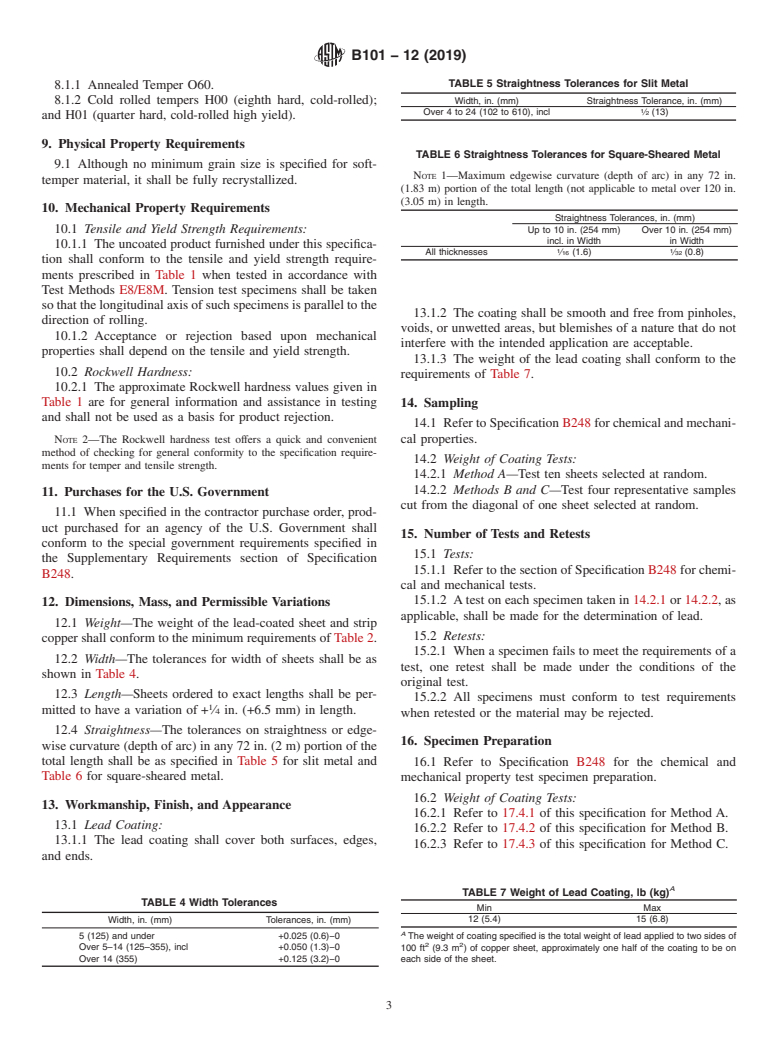
TABLE 5 Straightness Tolerances for Slit Metal
8.1.1 Annealed Temper O60.
8.1.2 Cold rolled tempers H00 (eighth hard, cold-rolled); Width, in. (mm) Straightness Tolerance, in. (mm)
Over 4 to 24 (102 to 610), incl ⁄2 (13)
and H01 (quarter hard, cold-rolled high yield).
9. Physical Property Requirements
TABLE 6 Straightness Tolerances for Square-Sheared Metal
9.1 Although no minimum grain size is specified for soft-
NOTE 1—Maximum edgewise curvature (depth of arc) in any 72 in.
temper material, it shall be fully recrystallized.
(1.83 m) portion of the total length (not applicable to metal over 120 in.
(3.05 m) in length.
10. Mechanical Property Requirements
Straightness Tolerances, in. (mm)
10.1 Tensile and Yield Strength Requirements: Up to 10 in. (254 mm) Over 10 in. (254 mm)
incl. in Width in Width
10.1.1 The uncoated product furnished under this specifica-
1 1
All thicknesses ⁄16 (1.6) ⁄32 (0.8)
tion shall conform to the tensile and yield strength require-
ments prescribed in Table 1 when tested in accordance with
Test Methods E8/E8M. Tension test specimens shall be taken
so that the longitudinal axis of such specimens is parallel to the
13.1.2 The coating shall be smooth and free from pinholes,
direction of rolling.
voids, or unwetted areas, but blemishes of a nature that do not
10.1.2 Acceptance or rejection based upon m
...
This document is not an ASTM standard and is intended only to provide the user of an ASTM standard an indication of what changes have been made to the previous version. Because
it may not be technically possible to adequately depict all changes accurately, ASTM recommends that users consult prior editions as appropriate. In all cases only the current version
of the standard as published by ASTM is to be considered the official document.
Designation: B101 − 12 B101 − 12 (Reapproved 2019)
Standard Specification for
Lead-Coated Copper Sheet and Strip for Building
Construction
This standard is issued under the fixed designation B101; the number immediately following the designation indicates the year of
original adoption or, in the case of revision, the year of last revision. A number in parentheses indicates the year of last reapproval. A
superscript epsilon (´) indicates an editorial change since the last revision or reapproval.
This standard has been approved for use by agencies of the U.S. Department of Defense.
1. Scope*
1.1 This specification establishes the requirements for lead-coated copper sheet and strip in flat lengths (or in coils) in
ounce-weight thicknesses for roofing, flashing, gutters, downspouts, and for the general sheet metalwork in building construction.
The lead coating is applied by hot dipping.
1.2 Products produced to this specification are not intended for electrical applications.
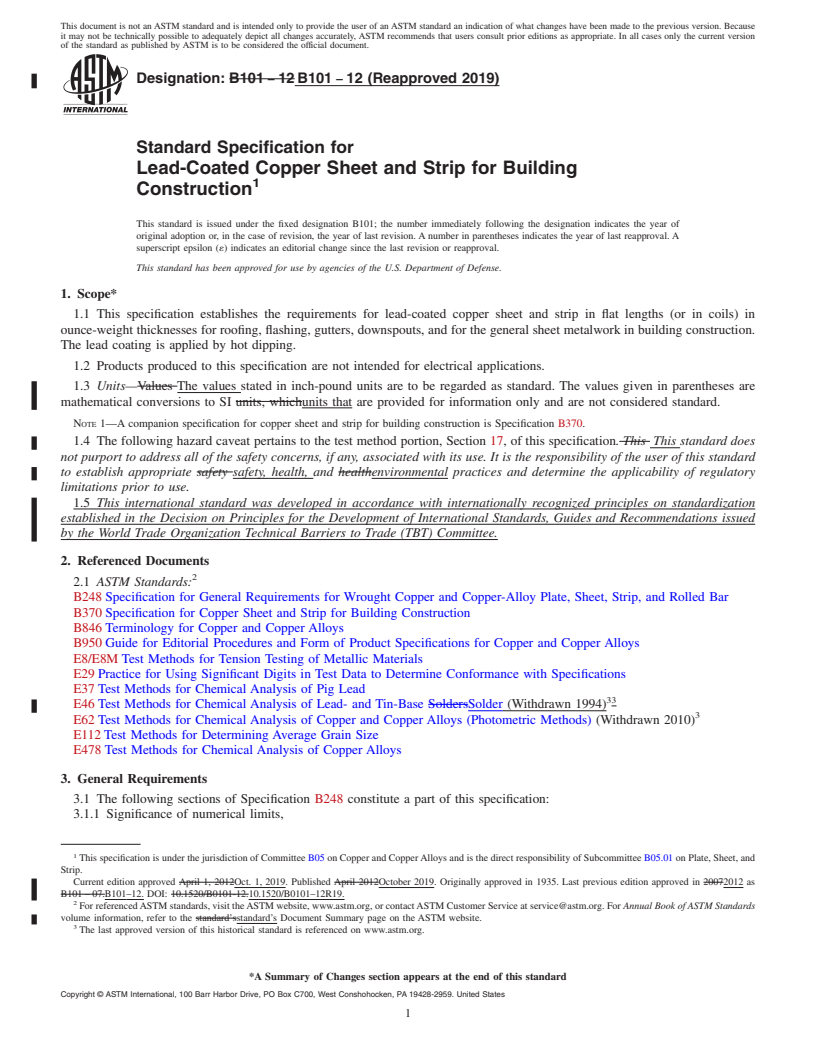
1.3 Units—Values The values stated in inch-pound units are to be regarded as standard. The values given in parentheses are
mathematical conversions to SI units, whichunits that are provided for information only and are not considered standard.
NOTE 1—A companion specification for copper sheet and strip for building construction is Specification B370.
1.4 The following hazard caveat pertains to the test method portion, Section 17, of this specification. This This standard does
not purport to address all of the safety concerns, if any, associated with its use. It is the responsibility of the user of this standard
to establish appropriate safety safety, health, and healthenvironmental practices and determine the applicability of regulatory
limitations prior to use.
1.5 This international standard was developed in accordance with internationally recognized principles on standardization
established in the Decision on Principles for the Development of International Standards, Guides and Recommendations issued
by the World Trade Organization Technical Barriers to Trade (TBT) Committee.
2. Referenced Documents
2.1 ASTM Standards:
B248 Specification for General Requirements for Wrought Copper and Copper-Alloy Plate, Sheet, Strip, and Rolled Bar
B370 Specification for Copper Sheet and Strip for Building Construction
B846 Terminology for Copper and Copper Alloys
B950 Guide for Editorial Procedures and Form of Product Specifications for Copper and Copper Alloys
E8/E8M Test Methods for Tension Testing of Metallic Materials
E29 Practice for Using Significant Digits in Test Data to Determine Conformance with Specifications
E37 Test Methods for Chemical Analysis of Pig Lead
E46 Test Methods for Chemical Analysis of Lead- and Tin-Base SoldersSolder (Withdrawn 1994)
E62 Test Methods for Chemical Analysis of Copper and Copper Alloys (Photometric Methods) (Withdrawn 2010)
E112 Test Methods for Determining Average Grain Size
E478 Test Methods for Chemical Analysis of Copper Alloys
3. General Requirements
3.1 The following sections of Specification B248 constitute a part of this specification:
3.1.1 Significance of numerical limits,
This specification is under the jurisdiction of Committee B05 on Copper and Copper Alloys and is the direct responsibility of Subcommittee B05.01 on Plate, Sheet, and
Strip.
Current edition approved April 1, 2012Oct. 1, 2019. Published April 2012October 2019. Originally approved in 1935. Last previous edition approved in 20072012 as
B101 – 07.B101–12. DOI: 10.1520/B0101-12.10.1520/B0101–12R19.
For referenced ASTM standards, visit the ASTM website, www.astm.org, or contact ASTM Customer Service at service@astm.org. For Annual Book of ASTM Standards
volume information, refer to the standard’sstandard’s Document Summary page on the ASTM website.
The last approved version of this historical standard is referenced on www.astm.org.
*A Summary of Changes section appears at the end of this standard
Copyright © ASTM International, 100 Barr Harbor Drive, PO Box C700, West Conshohocken, PA 19428-2959. United States
B101 − 12 (2019)
3.1.2 Inspection,
3.1.3 Rejection and rehearing,
3.1.4 Certification,
3.1.5 Mill test reports, and
3.1.6 Packaging and package marking.
3.2 In addition, when a section with a title identical to that referenced in 3.1, above, appears in this specification, it contains
additional requirements that supplement those appearing in Specification B248.
4. Terminology
4.1 For definitions of terms related to copper and copper alloys, refer to Terminology B846.
TABLE 1 Mechanical Properties of Uncoated Sheet
B
Yield Strength, at Approximate Rockwell Hardness
A
Temper Designation Tensile Strength, ksi (MPa)
(for Information Only)
0.5 % Extension
F Scale Superficial 30 T
Under Load, min,
Standard Former Min Max
ksi (MPa) Min Max Min Max
O60 soft 30 (205) 38 (260) . . 65 . 31
H00 cold-rolled 32 (220) 40 (275) 20 (140) 54 82 15 49
H01 cold-rolled (high yield) 34 (235) 42 (290) 28 (195) 60 84 18 51
A
ksi = 100 psi.
B
Rockwell hardness values apply as follows: The F scale applies to metal 0.020 in. (0.508 mm) and over in thickness; the superficial 30T scale applies to metal 0.012
in. (0.305 mm) to 0.020 in. (0.508 mm) in thickness.
B101 − 12 (2019)
4.2 Definitions of Terms Specific to This Standard:
4.2.1 coil—a length of the product wound into a series of connected turns.
4.2.1.1 Discussion—
The unqualified term “coil” as applied to “flat product” usually refers to a coil in which the product is spirally wound, with the
successive layers on top of one another. (Sometimes called a “roll.”)
4.2.2 lead-coated copper sheet (for building construction), n—a rolled flat product over 24 in. (610 mm) in width and of
ounce-weight thickness from 8 oz (227 g) to 48 oz (1361 g).
4.2.3 lead-coated strip (for building construction), n—a rolled flat product up to and including 24 in. (610 mm) in width and
of ounce-weight thickness from 8 oz (227 g) to 48 oz (1361 g).(1361 g).
4.2.4 lengths, mill, n—straight lengths, including ends, that are conveniently manufactured in the mills.
4.2.4.1 Discussion—
Full length pieces are usually 8, 10, or 12 ft (2.44, 3.05, or 3.66 m) and subject to established length tolerances.
4.2.5 ounce-weight—the weight of uncoated copper sheet or strip expressed in ounces per square foot.
4.2.6 thickness, ounce-weight, n—the metal thickness that corresponds to the ounce weight.
5. Ordering Information
5.1 Include the following specified choices when placing orders for product under this specification, as applicable:
5.1.1 ASTM designation and year of issue.
5.1.2 Temper (Section 8 and Table 1),
5.1.3 How furnished: flat lengths or in coils,
5.1.4 Quantity: total weight or sheets of each size,
5.1.5 Ounce-weight or ounce-weight thickness of the uncoated copper sheet or strip (Table 2),
5.1.6 Dimensions: width and length (Section 12),
5.1.7 Certification, where required (see 5.1.4),
5.1.8 Mill test report, where required (see 5.1.5), and
5.1.9 If the material being purchased is intended for use by agencies of the U.S. government,Government, refer to Section 11.
5.1.10 Other variations in coating or texture shall be furnished by agreement in writing between the purchaser and the
manufacturer or supplier.
6. Materials and Manufacture
6.1 Materials:
6.1.1 The lead coating shall conform to the chemical requirements of Table 3.
6.1.2 The copper sheet or strip to be lead coated shall be manufactured by any process that provides a finished product that
conforms to the requirements of Specification B370.
6.2 Manufacture:
6.2.1 The lead coating shall be applied to the copper sheet or strip by hot dipping in a bath of molten lead.
6.2.2 Unless otherwise specified, the lead coating shall be applied to the copper sheet or strip after slitting and cutting to the
specified length.
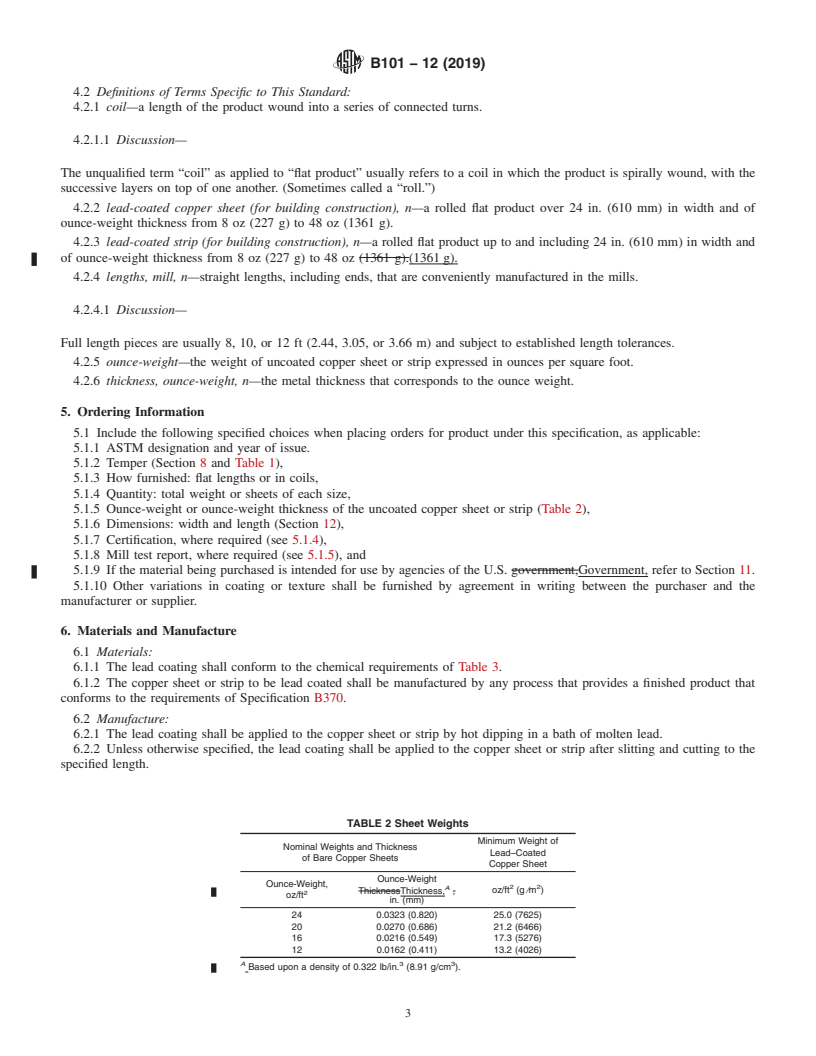
TABLE 2 Sheet Weights
Minimum Weight of
Nominal Weights and Thickness
Lead–Coated
of Bare Copper Sheets
Copper Sheet
Ounce-Weight
Ounce-Weight,
2 2
A
oz/ft (g ⁄m )
ThicknessThickness, ,
oz/ft
in. (mm)
24 0.0323 (0.820) 25.0 (7625)
20 0.0270 (0.686) 21.2 (6466)
16 0.0216 (0.549) 17.3 (5276)
12 0.0162 (0.411) 13.2 (4026)
A 3 3
Based upon a density of 0.322 lb/in. (8.91 g/cm ).
B101 − 12 (2019)
TABLE 3 Chemical Requirements for Lead
Used to Coat Copper Sheet
Composition, % (Maximum
Element unless shown as range or
remainder)
Silver 0.02
Copper 0.08
Arsenic plus antimony 0.10
Zinc 0.005
Iron 0.01
Bismuth 0.08
Lead remainder
Tin 3.0-4.0
Phosphorus 0.03
TABLE 3 Chemical Requirements for Lead
Used to Coat Copper Sheet
Composition, %
Element (Maximum unless shown
as range or remainder)
Silver 0.02
Copper 0.08
Arsenic plus antimony 0.10
Zinc 0.005
Iron 0.01
Bismuth 0.08
Lead remainder
Tin 3.0-4.0
Phosphorus 0.03
7. Chemical Composition
7.1 The copper sheet or strip shall have a minimum copper, including silver, content of 99.5 %.
7.2 Any copper that complies with 7.1 shall be acceptable.
7.3 If limits for unnamed elements are required, they shall be established and analysis required by agreement between the
manufacturer or supplier and purchaser.
7.4 The lead coating shall conform to the chemical requirements of Table 3.
8. Temper
8.1 The standard tempers of the uncoated copper sheet and strip described in this specification are given in Table 1.
8.1.1 Annealed Temper O60.
8.1.2 Cold rolled tempers H00 (eighth hard, cold-rolled); and H01 (quarter hard, cold-rolled high yield).
9. Physical Property Requirements
9.1 Although no minimum grain size is specified for soft-temper material, it shall be fully recrystallized.
10. Mechanical Property Requirements
10.1 Tensile and Yield Strength Requirements:
10.1.1 The uncoated product furnished under this specification shall conform to the tensile and yield strength requirements
prescribed in Table 1 when tested in accordance with Test Methods E8/E8M. Tension test specimens shall be taken so that the
longitudinal axis of such specimens is parallel to the direction of rolling.
10.1.2 Acceptance or rejection based upon mechanical properties shall depend on the tensile and yield strength.
10.2 Rockwell Hardness:
10.2.1 The approximate Rockwell hardness values given in Table 1 are for general information and assistance in testing and
shall not be used as a basis for product rejection.
NOTE 2—The Rockwell hardness test offers a quick and convenient method of checking for general conformity to the specification requirements for
temper and tensile strength.
11. Purchases for the U.S. Government
11.1 When specified in the contractor purchase order, product purchased for an agency of the U.S. governmentGovernment shall
...
Questions, Comments and Discussion
Ask us and Technical Secretary will try to provide an answer. You can facilitate discussion about the standard in here.