


ASTM D3893-03(2017)
(Test Method)Standard Test Method for Purity of Methyl Amyl Ketone and Methyl Isoamyl Ketone by Gas Chromatography
Standard Test Method for Purity of Methyl Amyl Ketone and Methyl Isoamyl Ketone by Gas Chromatography
SIGNIFICANCE AND USE
4.1 This procedure is designed to determine the purity of the two ketones, methyl isoamyl ketone and methyl amyl ketone, and to obtain the concentration of their various impurities, several of which are critical in the application of these solvents.
SCOPE
1.1 This test method covers the determination of the purity of methyl amyl ketone and methyl isoamyl ketone. In addition, the method determines total ketones and various impurities which may include acetone, isopropyl alcohol, methyl propyl ketone, methyl isobutyl ketone, methyl butyl ketone, methyl isobutyl carbinol, mesityl oxide, methyl isoamyl ketone, methyl butyl carbinol, methyl amyl ketone, and diisobutyl ketone.
1.2 Water and acid cannot be determined by this test method. They must be determined by other appropriate ASTM procedures, and the results used to normalize the chromatographic data.
1.3 For purposes of determining conformance of an observed or a calculated value using this test method to relevant specifications, test result(s) shall be rounded “off to the nearest unit” in the last right-hand digit used in expressing the specification limit, in accordance with the rounding-off method of Practice E29.
1.4 The values stated in SI units are to be regarded as standard. No other units of measurement are included in this standard.
1.5 For hazard information and guidance, see the supplier’s Safety Data Sheet.
1.6 This standard does not purport to address all of the safety concerns, if any, associated with its use. It is the responsibility of the user of this standard to establish appropriate safety, health, and environmental practices and determine the applicability of regulatory limitations prior to use.
1.7 This international standard was developed in accordance with internationally recognized principles on standardization established in the Decision on Principles for the Development of International Standards, Guides and Recommendations issued by the World Trade Organization Technical Barriers to Trade (TBT) Committee.
General Information
Buy Standard
Standards Content (Sample)
NOTICE: This standard has either been superseded and replaced by a new version or withdrawn.
Contact ASTM International (www.astm.org) for the latest information
Designation: D3893 − 03 (Reapproved 2017)
Standard Test Method for
Purity of Methyl Amyl Ketone and Methyl Isoamyl Ketone by
Gas Chromatography
This standard is issued under the fixed designation D3893; the number immediately following the designation indicates the year of
original adoption or, in the case of revision, the year of last revision. A number in parentheses indicates the year of last reapproval. A
superscript epsilon (´) indicates an editorial change since the last revision or reapproval.
1. Scope 2. Referenced Documents
1.1 This test method covers the determination of the purity 2.1 ASTM Standards:
of methyl amyl ketone and methyl isoamyl ketone. In addition, D1364 Test Method for Water in Volatile Solvents (Karl
the method determines total ketones and various impurities Fischer Reagent Titration Method)
which may include acetone, isopropyl alcohol, methyl propyl D1613 Test Method for Acidity in Volatile Solvents and
ketone, methyl isobutyl ketone, methyl butyl ketone, methyl Chemical Intermediates Used in Paint, Varnish, Lacquer,
isobutyl carbinol, mesityl oxide, methyl isoamyl ketone, and Related Products
methyl butyl carbinol, methyl amyl ketone, and diisobutyl E29 Practice for Using Significant Digits in Test Data to
ketone. Determine Conformance with Specifications
E180 Practice for Determining the Precision of ASTM
1.2 Water and acid cannot be determined by this test
Methods for Analysis and Testing of Industrial and Spe-
method. They must be determined by other appropriate ASTM
cialty Chemicals (Withdrawn 2009)
procedures, and the results used to normalize the chromato-
graphic data.
3. Summary of Method
1.3 For purposes of determining conformance of an ob-
3.1 A representative specimen is introduced onto a gas-
served or a calculated value using this test method to relevant
liquid partition column. The separated components are mea-
specifications, test result(s) shall be rounded “off to the nearest
sured in the effluent by a detector and recorded as a chromato-
unit” in the last right-hand digit used in expressing the
gram. The chromatogram is interpreted by applying component
specification limit, in accordance with the rounding-off method
attenuation and detector response factors to the peak areas and
of Practice E29.
relative concentrations are determined by relating the indi-
1.4 The values stated in SI units are to be regarded as
vidual peak responses to the total peak response. Water and
standard. No other units of measurement are included in this acidity are measured by Test Methods D1364 and D1613,
standard.
respectively, and the results are used to normalize the values
obtained by gas chromatography.
1.5 For hazard information and guidance, see the supplier’s
Safety Data Sheet.
4. Significance and Use
1.6 This standard does not purport to address all of the
4.1 This procedure is designed to determine the purity of the
safety concerns, if any, associated with its use. It is the
two ketones, methyl isoamyl ketone and methyl amyl ketone,
responsibility of the user of this standard to establish appro-
and to obtain the concentration of their various impurities,
priate safety, health, and environmental practices and deter-
several of which are critical in the application of these solvents.
mine the applicability of regulatory limitations prior to use.
1.7 This international standard was developed in accor-
5. Apparatus
dance with internationally recognized principles on standard-
5.1 Chromatograph—Any gas-liquid chromatographic in-
ization established in the Decision on Principles for the
strument having either a thermal conductivity or flame ioniza-
Development of International Standards, Guides and Recom-
tion detector and sufficient sensitivity and stability to obtain for
mendations issued by the World Trade Organization Technical
0.01 % impurity in the specimen a recorder deflection of at
Barriers to Trade (TBT) Committee.
1 2
This test method is under the jurisdiction of ASTM Committee D01 on Paint For referenced ASTM standards, visit the ASTM website, www.astm.org, or
and Related Coatings, Materials, and Applications and is the direct responsibility of contact ASTM Customer Service at service@astm.org. For Annual Book of ASTM
Subcommittee D01.35 on Solvents, Plasticizers, and Chemical Intermediates. Standards volume information, refer to the standard’s Document Summary page on
Current edition approved Dec. 1, 2017. Published December 2017. Originally the ASTM website.
approved in 1980. Last previous edition approved in 2009 as D3893 – 09. DOI: The last approved version of this historical standard is referenced on
10.1520/D3893-03R17. www.astm.org.
Copyright © ASTM International, 100 Barr Harbor Drive, PO Box C700, West Conshohocken, PA 19428-2959. United States
D3893 − 03 (2017)
least 20 mm at a signal-to-noise ratio of at least 5 to 1. A mL of methylene chloride and add to the solid support. Add
recording integrator or computer data processing system may additional methylene chloride to wet and cover the solid
also be used. support. Evaporate the methylene chloride in a fume hood with
5.1.1 The injection port of the chromatograph must have a gentle stirring and under a gentle stream of nitrogen.
volume of at least 1.2 mL to provide for proper vaporization of
7.3 Add 12 g of the packing prepared in 7.1 and 12 g of the
the specimen. The use of a smaller injection port or on-column
packing prepared in 7.2 to a small glass bottle or beaker and
injection causes peak broadening and tailing.
mix well. The mixture is used as the column packing material.
5.2 Column—Four and one half m of 3.2-mm stainless steel
7.4 Column Preparation—The method used to pack the
tubing packed with 80 to 90-mesh acid-washed, base-washed,
column is not critical provided that the finished column
and silanized diatomaceous earth support coated with 10.0 %
produces the required separation of all of the components to be
20 000 molecular weight polyethylene glycol and a 8.33 %
determined.
phenyl methyl (50:50) silicone. A capillary column, capable of
the required separation may also be used.
8. Calibration and Standardization
5.3 Specimen Introduction System—Any system capable of
8.1 Chromatograph—Install the column in the chromato-
introducing a representative specimen onto the column. Micro-
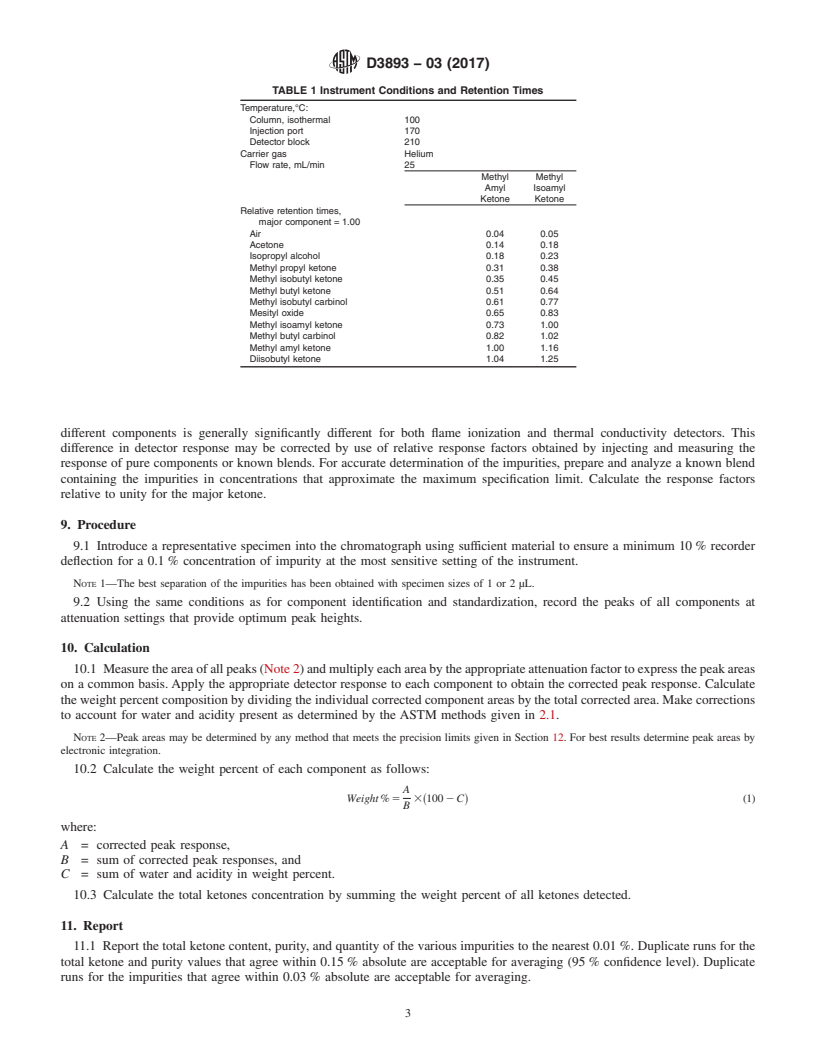
graph and adjust the operating parameters as directed in Table
liter syringes have been used successfully.
1. Allow sufficient time for the instrument to reach equilibrium
as indicated by a stable recorder baseline.
5.4 Recorder—A recording potentiometer with a full-scale
deflection of 1 mV, full-scale response time of 1 s or less, and
8.2 Determine the retention time of each component by
sufficient sensitivity and stability to meet the requirements of
injecting small amounts either separately or in known mix-
5.1.
tures. The components should elute close to the typical
retention times given in Table 1 and the chromatograms should
6. Reagents and Materials
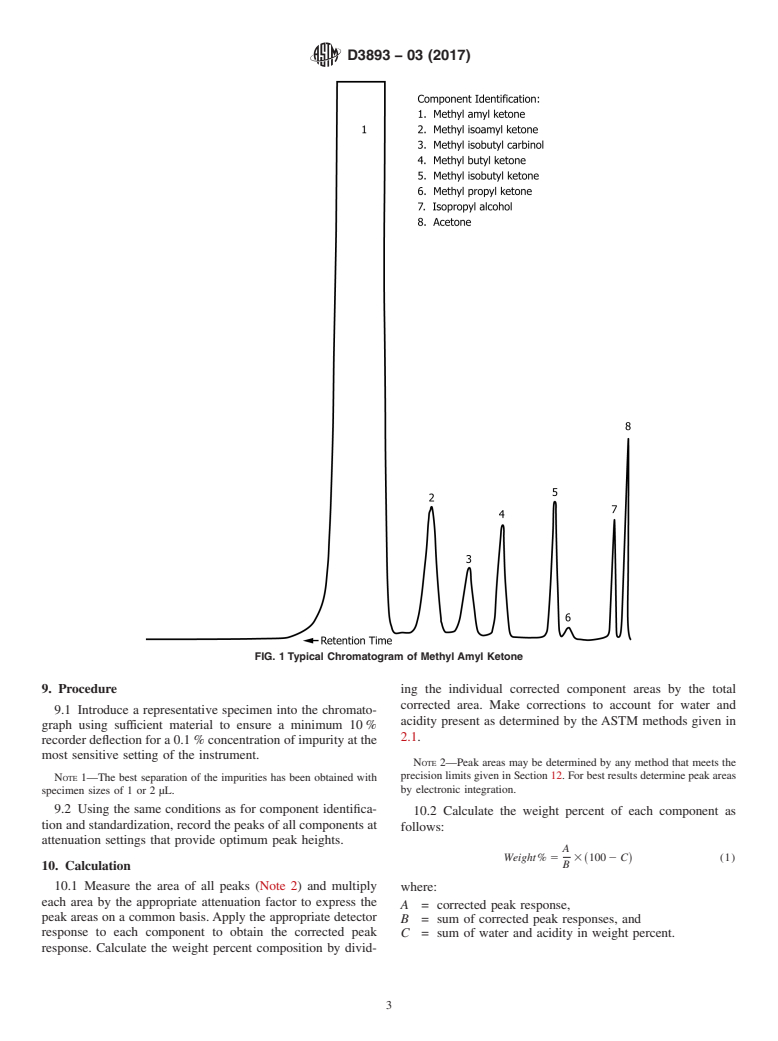
closely approximate those shown in Fig. 1 and Fig. 2.
6.1 Carrier Gas, appropriate to the type of detector used.
8.3 The area under each peak of the chromatogram is
Helium or hydrogen may be employed with thermal conduc-
considered a quantitative measure of the corresponding com-
tivity detectors and nitrogen, helium, or argon with flame
pound. The relative area is proportional to concentration if the
ionization detectors. The minimum purity of the carrier gas
detector responds equally to all the sample components. The
used should be 99.95 mol %. An oxygen removal system is
response to different components is generally significantly
recommended for the carrier gas.
different for both flame ionization and thermal conductivity
6.1.1 Warning—If hydrogen is used, take special safety
detectors. This difference in detector response may be cor-
precautions to ensure that the system is free of leaks and that
rected by use of relative response factors obtained by injecting
the effluent is vented properly.
and measuring the response of pure components or known
6.2 Column Materials:
blends. For
...
This document is not an ASTM standard and is intended only to provide the user of an ASTM standard an indication of what changes have been made to the previous version. Because
it may not be technically possible to adequately depict all changes accurately, ASTM recommends that users consult prior editions as appropriate. In all cases only the current version
of the standard as published by ASTM is to be considered the official document.
Designation: D3893 − 03 (Reapproved 2009) D3893 − 03 (Reapproved 2017)
Standard Test Method for
Purity of Methyl Amyl Ketone and Methyl Isoamyl Ketone by
Gas Chromatography
This standard is issued under the fixed designation D3893; the number immediately following the designation indicates the year of
original adoption or, in the case of revision, the year of last revision. A number in parentheses indicates the year of last reapproval. A
superscript epsilon (´) indicates an editorial change since the last revision or reapproval.
1. Scope*Scope
1.1 This test method covers the determination of the purity of methyl amyl ketone and methyl isoamyl ketone. In addition, the
method determines total ketones and various impurities which may include acetone, isopropyl alcohol, methyl propyl ketone,
methyl isobutyl ketone, methyl butyl ketone, methyl isobutyl carbinol, mesityl oxide, methyl isoamyl ketone, methyl butyl
carbinol, methyl amyl ketone, and diisobutyl ketone.
1.2 Water and acid cannot be determined by this test method. They must be determined by other appropriate ASTM procedures,
and the results used to normalize the chromatographic data.
1.3 For purposes of determining conformance of an observed or a calculated value using this test method to relevant
specifications, test result(s) shall be rounded “off to the nearest unit” in the last right-hand digit used in expressing the specification
limit, in accordance with the rounding-off method of Practice E29.
1.4 The values stated in SI units are to be regarded as standard. No other units of measurement are included in this standard.
1.5 For hazard information and guidance, see the supplier’s Material Safety Data Sheet.
1.6 This standard does not purport to address all of the safety concerns, if any, associated with its use. It is the responsibility
of the user of this standard to establish appropriate safety safety, health, and healthenvironmental practices and determine the
applicability of regulatory limitations prior to use.
1.7 This international standard was developed in accordance with internationally recognized principles on standardization
established in the Decision on Principles for the Development of International Standards, Guides and Recommendations issued
by the World Trade Organization Technical Barriers to Trade (TBT) Committee.
2. Referenced Documents
2.1 ASTM Standards:
D1364 Test Method for Water in Volatile Solvents (Karl Fischer Reagent Titration Method)
D1613 Test Method for Acidity in Volatile Solvents and Chemical Intermediates Used in Paint, Varnish, Lacquer, and Related
Products
E29 Practice for Using Significant Digits in Test Data to Determine Conformance with Specifications
E180 Practice for Determining the Precision of ASTM Methods for Analysis and Testing of Industrial and Specialty Chemicals
(Withdrawn 2009)
3. Summary of Method
3.1 A representative specimen is introduced onto a gas-liquid partition column. The separated components are measured in the
effluent by a detector and recorded as a chromatogram. The chromatogram is interpreted by applying component attenuation and
detector response factors to the peak areas and relative concentrations are determined by relating the individual peak responses to
the total peak response. Water and acidity are measured by Test Methods D1364 and D1613, respectively, and the results are used
to normalize the values obtained by gas chromatography.
This test method is under the jurisdiction of ASTM Committee D01 on Paint and Related Coatings, Materials, and Applications and is the direct responsibility of
Subcommittee D01.35 on Solvents, Plasticizers, and Chemical Intermediates.
Current edition approved Dec. 1, 2009Dec. 1, 2017. Published January 2010December 2017. Originally approved in 1980. Last previous edition approved in 20032009
as D3893 – 03.D3893 – 09. DOI: 10.1520/D3893-03R09.10.1520/D3893-03R17.
For referenced ASTM standards, visit the ASTM website, www.astm.org, or contact ASTM Customer Service at service@astm.org. For Annual Book of ASTM Standards
volume information, refer to the standard’s Document Summary page on the ASTM website.
The last approved version of this historical standard is referenced on www.astm.org.
*A Summary of Changes section appears at the end of this standard
Copyright © ASTM International, 100 Barr Harbor Drive, PO Box C700, West Conshohocken, PA 19428-2959. United States
D3893 − 03 (2017)
4. Significance and Use
4.1 This procedure is designed to determine the purity of the two ketones, methyl isoamyl ketone and methyl amyl ketone, and
to obtain the concentration of their various impurities, several of which are critical in the application of these solvents.
5. Apparatus
5.1 Chromatograph—Any gas-liquid chromatographic instrument having either a thermal conductivity or flame ionization
detector and sufficient sensitivity and stability to obtain for 0.01 % impurity in the specimen a recorder deflection of at least 20
mm at a signal-to-noise ratio of at least 5 to 1. A recording integrator or computer data processing system may also be used.
5.1.1 The injection port of the chromatograph must have a volume of at least 1.2 mL to provide for proper vaporization of the
specimen. The use of a smaller injection port or on-column injection causes peak broadening and tailing.
5.2 Column—Four and one half m of 3.2-mm stainless steel tubing packed with 80 to 90-mesh acid-washed, base-washed, and
silanized diatomaceous earth support coated with 10.0 % 20 000 molecular weight polyethylene glycol and a 8.33 % phenyl
methyl (50:50) silicone. A capillary column, capable of the required separation may also be used.
5.3 Specimen Introduction System—Any system capable of introducing a representative specimen onto the column. Microliter
syringes have been used successfully.
5.4 Recorder—A recording potentiometer with a full-scale deflection of 1 mV, full-scale response time of 1 s or less, and
sufficient sensitivity and stability to meet the requirements of 5.1.
6. Reagents and Materials
6.1 Carrier Gas, appropriate to the type of detector used. Helium or hydrogen may be employed with thermal conductivity
detectors and nitrogen, helium, or argon with flame ionization detectors. The minimum purity of the carrier gas used should be
99.95 mol %. An oxygen removal system is recommended for the carrier gas.
6.1.1 Warning—If hydrogen is used, take special safety precautions to ensure that the system is free of leaks and that the
effluent is vented properly.
6.2 Column Materials:
6.2.1 Liquid Phase—20 000 molecular weight polyethylene glycol and phenyl methyl (50:50) silicone.
6.2.2 Solid Support—Acid-washed, base-washed, and silanized diatomaceous earth, 80 to 90 mesh.
6.2.3 Solvents—Methylene chloride, reagent grade.
6.2.4 Tubing Material—The stainless steel tubing must be of uniform internal diameter and must be clean. Wash the inside of
the tubing with methylene chloride, then water, and finally methyl alcohol and blow dry with nitrogen.
6.3 Standards for Calibration and Identification—Standard samples of all components are needed for establishing identification
by retention time and for calibration for quantitative measurements. In most cases, the pure compounds required for calibration
cannot be purchased and must be purified by distillation before use.
7. Preparation of Column
7.1 Place 50 g of the solid support, 80 to 90 mesh, in a large evaporating dish. Dissolve 12.5 g of the polyethylene glycol in
about 40 mL of methylene chloride and add to the solid support. Add additional methylene chloride to wet and cover the solid
support. Evaporate the methylene chloride in a fume hood with gentle stirring and under a gentle stream of nitrogen.
7.2 Place 50 g of the solid support in a large evaporating dish. Dissolve 10 g of the phenyl methyl silicone in about 40 mL of
methylene chloride and add to the solid support. Add additional methylene chloride to wet and cover the solid support. Evaporate
the methylene chloride in a fume hood with gentle stirring and under a gentle stream of nitrogen.
7.3 Add 12 g of the packing prepared in 7.1 and 12 g of the packing prepared in 7.2 to a small glass bottle or beaker an
...
Questions, Comments and Discussion
Ask us and Technical Secretary will try to provide an answer. You can facilitate discussion about the standard in here.