

ASTM D3746/D3746M-85(2022)
(Test Method)Standard Test Method for Impact Resistance of Bituminous Roofing Systems
General Information
- Abstract
SIGNIFICANCE AND USE
4.1 This test method provides a means of evaluating roofing systems for resistance to impact loads of many kinds. It should also be useful in developing performance criteria for roofing systems.
SCOPE
1.1 This test method covers the determination of the resistance of bituminous roofing systems to impact loads at any desired temperature, with a missile of the weight, size, and shape specified herein.
1.2 The values stated in either SI units or inch-pound units are to be regarded separately as standard. The values stated in each system may not be exact equivalents; therefore, each system shall be used independently of the other. Combining values from the two systems may result in nonconformance with the standard.
1.3 This standard does not purport to address all of the safety concerns, if any, associated with its use. It is the responsibility of the user of this standard to establish appropriate safety, health, and environmental practices and determine the applicability of regulatory limitations prior to use. For specific precautionary statements, see Section 6.
1.4 This international standard was developed in accordance with internationally recognized principles on standardization established in the Decision on Principles for the Development of International Standards, Guides and Recommendations issued by the World Trade Organization Technical Barriers to Trade (TBT) Committee.
- Status
- Published
- Publication Date
- 30-Apr-2022
- Technical Committee
- D08 - Roofing and Waterproofing
- Drafting Committee
- D08.20 - Roofing Membrane Systems


Overview
ASTM D3746/D3746M-85(2022): Standard Test Method for Impact Resistance of Bituminous Roofing Systems provides a standardized procedure for determining how bituminous roofing systems withstand impact loads. Developed by ASTM International, this test method allows for the evaluation of roofing membranes and related assemblies using a controlled missile impact at any desired temperature. By establishing consistent criteria and methods, this standard is critical for manufacturers, installers, and designers who want to assess or verify the performance and durability of bituminous roofing products under impact conditions.
Key Topics
- Impact Resistance Testing: Specifies a method using a standardized missile to simulate impacts that may occur during installation, maintenance, or environmental events such as hail or debris strikes.
- Temperature Flexibility: Test procedures can be conducted at various temperatures, reflecting real-world climatic conditions and ensuring comprehensive system evaluation.
- Specimen Preparation: Outlines procedures for both field and laboratory sample preparation, ensuring representative and comparable results.
- Damage Assessment: Instructs on classifying and recording types of roofing membrane damage, supporting quantitative comparisons between systems.
- Unit Standardization: Values can be reported in SI or inch-pound units, but systems must not be mixed to maintain standard compliance.
- Safety Considerations: Emphasizes the need for appropriate health, safety, and environmental precautions, especially regarding chemicals and impact testing.
Applications
- Product Development: Manufacturers use this standard to design bituminous roofing systems that meet or exceed established impact resistance criteria. The results help guide material selection and formulation for improved durability.
- Quality Control: The method serves as a benchmark for verifying the impact resistance of finished product batches prior to market release or after installation.
- Performance Criteria: Building owners, contractors, and specifiers rely on the results to select roofing systems suitable for regions prone to hail, falling debris, or similar hazards.
- Regulatory Compliance: Test results following ASTM D3746/D3746M may be required for compliance with local, national, or international building codes and specifications.
- Damage Analysis and Forensics: Roof failures can be analyzed using this method to determine whether impact loads exceeded design expectations or if materials underperformed.
Related Standards
- ASTM D2829/D2829M: Practice for Sampling and Analysis of Existing Built-Up Roof Systems - referenced for field sampling procedures.
- Other Bituminous Roofing Standards: Together with ASTM D3746/D3746M, related standards help define comprehensive testing frameworks for attributes such as weathering, fire resistance, and waterproofing.
- World Trade Organization (WTO) TBT Principles: This standard aligns with internationally recognized standardization principles, facilitating international trade and acceptance.
- Building Codes and Best Practices: Many regional and international building codes cite ASTM standards, including D3746/D3746M, to ensure reliable performance and safety.
Keywords: ASTM D3746/D3746M, impact resistance, bituminous roofing, roofing systems, standard test method, roofing membrane, missile test, roofing durability, roofing performance, asphalt roofing, building standards, weathering resistance.
Get Certified
Connect with accredited certification bodies for this standard

DIBt (Deutsches Institut für Bautechnik)
German Institute for Building Technology.
DIN CERTCO
DIN Group product certification.

Aboma Certification B.V.
Specialized in construction, metal, and transport sectors.
Sponsored listings
Frequently Asked Questions
ASTM D3746/D3746M-85(2022) is a standard published by ASTM International. Its full title is "Standard Test Method for Impact Resistance of Bituminous Roofing Systems". This standard covers: SIGNIFICANCE AND USE 4.1 This test method provides a means of evaluating roofing systems for resistance to impact loads of many kinds. It should also be useful in developing performance criteria for roofing systems. SCOPE 1.1 This test method covers the determination of the resistance of bituminous roofing systems to impact loads at any desired temperature, with a missile of the weight, size, and shape specified herein. 1.2 The values stated in either SI units or inch-pound units are to be regarded separately as standard. The values stated in each system may not be exact equivalents; therefore, each system shall be used independently of the other. Combining values from the two systems may result in nonconformance with the standard. 1.3 This standard does not purport to address all of the safety concerns, if any, associated with its use. It is the responsibility of the user of this standard to establish appropriate safety, health, and environmental practices and determine the applicability of regulatory limitations prior to use. For specific precautionary statements, see Section 6. 1.4 This international standard was developed in accordance with internationally recognized principles on standardization established in the Decision on Principles for the Development of International Standards, Guides and Recommendations issued by the World Trade Organization Technical Barriers to Trade (TBT) Committee.
SIGNIFICANCE AND USE 4.1 This test method provides a means of evaluating roofing systems for resistance to impact loads of many kinds. It should also be useful in developing performance criteria for roofing systems. SCOPE 1.1 This test method covers the determination of the resistance of bituminous roofing systems to impact loads at any desired temperature, with a missile of the weight, size, and shape specified herein. 1.2 The values stated in either SI units or inch-pound units are to be regarded separately as standard. The values stated in each system may not be exact equivalents; therefore, each system shall be used independently of the other. Combining values from the two systems may result in nonconformance with the standard. 1.3 This standard does not purport to address all of the safety concerns, if any, associated with its use. It is the responsibility of the user of this standard to establish appropriate safety, health, and environmental practices and determine the applicability of regulatory limitations prior to use. For specific precautionary statements, see Section 6. 1.4 This international standard was developed in accordance with internationally recognized principles on standardization established in the Decision on Principles for the Development of International Standards, Guides and Recommendations issued by the World Trade Organization Technical Barriers to Trade (TBT) Committee.
ASTM D3746/D3746M-85(2022) is classified under the following ICS (International Classification for Standards) categories: 91.100.50 - Binders. Sealing materials. The ICS classification helps identify the subject area and facilitates finding related standards.
ASTM D3746/D3746M-85(2022) is available in PDF format for immediate download after purchase. The document can be added to your cart and obtained through the secure checkout process. Digital delivery ensures instant access to the complete standard document.
Standards Content (Sample)
This international standard was developed in accordance with internationally recognized principles on standardization established in the Decision on Principles for the
Development of International Standards, Guides and Recommendations issued by the World Trade Organization Technical Barriers to Trade (TBT) Committee.
Designation: D3746/D3746M −85 (Reapproved 2022)
Standard Test Method for
Impact Resistance of Bituminous Roofing Systems
This standard is issued under the fixed designation D3746/D3746M; the number immediately following the designation indicates the
year of original adoption or, in the case of revision, the year of last revision. A number in parentheses indicates the year of last
reapproval. A superscript epsilon (´) indicates an editorial change since the last revision or reapproval.
1. Scope each quadrant, from a standard missile falling freely from a
predetermined height with an impact energy of 30.0 J
1.1 This test method covers the determination of the resis-
[22 lbf·ft]. Damage to the membrane is assessed by visual
tance of bituminous roofing systems to impact loads at any
examination of the felts after solvent extraction of the bitumen.
desired temperature, with a missile of the weight, size, and
shape specified herein. 3.2 The effect of specimen temperature on impact resistance
canbestudiedbyrunningthetestinanenvironmental chamber
1.2 The values stated in either SI units or inch-pound units
at any desired temperature.
are to be regarded separately as standard. The values stated in
each system may not be exact equivalents; therefore, each
4. Significance and Use
system shall be used independently of the other. Combining
values from the two systems may result in nonconformance
4.1 This test method provides a means of evaluating roofing
with the standard.
systems for resistance to impact loads of many kinds. It should
also be useful in developing performance criteria for roofing
1.3 This standard does not purport to address all of the
systems.
safety concerns, if any, associated with its use. It is the
responsibility of the user of this standard to establish appro-
5. Apparatus
priate safety, health, and environmental practices and deter-
mine the applicability of regulatory limitations prior to use.
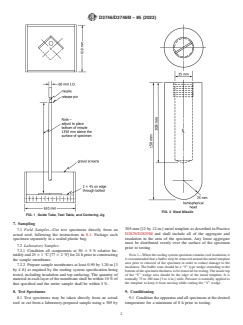
5.1 Vertical Guide Tube, 1.22 m [4.0 ft] long by 60 mm
For specific precautionary statements, see Section 6. 3
[2 ⁄8 in.] in inside diameter, suitably positioned over a 610-mm
1.4 This international standard was developed in accor-
[24-in.] square, horizontal test table constructed of wood 2 by
dance with internationally recognized principles on standard-
4s on edge, through-bolted and fitted with a centering jig to
ization established in the Decision on Principles for the
ensure proper alignment of the specimen beneath the guide
Development of International Standards, Guides and Recom-
tube (see Fig. 1). The guide tube is adjustable in height to
mendations issued by the World Trade Organization Technical
accommodate differing specimen thicknesses and maintain
Barriers to Trade (TBT) Committee.
constant missile impact energy. Provision is made at the top of
the guide tube to support the missile during alignment of the
2. Referenced Documents
specimen, and for instantaneous release of the missile to
2.1 ASTM Standards: free-fall within the guide tube until contact is made with the
D2829/D2829M Practice for Sampling and Analysis of Ex- specimen. Gravel screens are attached to the edges of the test
isting Built-Up Roof Systems table to retain any loose gravel that might fly from the impact
area.
3. Summary of Test Method
5.2 Missile (see Fig. 2), consisting of a steel cylinder 50 mm
3.1 This test method subjects 305 by 305-mm [12 by 12-in.]
[2 in.] in diameter by 150 mm [6 in.] long, with a case-
specimens of a roofing system (insulation and membrane
hardened hemispherical head. The mass of the missile is
complete with top surfacing) to a series of four impacts, one in
adjusted to 2.27 kg [5.0 lb] by the addition of lead shot to a
cavity machined into the cylindrical portion and sealed with a
screw cap.
This test method is under the jurisdiction ofASTM Committee D08 on Roofing
and Waterproofing and is the direct responsibility of Subcommittee D08.20 on
6. Safety Precautions
Roofing Membrane Systems.
Current edition approved May 1, 2022. Published May 2022. Originally
6.1 Employ suitable devices for eye protection when carry-
approved in 1978. Last previous edition approved in 2015 as D3746/D3746M – 85
ɛ1 ing out steps in 10.1 – 10.7.3.
(2015) . DOI: 10.1520/D3746_D3746M-85R22.
For referenced ASTM standards, visit the ASTM website, www.astm.org, or
6.2 Use a fume hood when extracting specimens with 1,1,1
contact ASTM Customer Service at service@astm.org. For Annual Book of ASTM
trichloroethane or xylene in 10.7.3.Trichloroethane and xylene
Standards volume information, refer to the standard’s Document Summary page on
the ASTM website. are toxic and good ventilation should be provided.
Copyright © ASTM International, 100 Barr Harbor Drive, PO Box C700, West Conshohocken, PA 19428-2959. United States
D3746/D3746M − 85 (2022)
FIG. 2 Steel Missile
FIG. 1 Guide Tube, Test Table, and Centering Jig
7. Sampling
305-mm [12 by 12-in.] metal template as described in Practice
7.1 Field Samples—Cut test specimens directly from an
D2829/D2829M and shall include all of the aggregate and
actual roof, following the instructions in 8.1. Package each
insulation in the area of the specimen. Any loose aggregate
specimen
...