


ASTM F1884-04(2018)
(Test Method)Standard Test Methods for Determining Residual Solvents in Packaging Materials
Standard Test Methods for Determining Residual Solvents in Packaging Materials
SIGNIFICANCE AND USE
5.1 This test method is intended to measure volatile organic compounds that are emitted from packaging materials under high-temperature conditions.
5.2 This test method may be useful in assisting in the development and manufacture of packaging materials having minimal retained packaging ink/adhesive solvents.
5.3 Modification of this procedure by utilizing appropriate qualitative GC detection devices such as a mass spectrometer in place of the flame ionization detector may provide identification of volatile organics of unknown identity.
SCOPE
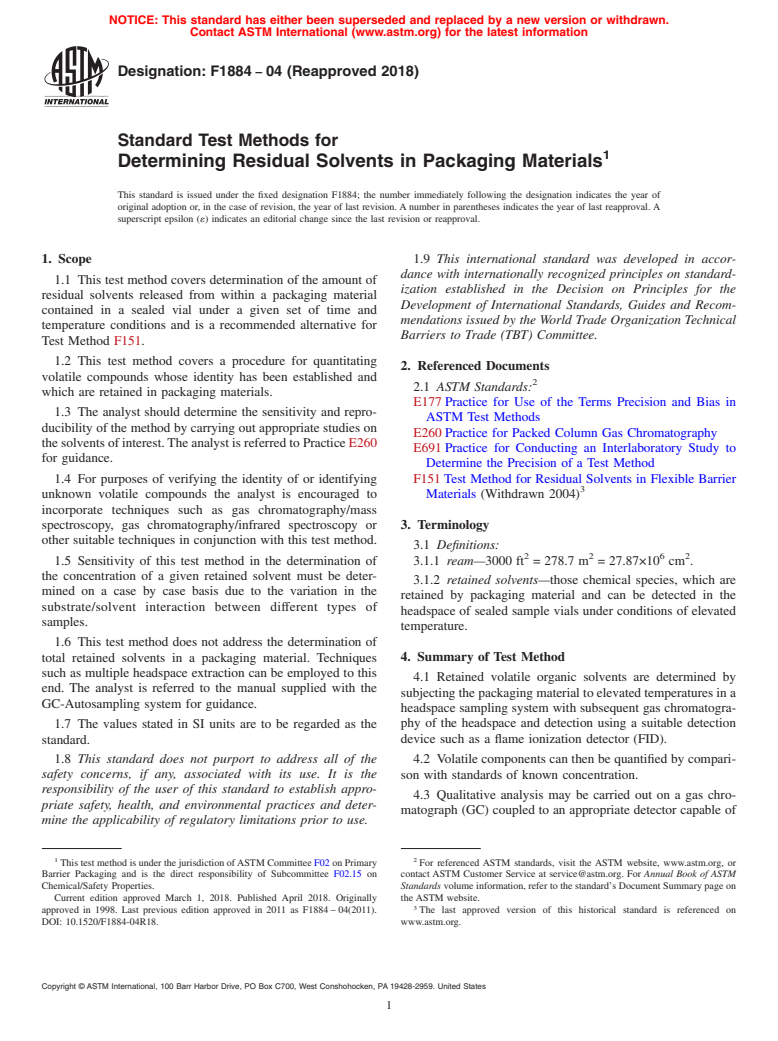
1.1 This test method covers determination of the amount of residual solvents released from within a packaging material contained in a sealed vial under a given set of time and temperature conditions and is a recommended alternative for Test Method F151.
1.2 This test method covers a procedure for quantitating volatile compounds whose identity has been established and which are retained in packaging materials.
1.3 The analyst should determine the sensitivity and reproducibility of the method by carrying out appropriate studies on the solvents of interest. The analyst is referred to Practice E260 for guidance.
1.4 For purposes of verifying the identity of or identifying unknown volatile compounds the analyst is encouraged to incorporate techniques such as gas chromatography/mass spectroscopy, gas chromatography/infrared spectroscopy or other suitable techniques in conjunction with this test method.
1.5 Sensitivity of this test method in the determination of the concentration of a given retained solvent must be determined on a case by case basis due to the variation in the substrate/solvent interaction between different types of samples.
1.6 This test method does not address the determination of total retained solvents in a packaging material. Techniques such as multiple headspace extraction can be employed to this end. The analyst is referred to the manual supplied with the GC-Autosampling system for guidance.
1.7 The values stated in SI units are to be regarded as the standard.
1.8 This standard does not purport to address all of the safety concerns, if any, associated with its use. It is the responsibility of the user of this standard to establish appropriate safety, health, and environmental practices and determine the applicability of regulatory limitations prior to use.
1.9 This international standard was developed in accordance with internationally recognized principles on standardization established in the Decision on Principles for the Development of International Standards, Guides and Recommendations issued by the World Trade Organization Technical Barriers to Trade (TBT) Committee.
General Information
Buy Standard
Standards Content (Sample)
NOTICE: This standard has either been superseded and replaced by a new version or withdrawn.
Contact ASTM International (www.astm.org) for the latest information
Designation: F1884 − 04 (Reapproved 2018)
Standard Test Methods for
Determining Residual Solvents in Packaging Materials
This standard is issued under the fixed designation F1884; the number immediately following the designation indicates the year of
original adoption or, in the case of revision, the year of last revision. A number in parentheses indicates the year of last reapproval. A
superscript epsilon (´) indicates an editorial change since the last revision or reapproval.
1. Scope 1.9 This international standard was developed in accor-
dance with internationally recognized principles on standard-
1.1 This test method covers determination of the amount of
ization established in the Decision on Principles for the
residual solvents released from within a packaging material
Development of International Standards, Guides and Recom-
contained in a sealed vial under a given set of time and
mendations issued by the World Trade Organization Technical
temperature conditions and is a recommended alternative for
Barriers to Trade (TBT) Committee.
Test Method F151.
1.2 This test method covers a procedure for quantitating
2. Referenced Documents
volatile compounds whose identity has been established and
2.1 ASTM Standards:
which are retained in packaging materials.
E177 Practice for Use of the Terms Precision and Bias in
1.3 The analyst should determine the sensitivity and repro-
ASTM Test Methods
ducibility of the method by carrying out appropriate studies on
E260 Practice for Packed Column Gas Chromatography
the solvents of interest. The analyst is referred to Practice E260
E691 Practice for Conducting an Interlaboratory Study to
for guidance.
Determine the Precision of a Test Method
F151 Test Method for Residual Solvents in Flexible Barrier
1.4 For purposes of verifying the identity of or identifying
unknown volatile compounds the analyst is encouraged to Materials (Withdrawn 2004)
incorporate techniques such as gas chromatography/mass
spectroscopy, gas chromatography/infrared spectroscopy or 3. Terminology
other suitable techniques in conjunction with this test method.
3.1 Definitions:
2 2 6 2
1.5 Sensitivity of this test method in the determination of 3.1.1 ream—3000 ft = 278.7 m = 27.87×10 cm .
the concentration of a given retained solvent must be deter-
3.1.2 retained solvents—those chemical species, which are
mined on a case by case basis due to the variation in the
retained by packaging material and can be detected in the
substrate/solvent interaction between different types of
headspace of sealed sample vials under conditions of elevated
samples.
temperature.
1.6 This test method does not address the determination of
4. Summary of Test Method
total retained solvents in a packaging material. Techniques
such as multiple headspace extraction can be employed to this
4.1 Retained volatile organic solvents are determined by
end. The analyst is referred to the manual supplied with the
subjecting the packaging material to elevated temperatures in a
GC-Autosampling system for guidance.
headspace sampling system with subsequent gas chromatogra-
phy of the headspace and detection using a suitable detection
1.7 The values stated in SI units are to be regarded as the
standard. device such as a flame ionization detector (FID).
1.8 This standard does not purport to address all of the 4.2 Volatile components can then be quantified by compari-
safety concerns, if any, associated with its use. It is the
son with standards of known concentration.
responsibility of the user of this standard to establish appro-
4.3 Qualitative analysis may be carried out on a gas chro-
priate safety, health, and environmental practices and deter-
matograph (GC) coupled to an appropriate detector capable of
mine the applicability of regulatory limitations prior to use.
1 2
This test method is under the jurisdiction of ASTM Committee F02 on Primary For referenced ASTM standards, visit the ASTM website, www.astm.org, or
Barrier Packaging and is the direct responsibility of Subcommittee F02.15 on contact ASTM Customer Service at service@astm.org. For Annual Book of ASTM
Chemical/Safety Properties. Standards volume information, refer to the standard’s Document Summary page on
Current edition approved March 1, 2018. Published April 2018. Originally the ASTM website.
approved in 1998. Last previous edition approved in 2011 as F1884 – 04(2011). The last approved version of this historical standard is referenced on
DOI: 10.1520/F1884-04R18. www.astm.org.
Copyright © ASTM International, 100 Barr Harbor Drive, PO Box C700, West Conshohocken, PA 19428-2959. United States
F1884 − 04 (2018)
compound detection / identification, such as a mass spectrom- 7.2.1 An example of a working standard is listed below. The
eter or infrared detector. standard used will vary based on the solvents present in the
sample to be tested. The quantities shown in the table will
5. Significance and Use
result in roughly equivalent size peaks due to differences in
5.1 This test method is intended to measure volatile organic detector response. If the solvents are mixed neat, adding 1 µL
per gram of material in the headspace vial provides a good
compounds that are emitted from packaging materials under
high-temperature conditions. starting point for calibration.
7.2.2 If desired, water may be used as the diluent for the
5.2 This test method may be useful in assisting in the
standard. The solvents are diluted in 1 L of water, typically 2
development and manufacture of packaging materials having
mL of the resulting solution is added per gram of sample in the
minimal retained packaging ink/adhesive solvents.
headspace vial for calibration. 2 mL of 20 µl/L of 4-heptanone
5.3 Modification of this procedure by utilizing appropriate
containing solution in water can be used as an internal
qualitative GC detection devices such as a mass spectrometer
standard.
in place of the flame ionization detector may provide identifi-
NOTE 1—Water will change the partition coefficient between the sample
cation of volatile organics of unknown identity.
and retained solvents.
Solvent µL/L µg/mL
6. Interferences
6.1 Gas Chromatography—Because of the potentially large Methanol 120 94.96
Ethanol 80 63.14
number of chemical species that can be analyzed using this
2-Propanol 60 47.13
methodology, not all species will be resolved from one another
n-Propanol 60 48.21
on a particular GC column under a given set of conditions. Methylethyl ketone 40 32.20
Ethylacetate 40 36.08
Techniques available to the analyst to verify the identity of
2-Propylacetate 20 17.08
chemical species being quantitated include retention time
Benzene 10 8.76
comparisons using alternate GC conditions or using an alter- Methylisobutylketone 20 16.02
Toluene 10 8.70
nate GC column. Good judgment in the interpretation of
Heptanone 20 16.42
chromatographic results is always important. Refer to Practice
7.3 Vials, 20 mL. To ensure against extraneous peaks in the
E260 for guidance.
gas chromatographic traces, wash vials thoroughly and dry in
6.2 Apparatus—Because this method is designed for detect-
a 125°C air oven for a minimum of 4 h before using.
ing trace quantities of organic compounds, contaminants can
7.4 Vial Crimp Caps.
lead to misinterpretation of results. Preparing apparatus prop-
erly and carrying out blank determinations is essential to 7.5 Septa, Teflon/Silicone. To ensure that the septa are free
minimize this possibility. of volatiles, condition the septa in a vacuum oven at 130°C for
16 h.
TEST METHOD A
4,5
7.6 Crimping Tool for Vials.
4,6
7. Apparatus and Reagents
7.7 Syringe—2 mL gas tight with valve. Store syringe in
7.1 Gas chromatograph equipped as follows: 90°C oven between uses.
4,7
7.1.1 FID Detector, compatible with capillary columns.
7.8 4-Heptanone.
7.1.2 Injector, split/split-less compatible with capillary col-
7.9 For Manual Injection Only—Hot air oven and heat
umns.
resistant gloves.
7.1.3 Column, DB-5, 30m, 0.25 mm ID, 1 µm film
thickness, Cat. No. 122–5033, or 0.32 mm, Cat. No.
8. Instrument Setup
123–5033. A short piece of deactivated fused silica column
8.1 Set up the gas chromatographic system per the manu-
may be placed between the injector and the column to serve as
facturer’s recommendations and as follows:
a guard column.
7.1.4 Peak Area Integration System, compatible with GC 8.1.1 Injector Temperature—250°C.
8.1.2 Detector Temperature—250°C.
system in use. Alternately, a chart recorder and hand integra-
tion can be used. 8.1.3 Column Temperature:
8.1.3.1 Initial 40°C for 4 min.
7.1.5 Auto sampler is recommended.
8.1.3.2 Program—Adjust temperature program to give a
7.2 Standard Solutions, consisting of the organic solvent
retention window of at least 15 min to ensure optimum
mixture of interest, at concentrations that simulate the expected
separation of solvents.
retention levels. 4-Heptanone may be added to the solutions for
use as an internal standard as described in Practice E260.
The sole source of supply of the apparatus known to the committee at this time
The sole source of supply of the apparatus known to the committee at this time is Cat. No. 33280, Supelco Inc., Bellefonte, PA 16823.
is J. and W. Scientific, Cat. No. 122-5033 and Cat. No. 123-5033. If you are aware The sole source of supply of the apparatus known to the committee at this time
of alternative suppliers, please provide this information to ASTM Headquarters. is Cat. No. 050034, Alltech, 2051 Waukegan Rd., Deerfield, IL 60015.
Your comments will receive careful consideration at a meeting of the responsible The sole source of supply of the apparatus known to the committee at this time
technical committee, which you may attend. is Cat. No. 10, 174-5, Aldrich, 940 W. St. Paul Ave., Milwaukee, WI 53233.
F1884 − 04 (2018)
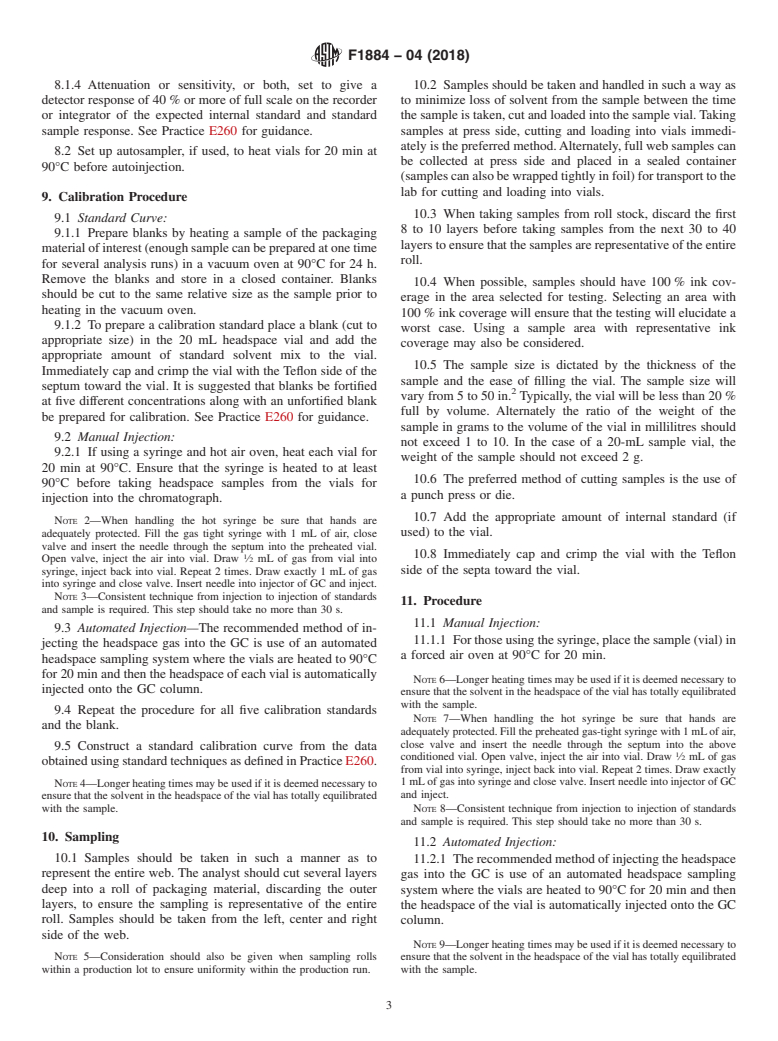
8.1.4 Attenuation or sensitivity, or both, set to give a 10.2 Samples should be taken and handled in such a way as
detector response of 40 % or more of full scale on the recorder to minimize loss of solvent from the sample between the time
or integrator of the expected internal standard and standard the sample is taken, cut and loaded into the sample vial. Taking
sample response. See Practice E260 for guidance. samples at press side, cutting and loading into vials immedi-
ately is the preferred method. Alternately, full web samples can
8.2 Set up autosampler, if used, to heat vials for 20 min at
be collected at press side and placed in a sealed container
90°C before autoinjection.
(samples can also be wrapped tightly in foil) for transport to the
lab for cutting and loading into vials.
9. Calibration Procedure
10.3 When taking samples from roll stock, discard the first
9.1 Standard Curve:
8 to 10 layers before taking samples from the next 30 to 40
9.1.1 Prepare blanks by heating a sample of the packaging
layers to ensure that the samples are representative of the entire
material of interest (enough sample can be prepared at one time
roll.
for several analysis runs) in a vacuum oven at 90°C for 24 h.
Remove the blanks and store in a closed container. Blanks
10.4 When possible, samples should have 100 % ink cov-
should be cut to the same relative size as the sample prior to
erage in the area selected for testing. Selecting an area with
heating in the vacuum oven.
100 % ink coverage will ensure that the testing will elucidate a
9.1.2 To prepare a calibration standard place a blank (cut to
worst case. Using a sample area with representative ink
appropriate size) in the 20 mL headspace vial and add the
coverage may also be considered.
appropriate amount of standard solvent mix to the vial.
10.5 The sample size is dictated by the thickness of the
Immediately cap and crimp the vial with the Teflon side of the
sample and the ease of filling the vial. The sample size will
septum toward the vial. It is suggested that blanks be fortified
vary from 5 to 50 in. Typically, the vial will be less than 20 %
at five different concentrations along with an unfortified blank
full by volume. Alternately the ratio of the weight of the
be prepared for calibration. See Practice E260 for guidance.
sample in grams to the volume of the vial in millilitres should
9.2 Manual Injection:
not exceed 1 to 10. In the case of a 20-mL sample vial, the
9.2.1 If using a syringe and hot air oven, heat each vial for
weight of the sample should not exceed 2 g.
20 min at 90°C. Ensure that the syringe is heated to at least
10.6 The preferred method of cutting samples is the use of
90°C before taking headspace samples from the vials for
a punch press or die.
injection into the chromatograph.
10.7 Add the appropriate amount of internal standard (if
NOTE 2—When handling the hot syringe be sure that hands are
adequately protected. Fill the gas tight syringe with 1 mL of air, close used) to the vial.
valve and insert the needle through the septum into the preheated vial.
10.8 Immediately cap and crimp the vial with the Teflon
Open valve, inject the air into vial. Draw ⁄2 mL of gas from vial into
side of the septa toward the vial.
syringe, inject back into vial. Repeat 2 times. Draw exactly 1 mL of gas
into syringe and close valve. Insert needle into injector of GC and inject.
NOTE 3—Consistent technique from injection to injection of standards
11. Procedure
and sample is required. This step should take no more than 30 s.
11.1 Manual Injection:
9.3 Automated Injection—The recommended method of in-
11.1.1 For those using the syringe, place the sample (vial) in
jecting the headspace gas into the GC is use of an automated
a forced air oven at 90°C for 20 min.
headspace sampling system where the vials are heated to 90°C
for 20 min and then the headspace of each vial is automatically
NOTE 6—Longer heating times may be used if it is deemed necessary to
injected onto the GC column.
ensure that the solvent in the headspace of the vial has totally equilibrated
with the sample.
9.4 Repeat the procedure for all five calibration standards
NOTE 7—When handling the hot syringe be sure that hands are
and the blank.
adequately protected. Fill the preheated gas-tight syringe with 1 mL of air,
close valve and insert the needle through the septum into the above
9.5 Construct a standard calibration curve from the data
conditioned vial. Open valve, inject the air into vial. Draw ⁄2 mL of gas
obtained using standard techniques as defined in Practice E260.
from vial into syringe, inject back into vial. Repeat 2 times. Draw exactly
1 mL of gas into syringe and close valve. Insert needle into injector of GC
NOTE 4—Longer heating times may be used if it is deemed necessary to
and inject.
ensure that the solvent in the headspace of the vial has totally equilibrated
with the sample. NOTE 8—Consistent t
...
This document is not an ASTM standard and is intended only to provide the user of an ASTM standard an indication of what changes have been made to the previous version. Because
it may not be technically possible to adequately depict all changes accurately, ASTM recommends that users consult prior editions as appropriate. In all cases only the current version
of the standard as published by ASTM is to be considered the official document.
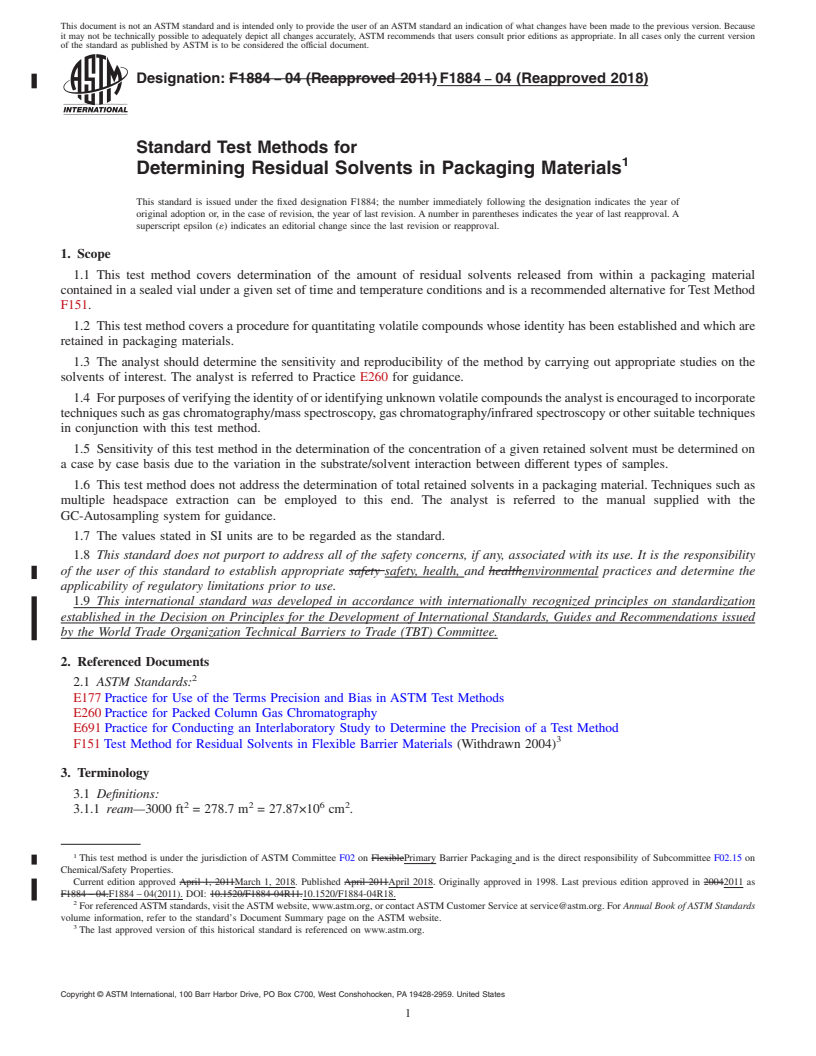
Designation: F1884 − 04 (Reapproved 2011) F1884 − 04 (Reapproved 2018)
Standard Test Methods for
Determining Residual Solvents in Packaging Materials
This standard is issued under the fixed designation F1884; the number immediately following the designation indicates the year of
original adoption or, in the case of revision, the year of last revision. A number in parentheses indicates the year of last reapproval. A
superscript epsilon (´) indicates an editorial change since the last revision or reapproval.
1. Scope
1.1 This test method covers determination of the amount of residual solvents released from within a packaging material
contained in a sealed vial under a given set of time and temperature conditions and is a recommended alternative for Test Method
F151.
1.2 This test method covers a procedure for quantitating volatile compounds whose identity has been established and which are
retained in packaging materials.
1.3 The analyst should determine the sensitivity and reproducibility of the method by carrying out appropriate studies on the
solvents of interest. The analyst is referred to Practice E260 for guidance.
1.4 For purposes of verifying the identity of or identifying unknown volatile compounds the analyst is encouraged to incorporate
techniques such as gas chromatography/mass spectroscopy, gas chromatography/infrared spectroscopy or other suitable techniques
in conjunction with this test method.
1.5 Sensitivity of this test method in the determination of the concentration of a given retained solvent must be determined on
a case by case basis due to the variation in the substrate/solvent interaction between different types of samples.
1.6 This test method does not address the determination of total retained solvents in a packaging material. Techniques such as
multiple headspace extraction can be employed to this end. The analyst is referred to the manual supplied with the
GC-Autosampling system for guidance.
1.7 The values stated in SI units are to be regarded as the standard.
1.8 This standard does not purport to address all of the safety concerns, if any, associated with its use. It is the responsibility
of the user of this standard to establish appropriate safety safety, health, and healthenvironmental practices and determine the
applicability of regulatory limitations prior to use.
1.9 This international standard was developed in accordance with internationally recognized principles on standardization
established in the Decision on Principles for the Development of International Standards, Guides and Recommendations issued
by the World Trade Organization Technical Barriers to Trade (TBT) Committee.
2. Referenced Documents
2.1 ASTM Standards:
E177 Practice for Use of the Terms Precision and Bias in ASTM Test Methods
E260 Practice for Packed Column Gas Chromatography
E691 Practice for Conducting an Interlaboratory Study to Determine the Precision of a Test Method
F151 Test Method for Residual Solvents in Flexible Barrier Materials (Withdrawn 2004)
3. Terminology
3.1 Definitions:
2 2 6 2
3.1.1 ream—3000 ft = 278.7 m = 27.87×10 cm .
This test method is under the jurisdiction of ASTM Committee F02 on FlexiblePrimary Barrier Packaging and is the direct responsibility of Subcommittee F02.15 on
Chemical/Safety Properties.
Current edition approved April 1, 2011March 1, 2018. Published April 2011April 2018. Originally approved in 1998. Last previous edition approved in 20042011 as
F1884 – 04.F1884 – 04(2011). DOI: 10.1520/F1884-04R11.10.1520/F1884-04R18.
For referenced ASTM standards, visit the ASTM website, www.astm.org, or contact ASTM Customer Service at service@astm.org. For Annual Book of ASTM Standards
volume information, refer to the standard’s Document Summary page on the ASTM website.
The last approved version of this historical standard is referenced on www.astm.org.
Copyright © ASTM International, 100 Barr Harbor Drive, PO Box C700, West Conshohocken, PA 19428-2959. United States
F1884 − 04 (2018)
3.1.2 retained solvents—those chemical species, which are retained by packaging material and can be detected in the headspace
of sealed sample vials under conditions of elevated temperature.
4. Summary of Test Method
4.1 Retained volatile organic solvents are determined by subjecting the packaging material to elevated temperatures in a
headspace sampling system with subsequent gas chromatography of the headspace and detection using a suitable detection device
such as a flame ionization detector (FID).
4.2 Volatile components can then be quantified by comparison with standards of known concentration.
4.3 Qualitative analysis may be carried out on a gas chromatograph (GC) coupled to an appropriate detector capable of
compound detection / identification, such as a mass spectrometer or infrared detector.
5. Significance and Use
5.1 This test method is intended to measure volatile organic compounds that are emitted from packaging materials under
high-temperature conditions.
5.2 This test method may be useful in assisting in the development and manufacture of packaging materials having minimal
retained packaging ink/adhesive solvents.
5.3 Modification of this procedure by utilizing appropriate qualitative GC detection devices such as a mass spectrometer in place
of the flame ionization detector may provide identification of volatile organics of unknown identity.
6. Interferences
6.1 Gas Chromatography—Because of the potentially large number of chemical species that can be analyzed using this
methodology, not all species will be resolved from one another on a particular GC column under a given set of conditions.
Techniques available to the analyst to verify the identity of chemical species being quantitated include retention time comparisons
using alternate GC conditions or using an alternate GC column. Good judgment in the interpretation of chromatographic results
is always important. Refer to Practice E260 for guidance.
6.2 Apparatus—Because this method is designed for detecting trace quantities of organic compounds, contaminants can lead to
misinterpretation of results. Preparing apparatus properly and carrying out blank determinations is essential to minimize this
possibility.
TEST METHOD A
7. Apparatus and Reagents
7.1 Gas chromatograph equipped as follows:
7.1.1 FID Detector, compatible with capillary columns.
7.1.2 Injector, split/split-less compatible with capillary columns.
7.1.3 Column, DB-5, 30m, 0.25 mm ID, 1 μm film thickness, Cat. No. 122–5033, or 0.32 mm, Cat. No. 123–5033. A short piece
of deactivated fused silica column may be placed between the injector and the column to serve as a guard column.
7.1.4 Peak Area Integration System, compatible with GC system in use. Alternately, a chart recorder and hand integration can
be used.
7.1.5 Auto sampler is recommended.
7.2 Standard Solutions, consisting of the organic solvent mixture of interest, at concentrations that simulate the expected
retention levels. 4-Heptanone may be added to the solutions for use as an internal standard as described in Practice E260.
7.2.1 An example of a working standard is listed below. The standard used will vary based on the solvents present in the sample
to be tested. The quantities shown in the table will result in roughly equivalent size peaks due to differences in detector response.
If the solvents are mixed neat, adding 1 μL per gram of material in the headspace vial provides a good starting point for calibration.
7.2.2 If desired, water may be used as the diluent for the standard. The solvents are diluted in 1 L of water, typically 2 mL of
the resulting solution is added per gram of sample in the headspace vial for calibration. 2 mL of 20 μl/L of 4-heptanone containing
solution in water can be used as an internal standard.
NOTE 1—Water will change the partition coefficient between the sample and retained solvents.
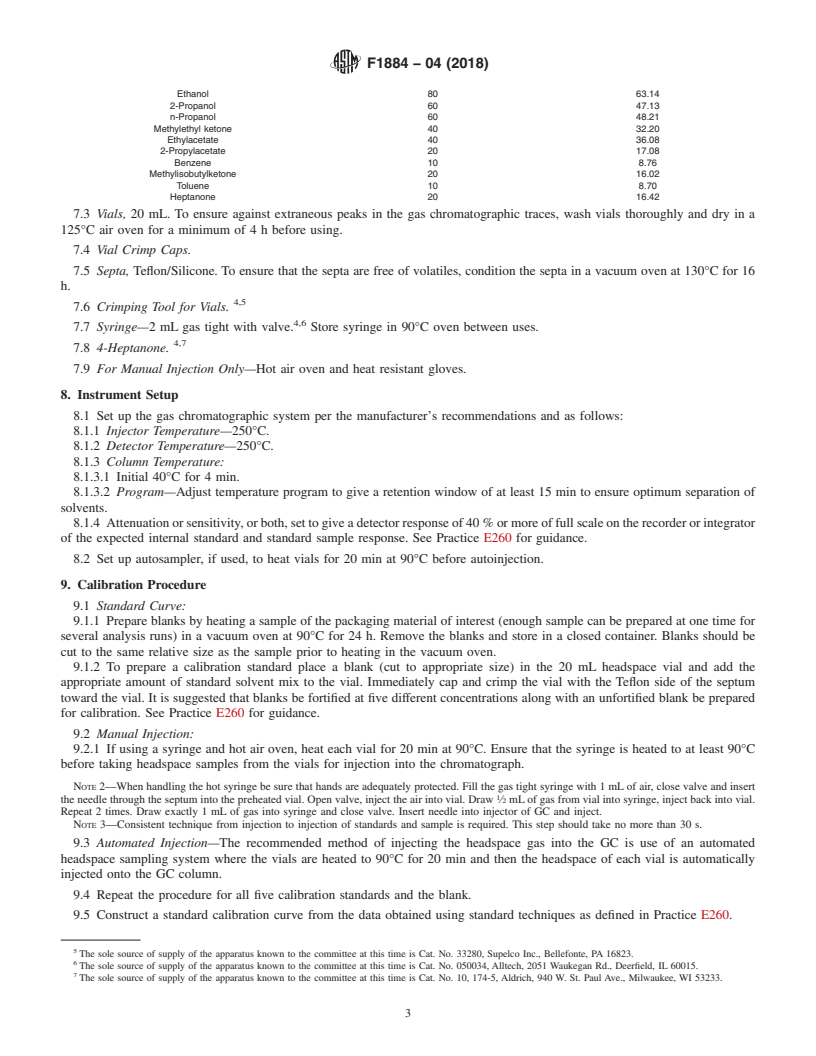
Solvent μL/L μg/mL
Methanol 120 94.96
The sole source of supply of the apparatus known to the committee at this time is J. and W. Scientific, Cat. No. 122-5033 and Cat. No. 123-5033. If you are aware of
alternative suppliers, please provide this information to ASTM Headquarters. Your comments will receive careful consideration at a meeting of the responsible technical
committee, which you may attend.
F1884 − 04 (2018)
Ethanol 80 63.14
2-Propanol 60 47.13
n-Propanol 60 48.21
Methylethyl ketone 40 32.20
Ethylacetate 40 36.08
2-Propylacetate 20 17.08
Benzene 10 8.76
Methylisobutylketone 20 16.02
Toluene 10 8.70
Heptanone 20 16.42
7.3 Vials, 20 mL. To ensure against extraneous peaks in the gas chromatographic traces, wash vials thoroughly and dry in a
125°C air oven for a minimum of 4 h before using.
7.4 Vial Crimp Caps.
7.5 Septa, Teflon/Silicone. To ensure that the septa are free of volatiles, condition the septa in a vacuum oven at 130°C for 16
h.
4,5
7.6 Crimping Tool for Vials.
4,6
7.7 Syringe—2 mL gas tight with valve. Store syringe in 90°C oven between uses.
4,7
7.8 4-Heptanone.
7.9 For Manual Injection Only—Hot air oven and heat resistant gloves.
8. Instrument Setup
8.1 Set up the gas chromatographic system per the manufacturer’s recommendations and as follows:
8.1.1 Injector Temperature—250°C.
8.1.2 Detector Temperature—250°C.
8.1.3 Column Temperature:
8.1.3.1 Initial 40°C for 4 min.
8.1.3.2 Program—Adjust temperature program to give a retention window of at least 15 min to ensure optimum separation of
solvents.
8.1.4 Attenuation or sensitivity, or both, set to give a detector response of 40 % or more of full scale on the recorder or integrator
of the expected internal standard and standard sample response. See Practice E260 for guidance.
8.2 Set up autosampler, if used, to heat vials for 20 min at 90°C before autoinjection.
9. Calibration Procedure
9.1 Standard Curve:
9.1.1 Prepare blanks by heating a sample of the packaging material of interest (enough sample can be prepared at one time for
several analysis runs) in a vacuum oven at 90°C for 24 h. Remove the blanks and store in a closed container. Blanks should be
cut to the same relative size as the sample prior to heating in the vacuum oven.
9.1.2 To prepare a calibration standard place a blank (cut to appropriate size) in the 20 mL headspace vial and add the
appropriate amount of standard solvent mix to the vial. Immediately cap and crimp the vial with the Teflon side of the septum
toward the vial. It is suggested that blanks be fortified at five different concentrations along with an unfortified blank be prepared
for calibration. See Practice E260 for guidance.
9.2 Manual Injection:
9.2.1 If using a syringe and hot air oven, heat each vial for 20 min at 90°C. Ensure that the syringe is heated to at least 90°C
before taking headspace samples from the vials for injection into the chromatograph.
NOTE 2—When handling the hot syringe be sure that hands are adequately protected. Fill the gas tight syringe with 1 mL of air, close valve and insert
the needle through the septum into the preheated vial. Open valve, inject the air into vial. Draw ⁄2 mL of gas from vial into syringe, inject back into vial.
Repeat 2 times. Draw exactly 1 mL of gas into syringe and close valve. Insert needle into injector of GC and inject.
NOTE 3—Consistent technique from injection to injection of standards and sample is required. This step should take no more than 30 s.
9.3 Automated Injection—The recommended method of injecting the headspace gas into the GC is use of an automated
headspace sampling system where the vials are heated to 90°C for 20 min and then the headspace of each vial is automatically
injected onto the GC column.
9.4 Repeat the procedure for all five calibration standards and the blank.
9.5 Construct a standard calibration curve from the data obtained using standard techniques as defined in Practice E260.
The sole source of supply of the apparatus known to the committee at this time is Cat. No. 33280, Supelco Inc., Bellefonte, PA 16823.
The sole source of supply of the apparatus known to the committee at this time is Cat. No. 050034, Alltech, 2051 Waukegan Rd., Deerfield, IL 60015.
The sole source of supply of the apparatus known to the committee at this time is Cat. No. 10, 174-5, Aldrich, 940 W. St. Paul Ave., Milwaukee, WI 53233.
F1884 − 04 (2018)
NOTE 4—Longer heating times may be used if it is deemed necessary to ensure that the solvent in the headspace of the vial has totally equilibrated
with the sample.
10. Sampling
10.1 Samples should be taken in such a manner as to represent the entire web. The analyst should cut several layers deep into
a roll of packaging material, discarding the outer layers, to ensure the sampling is representative of the entire roll. Samples should
be taken from the left, center and right side of the web.
NOTE 5—Consideration should also be given when sampling rolls within a production lot to ensure uniformity within the production run.
10.2 Samples should be taken and handled in such a way as to minimize loss of solvent from the sample between the time the
sample is taken, cut and loaded into the sample vial. Taking samples at press side, cutting and loading into vials immediately is
the preferred method. Alternately, full web samples can be collected at press side and placed in a sealed container (samples can
also be wrapped tightly in foil) for transport to the lab for cutting and loading into vials.
10.3 When taking samples from roll stock, discard the first 8 to 10 layers before taking samples from the next 30 to 40 layers
to ensure that the samples are representative of the entire roll.
10.4 When possible, samples should have 100 % ink coverage in the area selected for testing. Selecting an area with 100 % ink
coverage will ensure that the testing will elucidate a worst case. Using a sample area with representative ink coverage may also
be considered.
10.5 The sample size is dictated by the thickness of the sample and the ease of filling the vial. The sample size will vary from
5 to 50 in. Typically, the vial will be less than 20 % full by volume. Alternately the ratio of the weight of the sample in grams
to the volume of the vial in millilitres should not exceed 1 to 10. In the case of a 20-mL sample vial, the weight of the sample
should not exceed 2 g.
10.6 The preferred method of cutting samples is the use of a punch press or die.
10.7 Add the appropriate amount of internal standard (if used) to t
...
Questions, Comments and Discussion
Ask us and Technical Secretary will try to provide an answer. You can facilitate discussion about the standard in here.