


ASTM G66-99(2018)
(Test Method)Standard Test Method for Visual Assessment of Exfoliation Corrosion Susceptibility of 5XXX Series Aluminum Alloys (ASSET Test)
Standard Test Method for Visual Assessment of Exfoliation Corrosion Susceptibility of 5XXX Series Aluminum Alloys (ASSET Test)
SIGNIFICANCE AND USE
5.1 This test method provides a reliable prediction of the exfoliation corrosion behavior of Al-Mg alloys in marine environments.5,6,7 The test is useful for alloy development studies and quality control of mill products such as sheet and plate.
SCOPE
1.1 This test method covers a procedure for continuous immersion exfoliation corrosion testing of 5XXX series aluminum-magnesium alloys containing 2.0 % or more magnesium.
1.2 This test method applies only to wrought products.
1.3 The values stated in SI units are to be regarded as the standard. The values given in parentheses are for information only.
1.4 This standard does not purport to address all of the safety concerns, if any, associated with its use. It is the responsibility of the user of this standard to establish appropriate safety, health, and environmental practices and determine the applicability of regulatory limitations prior to use.
1.5 This international standard was developed in accordance with internationally recognized principles on standardization established in the Decision on Principles for the Development of International Standards, Guides and Recommendations issued by the World Trade Organization Technical Barriers to Trade (TBT) Committee.
General Information
Buy Standard
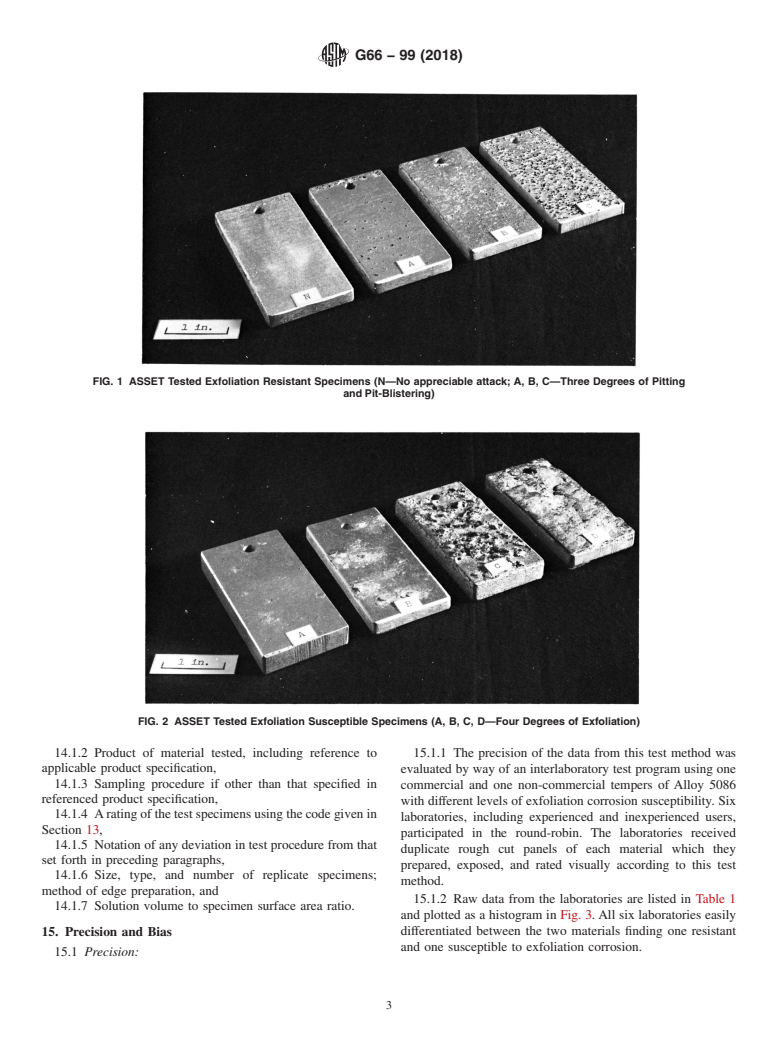
Standards Content (Sample)
NOTICE: This standard has either been superseded and replaced by a new version or withdrawn.
Contact ASTM International (www.astm.org) for the latest information
Designation: G66 − 99 (Reapproved 2018)
Standard Test Method for
Visual Assessment of Exfoliation Corrosion Susceptibility of
5XXX Series Aluminum Alloys (ASSET Test)
This standard is issued under the fixed designation G66; the number immediately following the designation indicates the year of original
adoption or, in the case of revision, the year of last revision. A number in parentheses indicates the year of last reapproval. A superscript
epsilon (´) indicates an editorial change since the last revision or reapproval.
1. Scope 3. Terminology
1.1 This test method covers a procedure for continuous 3.1 Definitions:
immersion exfoliation corrosion testing of 5XXX series 3.1.1 exfoliation—corrosion that proceeds laterally from the
aluminum-magnesium alloys containing 2.0 % or more mag- sites of initiation along planes parallel to the surface, generally
nesium. at grain boundaries, forming corrosion products that force
metal away from the body of the material, giving rise to a
1.2 This test method applies only to wrought products.
layered appearance (see Terminology G15).
1.3 The values stated in SI units are to be regarded as the
4. Summary of Test Method
standard. The values given in parentheses are for information
only.
4.1 Specimens are immersed for 24 h at 65 6 1°C (150 6
2°F) in a solution containing ammonium chloride, ammonium
1.4 This standard does not purport to address all of the
nitrate, ammonium tartrate, and hydrogen peroxide. The sus-
safety concerns, if any, associated with its use. It is the
ceptibility to exfoliation is determined by visual examination
responsibility of the user of this standard to establish appro-
using performance ratings established by reference to standard
priate safety, health, and environmental practices and deter-
photographs.
mine the applicability of regulatory limitations prior to use.
1.5 This international standard was developed in accor-
5. Significance and Use
dance with internationally recognized principles on standard-
5.1 This test method provides a reliable prediction of the
ization established in the Decision on Principles for the
exfoliation corrosion behavior of Al-Mg alloys in marine
Development of International Standards, Guides and Recom-
5,6,7
environments. The test is useful for alloy development
mendations issued by the World Trade Organization Technical
studies and quality control of mill products such as sheet and
Barriers to Trade (TBT) Committee.
plate.
2. Referenced Documents
6. Apparatus
2.1 ASTM Standards:
6.1 Any suitable glass or plastic container can be used to
D1193 Specification for Reagent Water
contain the solution and specimens during the test period.
G15 Terminology Relating to Corrosion and Corrosion Test-
Depending upon the shape and size of the specimens, rods or
ing (Withdrawn 2010)
racks of glass, plastic, or other inert substance shall be used to
2.2 ASTM Adjuncts:
support the specimens above the bottom of the container. The
ASSET Tested Specimens (Glossy Prints)
container should be fitted with a removable cover to reduce
evaporation.
This test method is under the jurisdiction of ASTM Committee G01 on
7. Reagents
Corrosion of Metals and is the direct responsibility of Subcommittee G01.05 on
Laboratory Corrosion Tests. This method was developed by a joint task group with
7.1 Purity of Reagents—Reagent grade chemicals shall be
The Aluminum Assoc., Inc.
used in all tests.
Current edition approved Oct. 1, 2018. Published November 2018. Originally
approved in 1980. Last previous edition approved in 2013 as G66 – 99 (2013). DOI:
10.1520/G0066-99R18. Aluminum Association Technical Report T1, “Exfoliation Corrosion Testing of
For referenced ASTM standards, visit the ASTM website, www.astm.org, or Aluminum Alloys 5086 and 5456”.
contact ASTM Customer Service at service@astm.org. For Annual Book of ASTM Sprowls, D. O., Walsh, J. D. and Shumaker, M. B., “Simplified Exfoliation
Standards volume information, refer to the standard’s Document Summary page on Testing of Aluminum Alloys”, Localized Corrosion—Cause of Metal Failure, ASTM
the ASTM website. STP 516, ASTM, 1972, pp 38–65.
3 7
The last approved version of this historical standard is referenced on www.ast- Summerson T. J., Interim Report, Aluminum Association Task Group on
m.org. Exfoliation and Stress Corrosion Cracking of Aluminum Alloys for Boat Stock;
Available from ASTM International Headquarters. Order Adjunct No. Proceedings Tri-Service Corrosion Military Equipment Conference, October 29–31,
ADJG0066. Original adjunct produced in 1987. 1974; Technical Report AFML-TR-75-42, Vol. II, p. 193–221, February 1, 1975.
Copyright © ASTM International, 100 Barr Harbor Drive, PO Box C700, West Conshohocken, PA 19428-2959. United States
G66 − 99 (2018)
7.2 Purity of Water—Distilled or deionized water conform- 12. Procedure
ing to Specification D1193. Type IV shall be used to prepare
12.1 Degrease the specimens with a suitable solvent. After
the test solution except chloride ion sodium limits can be
degreasing, prepare specimens as follows: Etch 1 min in 5 %
disregarded.
by weight sodium hydroxide solution at 80°C (176°F), rinse in
water, desmut 30 s in concentrated nitric acid at room
8. Test Solution
temperature, rinse with distilled or deionized water, air dry.
8.1 Preparation of Test Solution:
NOTE 2—If specimens are not to be immersed in the test solution
8.1.1 The test solution shall have the following composi-
immediately, they should be stored in a desiccator maintained at less than
tion:
1 % relative humidity (use fresh desiccant such as activated alumina or
NH Cl (1.0 M) anhydrous calcium sulfate).
NH NO (0.25 M)
4 3
12.2 Use fresh solution at the start of each test.
(NH ) C H O (0.01 M)
4 2 4 4 6
H O (0.09 M)
2 2
12.3 Immerse the specimens vertically with the top edge of
8.1.2 Dissolve 53.5 g ammonium chloride (NH Cl), 20.0 g
4 the specimens at least 25 mm (1 in.) below the surface of the
ammonium nitrate (NH NO ), 1.8 g ammonium tartrate
solution and the bottom edge at least 25 mm above the bottom
4 3
((NH ) C H O ), and 10 mL of 30 % stock solution hydrogen
of the container.
4 2 4 4 6
peroxide (H O ) in a small amount of water. After dissolving,
2 2
12.4 Immerse the specimens in the test solution continu-
mix the components together thoroughly and adjust the final
ously for 24 h.
dilution to 1 L.
12.5 Rinse the specimens gently in running tap water
NOTE 1—If a stock solution of the above chemicals is to be stored, the
immediately after removal from the solution, then soak in
hydrogen peroxide should not be added until the solution is heated for the
concentrated nitric acid at room temperature until they appear
test.
clean, again rinse in water, and air dry.
8.2 The solution will have a typical pH of 5.2 to 5.4.
12.5.1 Air-blast drying is to be avoided in order to prevent
8.3 The solution shall be used in sufficient quantity to
mechanical removal of exfoliated metal.
provide a volume-to-exposed specimen surface area ratio of at
2 2
least 100 L/m (65 mL/in. ). 13. Rating of Specimens
8.4 The temperature of the solution shall be maintained at 13.1 The following codes and classifications shall be used
65 6 1°C (150 6 2°F). for reporting the
...
This document is not an ASTM standard and is intended only to provide the user of an ASTM standard an indication of what changes have been made to the previous version. Because
it may not be technically possible to adequately depict all changes accurately, ASTM recommends that users consult prior editions as appropriate. In all cases only the current version
of the standard as published by ASTM is to be considered the official document.
Designation: G66 − 99 (Reapproved 2013) G66 − 99 (Reapproved 2018)
Standard Test Method for
Visual Assessment of Exfoliation Corrosion Susceptibility of
5XXX Series Aluminum Alloys (ASSET Test)
This standard is issued under the fixed designation G66; the number immediately following the designation indicates the year of original
adoption or, in the case of revision, the year of last revision. A number in parentheses indicates the year of last reapproval. A superscript
epsilon (´) indicates an editorial change since the last revision or reapproval.
1. Scope
1.1 This test method covers a procedure for continuous immersion exfoliation corrosion testing of 5XXX series aluminum-
magnesium alloys containing 2.0 % or more magnesium.
1.2 This test method applies only to wrought products.
1.3 The values stated in SI units are to be regarded as the standard. The values given in parentheses are for information only.
1.4 This standard does not purport to address all of the safety concerns, if any, associated with its use. It is the responsibility
of the user of this standard to establish appropriate safety safety, health, and healthenvironmental practices and determine the
applicability of regulatory limitations prior to use.
1.5 This international standard was developed in accordance with internationally recognized principles on standardization
established in the Decision on Principles for the Development of International Standards, Guides and Recommendations issued
by the World Trade Organization Technical Barriers to Trade (TBT) Committee.
2. Referenced Documents
2.1 ASTM Standards:
D1193 Specification for Reagent Water
G15 Terminology Relating to Corrosion and Corrosion Testing (Withdrawn 2010)
2.2 ASTM Adjuncts:
ASSET Tested Specimens (Glossy Prints)
3. Terminology
3.1 Definitions:
3.1.1 exfoliation—corrosion that proceeds laterally from the sites of initiation along planes parallel to the surface, generally at
grain boundaries, forming corrosion products that force metal away from the body of the material, giving rise to a layered
appearance (see Terminology G15).
4. Summary of Test Method
4.1 Specimens are immersed for 24 h at 65 6 1°C (150 6 2°F) in a solution containing ammonium chloride, ammonium nitrate,
ammonium tartrate, and hydrogen peroxide. The susceptibility to exfoliation is determined by visual examination using
performance ratings established by reference to standard photographs.
5. Significance and Use
5.1 This test method provides a reliable prediction of the exfoliation corrosion behavior of Al-Mg alloys in marine
5,6,7
environments. The test is useful for alloy development studies and quality control of mill products such as sheet and plate.
This test method is under the jurisdiction of ASTM Committee G01 on Corrosion of Metals and is the direct responsibility of Subcommittee G01.05 on Laboratory
Corrosion Tests. This method was developed by a joint task group with The Aluminum Assoc., Inc.
Current edition approved May 1, 2013Oct. 1, 2018. Published July 2013November 2018. Originally approved in 1980. Last previous edition approved in 20052013 as
G66 – 99 (2005).(2013). DOI: 10.1520/G0066-99R13.10.1520/G0066-99R18.
For referenced ASTM standards, visit the ASTM website, www.astm.org, or contact ASTM Customer Service at service@astm.org. For Annual Book of ASTM Standards
volume information, refer to the standard’s Document Summary page on the ASTM website.
The last approved version of this historical standard is referenced on www.astm.org.
Available from ASTM International Headquarters. Order Adjunct No. ADJG0066. Original adjunct produced in 1987.
Aluminum Association Technical Report T1,“ Exfoliation “Exfoliation Corrosion Testing of Aluminum Alloys 5086 and 5456”.
Copyright © ASTM International, 100 Barr Harbor Drive, PO Box C700, West Conshohocken, PA 19428-2959. United States
G66 − 99 (2018)
6. Apparatus
6.1 Any suitable glass or plastic container can be used to contain the solution and specimens during the test period. Depending
upon the shape and size of the specimens, rods or racks of glass, plastic, or other inert substance shall be used to support the
specimens above the bottom of the container. The container should be fitted with a removable cover to reduce evaporation.
7. Reagents
7.1 Purity of Reagents—Reagent grade chemicals shall be used in all tests.
7.2 Purity of Water—Distilled or deionized water conforming to Specification D1193. Type IV shall be used to prepare the test
solution except chloride ion sodium limits can be disregarded.
8. Test Solution
8.1 Preparation of Test Solution:
8.1.1 The test solution shall have the following composition:
NH Cl (1.0 M)
NH NO (0.25 M)
4 3
(NH ) C H O (0.01 M)
4 2 4 4 6
H O (0.09 M)
2 2
8.1.2 Dissolve 53.5 g ammonium chloride (NH Cl), 20.0 g ammonium nitrate (NH NO ), 1.8 g ammonium tartrate
4 4 3
((NH ) C H O ), and 10 mL of 30 % stock solution hydrogen peroxide (H O ) in a small amount of water. After dissolving, mix
4 2 4 4 6 2 2
the components together thoroughly and adjust the final dilution to 1 L.
NOTE 1—If a stock solution of the above chemicals is to be stored, the hydrogen peroxide should not be added until the solution is heated for the test.
8.2 The solution will have a typical pH of 5.2 to 5.4.
8.3 The solution shall be used in sufficient quantity to provide a volume-to-exposed specimen surface area ratio of at least 100
2 2
L/m (65 mL/in. ).
8.4 The temperature of the solution shall be maintained at 65 6 1°C (150 6 2°F).
9. Sampling
9.1 The procedure for sampling mill products is covered in product specifications, or otherwise, and is considered outside the
scope of this standard.
10. Test Specimen
10.1 While this test method can be used with any form of specimen or part that can be immersed in the test solution, it is
preferred that specimens be at least 40 by 100 mm (1.5 by 4.0 in.) with the metal working direction in the 40-mm (1.5-in.)
dimension.
10.2 The specimens should be sawed or machined to minimize introducing residual stresses in edges during preparation of the
specimens (sheared edges are allowed only if the edges are sufficiently dressed or filed down a distance equal to the thickness of
the specimen in order to remove metal deformed by shearing).
11. Standardization
11.1 To provide an indication when some inadvertent deviation from the correct test conditions occurs, it is necessary to expose
to the test at regular intervals a control specimen of a material of known susceptibility. This control should exhibit the same degree
of exfoliation each time it is included in the test.
11.2 The control may be any material of the Al-Mg series that has a well-documented susceptibility to exfoliation corrosion,
preferably one with an intermediate susceptibility.
12. Procedure
12.1 Degrease the specimens with a suitable solvent. After degreasing, prepare specimens as follows: Etch 1 min in 5 % by
weight sodium hydroxide solution at 80°C (176°F), rinse in water, desmut 30 s in concentrated nitric acid at room temperature,
rinse with distilled or deionized water, air dry.
NOTE 2—If specimens are not to be immersed in the test
...
Questions, Comments and Discussion
Ask us and Technical Secretary will try to provide an answer. You can facilitate discussion about the standard in here.