


ASTM F884-01(2016)
(Test Method)Standard Test Method for Motor Life Evaluation of a Built-In (Central Vacuum) Vacuum Cleaner
Standard Test Method for Motor Life Evaluation of a Built-In (Central Vacuum) Vacuum Cleaner
SIGNIFICANCE AND USE
4.1 The test results provide an indication of the motor life of an electric vacuum cleaner. The end of the motor life will be judged in accordance with Section 3.
SCOPE
1.1 This test method is limited to motor life evaluation of central vacuum cleaners.
1.2 This test method provides a test to determine operating life of the motor, before servicing is needed, by an accelerated laboratory procedure. The motor is tested while mounted and is operated in central vacuum cleaner.
1.3 The values as stated in inch-pound units are to be regarded as the standard. The values in parentheses are for information only.
1.4 This standard does not purport to address all of the safety concerns, if any, associated with its use. It is the responsibility of the user of this standard to establish appropriate safety and health practices and determine the applicability of regulatory limitations prior to use.
General Information
Buy Standard
Standards Content (Sample)
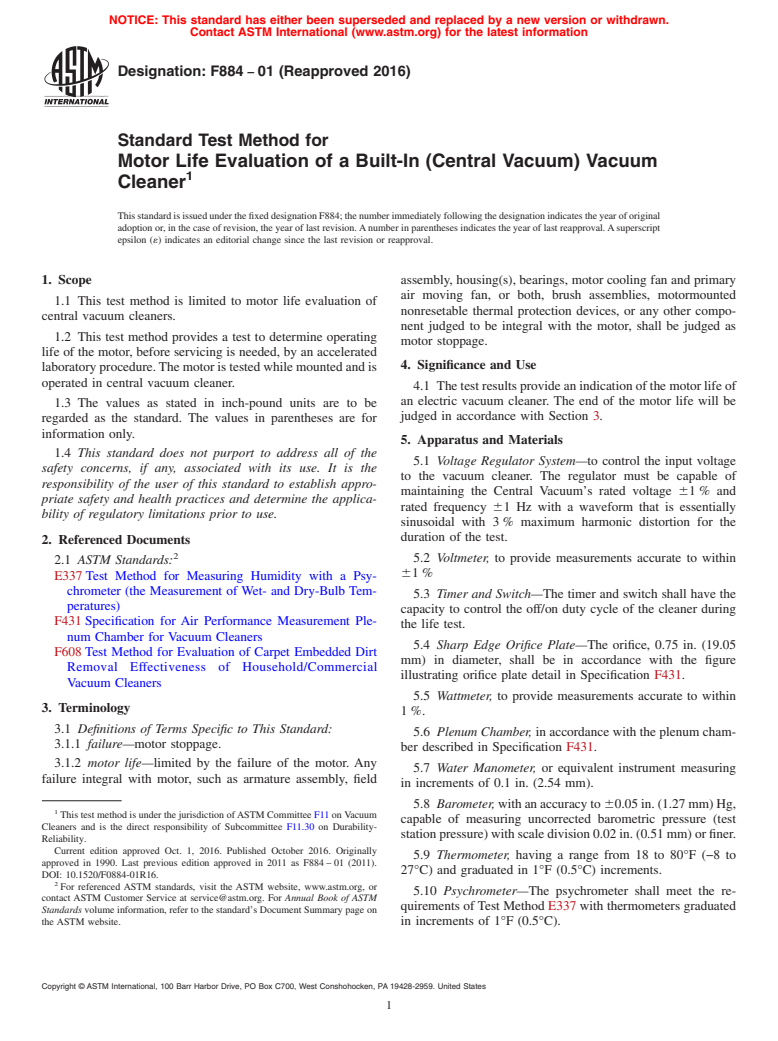
NOTICE: This standard has either been superseded and replaced by a new version or withdrawn.
Contact ASTM International (www.astm.org) for the latest information
Designation: F884 − 01 (Reapproved 2016)
Standard Test Method for
Motor Life Evaluation of a Built-In (Central Vacuum) Vacuum
Cleaner
This standard is issued under the fixed designation F884; the number immediately following the designation indicates the year of original
adoption or, in the case of revision, the year of last revision. A number in parentheses indicates the year of last reapproval. A superscript
epsilon (´) indicates an editorial change since the last revision or reapproval.
1. Scope assembly, housing(s), bearings, motor cooling fan and primary
air moving fan, or both, brush assemblies, motormounted
1.1 This test method is limited to motor life evaluation of
nonresetable thermal protection devices, or any other compo-
central vacuum cleaners.
nent judged to be integral with the motor, shall be judged as
1.2 This test method provides a test to determine operating
motor stoppage.
life of the motor, before servicing is needed, by an accelerated
4. Significance and Use
laboratory procedure. The motor is tested while mounted and is
operated in central vacuum cleaner.
4.1 The test results provide an indication of the motor life of
an electric vacuum cleaner. The end of the motor life will be
1.3 The values as stated in inch-pound units are to be
judged in accordance with Section 3.
regarded as the standard. The values in parentheses are for
information only.
5. Apparatus and Materials
1.4 This standard does not purport to address all of the
5.1 Voltage Regulator System—to control the input voltage
safety concerns, if any, associated with its use. It is the
to the vacuum cleaner. The regulator must be capable of
responsibility of the user of this standard to establish appro-
maintaining the Central Vacuum’s rated voltage 61 % and
priate safety and health practices and determine the applica-
rated frequency 61 Hz with a waveform that is essentially
bility of regulatory limitations prior to use.
sinusoidal with 3 % maximum harmonic distortion for the
duration of the test.
2. Referenced Documents
5.2 Voltmeter, to provide measurements accurate to within
2.1 ASTM Standards:
61 %
E337 Test Method for Measuring Humidity with a Psy-
chrometer (the Measurement of Wet- and Dry-Bulb Tem-
5.3 Timer and Switch—The timer and switch shall have the
peratures)
capacity to control the off/on duty cycle of the cleaner during
F431 Specification for Air Performance Measurement Ple-
the life test.
num Chamber for Vacuum Cleaners
5.4 Sharp Edge Orifice Plate—The orifice, 0.75 in. (19.05
F608 Test Method for Evaluation of Carpet Embedded Dirt
mm) in diameter, shall be in accordance with the figure
Removal Effectiveness of Household/Commercial
illustrating orifice plate detail in Specification F431.
Vacuum Cleaners
5.5 Wattmeter, to provide measurements accurate to within
3. Terminology
1 %.
3.1 Definitions of Terms Specific to This Standard:
5.6 Plenum Chamber, in accordance with the plenum cham-
3.1.1 failure—motor stoppage.
ber described in Specification F431.
3.1.2 motor life—limited by the failure of the motor. Any
5.7 Water Manometer, or equivalent instrument measuring
failure integral with motor, such as armature assembly, field
in increments of 0.1 in. (2.54 mm).
5.8 Barometer, with an accuracy to 60.05 in. (1.27 mm) Hg,
This test method is under the jurisdiction of ASTM Committee F11 on Vacuum
capable of measuring uncorrected barometric pressure (test
Cleaners and is the direct responsibility of Subcommittee F11.30 on Durability-
station pressure) with scale division 0.02 in. (0.51 mm) or finer.
Reliability.
Current edition approved Oct. 1, 2016. Published October 2016. Originally
5.9 Thermometer, having a range from 18 to 80°F (−8 to
approved in 1990. Last previous edition approved in 2011 as F884 – 01 (2011).
27°C) and graduated in 1°F (0.5°C) increments.
DOI: 10.1520/F0884-01R16.
For referenced ASTM standards, visit the ASTM website, www.astm.org, or
5.10 Psychrometer—The psychrometer shall meet the re-
contact ASTM Customer Service at service@astm.org. For Annual Book of ASTM
quirements of Test Method E337 with thermometers graduated
Standards volume information, refer to the standard’s Document Summary page on
the ASTM website. in increments of 1°F (0.5°C).
Copyright © ASTM International, 100 Barr Harbor Drive, PO Box C700, West Conshohocken, PA 19428-2959. United States
F884 − 01 (2016)
5.11 Test Fixture—Any suitable surface that will support the specified, replace reusable filters. When a new or cleaned filter
vacuum cleaner in the normal operating position. is placed in the cleaner, check the cleaner on the plenum
chamber for degradation of performance in accordance with
6. Sampling
7.7.1 and 7.7.2.
6.1 Test a minimum of three units (or a larger sample size if
7.5 Perform all tests in a controlled ambient atmosphere
desired) of similar models using the same motor style and
with a dry-bulb temperature from 68 to 81°F (20 to 27°C) and
amperage. Select all samples at random in accordance with
a relative humidity of 30 to 50 %.
good statistical practice. Results shall provide an 80 % confi-
7.6 Operate the cleaner at the voltage specified in 7.1.2 from
dence level within 610 % of the mean value. If not, test
a remote on/off switch and timer with a duty cycle of 8 min of
additional samples or reduce the results by the penalty factor as
operation, followed by 2 min off.
calculated in 7.9.
7.7 Test for degradation of performance every 168 h of
7. Procedures for Motor Life Evaluation
cycling time.
7.1 Determine initial performance as follows:
7.7.1 Performance Degradation—In accordance with the
7.1.1 Connect the manometer (or equivalent) to the plenum
procedure in Annex A1, use the suction at the start of the test
chamber. Install a new filter bag in the test cleaner, if required,
as the base for determining the 40 % degradation of perfor-
before conducting performance tests.
mance (see 7.1.4).
7.1.2 With a minimum length of 2 in. inside diameter tubing
7.7.2 If degradation is present, determine and correct the
sealed to the plenum chamber and to the cleaner, and without
cause. Replace any part, except the motor or its integral parts
an orifice plate in the holder, energize the cleaner at its rated
to bring the system within performance limits, and continue the
voltage 61 % and rated frequency 61 Hz for 5 min to stabilize
test until the motor stops.
motor temperatures. For vacuum cleaners with dual nameplate
7.8 Judge the end of the test in conformity with Section 3.
voltage rating, conduct testing at the highest voltage.
Express life in terms of “on” hours only.
7.1.3 With the cleaner operating at a constant rated voltage,
7.9 Calculate an estimate of the population mean in accor-
insert the 0.75-in. (19.05-mm) diameter sharp-edge orifice into
dance with the following procedure:
the holder on the orifice box.
7.9.1 Calculate sample mean for units tested and confidence
7.1.4 Record the suction and input power in that order as
soon as the manometer reading stabilizes. interval half-width.
7.1.4.1 Take the manometer reading as soon as the m
...
This document is not an ASTM standard and is intended only to provide the user of an ASTM standard an indication of what changes have been made to the previous version. Because
it may not be technically possible to adequately depict all changes accurately, ASTM recommends that users consult prior editions as appropriate. In all cases only the current version
of the standard as published by ASTM is to be considered the official document.
Designation: F884 − 01 (Reapproved 2011) F884 − 01 (Reapproved 2016)An American National Standard
Standard Test Method for
Motor Life Evaluation of a Built-In (Central Vacuum) Vacuum
Cleaner
This standard is issued under the fixed designation F884; the number immediately following the designation indicates the year of original
adoption or, in the case of revision, the year of last revision. A number in parentheses indicates the year of last reapproval. A superscript
epsilon (´) indicates an editorial change since the last revision or reapproval.
1. Scope
1.1 This test method is limited to motor life evaluation of central vacuum cleaners.
1.2 This test method provides a test to determine operating life of the motor, before servicing is needed, by an accelerated
laboratory procedure. The motor is tested while mounted and is operated in central vacuum cleaner.
1.3 The values as stated in inch-pound units are to be regarded as the standard. The values in parentheses are for information
only.
1.4 This standard does not purport to address all of the safety concerns, if any, associated with its use. It is the responsibility
of the user of this standard to establish appropriate safety and health practices and determine the applicability of regulatory
limitations prior to use.
2. Referenced Documents
2.1 ASTM Standards:
E337 Test Method for Measuring Humidity with a Psychrometer (the Measurement of Wet- and Dry-Bulb Temperatures)
F431 Specification for Air Performance Measurement Plenum Chamber for Vacuum Cleaners
F608 Test Method for Evaluation of Carpet Embedded Dirt Removal Effectiveness of Household/Commercial Vacuum Cleaners
3. Terminology
3.1 Definitions of Terms Specific to This Standard:
3.1.1 failure—motor stoppage.
3.1.2 motor life—limited by the failure of the motor. Any failure integral with motor, such as armature assembly, field assembly,
housing(s), bearings, motor cooling fan and primary air moving fan, or both, brush assemblies, motormounted nonresetable thermal
protection devices, or any other component judged to be integral with the motor, shall be judged as motor stoppage.
4. Significance and Use
4.1 The test results provide an indication of the motor life of an electric vacuum cleaner. The end of the motor life will be judged
in accordance with Section 3.
5. Apparatus and Materials
5.1 Voltage Regulator System—to control the input voltage to the vacuum cleaner. The regulator must be capable of maintaining
the Central Vacuum’s rated voltage 61 % and rated frequency 61 Hz with a waveform that is essentially sinusoidal with 3 %
maximum harmonic distortion for the duration of the test.
5.2 Voltmeter, to provide measurements accurate to within 61 %
5.3 Timer and Switch—The timer and switch shall have the capacity to control the off/on duty cycle of the cleaner during the
life test.
This test method is under the jurisdiction of ASTM Committee F11 on Vacuum Cleaners and is the direct responsibility of Subcommittee F11.30 on Durability-Reliability.
Current edition approved Nov. 1, 2011Oct. 1, 2016. Published March 2012October 2016. Originally approved in 1990. Last previous edition approved in 20062011 as
F884 – 01 (2006).(2011). DOI: 10.1520/F0884-01R11.10.1520/F0884-01R16.
For referenced ASTM standards, visit the ASTM website, www.astm.org, or contact ASTM Customer Service at service@astm.org. For Annual Book of ASTM Standards
volume information, refer to the standard’s Document Summary page on the ASTM website.
Copyright © ASTM International, 100 Barr Harbor Drive, PO Box C700, West Conshohocken, PA 19428-2959. United States
F884 − 01 (2016)
5.4 Sharp Edge Orifice Plate—The orifice, 0.75 in. (19.05 mm) in diameter, shall be in accordance with the figure illustrating
orifice plate detail in Specification F431.
5.5 Wattmeter, to provide measurements accurate to within 1 %.
5.6 Plenum Chamber, in accordance with the plenum chamber described in Specification F431.
5.7 Water Manometer, or equivalent instrument measuring in increments of 0.1 in. (2.54 mm).
5.8 Barometer, with an accuracy to 60.05 in. (1.27 mm) Hg, capable of measuring uncorrected barometric pressure (test station
pressure) with scale division 0.02 in. (0.51 mm) or finer.
5.9 Thermometer, having a range from 18 to 80°F (−8 to 27°C) and graduated in 1°F (0.5°C) increments.
5.10 Psychrometer—The psychrometer shall meet the requirements of Test Method E337 with thermometers graduated in
increments of 1°F (0.5°C).
5.11 Test Fixture—Any suitable surface that will support the vacuum cleaner in the normal operating position.
6. Sampling
6.1 Test a minimum of three units (or a larger sample size if desired) of similar models using the same motor style and
amperage. Select all samples at random in accordance with good statistical practice. Results shall provide an 80 % confidence level
within 610 % of the mean value. If not, test additional samples or reduce the results by the penalty factor as calculated in 7.9.
7. Procedures for Motor Life Evaluation
7.1 Determine initial performance as follows:
7.1.1 Connect the manometer (or equivalent) to the plenum chamber. Install a new filter bag in the test cleaner, if required,
before conducting performance tests.
7.1.2 With a minimum length of 2 in. inside diameter tubing sealed to the plenum chamber and to the cleaner, and without an
orifice plate in the holder, energize the cleaner at its rated voltage 61 % and rated frequency 61 Hz for 5 min to stabilize motor
temperatures. For vacuum cleaners with dual nameplate voltage rating, conduct testing at the highest voltage.
7.1.3 With the cleaner operating at a constant rated voltage, insert the 0.75-in. (19.05-mm) diameter sharp-edge orifice into the
holder on the orifice box.
7.1.4 Record the suction and input power in that order as soon as the manometer reading stabilizes.
7.1.4.1 Take the manometer reading as soon as the manometer reaches a true peak. (On higher manometer readings, the liquid
level may peak, drop, and peak a second time. The second peak is the true peak reading. A person conducting the test for the first
time shall observe at least one run before recording data. See Specification F431 for instructions on how to minimize the overshoot
(first peak) of the liquid level).
7.1.4.2 Take all readings within 10 s of the orifice plate insertion.
7.1.5 The input power reading is used to monitor the cleaner load.
7.1.6 Monitor the input power, the suction, or both, daily and measure on the plenum chamber every 168 h to ensure that a load
is maintained; that no mechanical problem has developed; and that the performance has not degraded by more than 40 %. If
degradation exceeds 40 %, see 7.7.1 and 7.7.2.
7.2 Install the cleaner on the test fixture with a 0.75-in. (19.05-mm) diameter sharp-edge orifice in the cleaner inlet opening.
7.3 If various settings are provided, set the motor speed setting and the suction regulator, or a combination of these, in
accordance with the manufacturer’s specified setting for
...
Questions, Comments and Discussion
Ask us and Technical Secretary will try to provide an answer. You can facilitate discussion about the standard in here.