

ASTM C711-22
(Test Method)Standard Test Method for Low-Temperature Flexibility and Tenacity of One-Part, Elastomeric, Solvent-Release Type Sealants
General Information
- Abstract
SIGNIFICANCE AND USE
4.1 This test method is not intended to simulate an actual use condition but it will give some indication of the elastomeric properties or flexibility of a building joint sealant at low temperature. It can serve to differentiate between elastomer-based sealants and sealants based on nonelastic binders that can harden or embrittle on aging and crack or lose adhesion when flexed at low temperature. In addition, it can aid in identifying sealants that have poor flexibility because they are overextended and contain a very low level of elastomeric binder as well as those sealants having binders that will embrittle at low temperature.
SCOPE
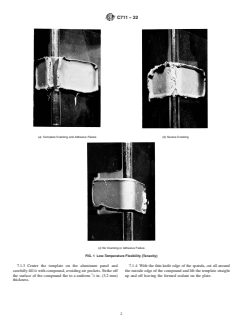
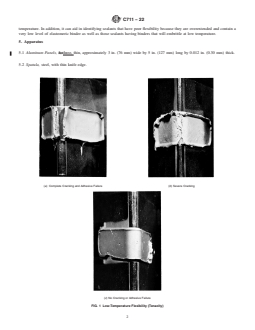
1.1 This test method covers determination of the low-temperature flexibility and tenacity of one-part, elastomeric, solvent-release type sealants after cyclic high- and low-temperature aging.
1.2 The subcommittee with jurisdiction is not aware of any similar ISO standard.
1.3 The values stated in inch-pound units are to be regarded as standard. The values given in parentheses are mathematical conversions to SI units that are provided for information only and are not considered standard.
1.4 This standard does not purport to address all of the safety concerns, if any, associated with its use. It is the responsibility of the user of this standard to establish appropriate safety, health, and environmental practices and determine the applicability of regulatory limitations prior to use.
1.5 This international standard was developed in accordance with internationally recognized principles on standardization established in the Decision on Principles for the Development of International Standards, Guides and Recommendations issued by the World Trade Organization Technical Barriers to Trade (TBT) Committee.
- Status
- Published
- Publication Date
- 31-May-2022
- Technical Committee
- C24 - Building Seals and Sealants
- Drafting Committee
- C24.20 - General Test Methods
Buy Documents


ASTM C711-22 - Standard Test Method for Low-Temperature Flexibility and Tenacity of One-Part, Elastomeric, Solvent-Release Type Sealants

REDLINE ASTM C711-22 - Standard Test Method for Low-Temperature Flexibility and Tenacity of One-Part, Elastomeric, Solvent-Release Type Sealants
Overview
ASTM C711-22: Standard Test Method for Low-Temperature Flexibility and Tenacity of One-Part, Elastomeric, Solvent-Release Type Sealants establishes a laboratory test procedure for evaluating the performance of one-part elastomeric solvent-release sealants when subjected to cyclic high- and low-temperature aging. The standard helps determine how these sealants retain flexibility and adhesion after exposure to extreme temperature cycles, providing critical information on their suitability for various sealing applications. This test does not simulate field conditions, but it aids in distinguishing elastomer-based sealants from those with nonelastic binders, highlighting products that may harden, embrittle, crack, or lose adhesion after aging.
Key Topics
- Low-Temperature Flexibility: Measures the ability of the sealant to bend at sub-freezing temperatures without cracking, separating, or losing adhesion.
- Tenacity After Aging: Assesses how well the sealant maintains adhesion and structural integrity following cycles of high and low temperatures.
- Sealant Differentiation: Helps identify sealants with insufficient elastomeric content or those prone to embrittlement under cold conditions.
- Laboratory Test Method: Describes standardized procedures and apparatus, including specimen preparation, temperature cycling, and evaluation for cracking and failure.
- Reporting Requirements: Outlines how to document results, such as the presence of deep cracks, separation, delamination, or adhesive failures.
Applications
ASTM C711-22 is essential for professionals involved in the selection and quality control of building joint sealants, particularly in environments prone to significant temperature fluctuations. Practical uses include:
- Product Development: Manufacturers use this method to evaluate the performance of new elastomeric, solvent-release type sealant formulations.
- Quality Assurance: Construction and building materials professionals rely on this test to ensure sealants meet required flexibility and tenacity standards, minimizing the risk of premature joint failure in buildings.
- Comparative Analysis: Enables users to compare one-part elastomeric sealants with competing products, differentiating high-performance options from those prone to brittle failure.
- Specification Compliance: Designers and specifiers reference ASTM C711-22 to ensure sealant products selected for projects will maintain integrity in low-temperature climates.
Related Standards
- ASTM C717: Provides terminology for building seals and sealants, referenced throughout ASTM C711-22 for consistent use of technical terms.
- No ISO Equivalent: Currently, there is no directly comparable ISO standard covering these specific performance attributes for one-part, elastomeric, solvent-release type sealants.
- Other test methods developed by ASTM Committee C24 address related physical and mechanical properties in various sealing systems.
Practical Value
By following ASTM C711-22, users can:
- Ensure sealants are fit for service in cold climates where flexibility and adhesion retention are critical.
- Reduce the risk of joint leaks and failure due to material embrittlement and poor low-temperature performance.
- Simplify product selection for construction and building envelope projects by identifying durable, elastomeric sealants.
- Achieve better long-term performance of building joints and structures exposed to thermal cycling.
Keywords: ASTM C711-22, low-temperature flexibility, elastomeric sealant, solvent-release sealant, tenacity, building joint sealants, sealant testing, ASTM standard, building materials testing, cold climate sealant performance.
Relations
- Effective Date
- 01-Mar-2019
- Effective Date
- 01-Mar-2018
- Effective Date
- 01-Nov-2017
- Effective Date
- 01-Jan-2017
- Effective Date
- 15-Nov-2016
- Effective Date
- 01-Sep-2016
- Effective Date
- 01-May-2014
- Effective Date
- 01-Feb-2014
- Effective Date
- 01-Nov-2013
- Effective Date
- 01-Dec-2012
- Effective Date
- 01-May-2012
- Effective Date
- 15-Jan-2012
- Effective Date
- 01-Mar-2011
- Effective Date
- 15-Jan-2011
- Effective Date
- 15-Jun-2010
Buy Documents
ASTM C711-22 - Standard Test Method for Low-Temperature Flexibility and Tenacity of One-Part, Elastomeric, Solvent-Release Type Sealants
REDLINE ASTM C711-22 - Standard Test Method for Low-Temperature Flexibility and Tenacity of One-Part, Elastomeric, Solvent-Release Type Sealants
Get Certified
Connect with accredited certification bodies for this standard

DIBt (Deutsches Institut für Bautechnik)
German Institute for Building Technology.
DIN CERTCO
DIN Group product certification.

Aboma Certification B.V.
Specialized in construction, metal, and transport sectors.
Sponsored listings
Frequently Asked Questions
ASTM C711-22 is a standard published by ASTM International. Its full title is "Standard Test Method for Low-Temperature Flexibility and Tenacity of One-Part, Elastomeric, Solvent-Release Type Sealants". This standard covers: SIGNIFICANCE AND USE 4.1 This test method is not intended to simulate an actual use condition but it will give some indication of the elastomeric properties or flexibility of a building joint sealant at low temperature. It can serve to differentiate between elastomer-based sealants and sealants based on nonelastic binders that can harden or embrittle on aging and crack or lose adhesion when flexed at low temperature. In addition, it can aid in identifying sealants that have poor flexibility because they are overextended and contain a very low level of elastomeric binder as well as those sealants having binders that will embrittle at low temperature. SCOPE 1.1 This test method covers determination of the low-temperature flexibility and tenacity of one-part, elastomeric, solvent-release type sealants after cyclic high- and low-temperature aging. 1.2 The subcommittee with jurisdiction is not aware of any similar ISO standard. 1.3 The values stated in inch-pound units are to be regarded as standard. The values given in parentheses are mathematical conversions to SI units that are provided for information only and are not considered standard. 1.4 This standard does not purport to address all of the safety concerns, if any, associated with its use. It is the responsibility of the user of this standard to establish appropriate safety, health, and environmental practices and determine the applicability of regulatory limitations prior to use. 1.5 This international standard was developed in accordance with internationally recognized principles on standardization established in the Decision on Principles for the Development of International Standards, Guides and Recommendations issued by the World Trade Organization Technical Barriers to Trade (TBT) Committee.
SIGNIFICANCE AND USE 4.1 This test method is not intended to simulate an actual use condition but it will give some indication of the elastomeric properties or flexibility of a building joint sealant at low temperature. It can serve to differentiate between elastomer-based sealants and sealants based on nonelastic binders that can harden or embrittle on aging and crack or lose adhesion when flexed at low temperature. In addition, it can aid in identifying sealants that have poor flexibility because they are overextended and contain a very low level of elastomeric binder as well as those sealants having binders that will embrittle at low temperature. SCOPE 1.1 This test method covers determination of the low-temperature flexibility and tenacity of one-part, elastomeric, solvent-release type sealants after cyclic high- and low-temperature aging. 1.2 The subcommittee with jurisdiction is not aware of any similar ISO standard. 1.3 The values stated in inch-pound units are to be regarded as standard. The values given in parentheses are mathematical conversions to SI units that are provided for information only and are not considered standard. 1.4 This standard does not purport to address all of the safety concerns, if any, associated with its use. It is the responsibility of the user of this standard to establish appropriate safety, health, and environmental practices and determine the applicability of regulatory limitations prior to use. 1.5 This international standard was developed in accordance with internationally recognized principles on standardization established in the Decision on Principles for the Development of International Standards, Guides and Recommendations issued by the World Trade Organization Technical Barriers to Trade (TBT) Committee.
ASTM C711-22 is classified under the following ICS (International Classification for Standards) categories: 91.100.50 - Binders. Sealing materials. The ICS classification helps identify the subject area and facilitates finding related standards.
ASTM C711-22 has the following relationships with other standards: It is inter standard links to ASTM C717-19, ASTM C717-18, ASTM C717-17a, ASTM C717-17, ASTM C717-16a, ASTM C717-16, ASTM C717-14a, ASTM C717-14, ASTM C717-13, ASTM C717-12b, ASTM C717-12a, ASTM C717-12, ASTM C717-11a, ASTM C717-11, ASTM C717-10. Understanding these relationships helps ensure you are using the most current and applicable version of the standard.
ASTM C711-22 is available in PDF format for immediate download after purchase. The document can be added to your cart and obtained through the secure checkout process. Digital delivery ensures instant access to the complete standard document.
Standards Content (Sample)
This international standard was developed in accordance with internationally recognized principles on standardization established in the Decision on Principles for the
Development of International Standards, Guides and Recommendations issued by the World Trade Organization Technical Barriers to Trade (TBT) Committee.
Designation: C711 − 22
Standard Test Method for
Low-Temperature Flexibility and Tenacity of One-Part,
Elastomeric, Solvent-Release Type Sealants
This standard is issued under the fixed designation C711; the number immediately following the designation indicates the year of
original adoption or, in the case of revision, the year of last revision. A number in parentheses indicates the year of last reapproval. A
superscript epsilon (´) indicates an editorial change since the last revision or reapproval.
1. Scope 4. Significance and Use
1.1 This test method covers determination of the low-
4.1 This test method is not intended to simulate an actual
temperature flexibility and tenacity of one-part, elastomeric, useconditionbutitwillgivesomeindicationoftheelastomeric
solvent-release type sealants after cyclic high- and low-
properties or flexibility of a building joint sealant at low
temperature aging. temperature. It can serve to differentiate between elastomer-
basedsealantsandsealantsbasedonnonelasticbindersthatcan
1.2 The subcommittee with jurisdiction is not aware of any
harden or embrittle on aging and crack or lose adhesion when
similar ISO standard.
flexed at low temperature. In addition, it can aid in identifying
1.3 The values stated in inch-pound units are to be regarded
sealants that have poor flexibility because they are overex-
as standard. The values given in parentheses are mathematical
tended and contain a very low level of elastomeric binder as
conversions to SI units that are provided for information only
well as those sealants having binders that will embrittle at low
and are not considered standard.
temperature.
1.4 This standard does not purport to address all of the
safety concerns, if any, associated with its use. It is the
5. Apparatus
responsibility of the user of this standard to establish appro-
5.1 Aluminum Panels, three, thin, approximately 3 in. (76
priate safety, health, and environmental practices and deter-
mm) wide by 5 in. (127 mm) long by 0.012 in. (0.30 mm)
mine the applicability of regulatory limitations prior to use.
thick.
1.5 This international standard was developed in accor-
5.2 Spatula, steel, with thin knife edge.
dance with internationally recognized principles on standard-
ization established in the Decision on Principles for the 1
5.3 Template, rectangular, of steel or brass, ⁄8 in. (3.2 mm)
Development of International Standards, Guides and Recom- 3
high, 1 in. by 3 ⁄4 in. (25 mm by 95 mm) inside and
mendations issued by the World Trade Organization Technical 3
approximately 2 in. by 4 ⁄4 in. (51 mm by 121 mm) outside.
Barriers to Trade (TBT) Committee.
5.4 Oven,forced-drafttype,havingatemperaturecontrolled
at 158 °F 6 3.6 °F (70 °C 6 2 °C).
2. Referenced Documents
5.5 Freezer Chest or Cold Box, having a controlled tem-
2.1 ASTM Standards:
perature of −10 °F 6 5 °F (−23 °C 6 3 °C).
C717 Terminology of Building Seals and Sealants
5.6 Mandrel or Rod, with a diameter of ⁄4 in. (6.4 mm),
3. Terminology
with a suitable holder or rack to support it.
3.1 Definitions—Refer to Terminology C717 for definitions
5.7 Methyl Ethyl Ketone, or similar solvent.
of the following terms used in this Test Method: elastomer,
elastomeric, joint, sealant, solvent-release sealant, standard
6. Sampling
conditions.
6.1 Create the test specimen from a previously unopened
container of sealant as received from the sealant manufacturer.
ThistestmethodisunderthejurisdictionofASTMCommitteeC24onBuilding
Seals and Sealantsand is the direct responsibility of Subcommittee C24.20 on
General Test Methods.
7. Test Specimens
CurrenteditionapprovedJune1,2022.PublishedJuly2022.Originallyapproved
7.1 Prepare three test specimens as follows:
in 1972. Las
...
This document is not an ASTM standard and is intended only to provide the user of an ASTM standard an indication of what changes have been made to the previous version. Because
it may not be technically possible to adequately depict all changes accurately, ASTM recommends that users consult prior editions as appropriate. In all cases only the current version
of the standard as published by ASTM is to be considered the official document.
Designation: C711 − 14 C711 − 22
Standard Test Method for
Low-Temperature Flexibility and Tenacity of One-Part,
Elastomeric, Solvent-Release Type Sealants
This standard is issued under the fixed designation C711; the number immediately following the designation indicates the year of
original adoption or, in the case of revision, the year of last revision. A number in parentheses indicates the year of last reapproval. A
superscript epsilon (´) indicates an editorial change since the last revision or reapproval.
1. Scope
1.1 This test method covers determination of the low-temperature flexibility and tenacity of one-part, elastomeric, solvent-release
type sealants after cyclic high- and low-temperature aging.
1.2 The subcommittee with jurisdiction is not aware of any similar ISO standard.
1.3 The values stated in inch-pound units are to be regarded as standard. The values given in parentheses are mathematical
conversions to SI units that are provided for information only and are not considered standard.
1.4 This standard does not purport to address all of the safety concerns, if any, associated with its use. It is the responsibility
of the user of this standard to establish appropriate safety safety, health, and healthenvironmental practices and determine the
applicability of regulatory limitations prior to use.
1.5 This international standard was developed in accordance with internationally recognized principles on standardization
established in the Decision on Principles for the Development of International Standards, Guides and Recommendations issued
by the World Trade Organization Technical Barriers to Trade (TBT) Committee.
2. Referenced Documents
2.1 ASTM Standards:
C717 Terminology of Building Seals and Sealants
3. Terminology
3.1 Definitions—Refer to Terminology C717 for definitions of the following terms used in this Test Method: elastomer,
elastomeric, joint, sealant, solvent-release sealant, standard conditions.
4. Significance and Use
4.1 This test method is not intended to simulate an actual use condition but it will give some indication of the elastomeric
properties or flexibility of a building joint sealant at low temperature. It can serve to differentiate between elastomer-based sealants
and sealants based on nonelastic binders that can harden or embrittle on aging and crack or lose adhesion when flexed at low
This test method is under the jurisdiction of ASTM Committee C24 on Building Seals and Sealantsand is the direct responsibility of Subcommittee C24.20 on General
Test Methods.
Current edition approved July 1, 2014June 1, 2022. Published August 2014July 2022. Originally approved in 1972. Last previous edition approved in 20092014 as
C711 – 03C711 – 14.(2009). DOI: 10.1520/C0711-14.10.1520/C0711-22.
For referenced ASTM standards, visit the ASTM website, www.astm.org, or contact ASTM Customer Service at service@astm.org. For Annual Book of ASTM Standards
volume information, refer to the standard’s Document Summary page on the ASTM website.
Copyright © ASTM International, 100 Barr Harbor Drive, PO Box C700, West Conshohocken, PA 19428-2959. United States
C711 − 22
temperature. In addition, it can aid in identifying sealants that have poor flexibility because they are overextended and contain a
very low level of elastomeric binder as well as those sealants having binders that will embrittle at low temperature.
5. Apparatus
5.1 Aluminum Panels, 3, three, thin, approximately 3 in. (76 mm) wide by 5 in. (127 mm) long by 0.012 in. (0.30 mm) thick.
5.2 Spatula, steel, with thin knife edge.
(a) Complete Cracking and Adhesive Failure (b) Severe Cracking
(c) No Cracking or Adhesive Failure
FIG. 1 Low-Temperature Flexibility (Tenacity)
C711 − 22
...