


ASTM A723/A723M-18a(2023)
(Specification)Standard Specification for Alloy Steel Forgings for High-Strength Pressure Component Application
Standard Specification for Alloy Steel Forgings for High-Strength Pressure Component Application
ABSTRACT
This specification covers the standard requirements for high-strength quenched and tempered alloy steel forgings for pressure vessels, isostatic presses, shock tubes, and similar components. These materials are not intended for welded construction. Three grades of nickel-chromium-molybdenum steels and six classes of increasing tensile strength are included. The strength class, section size, and configuration of the forging will largely dictate the applicable type of steel. Materials shall be manufactured by steel melting processes, rough machining, and final heat treatment, which shall consist of normalizing, reaustenitization, liquid quenching, and tempering. Conformance of the forging specimens to chemical composition requirements shall be analyzed by heat and product analyses. Proper sampling methods for mechanical properties testing shall be done by any of four possible ways, as judged appropriate. Steel specimens shall also undergo straight-beam and angle-beam ultrasonic examination, and magnetic particle examination procedures to evaluate nondestructive examination requirements. Repair welding of the forgings shall not be permitted.
SCOPE
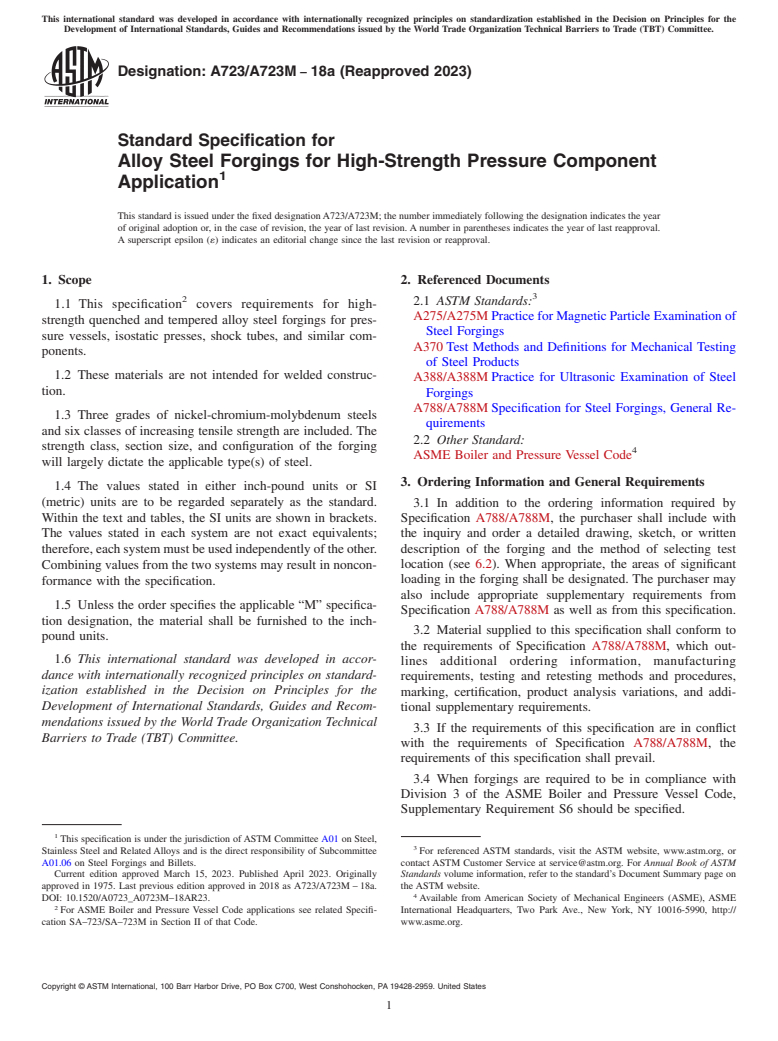
1.1 This specification2 covers requirements for high-strength quenched and tempered alloy steel forgings for pressure vessels, isostatic presses, shock tubes, and similar components.
1.2 These materials are not intended for welded construction.
1.3 Three grades of nickel-chromium-molybdenum steels and six classes of increasing tensile strength are included. The strength class, section size, and configuration of the forging will largely dictate the applicable type(s) of steel.
1.4 The values stated in either inch-pound units or SI (metric) units are to be regarded separately as the standard. Within the text and tables, the SI units are shown in brackets. The values stated in each system are not exact equivalents; therefore, each system must be used independently of the other. Combining values from the two systems may result in nonconformance with the specification.
1.5 Unless the order specifies the applicable “M” specification designation, the material shall be furnished to the inch-pound units.
1.6 This international standard was developed in accordance with internationally recognized principles on standardization established in the Decision on Principles for the Development of International Standards, Guides and Recommendations issued by the World Trade Organization Technical Barriers to Trade (TBT) Committee.
General Information
Standards Content (Sample)
This international standard was developed in accordance with internationally recognized principles on standardization established in the Decision on Principles for the
Development of International Standards, Guides and Recommendations issued by the World Trade Organization Technical Barriers to Trade (TBT) Committee.
Designation: A723/A723M − 18a (Reapproved 2023)
Standard Specification for
Alloy Steel Forgings for High-Strength Pressure Component
1
Application
This standard is issued under the fixed designation A723/A723M; the number immediately following the designation indicates the year
of original adoption or, in the case of revision, the year of last revision. A number in parentheses indicates the year of last reapproval.
A superscript epsilon (´) indicates an editorial change since the last revision or reapproval.
1. Scope 2. Referenced Documents
3
2
2.1 ASTM Standards:
1.1 This specification covers requirements for high-
A275/A275M Practice for Magnetic Particle Examination of
strength quenched and tempered alloy steel forgings for pres-
Steel Forgings
sure vessels, isostatic presses, shock tubes, and similar com-
A370 Test Methods and Definitions for Mechanical Testing
ponents.
of Steel Products
1.2 These materials are not intended for welded construc-
A388/A388M Practice for Ultrasonic Examination of Steel
tion.
Forgings
A788/A788M Specification for Steel Forgings, General Re-
1.3 Three grades of nickel-chromium-molybdenum steels
quirements
and six classes of increasing tensile strength are included. The
2.2 Other Standard:
strength class, section size, and configuration of the forging
4
ASME Boiler and Pressure Vessel Code
will largely dictate the applicable type(s) of steel.
3. Ordering Information and General Requirements
1.4 The values stated in either inch-pound units or SI
(metric) units are to be regarded separately as the standard.
3.1 In addition to the ordering information required by
Within the text and tables, the SI units are shown in brackets.
Specification A788/A788M, the purchaser shall include with
The values stated in each system are not exact equivalents; the inquiry and order a detailed drawing, sketch, or written
therefore, each system must be used independently of the other. description of the forging and the method of selecting test
location (see 6.2). When appropriate, the areas of significant
Combining values from the two systems may result in noncon-
loading in the forging shall be designated. The purchaser may
formance with the specification.
also include appropriate supplementary requirements from
1.5 Unless the order specifies the applicable “M” specifica-
Specification A788/A788M as well as from this specification.
tion designation, the material shall be furnished to the inch-
3.2 Material supplied to this specification shall conform to
pound units.
the requirements of Specification A788/A788M, which out-
1.6 This international standard was developed in accor-
lines additional ordering information, manufacturing
dance with internationally recognized principles on standard-
requirements, testing and retesting methods and procedures,
ization established in the Decision on Principles for the
marking, certification, product analysis variations, and addi-
Development of International Standards, Guides and Recom- tional supplementary requirements.
mendations issued by the World Trade Organization Technical
3.3 If the requirements of this specification are in conflict
Barriers to Trade (TBT) Committee.
with the requirements of Specification A788/A788M, the
requirements of this specification shall prevail.
3.4 When forgings are required to be in compliance with
Division 3 of the ASME Boiler and Pressure Vessel Code,
Supplementary Requirement S6 should be specified.
1
This specification is under the jurisdiction of ASTM Committee A01 on Steel,
3
Stainless Steel and Related Alloys and is the direct responsibility of Subcommittee For referenced ASTM standards, visit the ASTM website, www.astm.org, or
A01.06 on Steel Forgings and Billets. contact ASTM Customer Service at service@astm.org. For Annual Book of ASTM
Current edition approved March 15, 2023. Published April 2023. Originally Standards volume information, refer to the standard’s Document Summary page on
approved in 1975. Last previous edition approved in 2018 as A723/A723M – 18a. the ASTM website.
4
DOI: 10.1520/A0723_A0723M–18AR23. Available from American Society of Mechanical Engineers (ASME), ASME
2
For ASME Boiler and Pressure Vessel Code applications see related Specifi- International Headquarters, Two Park Ave., New York, NY 10016-5990, http://
cation SA–723/SA–723M in Section II of that Code. www.asme.org.
Copyright © ASTM International, 100 Barr Harbor Drive, PO Box C700, West Conshohocken, PA 19428-2959. United States
1
---------------------- Page: 1 ----------------------
A723/A723M − 18a (2023)
4. Materials and Manufacture tension test specimen as specified in Test Methods and Defi-
nitions A370 (that is, standard round 0.500 in.
...
Questions, Comments and Discussion
Ask us and Technical Secretary will try to provide an answer. You can facilitate discussion about the standard in here.