

ASTM D4989/D4989M-90a(2021)
(Test Method)Standard Test Method for Apparent Viscosity (Flow) of Roofing Bitumens Using the Parallel Plate Plastometer
General Information
- Abstract
ABSTRACT
This test method deals with the standards for the measurement of apparent viscosity of roofing bitumen by mean of a parallel plate plastometer. This method involves measuring viscosity using pre-determined arbitrary shear stress levels. The method involves molding the sample into a disc of specified dimensions, heating it to a selected temperature and placing it between the plates of a pre-heated apparatus and pressing under the standard conditions for a measured time.
SCOPE
1.1 This test method covers the measurement of apparent viscosity of roofing bitumen by means of a parallel plate plastometer. This test method is applicable for a viscosity range from 102 to 109 Pa·s [103 to 1010 poises]. See Note 1.
Note 1: This relatively simple test method of measuring viscosity uses predetermined, arbitrary shear stress levels. Since roofing bitumens are non-Newtonian, other viscosity test methods may give different results.
1.2 The values stated in either SI units or inch-pound units are to be regarded separately as standard. The values stated in each system may not be exact equivalents; therefore, each system shall be used independently of the other. Combining values from the two systems may result in nonconformance with the standard.
1.3 This standard does not purport to address all of the safety concerns, if any, associated with its use. It is the responsibility of the user of this standard to establish appropriate safety, health, and environmental practices and determine the applicability of regulatory limitations prior to use.
1.4 This international standard was developed in accordance with internationally recognized principles on standardization established in the Decision on Principles for the Development of International Standards, Guides and Recommendations issued by the World Trade Organization Technical Barriers to Trade (TBT) Committee.
- Status
- Published
- Publication Date
- 31-Dec-2020
- Technical Committee
- D08 - Roofing and Waterproofing

Overview
ASTM D4989/D4989M-90a(2021) - Standard Test Method for Apparent Viscosity (Flow) of Roofing Bitumens Using the Parallel Plate Plastometer, is a globally recognized ASTM International standard utilized for measuring the apparent viscosity of roofing bitumen. The method employs a parallel plate plastometer to evaluate roofing bitumen's flow characteristics under specified shear stress conditions.
Apparent viscosity indicates the material's resistance to flow, which is a critical property for the performance of roofing, dampproofing, and waterproofing systems. This test is specifically designed for bitumens that do not behave in a Newtonian manner, meaning their viscosity changes with applied stress.
Key Topics
- Apparent Viscosity Measurement: Provides a standardized approach for evaluating the flow properties of roofing bitumens over a broad viscosity range (10² to 10⁹ Pa·s).
- Parallel Plate Plastometer: Utilizes a parallel plate plastometer, where the sample is molded into a disc, heated, and subjected to pressure between two plates at a controlled temperature and time.
- Non-Newtonian Behavior: Recognizes the non-Newtonian characteristics of roofing bitumens, noting that different test methods may yield varying results.
- Standard Conditions: Specifies precise procedures for temperature, sample preparation, and timing, promoting consistency and repeatability.
- Unit Systems: Allows both SI and inch-pound unit systems, but each must be used independently to avoid nonconformance.
- Precision and Bias: Details repeatability and reproducibility guidelines to ensure reliable data.
- Health and Safety: Emphasizes the user’s responsibility to establish appropriate safety, health, and environmental practices when applying this test method.
Applications
The ASTM D4989/D4989M test method is essential in various industrial and quality assurance contexts, including:
- Roofing Material Quality Control: Ensures bitumen has consistent and suitable viscosity for application, performance, and longevity in roofing membranes and coatings.
- Product Development: Assists manufacturers in formulating roofing bitumens with desirable flow properties for specific climates and application techniques.
- Comparison and Specification Compliance: Offers a basis for comparing batch-to-batch uniformity and verifying compliance with project or product specifications.
- Regulatory and Procurement Standards: Facilitates objective evaluation and documentation to meet procurement requirements or regulatory guidelines for building materials.
- Research and Development: Supports technical research into bitumen rheology, additive effects, and improvements in roofing product performance.
Related Standards
Several ASTM standards complement or provide alternative methods for the testing of bitumens and roofing materials. Key related standards include:
- ASTM D2171/D2171M: Test Method for Viscosity of Asphalts by Vacuum Capillary Viscometer - a method for Newtonian and non-Newtonian asphalts.
- ASTM D3205: Test Method for Viscosity of Asphalt with Cone and Plate Viscometer (withdrawn).
- ASTM D140/D140M: Practice for Sampling Asphalt Materials - outlines best practices for obtaining representative samples.
- ASTM D312/D312M: Specification for Asphalt Used in Roofing.
- ASTM D450/D450M: Specification for Coal-Tar Pitch Used in Roofing, Dampproofing, and Waterproofing.
Practical Value
Implementing ASTM D4989/D4989M ensures reliable, consistent, and industry-accepted measurement of roofing bitumen’s viscosity. This enhances material quality management, supports compliance with international trade requirements, and enables informed selection and use of roofing products in construction projects. By following this international standard, organizations can minimize product variability and optimize roofing system performance.
Relations
- Effective Date
- 01-Dec-2023
- Effective Date
- 01-May-2018
- Effective Date
- 01-Jun-2016
- Effective Date
- 01-May-2016
- Effective Date
- 01-Jun-2015
- Effective Date
- 01-Feb-2015
- Effective Date
- 01-Jun-2014
- Effective Date
- 01-Jan-2013
- Refers
ASTM D2171/D2171M-10 - Standard Test Method for Viscosity of Asphalts by Vacuum Capillary Viscometer - Effective Date
- 01-Jun-2010
- Effective Date
- 01-Jun-2009
Get Certified
Connect with accredited certification bodies for this standard

DIBt (Deutsches Institut für Bautechnik)
German Institute for Building Technology.
DIN CERTCO
DIN Group product certification.

Aboma Certification B.V.
Specialized in construction, metal, and transport sectors.
Sponsored listings
Frequently Asked Questions
ASTM D4989/D4989M-90a(2021) is a standard published by ASTM International. Its full title is "Standard Test Method for Apparent Viscosity (Flow) of Roofing Bitumens Using the Parallel Plate Plastometer". This standard covers: ABSTRACT This test method deals with the standards for the measurement of apparent viscosity of roofing bitumen by mean of a parallel plate plastometer. This method involves measuring viscosity using pre-determined arbitrary shear stress levels. The method involves molding the sample into a disc of specified dimensions, heating it to a selected temperature and placing it between the plates of a pre-heated apparatus and pressing under the standard conditions for a measured time. SCOPE 1.1 This test method covers the measurement of apparent viscosity of roofing bitumen by means of a parallel plate plastometer. This test method is applicable for a viscosity range from 102 to 109 Pa·s [103 to 1010 poises]. See Note 1. Note 1: This relatively simple test method of measuring viscosity uses predetermined, arbitrary shear stress levels. Since roofing bitumens are non-Newtonian, other viscosity test methods may give different results. 1.2 The values stated in either SI units or inch-pound units are to be regarded separately as standard. The values stated in each system may not be exact equivalents; therefore, each system shall be used independently of the other. Combining values from the two systems may result in nonconformance with the standard. 1.3 This standard does not purport to address all of the safety concerns, if any, associated with its use. It is the responsibility of the user of this standard to establish appropriate safety, health, and environmental practices and determine the applicability of regulatory limitations prior to use. 1.4 This international standard was developed in accordance with internationally recognized principles on standardization established in the Decision on Principles for the Development of International Standards, Guides and Recommendations issued by the World Trade Organization Technical Barriers to Trade (TBT) Committee.
ABSTRACT This test method deals with the standards for the measurement of apparent viscosity of roofing bitumen by mean of a parallel plate plastometer. This method involves measuring viscosity using pre-determined arbitrary shear stress levels. The method involves molding the sample into a disc of specified dimensions, heating it to a selected temperature and placing it between the plates of a pre-heated apparatus and pressing under the standard conditions for a measured time. SCOPE 1.1 This test method covers the measurement of apparent viscosity of roofing bitumen by means of a parallel plate plastometer. This test method is applicable for a viscosity range from 102 to 109 Pa·s [103 to 1010 poises]. See Note 1. Note 1: This relatively simple test method of measuring viscosity uses predetermined, arbitrary shear stress levels. Since roofing bitumens are non-Newtonian, other viscosity test methods may give different results. 1.2 The values stated in either SI units or inch-pound units are to be regarded separately as standard. The values stated in each system may not be exact equivalents; therefore, each system shall be used independently of the other. Combining values from the two systems may result in nonconformance with the standard. 1.3 This standard does not purport to address all of the safety concerns, if any, associated with its use. It is the responsibility of the user of this standard to establish appropriate safety, health, and environmental practices and determine the applicability of regulatory limitations prior to use. 1.4 This international standard was developed in accordance with internationally recognized principles on standardization established in the Decision on Principles for the Development of International Standards, Guides and Recommendations issued by the World Trade Organization Technical Barriers to Trade (TBT) Committee.
ASTM D4989/D4989M-90a(2021) is classified under the following ICS (International Classification for Standards) categories: 91.100.50 - Binders. Sealing materials. The ICS classification helps identify the subject area and facilitates finding related standards.
ASTM D4989/D4989M-90a(2021) has the following relationships with other standards: It is inter standard links to ASTM D140/D140M-16(2023), ASTM D450/D450M-07(2018), ASTM D140/D140M-16, ASTM D312/D312M-16, ASTM D140/D140M-15, ASTM D312/D312M-15, ASTM D140/D140M-14, ASTM D450/D450M-07(2013)e1, ASTM D2171/D2171M-10, ASTM D140/D140M-09. Understanding these relationships helps ensure you are using the most current and applicable version of the standard.
ASTM D4989/D4989M-90a(2021) is available in PDF format for immediate download after purchase. The document can be added to your cart and obtained through the secure checkout process. Digital delivery ensures instant access to the complete standard document.
Standards Content (Sample)
This international standard was developed in accordance with internationally recognized principles on standardization established in the Decision on Principles for the
Development of International Standards, Guides and Recommendations issued by the World Trade Organization Technical Barriers to Trade (TBT) Committee.
Designation:D4989/D4989M −90a (Reapproved 2021)
Standard Test Method for
Apparent Viscosity (Flow) of Roofing Bitumens Using the
Parallel Plate Plastometer
This standard is issued under the fixed designation D4989/D4989M; the number immediately following the designation indicates the
year of original adoption or, in the case of revision, the year of last revision. A number in parentheses indicates the year of last
reapproval. A superscript epsilon (´) indicates an editorial change since the last revision or reapproval.
1. Scope Roofing, Dampproofing, and Waterproofing
D2171/D2171M Test Method for Viscosity of Asphalts by
1.1 This test method covers the measurement of apparent
Vacuum Capillary Viscometer
viscosity of roofing bitumen by means of a parallel plate
D3205 Test Method for Viscosity of Asphalt with Cone and
plastometer.Thistestmethodisapplicableforaviscosityrange
2 9 3 10 Plate Viscometer (Withdrawn 2000)
from 10 to 10 Pa·s [10 to 10 poises]. See Note 1.
NOTE1—Thisrelativelysimpletestmethodofmeasuringviscosityuses 3. Terminology
predetermined, arbitrary shear stress levels. Since roofing bitumens are
3.1 Definitions—See definitions of viscosity given in Test
non-Newtonian, other viscosity test methods may give different results.
Methods D2171/D2171M and D3205.
1.2 The values stated in either SI units or inch-pound units
are to be regarded separately as standard. The values stated in
4. Summary of Test Method
each system may not be exact equivalents; therefore, each
4.1 The sample is molded into a disc of specified
system shall be used independently of the other. Combining
dimensions,heatedtotheselectedtemperature,placedbetween
values from the two systems may result in nonconformance
the plates of the pre-heated apparatus, and pressed under
with the standard.
standard conditions for a measured time. The apparent viscos-
1.3 This standard does not purport to address all of the
ity is calculated from the final diameter of the pressed
safety concerns, if any, associated with its use. It is the
specimen disc.
responsibility of the user of this standard to establish appro-
priate safety, health, and environmental practices and deter- 5. Apparatus
mine the applicability of regulatory limitations prior to use.
5.1 Parallel Plate Plastometer—A modified form of Wil-
1.4 This international standard was developed in accor-
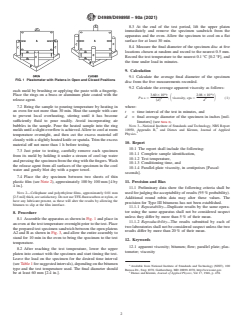
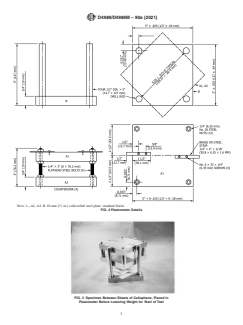
liams’ plastometer as shown in Figs. 1 and 2. Mass of PlatenA
dance with internationally recognized principles on standard-
is 5000 6 50 g [11.02 6 0.11 lb].
ization established in the Decision on Principles for the
5.2 Ring Molds, with an inside diameter of 25.40 6
Development of International Standards, Guides and Recom-
0.01 mm [1.0000 6 0.0025 in.] and a height of 12.70 6
mendations issued by the World Trade Organization Technical
0.01 mm [0.5000 6 0.0025 in.] cut from copper or brass
Barriers to Trade (TBT) Committee.
tubing.
2. Referenced Documents
5.3 Constant-Temperature Oven,capableofmaintainingtest
temperature within 60.1 °C [60.2 °F].
2.1 ASTM Standards:
D140/D140M Practice for Sampling Asphalt Materials
5.4 Scale, linearly graduated in millimeters over at least
D312/D312M Specification for Asphalt Used in Roofing
150 mm [6 in.] and accurate to 60.5 mm [60.02 in.].
D450/D450M Specification for Coal-Tar Pitch Used in
6. Sampling
6.1 Sample the material to be tested in accordance with
This test method is under the jurisdiction ofASTM Committee D08 on Roofing
Practice D140/D140M.
and Waterproofing and is the direct responsibility of Subcommittee D08.03 on
Surfacing and Bituminous Materials for Membrane Waterproofing and Built-up
7. Test Specimens
Roofing.
Current edition approved Jan. 1, 2021. Published January 2021. Originally
7.1 Prepare two molds by coating with a pasty mixture of
approved in 1990. Last previous edition approved in 2014 as D4989/D4989M – 90a
ɛ1
talc in glycerine as a mold release agent. Coat all surfaces of
(2014) . DOI: 10.1520/D4989_D4989M-90AR21.
For referenced ASTM standards, visit the ASTM website, www.astm.org, or
contact ASTM Customer Service at service@astm.org. For Annual Book of ASTM
Standards volume information, refer to the standard’s Document Summary page on The last approved version of this historical standard is referenced on
the ASTM website. www.astm.org.
Copyright © ASTM International, 100 Barr Harbor Drive, PO Box C700, West Conshohocken, PA 19428-2959. United States
D4989/D4989M−90a (2021)
8.3 At the end of the test period, lift the upper platen
immediately and remove the specimen sandwich from the
apparatus and the oven. Allow the specimen to cool on a flat
surface for at least 30 min.
8.4 Measure the final diameter of the specimen disc at five
locations chosen at random and record to the nearest 0.5 mm.
Record the test temperature to the nearest 0.1 °C [0.2 °F], and
the time under load in minutes.
9. Calculation
9.1 Calculate the average final diameter of the specimen
FIG. 1 Plastometer with Platens in Open and Closed Positions
disc from the five measurements recorded.
9.2 Calculate the average apparent viscosity as follows:
each mold by brushing or applying the paste with a fingertip.
18 10
3.60 310 t 2.08 310 t
Place the rings on a brass or aluminum plate coated with the
Pa·s 5 ; viscosity, cps 5 (1)
S D
8 8
~d! d
release agent.
7.2 Bring the sample to pouring temperature by heating in
where:
an oven for not more than 30 min. Heat the sample with care
t = time interval of the test in minutes, and
to prevent l
...