

ASTM D5864-23
(Test Method)Standard Test Method for Determining Aerobic Aquatic Biodegradation of Lubricants or Their Components
General Information
- Abstract
SIGNIFICANCE AND USE
5.1 Results from the test method suggest, within the confines of a controlled laboratory setting, the degree of aerobic aquatic biodegradation of a lubricant or components of a lubricant by measuring the evolved carbon dioxide upon exposure of the test material to an inoculum. The plateau level of CO2 evolution in this test method will suggest the degree of biodegradability of the lubricant. Test substances that achieve a high degree of biodegradation in this test may be assumed to easily biodegrade in many aerobic aquatic environments.
5.2 Because of the stringency of this test, a low yield of CO2 does not necessarily mean that the test substance is not biodegradable under environmental conditions, but indicates that further testing is necessary to establish biodegradability.
5.3 Information on toxicity to the inoculum of the test substance may be useful in the interpretation of low biodegradation results.
5.4 Activated sewage-sludge from a sewage-treatment plant that principally treats domestic waste is considered an acceptable active aerobic inoculum available over a wide geographical area in which to test a broad range of lubricants. An inoculum derived from soil or natural surface waters, or both, or any combination of the three sources, is also appropriate for this test method.
Note 1: Allowance for various and multiple inoculum sources provides access to a greater diversity of biochemical competency and potentially represents more accurately the capacity for biodegradation.
5.5 A reference or control substance known to biodegrade is necessary in order to verify the activity of the inoculum. The test must be regarded as invalid and should be repeated using a fresh inoculum if the reference does not demonstrate a biodegradation of >60 % of the theoretical CO2 evolution within 28 days.
5.6 A total CO2 evolution in the blank at the end of the test exceeding 75 mg CO2 per 3 L of medium shall be considered as invalidating the test.
5.7 The water...
SCOPE
1.1 This test method covers the determination of the degree of aerobic aquatic biodegradation of fully formulated lubricants or their components on exposure to an inoculum under laboratory conditions.
1.2 This test method is intended to specifically address the difficulties associated with testing water insoluble materials and complex mixtures such as are found in many lubricants.
1.3 This test method is designed to be applicable to all lubricants that are not volatile and are not inhibitory at the test concentration to the organisms present in the inoculum.
1.4 This standard does not purport to address all of the safety concerns, if any, associated with its use. It is the responsibility of the user of this standard to establish appropriate safety, health, and environmental practices and determine the applicability of regulatory limitations prior to use. Specific hazards are discussed in Section 10.
1.5 This international standard was developed in accordance with internationally recognized principles on standardization established in the Decision on Principles for the Development of International Standards, Guides and Recommendations issued by the World Trade Organization Technical Barriers to Trade (TBT) Committee.
- Status
- Published
- Publication Date
- 31-Oct-2023
- Technical Committee
- D02 - Petroleum Products, Liquid Fuels, and Lubricants
- Drafting Committee
- D02.12 - Environmental Standards for Lubricants
Buy Documents
ASTM D5864-23 - Standard Test Method for Determining Aerobic Aquatic Biodegradation of Lubricants or Their Components
REDLINE ASTM D5864-23 - Standard Test Method for Determining Aerobic Aquatic Biodegradation of Lubricants or Their Components
Overview
ASTM D5864-23: Standard Test Method for Determining Aerobic Aquatic Biodegradation of Lubricants or Their Components is an internationally recognized standard developed by ASTM International. This test method is designed to determine the degree of aerobic aquatic biodegradation of fully formulated lubricants or their components when exposed to an inoculum under controlled laboratory conditions. By analyzing the amount of carbon dioxide (CO₂) evolved, stakeholders can assess the potential environmental impact and biodegradability of lubricants in aquatic environments.
The standard is particularly significant for industries committed to sustainability, environmental compliance, and responsible lubricant formulation, including manufacturers of industrial, commercial, and automotive lubricants.
Key Topics
- Aerobic Aquatic Biodegradation: Measurement focuses on the biodegradation of lubricants or their components under aerobic (oxygen-rich) aquatic conditions, using the evolution of CO₂ as an indicator.
- Applicability: Developed for testing both water-insoluble materials and complex mixtures, which are common in many lubricants. Applicable to all non-volatile lubricants that do not inhibit the test organisms at the prescribed concentrations.
- Inoculum Sources: Utilizes active aerobic microbial inocula obtained from sources such as activated sewage sludge, soil, or surface waters-either individually or in combination-to better represent environmental diversity.
- Reference and Validation: The standard requires a reference material known to biodegrade as a control to confirm inoculum effectiveness. The validity of test results depends on the performance of the reference material.
- Test Method Summary:
- Lubricant samples are incubated with the inoculum.
- Evolved CO₂ is captured, measured, and compared against theoretical CO₂ evolution based on organic carbon present.
- Biodegradability is expressed as a percentage of this theoretical value, providing a clear, quantitative indication.
Applications
ASTM D5864-23 is widely used for:
- Product Development and Sustainability Claims: Assisting manufacturers in certifying their lubricants as “readily biodegradable,” aiding in eco-labeling and environmental product declarations.
- Regulatory Fulfillment: Addressing requirements from governmental agencies and environmental regulators regarding the environmental fate and compliance of lubricants.
- Environmental Risk Assessment: Supporting risk assessment studies related to accidental lubricant release into water bodies by offering standardized data on biodegradability.
- Comparative Performance Assessment: Facilitating the comparison of new lubrication formulations with existing benchmarks, especially when replacing conventional lubricants with bio-based or environmentally friendly alternatives.
- Research and Quality Control: Employed by researchers, formulators, and quality assurance teams to evaluate and monitor product environmental performance.
Related Standards
For comprehensive testing and regulatory compliance, ASTM D5864-23 is often used alongside the following standards:
- ASTM D1193: Specification for Reagent Water-ensures water purity for accurate testing.
- ASTM D1293: Test Methods for pH of Water-used for pH measurement during testing.
- ASTM D4175: Terminology Relating to Petroleum Products, Liquid Fuels, and Lubricants-provides essential definitions.
- ASTM D4447: Guide for Disposal of Laboratory Chemicals and Samples-ensures safe waste management.
- ASTM D5291: Test Methods for Carbon, Hydrogen, and Nitrogen in Petroleum Products and Lubricants-used to determine organic carbon content in test samples.
- ASTM E943: Terminology Relating to Biological Effects and Environmental Fate-supplements relevant terminology.
- ISO 4259: Petroleum Products-Determination and Application of Precision Data in Relation to Methods of Test-relevant for data analysis and interpretation.
Practical Value
Implementing ASTM D5864-23 helps the lubricant industry reliably measure and communicate the biodegradability of their products, supporting environmental stewardship and regulatory compliance. This standard delivers consistent, reproducible results that inform product design, marketing, and environmental safety strategies, making it an essential component of any advanced lubricant testing or sustainability program.
Relations
- Effective Date
- 01-Nov-2023
- Refers
ASTM D4175-23a - Standard Terminology Relating to Petroleum Products, Liquid Fuels, and Lubricants - Effective Date
- 15-Dec-2023
- Refers
ASTM D4175-23 - Standard Terminology Relating to Petroleum Products, Liquid Fuels, and Lubricants - Effective Date
- 01-Jul-2023
- Refers
ASTM D4175-23e1 - Standard Terminology Relating to Petroleum Products, Liquid Fuels, and Lubricants - Effective Date
- 01-Jul-2023
- Referred By
ASTM D6384-22 - Standard Terminology Relating to Biodegradability and Ecotoxicity of Lubricants - Effective Date
- 01-Nov-2023
- Effective Date
- 01-Nov-2023
- Referred By
ASTM D8029-18 - Standard Specification for Biodegradable, Low Aquatic Toxicity Hydraulic Fluids - Effective Date
- 01-Nov-2023
- Effective Date
- 01-Nov-2023
- Effective Date
- 01-Nov-2023
- Effective Date
- 01-Nov-2023
- Effective Date
- 01-Nov-2023
Buy Documents
ASTM D5864-23 - Standard Test Method for Determining Aerobic Aquatic Biodegradation of Lubricants or Their Components
REDLINE ASTM D5864-23 - Standard Test Method for Determining Aerobic Aquatic Biodegradation of Lubricants or Their Components
Get Certified
Connect with accredited certification bodies for this standard

CIS Institut d.o.o.
Personal Protective Equipment (PPE) certification body. Notified Body NB-2890 for EU Regulation 2016/425 PPE.

Kiwa BDA Testing
Building and construction product certification.
Kmetijski inštitut Slovenije
Agricultural Institute of Slovenia. Soil testing, plant health, agricultural product analysis.
Sponsored listings
Frequently Asked Questions
ASTM D5864-23 is a standard published by ASTM International. Its full title is "Standard Test Method for Determining Aerobic Aquatic Biodegradation of Lubricants or Their Components". This standard covers: SIGNIFICANCE AND USE 5.1 Results from the test method suggest, within the confines of a controlled laboratory setting, the degree of aerobic aquatic biodegradation of a lubricant or components of a lubricant by measuring the evolved carbon dioxide upon exposure of the test material to an inoculum. The plateau level of CO2 evolution in this test method will suggest the degree of biodegradability of the lubricant. Test substances that achieve a high degree of biodegradation in this test may be assumed to easily biodegrade in many aerobic aquatic environments. 5.2 Because of the stringency of this test, a low yield of CO2 does not necessarily mean that the test substance is not biodegradable under environmental conditions, but indicates that further testing is necessary to establish biodegradability. 5.3 Information on toxicity to the inoculum of the test substance may be useful in the interpretation of low biodegradation results. 5.4 Activated sewage-sludge from a sewage-treatment plant that principally treats domestic waste is considered an acceptable active aerobic inoculum available over a wide geographical area in which to test a broad range of lubricants. An inoculum derived from soil or natural surface waters, or both, or any combination of the three sources, is also appropriate for this test method. Note 1: Allowance for various and multiple inoculum sources provides access to a greater diversity of biochemical competency and potentially represents more accurately the capacity for biodegradation. 5.5 A reference or control substance known to biodegrade is necessary in order to verify the activity of the inoculum. The test must be regarded as invalid and should be repeated using a fresh inoculum if the reference does not demonstrate a biodegradation of >60 % of the theoretical CO2 evolution within 28 days. 5.6 A total CO2 evolution in the blank at the end of the test exceeding 75 mg CO2 per 3 L of medium shall be considered as invalidating the test. 5.7 The water... SCOPE 1.1 This test method covers the determination of the degree of aerobic aquatic biodegradation of fully formulated lubricants or their components on exposure to an inoculum under laboratory conditions. 1.2 This test method is intended to specifically address the difficulties associated with testing water insoluble materials and complex mixtures such as are found in many lubricants. 1.3 This test method is designed to be applicable to all lubricants that are not volatile and are not inhibitory at the test concentration to the organisms present in the inoculum. 1.4 This standard does not purport to address all of the safety concerns, if any, associated with its use. It is the responsibility of the user of this standard to establish appropriate safety, health, and environmental practices and determine the applicability of regulatory limitations prior to use. Specific hazards are discussed in Section 10. 1.5 This international standard was developed in accordance with internationally recognized principles on standardization established in the Decision on Principles for the Development of International Standards, Guides and Recommendations issued by the World Trade Organization Technical Barriers to Trade (TBT) Committee.
SIGNIFICANCE AND USE 5.1 Results from the test method suggest, within the confines of a controlled laboratory setting, the degree of aerobic aquatic biodegradation of a lubricant or components of a lubricant by measuring the evolved carbon dioxide upon exposure of the test material to an inoculum. The plateau level of CO2 evolution in this test method will suggest the degree of biodegradability of the lubricant. Test substances that achieve a high degree of biodegradation in this test may be assumed to easily biodegrade in many aerobic aquatic environments. 5.2 Because of the stringency of this test, a low yield of CO2 does not necessarily mean that the test substance is not biodegradable under environmental conditions, but indicates that further testing is necessary to establish biodegradability. 5.3 Information on toxicity to the inoculum of the test substance may be useful in the interpretation of low biodegradation results. 5.4 Activated sewage-sludge from a sewage-treatment plant that principally treats domestic waste is considered an acceptable active aerobic inoculum available over a wide geographical area in which to test a broad range of lubricants. An inoculum derived from soil or natural surface waters, or both, or any combination of the three sources, is also appropriate for this test method. Note 1: Allowance for various and multiple inoculum sources provides access to a greater diversity of biochemical competency and potentially represents more accurately the capacity for biodegradation. 5.5 A reference or control substance known to biodegrade is necessary in order to verify the activity of the inoculum. The test must be regarded as invalid and should be repeated using a fresh inoculum if the reference does not demonstrate a biodegradation of >60 % of the theoretical CO2 evolution within 28 days. 5.6 A total CO2 evolution in the blank at the end of the test exceeding 75 mg CO2 per 3 L of medium shall be considered as invalidating the test. 5.7 The water... SCOPE 1.1 This test method covers the determination of the degree of aerobic aquatic biodegradation of fully formulated lubricants or their components on exposure to an inoculum under laboratory conditions. 1.2 This test method is intended to specifically address the difficulties associated with testing water insoluble materials and complex mixtures such as are found in many lubricants. 1.3 This test method is designed to be applicable to all lubricants that are not volatile and are not inhibitory at the test concentration to the organisms present in the inoculum. 1.4 This standard does not purport to address all of the safety concerns, if any, associated with its use. It is the responsibility of the user of this standard to establish appropriate safety, health, and environmental practices and determine the applicability of regulatory limitations prior to use. Specific hazards are discussed in Section 10. 1.5 This international standard was developed in accordance with internationally recognized principles on standardization established in the Decision on Principles for the Development of International Standards, Guides and Recommendations issued by the World Trade Organization Technical Barriers to Trade (TBT) Committee.
ASTM D5864-23 is classified under the following ICS (International Classification for Standards) categories: 13.060.70 - Examination of biological properties of water. The ICS classification helps identify the subject area and facilitates finding related standards.
ASTM D5864-23 has the following relationships with other standards: It is inter standard links to ASTM D5864-18, ASTM D4175-23a, ASTM D4175-23, ASTM D4175-23e1, ASTM D6384-22, ASTM D6139-22, ASTM D8029-18, ASTM D6046-18, ASTM D6006-23, ASTM D7665-22, ASTM D8324-21. Understanding these relationships helps ensure you are using the most current and applicable version of the standard.
ASTM D5864-23 is available in PDF format for immediate download after purchase. The document can be added to your cart and obtained through the secure checkout process. Digital delivery ensures instant access to the complete standard document.
Standards Content (Sample)
This international standard was developed in accordance with internationally recognized principles on standardization established in the Decision on Principles for the
Development of International Standards, Guides and Recommendations issued by the World Trade Organization Technical Barriers to Trade (TBT) Committee.
Designation: D5864 − 23
Standard Test Method for
Determining Aerobic Aquatic Biodegradation of Lubricants
or Their Components
This standard is issued under the fixed designation D5864; the number immediately following the designation indicates the year of
original adoption or, in the case of revision, the year of last revision. A number in parentheses indicates the year of last reapproval. A
superscript epsilon (´) indicates an editorial change since the last revision or reapproval.
1. Scope* D5291 Test Methods for Instrumental Determination of
Carbon, Hydrogen, and Nitrogen in Petroleum Products
1.1 This test method covers the determination of the degree
and Lubricants
of aerobic aquatic biodegradation of fully formulated lubri-
E943 Terminology Relating to Biological Effects and Envi-
cants or their components on exposure to an inoculum under
ronmental Fate
laboratory conditions.
2.2 ISO Standard:
1.2 This test method is intended to specifically address the
4259:1992(E) Petroleum Products—Determination and Ap-
difficulties associated with testing water insoluble materials
plication of Precision Data in Relation to Methods of Test
and complex mixtures such as are found in many lubricants.
2.3 APHA Standard:
1.3 This test method is designed to be applicable to all
2540B Total Solids Dried at 103–105°C
lubricants that are not volatile and are not inhibitory at the test
9215 Heterotrophic Plate Count
concentration to the organisms present in the inoculum.
1.4 This standard does not purport to address all of the
3. Terminology
safety concerns, if any, associated with its use. It is the
3.1 Definitions:
responsibility of the user of this standard to establish appro-
3.1.1 For definitions of terms used in this test method, refer
priate safety, health, and environmental practices and deter-
to Terminology D4175.
mine the applicability of regulatory limitations prior to use.
3.1.2 Definitions of terms applicable to this test method that
Specific hazards are discussed in Section 10.
are not described herein appear in the ASTM Online Dictionary
1.5 This international standard was developed in accor-
of Engineering Science and Technology or Terminology E943.
dance with internationally recognized principles on standard-
3.1.3 aerobic, adj—(1) taking place in the presence of
ization established in the Decision on Principles for the
oxygen, (2) living or active in the presence of oxygen.
Development of International Standards, Guides and Recom-
3.1.4 biodegradation, n—the process of chemical break-
mendations issued by the World Trade Organization Technical
down or transformation of a material caused by organisms or
Barriers to Trade (TBT) Committee.
their enzymes.
2. Referenced Documents
3.1.4.1 Discussion—Biodegradation is only one mechanism
2 by which materials are transformed in the environment.
2.1 ASTM Standards:
D1193 Specification for Reagent Water 3.1.5 biomass, n—biological material including any mate-
rial other than fossil fuels which is or was a living organism or
D1293 Test Methods for pH of Water
D4175 Terminology Relating to Petroleum Products, Liquid component or product of a living organism.
3.1.5.1 Discussion—In biology and environmental science,
Fuels, and Lubricants
biomass is typically expressed as density of biological material
D4447 Guide for Disposal of Laboratory Chemicals and
per unit sample volume, area, or mass (g biomass / g (or / mL
Samples
or / cm ) sample); when used for products derived from
This test method is under the jurisdiction of ASTM Committee D02 on
Petroleum Products, Liquid Fuels, and Lubricants and is the direct responsibility of
Subcommittee D02.12 on Environmental Standards for Lubricants. Available from American National Standards Institute (ANSI), 25 W. 43rd St.,
Current edition approved Nov. 1, 2023. Published November 2023. Originally 4th Floor, New York, NY 10036, http://www.ansi.org.
approved in 1995. Last previous edition approved in 2018 as D5864 – 18. DOI: From Standard Methods for the Examination of Water and Wastewater, latest
10.1520/D5864-23. edition. Available from the American Public Health Association, 1015 18th St.,
For referenced ASTM standards, visit the ASTM website, www.astm.org, or N.W., Washington, DC 20036.
contact ASTM Customer Service at service@astm.org. For Annual Book of ASTM ASTM Online Dictionary of Engineering Science and Technology
Standards volume information, refer to the standard’s Document Summary page on (Stock#DEFONLINE) is available on the ASTM website, www.astm.org, or contact
the ASTM website. ASTM Customer Service at service@astm.org.
*A Summary of Changes section appears at the end of this standard
Copyright © ASTM International, 100 Barr Harbor Drive, PO Box C700, West Conshohocken, PA 19428-2959. United States
D5864 − 23
organisms biomass is typically expressed in terms of mass (kg, measure of the test substance’s ultimate biodegradation. CO
MT, etc.) or volume (L, m , bbl, etc.). production is quantified by trapping it in a Ba(OH) solution
3.1.5.2 Discussion—Products of living organisms include and titrating the solution to calculate the amount of CO
those materials produced directly by living organisms as absorbed.
metabolites (for example, ethanol, various carbohydrates and
4.2 The carbon content of the test substance is determined
fatty acids), materials manufactured by processing living
by Test Method D5291 or an equivalent method and the
organisms (for example: pellets manufactured by shredding
theoretical CO is calculated from that measurement. It is
and pelletizing plant material) and materials produced by
necessary to directly measure the carbon content of the test
processing living organisms, their components or metabolites
substance instead of calculating this number, because of the
(for example, transesterified oil; also called biodiesel).
complexity of the mixture of compounds present in lubricants.
3.1.6 blank, n—a flask containing the test medium and the
4.3 Biodegradability is expressed as a percentage of theo-
inoculum with no additional carbon source added.
retical CO production.
3.1.7 inoculum, n—the viable microorganisms used to con-
taminate a sample, device, or surface, often expressed as to
5. Significance and Use
number and type.
5.1 Results from the test method suggest, within the con-
3.1.8 lag phase, n—the period of physiological activity and
fines of a controlled laboratory setting, the degree of aerobic
diminished cell division following the addition of microorgan-
aquatic biodegradation of a lubricant or components of a
isms to a new culture medium.
lubricant by measuring the evolved carbon dioxide upon
3.1.9 log phase, n—the period of growth of microorganisms
exposure of the test material to an inoculum. The plateau level
during which cells divide at a constant rate.
of CO evolution in this test method will suggest the degree of
biodegradability of the lubricant. Test substances that achieve
3.1.10 mixed liquor, n—the contents of an aeration tank
a high degree of biodegradation in this test may be assumed to
including the activated sludge mixed with primary effluent or
easily biodegrade in many aerobic aquatic environments.
the raw wastewater and return sludge.
3.1.11 pre-adaptation, n—the pre-incubation of an inocu- 5.2 Because of the stringency of this test, a low yield of CO
does not necessarily mean that the test substance is not
lum in the presence of the test material under conditions similar
to the test conditions. biodegradable under environmental conditions, but indicates
that further testing is necessary to establish biodegradability.
3.1.11.1 Discussion—The aim of pre-adaptation is to im-
prove the precision of the test method by decreasing variability
5.3 Information on toxicity to the inoculum of the test
in the rate of biodegradation produced by the inoculum.
substance may be useful in the interpretation of low biodegra-
Pre-adaptation may mimic the natural processes which cause
dation results.
changes in the microbial population of the inoculum leading to
5.4 Activated sewage-sludge from a sewage-treatment plant
more rapid biodegradation of the test material but not to a
that principally treats domestic waste is considered an accept-
change in the final degree of biodegradation.
able active aerobic inoculum available over a wide geographi-
3.1.12 supernatant, n—the liquid above settled solids.
cal area in which to test a broad range of lubricants. An
3.1.13 theoretical CO , n—the amount of CO which could
2 2 inoculum derived from soil or natural surface waters, or both,
in theory be produced from the complete oxidation of all of the
or any combination of the three sources, is also appropriate for
carbon in a material.
this test method.
3.1.14 ultimate biodegradation, n—degradation achieved
NOTE 1—Allowance for various and multiple inoculum sources pro-
when a material is totally utilized by microorganisms resulting
vides access to a greater diversity of biochemical competency and
in the production of CO (and possibly methane in the case of potentially represents more accurately the capacity for biodegradation.
anaerobic biodegradation), water, inorganic compounds, and
5.5 A reference or control substance known to biodegrade is
new microbial cellular constituents (biomass or secretions, or
necessary in order to verify the activity of the inoculum. The
both).
test must be regarded as invalid and should be repeated using
a fresh inoculum if the reference does not demonstrate a
4. Summary of Test Method
biodegradation of >60 % of the theoretical CO evolution
4.1 Biodegradation of a lubricant or the component(s) of a
within 28 days.
lubricant is measured by collecting and measuring the CO
5.6 A total CO evolution in the blank at the end of the test
produced when the lubricant or component is exposed to
exceeding 75 mg CO per 3 L of medium shall be considered
microorganisms under controlled aerobic aquatic conditions.
as invalidating the test.
This value is then compared to the theoretical amount of CO
which could be generated if all of the carbon in the test material 5.7 The water solubility or dispersibility of the lubricant or
were converted to CO . CO is a product of aerobic microbial component may influence the results obtained and hence the
2 2
metabolism of carbon-containing substances and so is a direct procedure may be limited to comparing lubricants or compo-
nents with similar solubilities.
5.8 The ratio of carbon incorporated into cellular material to
Adapted from McGraw-Hill Dictionary of Scientific and Technical Terms, 4th
ed., 1989. carbon released as CO will vary depending on the organic
D5864 − 23
substrate, on the particular microorganisms carrying out the 6.1.2 Connect the bottles in series, as shown in Fig. 1, using
conversion, and on the environmental conditions under which vinyl, or other suitable non gas-permeable tubing, to a pres-
the conversion takes place. In principle, this variability com- surized air system, and purge air through the scrubbing
plicates the interpretation of the results from this test method. solution at a constant rate.
6.1.3 For each additional test substance to be tested, add one
6. Apparatus
additional 1 L plastic bottle filled with 700 mL of 10 M sodium
hydroxide.
6.1 Carbon Dioxide Scrubbing Apparatus—(see Fig. 1):
6.1.1 The following are required to produce a stream of
6.1.4 The CO scrubbing apparatus upstream of the Erlen-
CO -free air of sufficient volume to test up to three materials
meyer flask containing the Ba(OH) solution may be replaced
and the accompanying reference and blank controls in tripli-
by an alternative system which effectively and consistently
cate:
produces CO free air (that is, containing less than 1 ppm
6.1.1.1 Five 1 L plastic bottles, containing 700 mL of 10 M
CO ).
sodium hydroxide (NaOH),
6.2 Incubation/Biodegradation Apparatus—Each test
6.1.1.2 Two empty 1 L Erlenmeyer flasks, to prevent liquid
material, reference, or control requires the following:
carryover, and
6.2.1 Three 4 L Erlenmeyer flasks,
6.1.1.3 One 1 L Erlenmeyer flask, containing 700 mL of
0.0125 M barium hydroxide [Ba(OH) ] solution. 6.2.2 Stoppers, which are non-permeable to CO .
2 2
A = NaOH
B = Empty
C = Blank
S = Standard
D = Ba(OH)
1 = Test substance 1
2 = Test substance 2
3 = Test substance 3
FIG. 1 Aerobic Aquatic Biodegradation Testing Schematic
D5864 − 23
6.2.3 Flexible Plastic Tubing, which is non-permeable to 7.5 Barium Hydroxide Solution, 0.0125 M, is prepared dis-
CO . solving 4.0 g Ba(OH) 8H O per litre of distilled water. Filter
2 2 2
6.2.4 Agitators or Stirrers, for each 4 L Erlenmeyer flask. free of solid material, confirm molarity by titration with
standard acid, and store under nitrogen sealed as a clear
6.3 Analytical Balance, to weigh out test material or refer-
solution to prevent absorption of CO from the air. It is
ence material before or as adding to the test flask,
recommended that 5 L be prepared at a time when running a
6.4 Trapping Apparatus for Measuring Production of
series of tests.
CO —For each incubation apparatus, the following are re-
7.6 Difco Vitamin-free Casamino Acids.
quired:
6.4.1 Several 200 mL Bottles, fitted with gas bubblers and
7.7 Yeast Extract.
containing 100 mL 0.0125 M Ba(OH) carbon dioxide scrub-
7.8 Phenolphthalein.
bing solution.
7.9 Standardized Hydrochloric Acid (0.0480 M to
6.5 Titration Apparatus for Measuring Production of CO :
0.0520 M).
6.5.1 100 mL burette.
6.6 Glass Wool, for filtering the inoculum.
8. Inoculum Test Organisms
8.1 Sources of the Inoculum—The following provides sev-
7. Reagents and Materials
eral options for where and how to obtain an appropriate
7.1 Purity of Reagents—Reagent grade chemicals shall be
inoculum:
used in all tests. Unless otherwise indicated, it is intended that
8.1.1 Inoculum from Activated Sludge—Activated sludge
all reagents conform to the specifications of the Committee on
freshly sampled (that is, less than 24 h old) from a well-
Analytical Reagents of the American Chemical Society where
operated domestic sewage treatment plant (that is, one with no
such specifications are available. Other grades may be used,
recent upsets and operating within its design parameters) may
provided it is first ascertained that the reagent is of sufficiently
be used. This sewage treatment plant should receive minimal
high purity to permit its use without lessening the accuracy of
or no effluent from industry.
the determination.
8.1.1.1 Using CO -free air, aerate sludge in the laboratory
7.2 Purity of Water—Unless otherwise indicated, references
for 4 h. Remove and homogenize 500 mL of the mixed liquor
to water shall be understood to mean reagent water as defined
for 2 min at medium speed in a blender or equivalent high
by Type II of Specification D1193.
speed mixer.
8.1.1.2 If using sludge supernatant as the inoculum, allow
7.3 Prepare the following stock solutions:
the homogenized sludge to settle for 30 min. If the supernatant
7.3.1 Ammonium Sulfate Solution (40 g ⁄L)—Dissolve 40 g
still contains high levels of suspended solids at the end of
of ammonium sulfate ((NH ) SO ) in water and dilute to 1 L.
4 2 4
30 min, allow to settle for a further 30 min to 40 min or adapt
7.3.2 Calcium Chloride Solution (27.5 g ⁄L)—Dissolve
laboratory conditions to obtain better settling. Once sufficient
27.5 g of calcium chloride (CaCl ) in water and dilute to 1 L.
settling is achieved, decant sufficient volume of the supernatant
7.3.3 Ferric Chloride Solution (0.25 g ⁄L)—Dissolve 0.25 g
to provide a 1 % (by volume) inoculum. Avoid carry-over of
of ferric chloride hexahydrate (FeCl 6H O) in water and dilute
3 2
sludge solids which might cause inconsistencies in the mea-
to 1 L.
surement of CO production. The supernatant inoculum is
7.3.4 Magnesium Sulfate Solution (22.5 g ⁄L)—Dissolve 2
aerated immediately and continuously until use.
22.5 g of magnesium sulfate heptahydrate (MgSO 7H O) in
4 2
8.1.1.3 If using mixed liquor as the inoculum at 30 mg ⁄L
water and dilute to 1 L.
solids, determine the dry weight of sludge solids per unit
7.3.5 Phosphate Buffer—Dissolve 8.5 g potassium dihydro-
volume in samples of well-mixed homogenized sludge using
gen phosphate (KH PO ), 21.7 g potassium monohydrogen
2 4
APHA Test Method 2540B. Calculate the volume of mixed
phosphate (K HPO ), 33.4 g sodium monohydrogen phosphate
2 4
liquor needed to achieve a final sludge dry-weight concentra-
dihydrate (Na HPO 2H O), and 1.7 g ammonium chloride
2 4 2
tion in the test medium of 30 mg ⁄L. Continue to aerate the
(NH Cl) in water and dilute to 1 L.
mixed liquor until use.
7.4 The test medium will contain the following reagents
NOTE 2—The use of mixed liquor at 30 mg ⁄L solids without pre-
diluted to 1 L with water.
adaptation (8.3) may result in exceedance of the CO -production criterion
7.4.1 Ammonium Sulfate Solution, 1 mL, 2
in the blanks (75 mg CO total). It is recommended that this inoculum type
7.4.2 Calcium Chloride Solution, 1 mL,
be used only if the inoculum will be pre-adapted.
7.4.3 Ferric Chloride Solution, 4 mL,
8.1.2 Inoculum from Soil:
7.4.4 Magnesium Sulfate Solution, 1 mL, and
8.1.2.1 Suspend 100 g of soil in 1000 mL of water.
7.4.5 Phosphate Buffer Solution, 10 mL.
NOTE 3—Soils with an extremely large content of clay, sand or organic
carbon are unsuitable.
ACS Reagent Chemicals, Specifications and Procedures for Reagents and
Standard-Grade Reference Materials, American Chemical Society, Washington,
8.1.2.2 Allow the suspension to settle for
...
This document is not an ASTM standard and is intended only to provide the user of an ASTM standard an indication of what changes have been made to the previous version. Because
it may not be technically possible to adequately depict all changes accurately, ASTM recommends that users consult prior editions as appropriate. In all cases only the current version
of the standard as published by ASTM is to be considered the official document.
Designation: D5864 − 18 D5864 − 23
Standard Test Method for
Determining Aerobic Aquatic Biodegradation of Lubricants
or Their Components
This standard is issued under the fixed designation D5864; the number immediately following the designation indicates the year of
original adoption or, in the case of revision, the year of last revision. A number in parentheses indicates the year of last reapproval. A
superscript epsilon (´) indicates an editorial change since the last revision or reapproval.
1. Scope*
1.1 This test method covers the determination of the degree of aerobic aquatic biodegradation of fully formulated lubricants or
their components on exposure to an inoculum under laboratory conditions.
1.2 This test method is intended to specifically address the difficulties associated with testing water insoluble materials and
complex mixtures such as are found in many lubricants.
1.3 This test method is designed to be applicable to all lubricants that are not volatile and are not inhibitory at the test concentration
to the organisms present in the inoculum.
1.4 This standard does not purport to address all of the safety concerns, if any, associated with its use. It is the responsibility
of the user of this standard to establish appropriate safety, health, and environmental practices and determine the applicability of
regulatory limitations prior to use. Specific hazards are discussed in Section 10.
1.5 This international standard was developed in accordance with internationally recognized principles on standardization
established in the Decision on Principles for the Development of International Standards, Guides and Recommendations issued
by the World Trade Organization Technical Barriers to Trade (TBT) Committee.
2. Referenced Documents
2.1 ASTM Standards:
D1193 Specification for Reagent Water
D1293 Test Methods for pH of Water
D4175 Terminology Relating to Petroleum Products, Liquid Fuels, and Lubricants
D4447 Guide for Disposal of Laboratory Chemicals and Samples
D5291 Test Methods for Instrumental Determination of Carbon, Hydrogen, and Nitrogen in Petroleum Products and Lubricants
E943 Terminology Relating to Biological Effects and Environmental Fate
2.2 ISO Standard:
4259:1992(E) Petroleum Products—Determination and Application of Precision Data in Relation to Methods of Test
This test method is under the jurisdiction of ASTM Committee D02 on Petroleum Products, Liquid Fuels, and Lubricants and is the direct responsibility of Subcommittee
D02.12 on Environmental Standards for Lubricants.
Current edition approved June 1, 2018Nov. 1, 2023. Published June 2018November 2023. Originally approved in 1995. Last previous edition approved in 20172018 as
D5864 – 17.D5864 – 18. DOI: 10.1520/D5864-18.10.1520/D5864-23.
For referenced ASTM standards, visit the ASTM website, www.astm.org, or contact ASTM Customer Service at service@astm.org. For Annual Book of ASTM Standards
volume information, refer to the standard’s Document Summary page on the ASTM website.
Available from American National Standards Institute (ANSI), 25 W. 43rd St., 4th Floor, New York, NY 10036, http://www.ansi.org.
*A Summary of Changes section appears at the end of this standard
Copyright © ASTM International, 100 Barr Harbor Drive, PO Box C700, West Conshohocken, PA 19428-2959. United States
D5864 − 23
2.3 APHA Standard:
2540B Total Solids Dried at 103–105°C
9215 Heterotrophic Plate Count
3. Terminology
3.1 Definitions:
3.1.1 For definitions of terms used in this test method, refer to Terminology D4175.
3.1.2 Definitions of terms applicable to this test method that are not described herein appear in the ASTM Online Dictionary of
Engineering Science and Technology or Terminology E943.
3.1.3 aerobic, adj—(1) taking place in the presence of oxygen, (2) living or active in the presence of oxygen.
3.1.4 biodegradation, n—the process of chemical breakdown or transformation of a material caused by organisms or their
enzymes.
3.1.4.1 Discussion—
Biodegradation is only one mechanism by which materials are transformed in the environment.
3.1.5 biomass, n—biological material including any material other than fossil fuels which is or was a living organism or
component or product of a living organism.
3.1.5.1 Discussion—
In biology and environmental science, biomass is typically expressed as density of biological material per unit sample volume,
area, or mass (g biomass / g (or / mL or / cm ) sample); when used for products derived from organisms biomass is typically
expressed in terms of mass (kg, MT, etc.) or volume (L, m , bbl, etc.).
3.1.5.2 Discussion—
Products of living organisms include those materials produced directly by living organisms as metabolites (for example, ethanol,
various carbohydrates and fatty acids), materials manufactured by processing living organisms (for example: pellets manufactured
by shredding and pelletizing plant material) and materials produced by processing living organisms, their components or
metabolites (for example, transesterified oil; also called biodiesel).
3.1.6 blank, n—a flask containing the test medium and the inoculum with no additional carbon source added.
3.1.7 inoculum, n—the viable microorganisms used to contaminate a sample, device, or surface, often expressed as to number and
type.
3.1.8 lag phase, n—the period of physiological activity and diminished cell division following the addition of microorganisms to
a new culture medium.
3.1.9 log phase, n—the period of growth of microorganisms during which cells divide at a constant rate.
3.1.10 mixed liquor, n—the contents of an aeration tank including the activated sludge mixed with primary effluent or the raw
wastewater and return sludge.
3.1.11 pre-adaptation, n—the pre-incubation of an inoculum in the presence of the test material under conditions similar to the
test conditions.
3.1.11.1 Discussion—
The aim of pre-adaptation is to improve the precision of the test method by decreasing variability in the rate of biodegradation
produced by the inoculum. Pre-adaptation may mimic the natural processes which cause changes in the microbial population of
the inoculum leading to more rapid biodegradation of the test material but not to a change in the final degree of biodegradation.
From Standard Methods for the Examination of Water and Wastewater, latest edition. Available from the American Public Health Association, 1015 18th St., N.W.,
Washington, DC 20036.
ASTM Online Dictionary of Engineering Science and Technology (Stock#DEFONLINE) is available on the ASTM website, www.astm.org, or contact ASTM Customer
Service at service@astm.org.
Adapted from McGraw-Hill Dictionary of Scientific and Technical Terms, 4th ed., 1989.
D5864 − 23
3.1.12 supernatant, n—the liquid above settled solids.
3.1.13 theoretical CO , n—the amount of CO which could in theory be produced from the complete oxidation of all of the carbon
2 2
in a material.
3.1.14 ultimate biodegradation, n—degradation achieved when a material is totally utilized by microorganisms resulting in the
production of CO (and possibly methane in the case of anaerobic biodegradation), water, inorganic compounds, and new microbial
cellular constituents (biomass or secretions, or both).
4. Summary of Test Method
4.1 Biodegradation of a lubricant or the component(s) of a lubricant is measured by collecting and measuring the CO produced
when the lubricant or component is exposed to microorganisms under controlled aerobic aquatic conditions. This value is then
compared to the theoretical amount of CO which could be generated if all of the carbon in the test material were converted to
CO . CO is a product of aerobic microbial metabolism of carbon-containing substances and so is a direct measure of the test
2 2
substance’s ultimate biodegradation. CO production is quantified by trapping it in a Ba(OH) solution and titrating the solution
2 2
to calculate the amount of CO absorbed.
4.2 The carbon content of the test substance is determined by Test Method D5291 or an equivalent method and the theoretical CO
is calculated from that measurement. It is necessary to directly measure the carbon content of the test substance instead of
calculating this number, because of the complexity of the mixture of compounds present in lubricants.
4.3 Biodegradability is expressed as a percentage of theoretical CO production.
5. Significance and Use
5.1 Results from the test method suggest, within the confines of a controlled laboratory setting, the degree of aerobic aquatic
biodegradation of a lubricant or components of a lubricant by measuring the evolved carbon dioxide upon exposure of the test
material to an inoculum. The plateau level of CO evolution in this test method will suggest the degree of biodegradability of the
lubricant. Test substances that achieve a high degree of biodegradation in this test may be assumed to easily biodegrade in many
aerobic aquatic environments.
5.2 Because of the stringency of this test, a low yield of CO does not necessarily mean that the test substance is not biodegradable
under environmental conditions, but indicates that further testing is necessary to establish biodegradability.
5.3 Information on toxicity to the inoculum of the test substance may be useful in the interpretation of low biodegradation results.
5.4 Activated sewage-sludge from a sewage-treatment plant that principally treats domestic waste is considered an acceptable
active aerobic inoculum available over a wide geographical area in which to test a broad range of lubricants. An inoculum derived
from soil or natural surface waters, or both, or any combination of the three sources, is also appropriate for this test method.
NOTE 1—Allowance for various and multiple inoculum sources provides access to a greater diversity of biochemical competency and potentially
represents more accurately the capacity for biodegradation.
5.5 A reference or control substance known to biodegrade is necessary in order to verify the activity of the inoculum. The test must
be regarded as invalid and should be repeated using a fresh inoculum if the reference does not demonstrate a biodegradation of
>60 % of the theoretical CO evolution within 28 days.
5.6 A total CO evolution in the blank at the end of the test exceeding 75 mg CO per 3 L of medium shall be considered as
2 2
invalidating the test.
5.7 The water solubility or dispersibility of the lubricant or component may influence the results obtained and hence the procedure
may be limited to comparing lubricants or components with similar solubilities.
D5864 − 23
5.8 The ratio of carbon incorporated into cellular material to carbon released as CO will vary depending on the organic substrate,
on the particular microorganisms carrying out the conversion, and on the environmental conditions under which the conversion
takes place. In principle, this variability complicates the interpretation of the results from this test method.
6. Apparatus
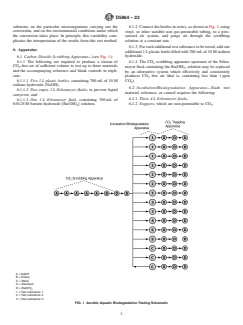
6.1 Carbon Dioxide Scrubbing Apparatus—(see Fig. 1):
6.1.1 The following are required to produce a stream of CO -free air of sufficient volume to test up to three materials and the
accompanying reference and blank controls in triplicate:
6.1.1.1 Five 1 L plastic bottles, containing 700 mL of 10 M sodium hydroxide (NaOH),
6.1.1.2 Two empty 1 L Erlenmeyer flasks, to prevent liquid carryover, and
6.1.1.3 One 1 L Erlenmeyer flask, containing 700 mL of 0.0125 M barium hydroxide [Ba(OH) ] solution.
A = NaOH
B = Empty
C = Blank
S = Standard
D = Ba(OH)
1 = Test substance 1
2 = Test substance 2
3 = Test substance 3
FIG. 1 Aerobic Aquatic Biodegradation Testing Schematic
D5864 − 23
6.1.2 Connect the bottles in series, as shown in Fig. 1, using vinyl, or other suitable non gas-permeable tubing, to a pressurized
air system, and purge air through the scrubbing solution at a constant rate.
6.1.3 For each additional test substance to be tested, add one additional 1 L plastic bottle filled with 700 mL of 10 M sodium
hydroxide.
6.1.4 The CO scrubbing apparatus upstream of the Erlenmeyer flask containing the Ba(OH) solution may be replaced by an
2 2
alternative system which effectively and consistently produces CO free air (that is, containing less than 1 ppm CO ).
2 2
6.2 Incubation/Biodegradation Apparatus—Each test material, reference, or control requires the following:
6.2.1 Three 4 L Erlenmeyer flasks,
6.2.2 Stoppers, which are non-permeable to CO .
6.2.3 Flexible Plastic Tubing, which is non-permeable to CO .
6.2.4 Agitators or Stirrers, for each 4 L Erlenmeyer flask.
6.3 Analytical Balance, to weigh out test material or reference material before or as adding to the test flask,
6.4 Trapping Apparatus for Measuring Production of CO —For each incubation apparatus, the following are required:
6.4.1 Several 200 mL Bottles, fitted with gas bubblers and containing 100 mL 0.0125 M Ba(OH) carbon dioxide scrubbing
solution.
6.5 Titration Apparatus for Measuring Production of CO :
6.5.1 100 mL burette.
6.6 Glass Wool, for filtering the inoculum.
7. Reagents and Materials
7.1 Purity of Reagents—Reagent grade chemicals shall be used in all tests. Unless otherwise indicated, it is intended that all
reagents conform to the specifications of the Committee on Analytical Reagents of the American Chemical Society where such
specifications are available. Other grades may be used, provided it is first ascertained that the reagent is of sufficiently high purity
to permit its use without lessening the accuracy of the determination.
7.2 Purity of Water—Unless otherwise indicated, references to water shall be understood to mean reagent water as defined by Type
II of Specification D1193.
7.3 Prepare the following stock solutions:
7.3.1 Ammonium Sulfate Solution (40 g ⁄L)—Dissolve 40 g of ammonium sulfate ((NH ) SO ) in water and dilute to 1 L.
4 2 4
7.3.2 Calcium Chloride Solution (27.5 g ⁄L)—Dissolve 27.5 g of calcium chloride (CaCl ) in water and dilute to 1 L.
7.3.3 Ferric Chloride Solution (0.25 g ⁄L)—Dissolve 0.25 g of ferric chloride hexahydrate (FeCl 6H O) in water and dilute to 1 L.
3 2
Reagent Chemicals, American Chemical Society Specifications,ACS Reagent Chemicals, Specifications and Procedures for Reagents and Standard-Grade Reference
Materials, American Chemical Society, Washington, DC. For Suggestionssuggestions on the testing of reagents not listed by the American Chemical Society, see
AnnualAnalar Standards for Laboratory Chemicals, BDH Ltd., Poole, Dorset, U.K., and the United States Pharmacopeia and National Formulary, U.S. Pharmacopeial
Convention, Inc. (USPC), Rockville, MD.
D5864 − 23
7.3.4 Magnesium Sulfate Solution (22.5 g ⁄L)—Dissolve 22.5 g of magnesium sulfate heptahydrate (MgSO 7H O) in water and
4 2
dilute to 1 L.
7.3.5 Phosphate Buffer—Dissolve 8.5 g potassium dihydrogen phosphate (KH PO ), 21.7 g potassium monohydrogen phosphate
2 4
(K HPO ), 33.4 g sodium monohydrogen phosphate dihydrate (Na HPO 2H O), and 1.7 g ammonium chloride (NH Cl) in water
2 4 2 4 2 4
and dilute to 1 L.
7.4 The test medium will contain the following reagents diluted to 1 L with water.
7.4.1 Ammonium Sulfate Solution, 1 mL,
7.4.2 Calcium Chloride Solution, 1 mL,
7.4.3 Ferric Chloride Solution, 4 mL,
7.4.4 Magnesium Sulfate Solution, 1 mL, and
7.4.5 Phosphate Buffer Solution, 10 mL.
7.5 Barium Hydroxide Solution, 0.0125 M, is prepared dissolving 4.0 g Ba(OH) 8H O per litre of distilled water. Filter free of
2 2
solid material, confirm molarity by titration with standard acid, and store under nitrogen sealed as a clear solution to prevent
absorption of CO from the air. It is recommended that 5 L be prepared at a time when running a series of tests.
7.6 Difco Vitamin-free Casamino Acids.
7.7 Yeast Extract.
7.8 Phenolphthalein.
7.9 Standardized Hydrochloric Acid (0.0480 M to 0.0520 M).
8. Inoculum Test Organisms
8.1 Sources of the Inoculum—The following provides several options for where and how to obtain an appropriate inoculum:
8.1.1 Inoculum from Activated Sludge—Activated sludge freshly sampled (that is, less than 24 h old) from a well-operated
domestic sewage treatment plant (that is, one with no recent upsets and operating within its design parameters) may be used. This
sewage treatment plant should receive minimal or no effluent from industry.
8.1.1.1 Using CO -free air, aerate sludge in the laboratory for 4 h. Remove and homogenize 500 mL of the mixed liquor for 2 min
at medium speed in a blender or equivalent high speed mixer.
8.1.1.2 If using sludge supernatant as the inoculum, allow the homogenized sludge to settle for 30 min. If the supernatant still
contains high levels of suspended solids at the end of 30 min, allow to settle for a further 30 min to 40 min or adapt laboratory
conditions to obtain better settling. Once sufficient settling is achieved, decant sufficient volume of the supernatant to provide a
1 % (by volume) inoculum. Avoid carry-over of sludge solids which might cause inconsistencies in the measurement of CO
production. The supernatant inoculum is aerated immediately and continuously until use.
8.1.1.3 If using mixed liquor as the inoculum at 30 mg ⁄L solids, determine the dry weight of sludge solids per unit volume in
samples of well-mixed homogenized sludge using APHA Test Method 2540B. Calculate the volume of mixed liquor needed to
achieve a final sludge dry-weight concentration in the test medium of 30 mg ⁄L. Continue to aerate the mixed liquor until use.
NOTE 2—The use of mixed liquor at 30 mg ⁄L solids without pre-adaptation (8.3) may result in exceedance of the CO -production criterion in the blanks
(75
...