

ASTM B522-01(2021)
(Specification)Standard Specification for Gold-Silver-Platinum Electrical Contact Alloy
General Information
- Abstract
ABSTRACT
This specification covers 69% gold, 25% silver, 6% platinum alloy tubing, rod, wire, and sheet material for sliding electrical contacts. The material shall be finished by such operations (cold working, annealing, turning, grinding, pickling) as are required to produce the prescribed properties. The material shall be tested and conform to chemical composition, and mechanical and electrical property requirements. The mechanical requirements of the material are ultimate tensile strength, elongation, microhardness, hardness, or a combination of these mechanical properties as temper criterion. All tests shall be conducted at room temperature.
SCOPE
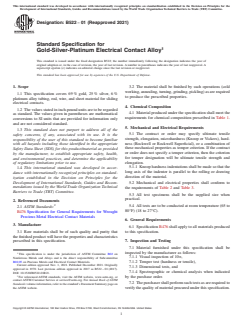
1.1 This specification covers 69 % gold, 25 % silver, 6 % platinum alloy tubing, rod, wire, and sheet material for sliding electrical contacts.
1.2 The values stated in inch-pound units are to be regarded as standard. The values given in parentheses are mathematical conversions to SI units that are provided for information only and are not considered standard.
1.3 This standard does not purport to address all of the safety concerns, if any, associated with its use. It is the responsibility of the user of this standard to become familiar with all hazards including those identified in the appropriate Safety Data Sheet (SDS) for this product/material as provided by the manufacturer, to establish appropriate safety, health, and environmental practices, and determine the applicability of regulatory limitations prior to use.
1.4 This international standard was developed in accordance with internationally recognized principles on standardization established in the Decision on Principles for the Development of International Standards, Guides and Recommendations issued by the World Trade Organization Technical Barriers to Trade (TBT) Committee.
- Status
- Published
- Publication Date
- 31-Oct-2021
- Technical Committee
- B02 - Nonferrous Metals and Alloys


Overview
ASTM B522-01(2021), Standard Specification for Gold-Silver-Platinum Electrical Contact Alloy, establishes the requirements for a specialty alloy containing 69% gold, 25% silver, and 6% platinum. This specification applies to tubing, rod, wire, and sheet materials designed specifically for sliding electrical contacts. ASTM B522 ensures consistent quality and performance in high-reliability electrical applications by specifying the chemical composition, mechanical properties, and required manufacturing processes for this precious metal alloy.
Manufacturers and users must adhere to precise finishing operations such as cold working, annealing, turning, grinding, and pickling to meet the alloy’s prescribed properties. Additionally, materials under this standard must conform to stringent mechanical and electrical property requirements to ensure optimal performance in demanding environments.
Key Topics
- Material Composition: Covers alloy with 68–70% gold, 23.5–26.5% silver, and 5–7% platinum, with tightly controlled impurity limits.
- Product Forms: Applicable to tubing, rod, wire, and sheet materials for electrical contacts.
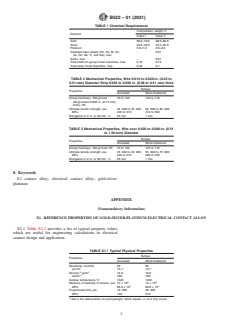
- Mechanical Properties: Includes criteria such as ultimate tensile strength, elongation, microhardness (Knoop or Vickers), and Rockwell hardness as temper conditions.
- Electrical Properties: Specifies typical resistivity and density values, vital for electrical contact functionality.
- Manufacturing Processes: Requires finishing methods (cold working, annealing, etc.) to achieve the prescribed mechanical and electrical properties.
- Testing and Inspection: Encompasses visual, hardness/temper, dimensional, and spectrochemical analysis, with all quality verification performed at room temperature.
- Safety and Compliance: Encourages users to follow proper safety, health, and environmental practices, referencing relevant Safety Data Sheets (SDS).
Applications
ASTM B522 gold-silver-platinum alloys are engineered for use in high-reliability and high-performance sliding electrical contacts, where stable conductivity and mechanical endurance are essential. Typical applications include:
- Electrical Contacts: For relays, switches, and connectors requiring low resistance, excellent wear characteristics, and resistance to corrosion and oxidation.
- Aerospace & Defense: Used in mission-critical systems where electrical reliability under stress and adverse conditions is crucial.
- Medical Devices: Applied in devices where consistent electrical performance is mandatory.
- Instrumentation: Suitable for high-precision measuring instruments and control equipment due to stable physical and electrical properties.
Key value points include high chemical stability, excellent mechanical strength, and resistance to tarnish and corrosion, making this alloy preferable for demanding environments.
Related Standards
For optimal implementation and conformity, ASTM B522 users should familiarize themselves with additional relevant standards, including:
- ASTM B476: General Requirements for Wrought Precious Metal Electrical Contact Materials, which provides overarching requirements for the production of similar alloys.
- ASTM Committee B02: Governs nonferrous metals and alloys, ensuring harmonization with other precious metal standards.
- Safety Data Sheets (SDS): Mandated for review to ensure safe handling and application of gold-silver-platinum alloys in manufacturing and operational environments.
For more comprehensive guidance, users can visit the official ASTM website (www.astm.org) where the standard and referenced documents are available.
Keywords: gold-silver-platinum alloy, ASTM B522, electrical contact material, sliding electrical contacts, precious metal alloys, contact alloy standards, mechanical properties, tensile strength, hardness, high reliability electrical contacts, ASTM International.
Relations
- Effective Date
- 01-May-2012
- Effective Date
- 01-Jun-2006
- Effective Date
- 10-May-2001
Get Certified
Connect with accredited certification bodies for this standard

Element Materials Technology
Materials testing and product certification.

Inštitut za kovinske materiale in tehnologije
Institute of Metals and Technology. Materials testing, metallurgical analysis, NDT.
Sponsored listings
Frequently Asked Questions
ASTM B522-01(2021) is a technical specification published by ASTM International. Its full title is "Standard Specification for Gold-Silver-Platinum Electrical Contact Alloy". This standard covers: ABSTRACT This specification covers 69% gold, 25% silver, 6% platinum alloy tubing, rod, wire, and sheet material for sliding electrical contacts. The material shall be finished by such operations (cold working, annealing, turning, grinding, pickling) as are required to produce the prescribed properties. The material shall be tested and conform to chemical composition, and mechanical and electrical property requirements. The mechanical requirements of the material are ultimate tensile strength, elongation, microhardness, hardness, or a combination of these mechanical properties as temper criterion. All tests shall be conducted at room temperature. SCOPE 1.1 This specification covers 69 % gold, 25 % silver, 6 % platinum alloy tubing, rod, wire, and sheet material for sliding electrical contacts. 1.2 The values stated in inch-pound units are to be regarded as standard. The values given in parentheses are mathematical conversions to SI units that are provided for information only and are not considered standard. 1.3 This standard does not purport to address all of the safety concerns, if any, associated with its use. It is the responsibility of the user of this standard to become familiar with all hazards including those identified in the appropriate Safety Data Sheet (SDS) for this product/material as provided by the manufacturer, to establish appropriate safety, health, and environmental practices, and determine the applicability of regulatory limitations prior to use. 1.4 This international standard was developed in accordance with internationally recognized principles on standardization established in the Decision on Principles for the Development of International Standards, Guides and Recommendations issued by the World Trade Organization Technical Barriers to Trade (TBT) Committee.
ABSTRACT This specification covers 69% gold, 25% silver, 6% platinum alloy tubing, rod, wire, and sheet material for sliding electrical contacts. The material shall be finished by such operations (cold working, annealing, turning, grinding, pickling) as are required to produce the prescribed properties. The material shall be tested and conform to chemical composition, and mechanical and electrical property requirements. The mechanical requirements of the material are ultimate tensile strength, elongation, microhardness, hardness, or a combination of these mechanical properties as temper criterion. All tests shall be conducted at room temperature. SCOPE 1.1 This specification covers 69 % gold, 25 % silver, 6 % platinum alloy tubing, rod, wire, and sheet material for sliding electrical contacts. 1.2 The values stated in inch-pound units are to be regarded as standard. The values given in parentheses are mathematical conversions to SI units that are provided for information only and are not considered standard. 1.3 This standard does not purport to address all of the safety concerns, if any, associated with its use. It is the responsibility of the user of this standard to become familiar with all hazards including those identified in the appropriate Safety Data Sheet (SDS) for this product/material as provided by the manufacturer, to establish appropriate safety, health, and environmental practices, and determine the applicability of regulatory limitations prior to use. 1.4 This international standard was developed in accordance with internationally recognized principles on standardization established in the Decision on Principles for the Development of International Standards, Guides and Recommendations issued by the World Trade Organization Technical Barriers to Trade (TBT) Committee.
ASTM B522-01(2021) is classified under the following ICS (International Classification for Standards) categories: 77.120.99 - Other non-ferrous metals and their alloys. The ICS classification helps identify the subject area and facilitates finding related standards.
ASTM B522-01(2021) has the following relationships with other standards: It is inter standard links to ASTM B476-01(2012), ASTM B476-01(2006), ASTM B476-01. Understanding these relationships helps ensure you are using the most current and applicable version of the standard.
ASTM B522-01(2021) is available in PDF format for immediate download after purchase. The document can be added to your cart and obtained through the secure checkout process. Digital delivery ensures instant access to the complete standard document.
Standards Content (Sample)
This international standard was developed in accordance with internationally recognized principles on standardization established in the Decision on Principles for the
Development of International Standards, Guides and Recommendations issued by the World Trade Organization Technical Barriers to Trade (TBT) Committee.
Designation:B522 −01 (Reapproved 2021)
Standard Specification for
Gold-Silver-Platinum Electrical Contact Alloy
This standard is issued under the fixed designation B522; the number immediately following the designation indicates the year of
original adoption or, in the case of revision, the year of last revision.Anumber in parentheses indicates the year of last reapproval.A
superscript epsilon (´) indicates an editorial change since the last revision or reapproval.
This standard has been approved for use by agencies of the U.S. Department of Defense.
1. Scope 3.2 The material shall be finished by such operations (cold
working,annealing,turning,grinding,pickling)asarerequired
1.1 This specification covers 69% gold, 25% silver, 6%
to produce the prescribed properties.
platinum alloy tubing, rod, wire, and sheet material for sliding
electrical contacts.
4. Chemical Composition
1.2 The values stated in inch-pound units are to be regarded
4.1 Materialproducedunderthespecificationshallmeetthe
as standard. The values given in parentheses are mathematical
requirements for chemical composition prescribed in Table 1.
conversions to SI units that are provided for information only
and are not considered standard.
5. Mechanical and Electrical Requirements
1.3 This standard does not purport to address all of the
5.1 The contract or order may specify ultimate tensile
safety concerns, if any, associated with its use. It is the
strength, elongation, microhardness (Knoop or Vickers), hard-
responsibility of the user of this standard to become familiar
ness (Rockwell or Rockwell Superficial), or a combination of
with all hazards including those identified in the appropriate
these mechanical properties as temper criterion. If the contract
Safety Data Sheet (SDS) for this product/material as provided
or order does not specify a temper criterion, then the criterion
by the manufacturer, to establish appropriate safety, health,
for temper designation will be ultimate tensile strength and
and environmental practices, and determine the applicability
elongation.
of regulatory limitations prior to use.
5.1.1 Knoophardnessindentationsshallbemadesothatthe
1.4 This international standard was developed in accor-
long axis of the indenter is parallel to the rolling or drawing
dance with internationally recognized principles on standard-
direction of the material.
ization established in the Decision on Principles for the
Development of International Standards, Guides and Recom-
5.2 Mechanical and electrical properties shall conform to
mendations issued by the World Trade Organization Technical
the requirements of Table 2 and Table 3.
Barriers to Trade (TBT) Committee.
5.3 All test specimens shall be the supplied size when
practical.
2. Referenced Documents
5.4 All tests are to be conducted at room temperature (65 to
2.1 ASTM Standards:
80°F) (18 to 27°C).
B476Specification for General Requirements for Wrought
Precious Metal Electrical Contact Materials
6. General Requirements
3. Manufacture
6.1 Specification B476 shall apply to all materials produced
3.1 Raw materials shall be of such quality and purity that to this specification.
thefinishedproductwillhavethepropertiesandcharacteristics
prescribed in this specification. 7. Inspection and Testing
7.1 Material furnished under this specification shall be
inspected by the manufacturer as follows:
This specification is under the jurisdiction of ASTM Committee B02 on
7.1.1 Visual inspection of 10×,
Nonferrous Metals and Alloys and is the direct responsibility of Subcommittee
B02.05 on Precious Metals and Electrical Contact Materials.
7.1.2 Temper test (hardness or tensile),
Current edition approved Nov. 1, 2021. Published December 2021. Originally
7.1.3 Dimensional tests, and
approved in 1970. Last previous edition approved in 2017 as B
...