


ASTM F1521-12(2018)
(Test Method)Standard Test Methods for Performance of Range Tops
Standard Test Methods for Performance of Range Tops
SIGNIFICANCE AND USE
5.1 The energy input rate test is used to confirm that the range under test is operating at the manufacturer's rated input. This test would also indicate any problems with the electric power supply or gas service pressure.
5.2 The heat transfer characteristics of a cooking unit can be simulated by measuring the temperature uniformity of a steel plate.
5.3 Idle energy rate and pilot energy consumption can be used by food service operators to estimate energy consumption during non-cooking periods.
5.4 The cooking energy efficiency is a direct measurement of range efficiency at the full-energy input rate. This data can be used by food service operators in the selection of ranges, as well as for the management of a restaurant's energy demands.
Note 1: The PG&E Food Service Technology Center has determined that the cooking energy efficiency does not significantly change for different input rates. If precise efficiency calculations are desired at lower input rates, the full-input rate test procedure is valid for all input rates (that is, less than full-input).
5.5 Production rate and production capacity can be used to estimate the amount of time required for food preparation and as a measure of range capacity. This helps the food service operator match a range to particular food output requirements.
SCOPE
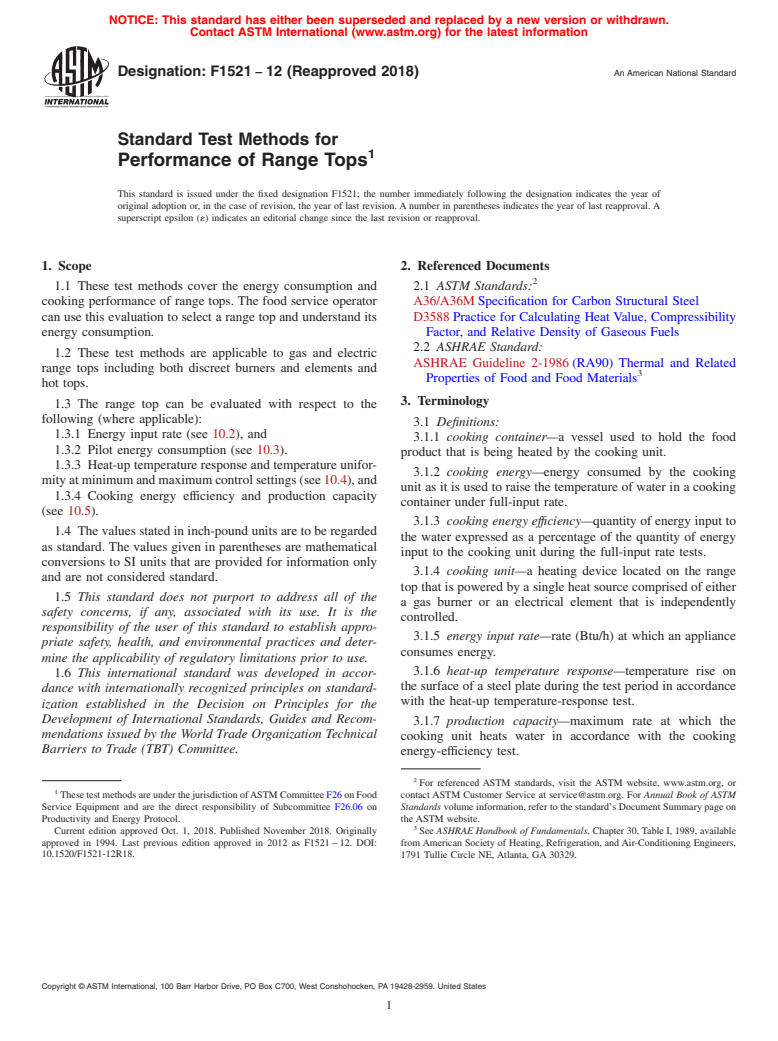
1.1 These test methods cover the energy consumption and cooking performance of range tops. The food service operator can use this evaluation to select a range top and understand its energy consumption.
1.2 These test methods are applicable to gas and electric range tops including both discreet burners and elements and hot tops.
1.3 The range top can be evaluated with respect to the following (where applicable):
1.3.1 Energy input rate (see 10.2), and
1.3.2 Pilot energy consumption (see 10.3).
1.3.3 Heat-up temperature response and temperature uniformity at minimum and maximum control settings (see 10.4), and
1.3.4 Cooking energy efficiency and production capacity (see 10.5).
1.4 The values stated in inch-pound units are to be regarded as standard. The values given in parentheses are mathematical conversions to SI units that are provided for information only and are not considered standard.
1.5 This standard does not purport to address all of the safety concerns, if any, associated with its use. It is the responsibility of the user of this standard to establish appropriate safety, health, and environmental practices and determine the applicability of regulatory limitations prior to use.
1.6 This international standard was developed in accordance with internationally recognized principles on standardization established in the Decision on Principles for the Development of International Standards, Guides and Recommendations issued by the World Trade Organization Technical Barriers to Trade (TBT) Committee.
General Information
Buy Standard
Standards Content (Sample)
NOTICE: This standard has either been superseded and replaced by a new version or withdrawn.
Contact ASTM International (www.astm.org) for the latest information
Designation: F1521 − 12 (Reapproved 2018) An American National Standard
Standard Test Methods for
Performance of Range Tops
This standard is issued under the fixed designation F1521; the number immediately following the designation indicates the year of
original adoption or, in the case of revision, the year of last revision.Anumber in parentheses indicates the year of last reapproval.A
superscript epsilon (´) indicates an editorial change since the last revision or reapproval.
1. Scope 2. Referenced Documents
1.1 These test methods cover the energy consumption and 2.1 ASTM Standards:
cooking performance of range tops. The food service operator A36/A36MSpecification for Carbon Structural Steel
can use this evaluation to select a range top and understand its D3588Practice for Calculating Heat Value, Compressibility
energy consumption. Factor, and Relative Density of Gaseous Fuels
2.2 ASHRAE Standard:
1.2 These test methods are applicable to gas and electric
ASHRAE Guideline 2-1986(RA90) Thermal and Related
range tops including both discreet burners and elements and
Properties of Food and Food Materials
hot tops.
3. Terminology
1.3 The range top can be evaluated with respect to the
following (where applicable):
3.1 Definitions:
1.3.1 Energy input rate (see 10.2), and
3.1.1 cooking container—a vessel used to hold the food
1.3.2 Pilot energy consumption (see 10.3).
product that is being heated by the cooking unit.
1.3.3 Heat-uptemperatureresponseandtemperatureunifor-
3.1.2 cooking energy—energy consumed by the cooking
mityatminimumandmaximumcontrolsettings(see10.4),and
unit as it is used to raise the temperature of water in a cooking
1.3.4 Cooking energy efficiency and production capacity
container under full-input rate.
(see 10.5).
3.1.3 cooking energy effıciency—quantity of energy input to
1.4 The values stated in inch-pound units are to be regarded
the water expressed as a percentage of the quantity of energy
as standard. The values given in parentheses are mathematical
input to the cooking unit during the full-input rate tests.
conversions to SI units that are provided for information only
3.1.4 cooking unit—a heating device located on the range
and are not considered standard.
top that is powered by a single heat source comprised of either
1.5 This standard does not purport to address all of the
a gas burner or an electrical element that is independently
safety concerns, if any, associated with its use. It is the
controlled.
responsibility of the user of this standard to establish appro-
3.1.5 energy input rate—rate (Btu/h) at which an appliance
priate safety, health, and environmental practices and deter-
consumes energy.
mine the applicability of regulatory limitations prior to use.
3.1.6 heat-up temperature response—temperature rise on
1.6 This international standard was developed in accor-
the surface of a steel plate during the test period in accordance
dance with internationally recognized principles on standard-
with the heat-up temperature-response test.
ization established in the Decision on Principles for the
Development of International Standards, Guides and Recom-
3.1.7 production capacity—maximum rate at which the
mendations issued by the World Trade Organization Technical
cooking unit heats water in accordance with the cooking
Barriers to Trade (TBT) Committee.
energy-efficiency test.
For referenced ASTM standards, visit the ASTM website, www.astm.org, or
ThesetestmethodsareunderthejurisdictionofASTMCommitteeF26onFood contact ASTM Customer Service at service@astm.org. For Annual Book of ASTM
Service Equipment and are the direct responsibility of Subcommittee F26.06 on Standards volume information, refer to the standard’s Document Summary page on
Productivity and Energy Protocol. the ASTM website.
Current edition approved Oct. 1, 2018. Published November 2018. Originally See ASHRAE Handbook of Fundamentals, Chapter 30,Table I, 1989, available
approved in 1994. Last previous edition approved in 2012 as F1521–12. DOI: fromAmerican Society of Heating, Refrigeration, andAir-Conditioning Engineers,
10.1520/F1521-12R18. 1791 Tullie Circle NE, Atlanta, GA 30329.
Copyright © ASTM International, 100 Barr Harbor Drive, PO Box C700, West Conshohocken, PA 19428-2959. United States
F1521 − 12 (2018)
3.1.8 production rate—rate at which the cooking unit heats as a measure of range capacity. This helps the food service
water in accordance with the cooking energy-efficiency test. operator match a range to particular food output requirements.
3.1.9 range—a device for cooking food by direct or indirect
6. Apparatus
heat transfer from one or more cooking units to one or more
cooking containers.
6.1 Analytical Balance Scale,forthedeterminationofwater
and cooking container weight, with a resolution of 0.01 lb (5
3.1.10 temperature uniformity—the comparison of indi-
g).
vidual temperatures measured on the surface of a steel plate at
the end of the test period in accordance with the heat-up
6.2 Barometer, for measuring absolute atmospheric
temperature-response test.
pressure, to be used for adjustment of measured natural gas
3.1.11 uncertainty—measure of systematic and precision
volume to standard conditions. The barometer shall have a
errors in specified instrumentation or measure of repeatability
resolution of 0.2 in. Hg (670 Pa).
of a reported test result.
6.3 Cooking Container, 13-in. (330-mm) diameter, 20-qt
(19-L),saucepotwithmatchinglid.Thebottomofthepotshall
4. Summary of Test Methods
be flat to within 0.0625 in. (1.6 mm) over the diameter.
4.1 The range to be tested is connected to the appropriate
6.3.1 The recommended cooking container for all testing
meteredenergysource.Theenergyinputrateisdeterminedfor 4
shallbeaprofessionalstandardweightWearEverModel4333
each type of cooking unit on the range top and for the entire 4
sauce pot with a Wear Ever Model 4193 lid. If it is not
range top (all cooking units operating at the same time) to
possibletousetherecommendedcookingcontainerfortesting,
confirm that the range top is operating within 5.0% of the
then a cooking container with a similar capacity may be
nameplate energy input rate. The pilot energy consumption is
substituted. The cooking container capacity should be no less
also determined when applicable to the range being tested.
than12-qtandnomorethan24-qt.Thecookingcontainermay
4.2 Thermocouples are attached to a circular steel plate be aluminum or steel. The weight of the substituted cooking
container and lid must be noted and included in 11.7.1.
which is then placed on the cooking unit to be tested. The
heat-up temperature response of the cooking unit at the
NOTE 2—The recommended aluminum sauce pot may not always be a
minimumcontrolsettingandatthemaximumcontrolsettingis
suitable cooking container. For example, an electric induction range top
determined as well as the temperature uniformity at each
requiresthatthecookingcontainerbemagnetic,typicallysteelorstainless
control setting. steel plated nickel. For this reason 6.3.1 is included for flexibility.
4.3 Energy consumption and time are monitored as each 6.4 Canopy Exhaust Hood, 4 ft (1.2 m) in depth, wall-
differenttypeofcookingunitontherangeisusedtoheatwater mounted with the lower edge of the hood 6 ⁄2 ft (2.0 m) from
from 70 to 200°F (21 to 93°C) at the full-energy input rate. the floor and with the capacity to operate at a nominal exhaust
Cooking energy efficiency and production capacity are calcu- ventilationrateof300ft /min/linearfoot(230L/s/linearmetre)
lated from this data.
of active hood length. This hood shall extend a minimum of 6
in.(150mm)pastbothsidesofthecookingapplianceandshall
5. Significance and Use not incorporate side curtains or partitions.
5.1 The energy input rate test is used to confirm that the
6.5 Gas Meter, for measuring the gas consumption of a
range under test is operating at the manufacturer’s rated input.
range,shallbeapositivedisplacementtypewitharesolutionof
3 3
This test would also indicate any problems with the electric
at least 0.01 ft (0.0003 m ) and a maximum error no greater
power supply or gas service pressure.
than 1% of the measured value for any demand greater than
3 3
2.2ft /h(0.06m /h).Ifthemeterisusedformeasuringthegas
5.2 Theheattransfercharacteristicsofacookingunitcanbe
consumed by the pilot lights, it shall have a resolution of at
simulated by measuring the temperature uniformity of a steel
3 3
least0.01ft (0.0003m )andhaveamaximumerrornogreater
plate.
than 2% of the measured value.
5.3 Idle energy rate and pilot energy consumption can be
6.6 Pressure Gage, for monitoring natural gas pressure,
usedbyfoodserviceoperatorstoestimateenergyconsumption
with a range from 0 to 10 in. H O (0 to 2.5 kPa), a resolution
during non-cooking periods. 2
of 0.5 in. H O (125 Pa), and a maximum uncertainty of 1% of
5.4 The cooking energy efficiency is a direct measurement
the measured value.
of range efficiency at the full-energy input rate. This data can
6.7 Steel Plate,composedofstructural-gradecarbonsteelin
be used by food service operators in the selection of ranges, as
accordance with Specification A36/A36M, free of rust or
well as for the management of a restaurant’s energy demands.
corrosion,12-in.(300-mm)diameter,and ⁄4in.(6.4mm)thick.
NOTE 1—The PG&E Food Service Technology Center has determined
The plate shall be flat to within 0.010 in. (3 mm) over the
that the cooking energy efficiency does not significantly change for
diameter.
different input rates. If precise efficiency calculations are desired at lower
inputrates,thefull-inputratetestprocedureisvalidforallinputrates(that
is, less than full-input).
5.5 Production rate and production capacity can be used to
AvailablefromLincolnFoodserviceProducts,Inc.,P.O.Box1229,FortWayne,
estimate the amount of time required for food preparation and IN 46801.
F1521 − 12 (2018)
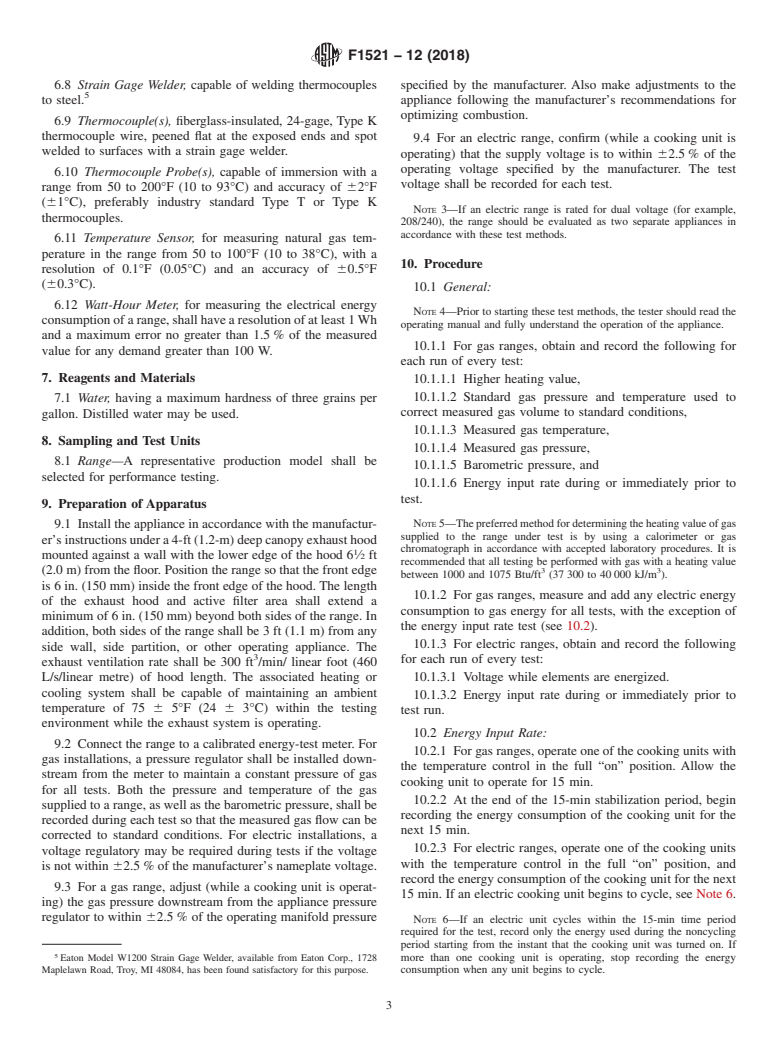
6.8 Strain Gage Welder, capable of welding thermocouples specified by the manufacturer. Also make adjustments to the
to steel. appliance following the manufacturer’s recommendations for
optimizing combustion.
6.9 Thermocouple(s), fiberglass-insulated, 24-gage, Type K
thermocouple wire, peened flat at the exposed ends and spot
9.4 For an electric range, confirm (while a cooking unit is
welded to surfaces with a strain gage welder.
operating) that the supply voltage is to within 62.5% of the
operating voltage specified by the manufacturer. The test
6.10 Thermocouple Probe(s), capable of immersion with a
voltage shall be recorded for each test.
range from 50 to 200°F (10 to 93°C) and accuracy of 62°F
(61°C), preferably industry standard Type T or Type K
NOTE 3—If an electric range is rated for dual voltage (for example,
thermocouples.
208/240), the range should be evaluated as two separate appliances in
accordance with these test methods.
6.11 Temperature Sensor, for measuring natural gas tem-
perature in the range from 50 to 100°F (10 to 38°C), with a
10. Procedure
resolution of 0.1°F (0.05°C) and an accuracy of 60.5°F
(60.3°C).
10.1 General:
6.12 Watt-Hour Meter, for measuring the electrical energy
NOTE 4—Prior to starting these test methods, the tester should read the
consumptionofarange,shallhavearesolutionofatleast1Wh
operating manual and fully understand the operation of the appliance.
and a maximum error no greater than 1.5% of the measured
10.1.1 For gas ranges, obtain and record the following for
value for any demand greater than 100 W.
each run of every test:
7. Reagents and Materials
10.1.1.1 Higher heating value,
10.1.1.2 Standard gas pressure and temperature used to
7.1 Water, having a maximum hardness of three grains per
correct measured gas volume to standard conditions,
gallon. Distilled water may be used.
10.1.1.3 Measured gas temperature,
8. Sampling and Test Units
10.1.1.4 Measured gas pressure,
8.1 Range—A representative production model shall be
10.1.1.5 Barometric pressure, and
selected for performance testing.
10.1.1.6 Energy input rate during or immediately prior to
test.
9. Preparation of Apparatus
NOTE5—Thepreferredmethodfordeterminingtheheatingvalueofgas
9.1 Installtheapplianceinaccordancewiththemanufactur-
supplied to the range under test is by using a calorimeter or gas
er’sinstructionsundera4-ft(1.2-m)deepcanopyexhausthood
chromatograph in accordance with accepted laboratory procedures. It is
mounted against a wall with the lower edge of the hood 6 ⁄2 ft
recommended that all testing be performed with gas with a heating value
3 3
(2.0m)fromthefloor.Positiontherangesothatthefrontedge
between 1000 and 1075 Btu/ft (37300 to 40000 kJ/m ).
is 6 in. (150 mm) inside the front edge of the hood.The length
10.1.2 For gas ranges, measure and add any electric energy
of the exhaust hood and active filter area shall extend a
consumption to gas energy for all tests, with the exception of
minimum of 6 in. (150 mm) beyond both sides of the range. In
the energy input rate test (see 10.2).
addition, both sides of the range shall be 3 ft (1.1 m) from any
10.1.3 For electric ranges, obtain and record the following
side wall, side partition, or other operating appliance. The
for each run of every test:
exhaust ventilation rate shall be 300 ft /min/ linear foot (460
L/s/linear metre) of hood length. The associated heating or 10.1.3.1 Voltage while elements are energized.
cooling system shall be capable of maintaining an ambient
10.1.3.2 Energy input rate during or immediately prior to
temperature of 75 6 5°F (24 6 3°C) within the testing
test run.
environment while the exhaust system is operating.
10.2 Energy Input Rate:
9.2 Connect the range to a calibrated energy-test meter. For
10.2.1 Forgasranges,operateoneofthecookingunitswith
gas installations, a pressure regulator shall be installed down-
the temperature control in the full “on” position. Allow the
stream from the meter to maintain a constant pressure of gas
cooking unit to operate for 15 min.
for all tests. Both the pressure and temperature of the gas
10.2.2 At the end of the 15-min stabilization period, begin
suppliedtoarange,aswellasthebarometricpressure,shallbe
recording the energy consumption of the cooking unit for the
recorded during each test so that the measured gas flow can be
next 15 min.
corrected to standard conditions. For electric installations, a
10.2.3 For electric ranges, operate one of the cooking units
voltage regulatory may be required during tests if the voltage
with the temperature control in the full “on” position, and
is not within 62.5% of the manufacturer’s nameplate voltage.
record the energy consumption of the cooking unit for the next
9.3 For a gas range, adjust (while a cooking unit is operat-
15 min. If an electric cooking unit begins to cycle, see Note 6.
ing) the gas pressure do
...
This document is not an ASTM standard and is intended only to provide the user of an ASTM standard an indication of what changes have been made to the previous version. Because
it may not be technically possible to adequately depict all changes accurately, ASTM recommends that users consult prior editions as appropriate. In all cases only the current version
of the standard as published by ASTM is to be considered the official document.
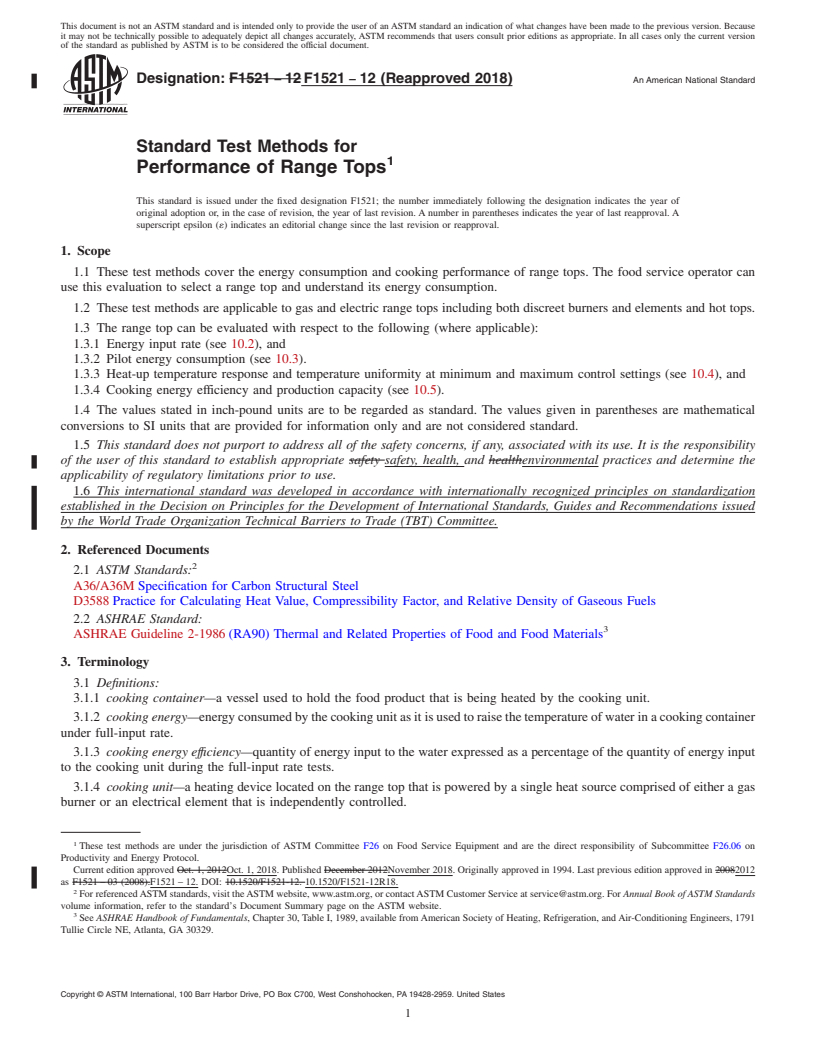
Designation: F1521 − 12 F1521 − 12 (Reapproved 2018) An American National Standard
Standard Test Methods for
Performance of Range Tops
This standard is issued under the fixed designation F1521; the number immediately following the designation indicates the year of
original adoption or, in the case of revision, the year of last revision. A number in parentheses indicates the year of last reapproval. A
superscript epsilon (´) indicates an editorial change since the last revision or reapproval.
1. Scope
1.1 These test methods cover the energy consumption and cooking performance of range tops. The food service operator can
use this evaluation to select a range top and understand its energy consumption.
1.2 These test methods are applicable to gas and electric range tops including both discreet burners and elements and hot tops.
1.3 The range top can be evaluated with respect to the following (where applicable):
1.3.1 Energy input rate (see 10.2), and
1.3.2 Pilot energy consumption (see 10.3).
1.3.3 Heat-up temperature response and temperature uniformity at minimum and maximum control settings (see 10.4), and
1.3.4 Cooking energy efficiency and production capacity (see 10.5).
1.4 The values stated in inch-pound units are to be regarded as standard. The values given in parentheses are mathematical
conversions to SI units that are provided for information only and are not considered standard.
1.5 This standard does not purport to address all of the safety concerns, if any, associated with its use. It is the responsibility
of the user of this standard to establish appropriate safety safety, health, and healthenvironmental practices and determine the
applicability of regulatory limitations prior to use.
1.6 This international standard was developed in accordance with internationally recognized principles on standardization
established in the Decision on Principles for the Development of International Standards, Guides and Recommendations issued
by the World Trade Organization Technical Barriers to Trade (TBT) Committee.
2. Referenced Documents
2.1 ASTM Standards:
A36/A36M Specification for Carbon Structural Steel
D3588 Practice for Calculating Heat Value, Compressibility Factor, and Relative Density of Gaseous Fuels
2.2 ASHRAE Standard:
ASHRAE Guideline 2-1986 (RA90) Thermal and Related Properties of Food and Food Materials
3. Terminology
3.1 Definitions:
3.1.1 cooking container—a vessel used to hold the food product that is being heated by the cooking unit.
3.1.2 cooking energy—energy consumed by the cooking unit as it is used to raise the temperature of water in a cooking container
under full-input rate.
3.1.3 cooking energy effıciency—quantity of energy input to the water expressed as a percentage of the quantity of energy input
to the cooking unit during the full-input rate tests.
3.1.4 cooking unit—a heating device located on the range top that is powered by a single heat source comprised of either a gas
burner or an electrical element that is independently controlled.
These test methods are under the jurisdiction of ASTM Committee F26 on Food Service Equipment and are the direct responsibility of Subcommittee F26.06 on
Productivity and Energy Protocol.
Current edition approved Oct. 1, 2012Oct. 1, 2018. Published December 2012November 2018. Originally approved in 1994. Last previous edition approved in 20082012
as F1521 – 03 (2008).F1521 – 12. DOI: 10.1520/F1521-12. 10.1520/F1521-12R18.
For referenced ASTM standards, visit the ASTM website, www.astm.org, or contact ASTM Customer Service at service@astm.org. For Annual Book of ASTM Standards
volume information, refer to the standard’s Document Summary page on the ASTM website.
See ASHRAE Handbook of Fundamentals, Chapter 30, Table I, 1989, available from American Society of Heating, Refrigeration, and Air-Conditioning Engineers, 1791
Tullie Circle NE, Atlanta, GA 30329.
Copyright © ASTM International, 100 Barr Harbor Drive, PO Box C700, West Conshohocken, PA 19428-2959. United States
F1521 − 12 (2018)
3.1.5 energy input rate—rate (Btu/h) at which an appliance consumes energy.
3.1.6 heat-up temperature response—temperature rise on the surface of a steel plate during the test period in accordance with
the heat-up temperature-response test.
3.1.7 production capacity—maximum rate at which the cooking unit heats water in accordance with the cooking energy-
efficiency test.
3.1.8 production rate—rate at which the cooking unit heats water in accordance with the cooking energy-efficiency test.
3.1.9 range—a device for cooking food by direct or indirect heat transfer from one or more cooking units to one or more
cooking containers.
3.1.10 temperature uniformity—the comparison of individual temperatures measured on the surface of a steel plate at the end
of the test period in accordance with the heat-up temperature-response test.
3.1.11 uncertainty—measure of systematic and precision errors in specified instrumentation or measure of repeatability of a
reported test result.
4. Summary of Test Methods
4.1 The range to be tested is connected to the appropriate metered energy source. The energy input rate is determined for each
type of cooking unit on the range top and for the entire range top (all cooking units operating at the same time) to confirm that
the range top is operating within 5.0 % of the nameplate energy input rate. The pilot energy consumption is also determined when
applicable to the range being tested.
4.2 Thermocouples are attached to a circular steel plate which is then placed on the cooking unit to be tested. The heat-up
temperature response of the cooking unit at the minimum control setting and at the maximum control setting is determined as well
as the temperature uniformity at each control setting.
4.3 Energy consumption and time are monitored as each different type of cooking unit on the range is used to heat water from
70 to 200°F (21 to 93°C) at the full-energy input rate. Cooking energy efficiency and production capacity are calculated from this
data.
5. Significance and Use
5.1 The energy input rate test is used to confirm that the range under test is operating at the manufacturer’s rated input. This
test would also indicate any problems with the electric power supply or gas service pressure.
5.2 The heat transfer characteristics of a cooking unit can be simulated by measuring the temperature uniformity of a steel plate.
5.3 Idle energy rate and pilot energy consumption can be used by food service operators to estimate energy consumption during
non-cooking periods.
5.4 The cooking energy efficiency is a direct measurement of range efficiency at the full-energy input rate. This data can be used
by food service operators in the selection of ranges, as well as for the management of a restaurant’s energy demands.
NOTE 1—The PG&E Food Service Technology Center has determined that the cooking energy efficiency does not significantly change for different
input rates. If precise efficiency calculations are desired at lower input rates, the full-input rate test procedure is valid for all input rates (that is, less than
full-input).
5.5 Production rate and production capacity can be used to estimate the amount of time required for food preparation and as
a measure of range capacity. This helps the food service operator match a range to particular food output requirements.
6. Apparatus
6.1 Analytical Balance Scale, for the determination of water and cooking container weight, with a resolution of 0.01 lb (5 g).
6.2 Barometer, for measuring absolute atmospheric pressure, to be used for adjustment of measured natural gas volume to
standard conditions. The barometer shall have a resolution of 0.2 in. Hg (670 Pa).
6.3 Cooking Container, 13-in. (330-mm) diameter, 20-qt (19-L), sauce pot with matching lid. The bottom of the pot shall be
flat to within 0.0625 in. (1.6 mm) over the diameter.
6.3.1 The recommended cooking container for all testing shall be a professional standard weight Wear Ever Model 4333 sauce
pot with a Wear Ever Model 4193 lid. If it is not possible to use the recommended cooking container for testing, then a cooking
container with a similar capacity may be substituted. The cooking container capacity should be no less than 12-qt and no more
than 24-qt. The cooking container may be aluminum or steel. The weight of the substituted cooking container and lid must be noted
and included in 11.7.1.
NOTE 2—The recommended aluminum sauce pot may not always be a suitable cooking container. For example, an electric induction range top requires
Available from Lincoln Foodservice Products, Inc., P.O. Box 1229, Fort Wayne, IN 46801.
F1521 − 12 (2018)
that the cooking container be magnetic, typically steel or stainless steel plated nickel. For this reason 6.3.1 is included for flexibility.
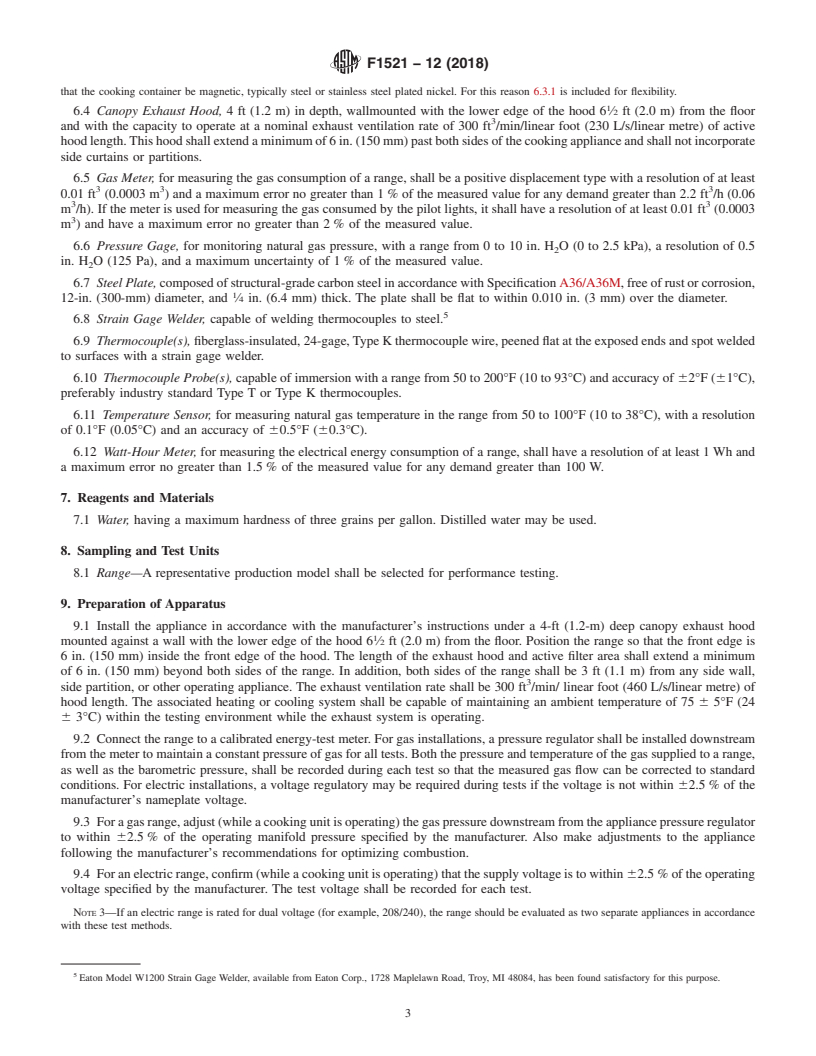
6.4 Canopy Exhaust Hood, 4 ft (1.2 m) in depth, wallmounted with the lower edge of the hood 6 ⁄2 ft (2.0 m) from the floor
and with the capacity to operate at a nominal exhaust ventilation rate of 300 ft /min/linear foot (230 L/s/linear metre) of active
hood length. This hood shall extend a minimum of 6 in. (150 mm) past both sides of the cooking appliance and shall not incorporate
side curtains or partitions.
6.5 Gas Meter, for measuring the gas consumption of a range, shall be a positive displacement type with a resolution of at least
3 3 3
0.01 ft (0.0003 m ) and a maximum error no greater than 1 % of the measured value for any demand greater than 2.2 ft /h (0.06
3 3
m /h). If the meter is used for measuring the gas consumed by the pilot lights, it shall have a resolution of at least 0.01 ft (0.0003
m ) and have a maximum error no greater than 2 % of the measured value.
6.6 Pressure Gage, for monitoring natural gas pressure, with a range from 0 to 10 in. H O (0 to 2.5 kPa), a resolution of 0.5
in. H O (125 Pa), and a maximum uncertainty of 1 % of the measured value.
6.7 Steel Plate, composed of structural-grade carbon steel in accordance with Specification A36/A36M, free of rust or corrosion,
12-in. (300-mm) diameter, and ⁄4 in. (6.4 mm) thick. The plate shall be flat to within 0.010 in. (3 mm) over the diameter.
6.8 Strain Gage Welder, capable of welding thermocouples to steel.
6.9 Thermocouple(s), fiberglass-insulated, 24-gage, Type K thermocouple wire, peened flat at the exposed ends and spot welded
to surfaces with a strain gage welder.
6.10 Thermocouple Probe(s), capable of immersion with a range from 50 to 200°F (10 to 93°C) and accuracy of 62°F (61°C),
preferably industry standard Type T or Type K thermocouples.
6.11 Temperature Sensor, for measuring natural gas temperature in the range from 50 to 100°F (10 to 38°C), with a resolution
of 0.1°F (0.05°C) and an accuracy of 60.5°F (60.3°C).
6.12 Watt-Hour Meter, for measuring the electrical energy consumption of a range, shall have a resolution of at least 1 Wh and
a maximum error no greater than 1.5 % of the measured value for any demand greater than 100 W.
7. Reagents and Materials
7.1 Water, having a maximum hardness of three grains per gallon. Distilled water may be used.
8. Sampling and Test Units
8.1 Range—A representative production model shall be selected for performance testing.
9. Preparation of Apparatus
9.1 Install the appliance in accordance with the manufacturer’s instructions under a 4-ft (1.2-m) deep canopy exhaust hood
mounted against a wall with the lower edge of the hood 6 ⁄2 ft (2.0 m) from the floor. Position the range so that the front edge is
6 in. (150 mm) inside the front edge of the hood. The length of the exhaust hood and active filter area shall extend a minimum
of 6 in. (150 mm) beyond both sides of the range. In addition, both sides of the range shall be 3 ft (1.1 m) from any side wall,
side partition, or other operating appliance. The exhaust ventilation rate shall be 300 ft /min/ linear foot (460 L/s/linear metre) of
hood length. The associated heating or cooling system shall be capable of maintaining an ambient temperature of 75 6 5°F (24
6 3°C) within the testing environment while the exhaust system is operating.
9.2 Connect the range to a calibrated energy-test meter. For gas installations, a pressure regulator shall be installed downstream
from the meter to maintain a constant pressure of gas for all tests. Both the pressure and temperature of the gas supplied to a range,
as well as the barometric pressure, shall be recorded during each test so that the measured gas flow can be corrected to standard
conditions. For electric installations, a voltage regulatory may be required during tests if the voltage is not within 62.5 % of the
manufacturer’s nameplate voltage.
9.3 For a gas range, adjust (while a cooking unit is operating) the gas pressure downstream from the appliance pressure regulator
to within 62.5 % of the operating manifold pressure specified by the manufacturer. Also make adjustments to the appliance
following the manufacturer’s recommendations for optimizing combustion.
9.4 For an electric range, confirm (while a cooking unit is operating) that the supply voltage is to within 62.5 % of the operating
voltage specified by the manufacturer. The test voltage shall be recorded for each test.
NOTE 3—If an electric range is rated for dual voltage (for example, 208/240), the range should be evaluated as two separate appliances in accordance
with these test methods.
Eaton Model W1200 Strain Gage Welder, available from Eaton Corp., 1728 Maplelawn Road, Troy, MI 48084, has been found satisfactory for this purpose.
F1521 − 12 (2018)
10. Procedure
10.1 General:
NOTE 4—Prior to starting these test methods, the tester should read the operating manual and fully understand the operation of the appliance.
10.1.1 For gas ranges, obtain and record the following for each run of every test:
10.1.1.1 Higher heating value,
10.1.1.2 Standard gas pressure and temperature used to correct measured gas volume to standard conditions,
10.1.1.3 Measured gas temperature,
10.1.1.4 Measured gas pressure,
10.1.1.5 Barometric pressure, and
10.1.1.6 Energy input rate during or immediately prior to test.
NOTE 5—The preferred method for determining the heating value of gas supplied to the range under test is by using a calorimeter or gas chromatograph
in accordance with accepted laboratory procedures. It is recommended that all testing be performed with gas with a heating value between 1000
...
Questions, Comments and Discussion
Ask us and Technical Secretary will try to provide an answer. You can facilitate discussion about the standard in here.