

ASTM D5575-18(2023)
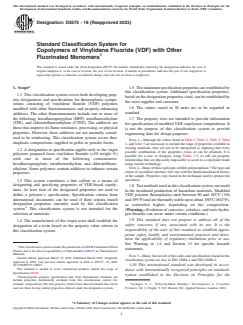
(Classification)Standard Classification System for Copolymers of Vinylidene Fluoride (VDF) with Other Fluorinated Monomers
General Information
- Abstract
ABSTRACT
This classification system covers both developing property designations and specifications for thermoplastic compositions consisting of vinylidene fluoride (VDF) polymers modified with other fluoromonomers and property-enhancing additives. Four property codes are presented: code 1 - melt temperature, code 2 - melt-flow rate or melt viscosity, or both, code 3 - tensile strength and modulus, and code 5 - density. The melt temperatures, melt-flow rate, melt viscosity, tensile properties, specific gravity, volume resistivity, dielectric constant, dissipation factor, and limiting oxygen index shall be tested to meet the requirements prescribed.
SCOPE
1.1 This classification system covers both developing property designations and specifications for thermoplastic compositions consisting of vinylidene fluoride (VDF) polymers modified with other fluoromonomers and property-enhancing additives. The other fluoromonomers include one or more of the following: hexafluoropropylene (HFP), tetrafluoroethylene (TFE), and chlorotrifluoroethylene (CTFE). The additives are those that improve its flame resistance, processing, or physical properties. However, these additives are not normally considered to be reinforcing. This classification system covers thermoplastic compositions supplied in pellet or powder forms.
1.2 A designation or specification applies only to the virgin polymers prepared from vinylidene fluoride (>50 weight %) with one or more of the following comonomers: hexafluoropropylene, tetrafluoroethylene, and chlorotrifluoroethylene. Some polymers contain additives to enhance certain properties.
1.3 This system constitutes a line callout as a means of designating and specifying properties of VDF-based copolymers. At least four of the designated properties are used to define a polymer's specification. Specification criteria from international documents can be used if their criteria match designation properties currently used by this classification system.2 This classification system is not intended for the selection of materials.
1.4 The manufacturer of the virgin resin shall establish the designation of a resin based on the property value criteria in this classification system.
1.5 The minimum specification properties are established by this classification system. Additional specification properties, based on the designation properties cited, can be established by the resin supplier and customer.
1.6 The values stated in SI units are to be regarded as standard.
1.7 The property tests are intended to provide information for specifications of modified VDF-copolymer compositions. It is not the purpose of this classification system to provide engineering data for design purposes.
Note 1: Although the values listed in Table 1, Table 2, Table 3, Table 4, and Table 5 are necessary to include the range of properties available in existing materials, they are not to be interpreted as implying that every possible combination of the properties exists or can be obtained. It is possible for a user or designer, using Tables 1-5, to call out property relationships that are physically impossible to occur in a copolymer made using current technology.
Position 5
Position 6
Position 7
Position 8
Code
Specific Gravity,
g/cm3
Code
Electrical a-c
Dielectric Constant
Loss
d-c Electric Volume
Code
Limiting Oxygen
Index
Code
Specimen Type
a
a
>10E3
a
a
D638 Type I
b
1.6 to
b
10E3 to 10E12
b
40 to
b
D638 Type II
c
1.7 to
c
>10E12
c
50 to
c
D638 Type III
d
1.8 to
d
d
60 to
d
D638 Type IV
e
1.9 to
e
e
70 to
e
ISO 527 Type 1A
f
2.0 to
f
f
80 to
f
ISO 527 Type 1B
g
2.1 to
g
g
>90
g
ISO 527 Typ...
- Status
- Published
- Publication Date
- 14-Mar-2023
- Technical Committee
- D20 - Plastics
- Drafting Committee
- D20.15 - Thermoplastic Materials
Overview
ASTM D5575-18(2023) is a standard classification system developed by ASTM International for the designation and specification of copolymers of vinylidene fluoride (VDF) with other fluorinated monomers. This standard applies to thermoplastic compositions consisting of VDF polymers modified with additional fluoromonomers, such as hexafluoropropylene (HFP), tetrafluoroethylene (TFE), and chlorotrifluoroethylene (CTFE), as well as property-enhancing additives. The classification covers materials supplied in pellet or powder form and provides a systematic approach to codifying key properties, facilitating precise material selection and communication within industries utilizing fluoropolymer materials.
Key Topics
- Copolymers of VDF: The standard focuses on thermoplastic copolymers where VDF is the primary component (over 50% by weight), combined with comonomers like HFP, TFE, and CTFE.
- Property Designations: Material specifications rely on a set of four mandated property codes:
- Melt temperature
- Melt-flow rate or melt viscosity
- Tensile strength and modulus
- Density (specific gravity)
- Additives: The use of additives to enhance flame resistance, processing, or physical properties is recognized, although such additives are not typically reinforcing.
- Test Methods: The standard references established ASTM and ISO test methods, including:
- Melt temperature (DSC testing)
- Melt-flow rate and viscosity (capillary rheometry and extrusion plastometry)
- Tensile properties (tensile strength, modulus, elongation)
- Electrical properties (volume resistivity, dielectric constant, dissipation factor)
- Flammability (limiting oxygen index)
- Classification System: The system provides detailed codes for each property, ensuring uniformity and international compatibility. It aligns with ISO 12086 for designation and testing where applicable.
- Specimen Preparation: Preference is given to compression-molded test specimens to ensure consistency in property evaluation.
Applications
Copolymers classified under ASTM D5575-18 are commonly used in demanding environments requiring chemical resistance, thermal stability, and electrical insulation. Key application areas include:
- Chemical processing equipment: Pipes, tanks, and linings benefit from the corrosion resistance and mechanical strength of VDF copolymers.
- Wire and cable insulation: The electrical properties and flame resistance of these materials make them ideal for use in electrical and electronic industries.
- Automotive and aerospace: Components exposed to harsh chemicals or requiring stable dielectric performance utilize VDF-based copolymers for safety and longevity.
- General industrial use: Seals, gaskets, membranes, and various molded or extruded industrial parts take advantage of the physical and chemical durability offered by these fluoropolymers.
The classification system allows manufacturers, suppliers, and end users to effectively communicate product requirements and performance characteristics, ensuring suitable material selection for specialized applications.
Related Standards
To ensure comprehensive material evaluation and global applicability, ASTM D5575-18 references or aligns with several key international standards:
- ASTM D638: Test Method for Tensile Properties of Plastics
- ASTM D1238: Test Method for Melt Flow Rates of Thermoplastics
- ASTM D792: Test Methods for Density and Specific Gravity of Plastics
- ASTM D3418 and D4591: Test Methods for Polymer Transition Temperatures
- ASTM D2863: Test Method for Measuring Limiting Oxygen Index of Plastics
- ISO 12086-1 & -2: Designation and Testing of Fluoropolymer Materials
This standard supports harmonization with global procurement and quality requirements, streamlining the specification and approval process for VDF-based copolymers and their applications in a variety of industries.
Keywords: ASTM D5575, vinylidene fluoride copolymers, fluorinated monomers, fluoropolymers, classification system, polymer specification, melt-flow rate, tensile strength, dielectric constant, limiting oxygen index, chemical resistance plastics, standard designation.
Relations
- Effective Date
- 01-Feb-2024
- Refers
ASTM D1238-23a - Standard Test Method for Melt Flow Rates of Thermoplastics by Extrusion Plastometer - Effective Date
- 15-Nov-2023
- Effective Date
- 01-Nov-2023
- Effective Date
- 01-Oct-2023
- Effective Date
- 29-Sep-2023
- Effective Date
- 01-Jan-2020
- Effective Date
- 01-Oct-2019
- Effective Date
- 01-Aug-2019
- Effective Date
- 15-Apr-2019
- Effective Date
- 01-Feb-2019
- Effective Date
- 01-Dec-2018
- Effective Date
- 01-Nov-2018
- Effective Date
- 01-May-2018
- Refers
ASTM D1600-18 - Standard Terminology for Abbreviated Terms Relating to Plastics (Withdrawn 2024) - Effective Date
- 01-Jan-2018
- Effective Date
- 01-Dec-2017
Get Certified
Connect with accredited certification bodies for this standard

DIN CERTCO
DIN Group product certification.

Smithers Quality Assessments
US management systems and product certification.
Sponsored listings
Frequently Asked Questions
ASTM D5575-18(2023) is a standard published by ASTM International. Its full title is "Standard Classification System for Copolymers of Vinylidene Fluoride (VDF) with Other Fluorinated Monomers". This standard covers: ABSTRACT This classification system covers both developing property designations and specifications for thermoplastic compositions consisting of vinylidene fluoride (VDF) polymers modified with other fluoromonomers and property-enhancing additives. Four property codes are presented: code 1 - melt temperature, code 2 - melt-flow rate or melt viscosity, or both, code 3 - tensile strength and modulus, and code 5 - density. The melt temperatures, melt-flow rate, melt viscosity, tensile properties, specific gravity, volume resistivity, dielectric constant, dissipation factor, and limiting oxygen index shall be tested to meet the requirements prescribed. SCOPE 1.1 This classification system covers both developing property designations and specifications for thermoplastic compositions consisting of vinylidene fluoride (VDF) polymers modified with other fluoromonomers and property-enhancing additives. The other fluoromonomers include one or more of the following: hexafluoropropylene (HFP), tetrafluoroethylene (TFE), and chlorotrifluoroethylene (CTFE). The additives are those that improve its flame resistance, processing, or physical properties. However, these additives are not normally considered to be reinforcing. This classification system covers thermoplastic compositions supplied in pellet or powder forms. 1.2 A designation or specification applies only to the virgin polymers prepared from vinylidene fluoride (>50 weight %) with one or more of the following comonomers: hexafluoropropylene, tetrafluoroethylene, and chlorotrifluoroethylene. Some polymers contain additives to enhance certain properties. 1.3 This system constitutes a line callout as a means of designating and specifying properties of VDF-based copolymers. At least four of the designated properties are used to define a polymer's specification. Specification criteria from international documents can be used if their criteria match designation properties currently used by this classification system.2 This classification system is not intended for the selection of materials. 1.4 The manufacturer of the virgin resin shall establish the designation of a resin based on the property value criteria in this classification system. 1.5 The minimum specification properties are established by this classification system. Additional specification properties, based on the designation properties cited, can be established by the resin supplier and customer. 1.6 The values stated in SI units are to be regarded as standard. 1.7 The property tests are intended to provide information for specifications of modified VDF-copolymer compositions. It is not the purpose of this classification system to provide engineering data for design purposes. Note 1: Although the values listed in Table 1, Table 2, Table 3, Table 4, and Table 5 are necessary to include the range of properties available in existing materials, they are not to be interpreted as implying that every possible combination of the properties exists or can be obtained. It is possible for a user or designer, using Tables 1-5, to call out property relationships that are physically impossible to occur in a copolymer made using current technology. Position 5 Position 6 Position 7 Position 8 Code Specific Gravity, g/cm3 Code Electrical a-c Dielectric Constant Loss d-c Electric Volume Code Limiting Oxygen Index Code Specimen Type a a >10E3 a a D638 Type I b 1.6 to b 10E3 to 10E12 b 40 to b D638 Type II c 1.7 to c >10E12 c 50 to c D638 Type III d 1.8 to d d 60 to d D638 Type IV e 1.9 to e e 70 to e ISO 527 Type 1A f 2.0 to f f 80 to f ISO 527 Type 1B g 2.1 to g g >90 g ISO 527 Typ...
ABSTRACT This classification system covers both developing property designations and specifications for thermoplastic compositions consisting of vinylidene fluoride (VDF) polymers modified with other fluoromonomers and property-enhancing additives. Four property codes are presented: code 1 - melt temperature, code 2 - melt-flow rate or melt viscosity, or both, code 3 - tensile strength and modulus, and code 5 - density. The melt temperatures, melt-flow rate, melt viscosity, tensile properties, specific gravity, volume resistivity, dielectric constant, dissipation factor, and limiting oxygen index shall be tested to meet the requirements prescribed. SCOPE 1.1 This classification system covers both developing property designations and specifications for thermoplastic compositions consisting of vinylidene fluoride (VDF) polymers modified with other fluoromonomers and property-enhancing additives. The other fluoromonomers include one or more of the following: hexafluoropropylene (HFP), tetrafluoroethylene (TFE), and chlorotrifluoroethylene (CTFE). The additives are those that improve its flame resistance, processing, or physical properties. However, these additives are not normally considered to be reinforcing. This classification system covers thermoplastic compositions supplied in pellet or powder forms. 1.2 A designation or specification applies only to the virgin polymers prepared from vinylidene fluoride (>50 weight %) with one or more of the following comonomers: hexafluoropropylene, tetrafluoroethylene, and chlorotrifluoroethylene. Some polymers contain additives to enhance certain properties. 1.3 This system constitutes a line callout as a means of designating and specifying properties of VDF-based copolymers. At least four of the designated properties are used to define a polymer's specification. Specification criteria from international documents can be used if their criteria match designation properties currently used by this classification system.2 This classification system is not intended for the selection of materials. 1.4 The manufacturer of the virgin resin shall establish the designation of a resin based on the property value criteria in this classification system. 1.5 The minimum specification properties are established by this classification system. Additional specification properties, based on the designation properties cited, can be established by the resin supplier and customer. 1.6 The values stated in SI units are to be regarded as standard. 1.7 The property tests are intended to provide information for specifications of modified VDF-copolymer compositions. It is not the purpose of this classification system to provide engineering data for design purposes. Note 1: Although the values listed in Table 1, Table 2, Table 3, Table 4, and Table 5 are necessary to include the range of properties available in existing materials, they are not to be interpreted as implying that every possible combination of the properties exists or can be obtained. It is possible for a user or designer, using Tables 1-5, to call out property relationships that are physically impossible to occur in a copolymer made using current technology. Position 5 Position 6 Position 7 Position 8 Code Specific Gravity, g/cm3 Code Electrical a-c Dielectric Constant Loss d-c Electric Volume Code Limiting Oxygen Index Code Specimen Type a a >10E3 a a D638 Type I b 1.6 to b 10E3 to 10E12 b 40 to b D638 Type II c 1.7 to c >10E12 c 50 to c D638 Type III d 1.8 to d d 60 to d D638 Type IV e 1.9 to e e 70 to e ISO 527 Type 1A f 2.0 to f f 80 to f ISO 527 Type 1B g 2.1 to g g >90 g ISO 527 Typ...
ASTM D5575-18(2023) is classified under the following ICS (International Classification for Standards) categories: 83.080.20 - Thermoplastic materials. The ICS classification helps identify the subject area and facilitates finding related standards.
ASTM D5575-18(2023) has the following relationships with other standards: It is inter standard links to ASTM D883-24, ASTM D1238-23a, ASTM D883-23, ASTM D2863-23, ASTM D2863-95, ASTM D883-20, ASTM D2863-19, ASTM D883-19c, ASTM D883-19a, ASTM D883-19, ASTM D883-18a, ASTM D883-18, ASTM D3222-18, ASTM D1600-18, ASTM D2863-17a. Understanding these relationships helps ensure you are using the most current and applicable version of the standard.
ASTM D5575-18(2023) is available in PDF format for immediate download after purchase. The document can be added to your cart and obtained through the secure checkout process. Digital delivery ensures instant access to the complete standard document.
Standards Content (Sample)
This international standard was developed in accordance with internationally recognized principles on standardization established in the Decision on Principles for the
Development of International Standards, Guides and Recommendations issued by the World Trade Organization Technical Barriers to Trade (TBT) Committee.
Designation: D5575 − 18 (Reapproved 2023)
Standard Classification System for
Copolymers of Vinylidene Fluoride (VDF) with Other
Fluorinated Monomers
This standard is issued under the fixed designation D5575; the number immediately following the designation indicates the year of
original adoption or, in the case of revision, the year of last revision. A number in parentheses indicates the year of last reapproval. A
superscript epsilon (´) indicates an editorial change since the last revision or reapproval.
1. Scope* 1.5 The minimum specification properties are established by
this classification system. Additional specification properties,
1.1 This classification system covers both developing prop-
based on the designation properties cited, can be established by
erty designations and specifications for thermoplastic compo-
the resin supplier and customer.
sitions consisting of vinylidene fluoride (VDF) polymers
1.6 The values stated in SI units are to be regarded as
modified with other fluoromonomers and property-enhancing
standard.
additives. The other fluoromonomers include one or more of
the following: hexafluoropropylene (HFP), tetrafluoroethylene
1.7 The property tests are intended to provide information
(TFE), and chlorotrifluoroethylene (CTFE). The additives are
for specifications of modified VDF-copolymer compositions. It
those that improve its flame resistance, processing, or physical
is not the purpose of this classification system to provide
properties. However, these additives are not normally consid-
engineering data for design purposes.
ered to be reinforcing. This classification system covers ther-
NOTE 1—Although the values listed in Table 1, Table 2, Table 3, Table
moplastic compositions supplied in pellet or powder forms.
4, and Table 5 are necessary to include the range of properties available in
existing materials, they are not to be interpreted as implying that every
1.2 A designation or specification applies only to the virgin
possible combination of the properties exists or can be obtained. It is
polymers prepared from vinylidene fluoride (>50 weight %)
possible for a user or designer, using Tables 1-5, to call out property
with one or more of the following comonomers:
relationships that are physically impossible to occur in a copolymer made
hexafluoropropylene, tetrafluoroethylene, and chlorotrifluoro-
using current technology.
NOTE 2—Many of these polymers exhibit polymorphism. The type and
ethylene. Some polymers contain additives to enhance certain
extent of crystalline structure will vary with the thermomechanical history
properties.
of the sample. Properties vary based on the technique used to prepare the
specimens.
1.3 This system constitutes a line callout as a means of
designating and specifying properties of VDF-based copoly-
1.8 Test methods used in this classification system can result
mers. At least four of the designated properties are used to
in the incidental production of hazardous materials. Modified
define a polymer’s specification. Specification criteria from
VDF polymer fluoroplastics melt between 90 and 182°C (194
international documents can be used if their criteria match
and 359°F) and are thermally stable up to about 350°C (662°F),
designation properties currently used by this classification
or somewhat higher, depending on the composition.
system. This classification system is not intended for the
(Warning—Evolution of corrosive, colorless, and toxic hydro-
selection of materials.
gen fluoride can occur under certain conditions.)
1.9 This standard does not purport to address all of the
1.4 The manufacturer of the virgin resin shall establish the
safety concerns, if any, associated with its use. It is the
designation of a resin based on the property value criteria in
responsibility of the user of this standard to establish appro-
this classification system.
priate safety, health, and environmental practices and deter-
mine the applicability of regulatory limitations prior to use.
See Warning in 1.8 and Section 10 for specific hazards
This classification system is under the jurisdiction of ASTM Committee D20 on
statements.
Plastics and is the direct responsibility of Subcommittee D20.15 on Thermoplastic
Materials.
NOTE 3—Many, but not all of the codes and specifications found in this
Current edition approved March 15, 2023. Published March 2023. Originally
classification system are also in ISO 12086-1 and ISO 12086-2.
approved in 1994. Last previous edition approved in 2018 as D5575 - 18. DOI:
1.10 This international standard was developed in accor-
10.1520/D5575-18R23.
This standard is needed to cover commercial products outside the scope of
dance with internationally recognized principles on standard-
Specification D3222.
ization established in the Decision on Principles for the
Fluoropolymer property specification data from international standards can
include properties intentionally excluded from this classification system (for
example, composition). The only property criteria from other documents that can be Lovinger, A. J., “Poly(vinylidene fluoride),” Developments in Crystalline
used are those having similar properties allowed under the designation system. Polymers, Vol 1, Chapter 5, D.C. Bassett, Ed., Applied Science, London, 1982.
*A Summary of Changes section appears at the end of this standard
Copyright © ASTM International, 100 Barr Harbor Drive, PO Box C700, West Conshohocken, PA 19428-2959. United States
D5575 − 18 (2023)
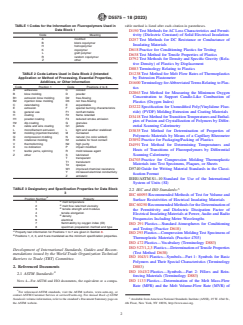
TABLE 1 Codes for the Information on Fluoropolymers Used in rable method is listed after each citation in parentheses.
Data Block 1
D150 Test Methods for AC Loss Characteristics and Permit-
Code Meaning tivity (Dielectric Constant) of Solid Electrical Insulation
A modified
D257 Test Methods for DC Resistance or Conductance of
B block copolymer
Insulating Materials
H homopolymer
K copolymer D618 Practice for Conditioning Plastics for Testing
L graft polymer
D638 Test Method for Tensile Properties of Plastics
R random copolymer
D792 Test Methods for Density and Specific Gravity (Rela-
Z other
tive Density) of Plastics by Displacement
D883 Terminology Relating to Plastics
TABLE 2 Code-Letters Used in Data Block 2 (Intended D1238 Test Method for Melt Flow Rates of Thermoplastics
Application or Method of Processing, Essential Properties,
by Extrusion Plastometer
Additives, or Other Information
D1600 Terminology for Abbreviated Terms Relating to Plas-
Code Position 1 Code Positions 2 to 8
tics
A adhesives C colored
D2863 Test Method for Measuring the Minimum Oxygen
B blow molding D powder
Concentration to Support Candle-Like Combustion of
B1 extrusion blow molding D2 free-flowing
B2 injection blow molding D3 not free-flowing
Plastics (Oxygen Index)
C calendaring E expandable
D3222 Specification for Unmodified Poly(Vinylidene Fluo-
E extrusion F special burning characteristics
G general use F1 nonflammable ride) (PVDF) Molding Extrusion and Coating Materials
H coating F2 flame retarded
D3418 Test Method for Transition Temperatures and Enthal-
H1 powder coating F4 reduced smoke emission
pies of Fusion and Crystallization of Polymers by Differ-
H2 dip coating G granules
K cable and wire coating G1 pellets ential Scanning Calorimetry
L monofilament extrusion L light and weather stabilized
D3835 Test Method for Determination of Properties of
M molding (injection/transfer) M nucleated
Polymeric Materials by Means of a Capillary Rheometer
Q compression molding N natural (no color added)
R rotational molding N1 suitable for food contact
D3892 Practice for Packaging/Packing of Plastics
V thermoforming N2 high purity
D4591 Test Method for Determining Temperatures and
X no indication P impact modified
Heats of Transitions of Fluoropolymers by Differential
Y textile yarns, spinning R mold release agent
Z other S lubricated Scanning Calorimetry
T transparent
D4703 Practice for Compression Molding Thermoplastic
T1 translucent
Materials into Test Specimens, Plaques, or Sheets
T2 opaque
W1 improved chemical resistance
D5740 Guide for Writing Material Standards in the Classi-
Y increased electrical conductivity
fication Format
Z antistatic
IEEE/ASTM S1–10 Standard for Use of the International
System of Units (SI)
TABLE 3 Designatory and Specification Properties for Data Block
2.2 IEC and ISO Standards:
IEC 60093 Recommended Methods of Test for Volume and
A
Position Number Property
Surface Resistivities of Electrical Insulating Materials
B
1 melt temperature
B IEC 60250 Recommended Methods for the Determination of
2 melt flow rate/melt viscosity
B
3 tensile strength and modulus
the Permittivity and Dielectric Dissipation Factor of
4 tensile elongation
Electrical Insulating Materials at Power, Audio and Radio
B
5 density
Frequencies Including Metre Wavelengths
6 electrical
7 flammability by oxygen index (OI)
ISO 291 Plastics—Standard Atmospheres for Conditioning
8 specimen preparation method and type
and Testing (Practice D618)
A
Property test information for Positions 1 to 7 are given in Section 8.
ISO 293 Plastics—Compression Molding Test Specimens of
B
Positions 1, 2, 3, and 5 are mandated as the minimum specification properties.
Thermoplastic Materials (Practice 4703)
ISO 472 Plastics—Vocabulary (Terminology D883)
ISO 527/1,2,3 Plastics—Determination of Tensile Properties
Development of International Standards, Guides and Recom-
(Test Method D638)
mendations issued by the World Trade Organization Technical
ISO 1043/1 Plastics—Symbols—Part 1: Symbols for Basic
Barriers to Trade (TBT) Committee.
Polymers and Their Special Characteristics (Terminology
D883)
2. Referenced Documents
ISO 1043/2 Plastics—Symbols—Part 2: Fillers and Rein-
2.1 ASTM Standards:
forcing Materials (Terminology D883)
NOTE 4—For ASTM and ISO documents, the equivalent or a compa-
ISO 1133 Plastics—Determination of the Melt Mass-Flow
Rate (MFR) and the Melt Volume-Flow Rate (MVR) of
For referenced ASTM standards, visit the ASTM website, www.astm.org, or
contact ASTM Customer Service at service@astm.org. For Annual Book of ASTM
Standards volume information, refer to the standard’s Document Summary page on Available from American National Standards Institute (ANSI), 25 W. 43rd St.,
the ASTM website. 4th Floor, New York, NY 10036, http://www.ansi.org.
D5575 − 18 (2023)
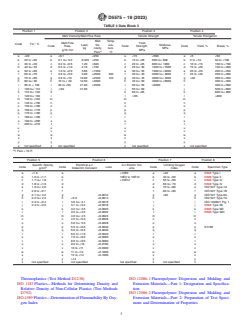
TABLE 4 Date Block 3
Position 1 Position 2 Position 3 Position 4
Melt Viscosity/Melt-Flow Rate Tensile Strength Tensile Elongation
Melt Temp-
Melt-Flow Yield
Code Tm,° C
Load, Vis- era- Modulus,
Code Rate, Code Strength, Code Yield, % Break, %
kg cosity, ture, MPa
g/10 min MPa
A
Pa/s °C
a <20 a <0.1 <250 a <15 <500 a <5 <50
b 20 to <30 b 0.1 to< 0.2 0.325 >250 b 15 to <20 500 to< 800 b 5 to <10 50 to <100
c 30 to <40 c 0.2 to <0.5 1.20 >500 c 20 to <25 800 to< 1200 c 10 to <15 100 to <150
d 40 to< 50 d 0.5 to <1.0 2.16 >100 d 25 to< 30 1200 to <1600 d 15 to <20 150 to <200
e 50 to <60 e 1.0 to <2.0 3.80 >1500 e 30 to< 35 1600 to <2000 e 20 to <25 200 to <250
f 60 to <70 f 2.0 to <5.0 5.00 >2000 230 f 35 to< 40 2000 to< 3000 f 25 to <30 250 to <300
g 70 to <80 g 5.0 to <10 10.00 >2500 125 g 40 to< 45 3000 to< 4000 g >30 300 to <350
h 80 to< 90 h 10 to < 20 12.50 >3000 h 45 to< 50 4000 to <6000 h 350 to <400
i 90 to < 100 i 20 to <50 21.60 >3500 i 50 to< 55 >6000 i 400 to <500
j 100 to< 110 j $50 31.60 j 55 to< 60 j 500 to <600
k 110 to< 120 k k 60 to <65 k 600 to< 800
l 120 to< 130 l l $65 l >800
m 130 to <140 m m m
n 140 to <150 n n n
o 150 to <160 o o o
p 160 to <170 p p p
q 170 to <180 q q q
r 180 to <190 r r r
s 190 to <200 s s s
t 200 to <210 t t t
u u u u
v v v v
w w w w
x x x x
y y y y
z not specified z not specified z not specified z not specified
A
1 Pa/s = 10 P.
Position 5 Position 6 Position 7 Position 8
Specific Gravity, Electrical a-c d-c Electric Vol- Limiting Oxygen
Code Code Loss Code Code Specimen Type
g/cm Dielectric Constant ume Index
a <1.6 a >10E3 a <40 a D638 Type I
b 1.6 to <1.7 b 10E3 to 10E12 b 40 to <50 b D638 Type II
c 1.7 to< 1.8 c >10E12 c 50 to <60 c D638 Type III
d 1.8 to <1.9 d d 60 to< 70 d D638 Type IV
e 1.9 to< 2.0 e e 70 to <80 e ISO 527 Type 1A
f 2.0 to <2.1 f f 80 to <90 f ISO 527 Type 1B
g 2.1 to< 2.2 g <0.0012 g >90 g ISO 527 Type 6A
h 2.2 to< 2.3 h <3.0 <0.0014 h h ISO 527 Type 7A
i 2.3 to <2.4 i 3.0 to< 3.1 <0.0016 i i ISO 12086/1 Fig. 1
j 2.4 to <2.5 j 3.1 to <3.2 <0.0018 j j D638 Type MI
k k 3.2 to< 3.5 <0.0020 k k D638 Type MII
l l 3.5 to <4.0 <0.0022 l l D638 Type MIII
m m 4.0 to< 4.5 <0.0024 m m
n n 4.5 to <5.0 <0.0026 n n
o o 5.0 to< 5.5 <0.0028 o o
p p 5.5 to <6.0 <0.0030 p p D1708
q q 6.0 to <6.5 <0.0035 q q
r r 6.5 to <7.0 <0.0040 r r
s s 7.0 to <8.0 <0.0060 s s
t t 8.0 to <9.0 <0.0080 t t
u u 9.0 to <10 <0.0100 u u
v v 10 to <11 <0.0300 v v
w w 11 to <12 <0.1000 w w
x x 12 to <14 >0.1000 x x
y y >14 y y
z not specified z not specified not specified z not specified z
Thermoplastics (Test Method D1238) ISO 12086-1 Fluoropolymer Dispersion and Molding and
ISO 1183 Plastics—Methods for Determining Density and Extrusion Materials—Part 1: Designation and Specifica-
Relative Density of Non-Cellular Plastics (Test Methods tion
D792) ISO 12086-2 Fluoropolymer Dispersion and Molding and
ISO 4589 Plastics—Determination of Flammability By Oxy- Extrusion Materials—Part 2: Preparation of Test Speci-
gen Index mens and Determination of Properties
D5575 − 18 (2023)
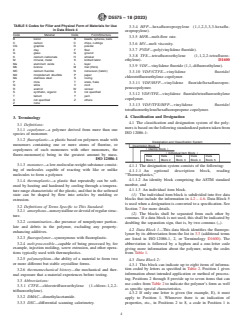
TABLE 5 Codes for Filler and Physical Form of Materials for Use
3.3.4 HFP—hexafluoropropylene (1,1,2,3,3,3-hexaflu-
in Data Block 4
oropropylene).
Code Material Code Form/Structure
3.3.5 MFR—melt-flow rate.
B boron B beads, spheres, balls
C carbon C chips, cuttings
3.3.6 MV—melt viscosity.
CG graphite D powder
3.3.7 PVDF—poly(vinylidene fluoride).
E clay F fiber
G glass G ground
3.3.8 TFE—tetrafluoroethylene (1,1,2,2-tetrafluoro-
K calcium carbonate H whisker
M mineral, metal K knitted fabric ethylene). D1600
Ma aluminum oxide L layer
3.3.9 VDF—vinylidene fluoride (1,1,-difluoroethylene).
Mb bronze M mat (thick)
MC calcium fluoride N nonwoven (fabric)
3.3.10 VDF/CTFE—vinylidene fluoride/
Md molybdenum disulfide P paper
chlorotrifluoroethylene copolymer.
Me stainless steel S roving
P mica T scale, flake
3.3.11 VDF/HFP—vinylidene fluoride/hexafluoropro-
Q silica V cord
penecopolymer.
R aramid W veneer
S synthetic, organic X not specified
3.3.12 VDF/TFE—vinylidene fluoride/tetrafluoroethylene
T talcum Y yarn
copolymer.
X not specified Z others
Z none
3.3.13 VDF/TFE/HFP—vinylidene fluoride/
tetrafluoroethylene/hexafluoropropene copolymer.
4. Classification and Designation
3. Terminology
4.1 The classification and designation system of the poly-
3.1 Definitions:
mers is based on the following standardized pattern taken from
3.1.1 copolymer—a polymer derived from more than one
ISO 12086-1:
species of monomer.
3.1.2 fluoroplastic—a plastic based on polymers made with
Designation and Classification System
monomers containing one or more atoms of fluorine, or
Description Block
| Identity Block |
copolymers of such monomers with other monomers, the
| Individual Item Block |
fluoro-monomer(s) being in the greatest amount by mass.
Data Data Data Data Data
ISO 12086-1
Block 1 Block 2 Block 3 Block 4 Block 5
3.1.3 monomer—a low-molecular-weight substance consist-
4.1.1 The designation system consists of the following:
ing of molecules capable of reacting with like or unlike
4.1.1.1 An optional description block, reading
molecules to form a polymer.
“Thermoplastics,”
4.1.1.2 An identity block comprising the ASTM standard
3.1.4 thermoplastic—a plastic that repeatedly can be soft-
number, and
ened by heating and hardened by cooling through a tempera-
4.1.1.3 An individual item block.
ture range characteristic of the plastic, and that in the softened
(1) The individual item block is subdivided into five data
state can be shaped by flow into articles by molding or
blocks that include the information in 4.2 – 4.6. Data Block 5
extrusion.
is used when a designation is converted to a specification. See
3.2 Definitions of Terms Specific to This Standard:
Section 7 for more details.
3.2.1 amorphous—noncrystalline or devoid of regular struc-
(2) The blocks shall be separated from each other by
ture.
commas. If a data block is not used, this shall be indicated by
3.2.2 contamination—the presence of nonpolymer particu-
doubling the separation sign, that is, by two commas (,,).
late and debris in the polymer, excluding any property-
4.2 Data Block 1—This data block identifies the fluoropo-
enhancing additives.
lymer by its abbreviation from the list in 3.3 (additional terms
3.2.3 fluoropolymer—synonymous with fluoroplastic.
are listed in ISO 12086-1, 2, or Terminology D1600). The
3.2.4 melt-processible—capable of being processed by, for
abbreviation is followed by a hyphen and a one-letter code
example, injection molding, screw extrusion, and other opera-
giving more information about the polymer, using the codes
tions typically used with thermoplastics. from Table 1.
3.2.5 polymorphism—the ability of a material to form two
4.3 Data Block 2:
or more different but stable crystalline forms.
4.3.1 This block can indicate up to eight items of informa-
tion coded by letters as specified in Table 2. Position 1 gives
3.2.6 thermomechanical history—the mechanical and ther-
information about intended application or method of process-
mal exposure that a material experiences before testing.
ing. Positions 2 through 8 provide up to seven items that can
3.3 Abbreviations:
use codes from Table 2 to indicate the polymer’s form as well
3.3.1 CTFE—chlorotrifluoroethylene (1-chloro-1,2,2-
as specific special characteristics.
trifluoroethylene).
4.3.2 If only one letter is given (for example, E), it must
3.3.2 DMAC—dimethylacetamide.
apply to Position 1. Whenever there is an indication of
3.3.3 DSC—differential scanning calorimetry. properties, etc., in Positions 2 to 8, a code in Position 1 is
D5575 − 18 (2023)
required. The code “X” indicates that no other letter code is and percentage elongation at yield and break. Order for
appropriate. An alphabetical order is recommended if more Positions 3 and 4 are as follows:
than one code letter is used in Positions 2 to 8.
Position 3 Order Position 4 Order
NOTE 5—Selecting the application or processing method for Position 1
1st = tensile yield 1st = tensile-yield elongation
of Data Block 2 must be done carefully. Many polymers are capable of
2nd = tensile break 2nd = tensile-break elongation
more than one application or method of processing (for example,
3rd = tensile modulus
extrusion (E) and molding (M) resins must be coded “general use” (G)).
4.4.5 Density (Relative Density, Specific Gravity) (Position
Coding for special methods of processing must be reserved for polymers
5)—Density shall be determined in accordance with the prin-
only designed for the application.
ciples of Test Methods D150 or ISO 12086-2. The cell codes
4.4 Data Block 3:
are listed in Table 4.
4.4.1 Data Block 3 is used as the designation or general
4.4.6 Electrical Properties (Position 6)—Electrical proper-
description of the fluoropolymer’s properties. The property
ties for d-c and a-c currents shall be determined by Test
values are presented by code letters in seven of eight positions
Methods D150, D257, or their ISO equivalents. The cell codes
within Data Block 3. Each position represents a specific
are listed in Table 4. Order for Position 6 is as follows:
property listed in Table 3. Table 4 lists the code letters
Position 6 Order
corresponding to the various property values. The values are
determined by the methods cited in Section 8. At least four of
Position 1 = resistivity
the seven properties are specification properties. Position 8
Position 2 = frequency (listed as the exponent of the power of ten)
Position 3 = dielectric constant
cites specimen preparation methods when the designation is
Position 4 = dissipation factor
converted to a specification.
Positions 5 to 7, 8 to 10, 11 to 13, . (repeat of 2 to 4 for each frequency cited)
4.4.1.1 Each position shall contain one or more code letters,
4.4.7 Flammability Properties (Position 7)—Flammability
depending on the property cited. The positions are separated by
properties shall be determined by oxygen index (OI) values
a hyphen (-). Use of an asterisk (*) or question mark (?) before
using Test Method D2863 or ISO 4583. The cell codes are
the code letters denotes that property as a specification prop-
listed in Table 4.
erty.
4.4.8 Specimen Preparation and Type (Position 8)—This
4.4.1.2 The resin manufacturer shall assign the codes in
position is used only when a designation is converted to a
Data Block 3, based on test results from Table 4. If test values
specification to describe the molded specimen type and its
lie on, or on either side of, a cell limit because of manufactur-
preparation. Section 9 provides information on preparing
ing tolerances, the resin manufacturer shall state which cell
compression-molded specimens. Cell codes are listed in Table
will designate.
2 and Table 4. Order for Position 8 is as follows:
NOTE 6—Properties other than those in this classification system or do
Position 8 Order
not have standard test methods are outside of the property focus of the
document scope (for example, comonomer ratios).
1st = molding method (from Table 2, Position 1)
2nd = tensile bar type and method (Table 4)
4.4.2 Melting Endotherm Peak Temperature (Position 1)—
Melting endotherm peak temperature shall be determined in
NOTE 7—Using specimen preparation method and type cited in Position
8 allows the supplier and customer to monitor polymer properties while
accordance with the principles of Test Methods D3418 and
minimizing the effects of specimen preparation.
D4591. Semicrystalline polymers shall use melting endotherm
peak temperature as a designatory property. Cell codes and
4.5 Data Block 4—Data Block 4 is used to site the type
ranges are given in Table 4.
(Position 1) and form (Position 2) of fillers or other materials
4.4.3 Melt-Flow Rate or Melt Viscosity (Position 2)—Melt added to the fluoropolymer. Letter codes listed in Table 5 are
viscosity (MV) shall be determined using Test Method D3835.
used to indicate the type and form used (supplemental codes
Melt-flow rate (MFR) shall be determined in accordance with can be found in ISO 1043/2). The nominal content, by weight
Test Method D1238 or ISO 1133, using test conditions selected
percent, is noted by arabic numerals after Position 2 to the
from Table 4. The melt viscosity or the melt-flow rate is
nearest 1 %. Additive contents below 2 % need not be speci-
indicated in Data Block 3 by the cell code and ranges in
fied. For designation clarity, a hyphen (-) is used to separate
accordance with Table 4, followed by the codes for tempera-
material type codes. When a material is present in more than
ture and load for MFR and shear rate for MV also included in
one form, a plus sign ( + ) is used to separate the form codes.
Table 4. Order for Position 2 is as follows:
4.6 Data Block 5:
Position 2 Order
4.6.1 Data Block 5 is used to denote changes in the values
1st = MFR
of a property when the designation is converted to specifica-
2nd = MFR load
tion. The type of changes would be the following:
3rd = MV
4th = Temperature 4.6.1.1 To cite the alternate property value range when a (?)
is used in Data Block 3. Where more than one (?) is cited, the
4.4.4 Tensile Strength Properties (Positions 3 and 4)—
value ranges shall be listed in order of their occurrence.
Tensile-strength properties shall be determined in accordance
with the principles of Test Method D638 or ISO 527 modified
NOTE 8—It is recommended that any ranges smaller than designated by
by details given in 8.9 or ISO 12086-2. Table 4 provides the
Table 4 codes be greater than the precision and bias for the test method
codes to use for each range of tensile strength and modulus, that measures the property.
D5575 − 18 (2023)
4.6.1.2 To cite a current ASTM or other standard specifica-
Data Block 3 Position Property
tion for the polymer (see 4.7 for restrictions).
1 melt temperature
4.6.1.3 A combination of 4.6.1.1 and 4.6.1.2.
2 melt-flow rate or melt viscosity, or both
3 tensil
...