


ASTM E2202-23
(Practice)Standard Practice for Measurement of Equipment-Generated Continuous Noise for Assessment of Health Hazards
Standard Practice for Measurement of Equipment-Generated Continuous Noise for Assessment of Health Hazards
SIGNIFICANCE AND USE
5.1 This standard defines measurement procedures for estimating the risk of noise-induced hearing loss among users of noise producing equipment. It is applicable to ground vehicles, aircraft, watercraft, and mobile, transportable, and stationary equipment. The primary approach is to separately measure the sound level at operator ear locations for each normal operating condition. These levels can be combined with operational use scenarios and exposure criteria to define noise exposure severity. The data can also be used to define hearing protection requirements or administrative controls to preclude hearing hazards.
5.2 The practice has the following limitations:
5.2.1 The practice uses field portable measurement equipment.
5.2.2 The practice produces data which may be compared with applicable criteria or limits if the limits are in terms of the quantities measured in this standard or which can be calculated from the measured data.
SCOPE
1.1 This standard defines noise measurement procedures for estimating the risk of hearing loss among users of noise producing equipment. It is applicable to ground vehicles, aircraft, watercraft, and other mobile, transportable, or stationary equipment.
1.2 This standard does not recommend noise exposure limit levels or criteria for any application discussed.
1.3 The values stated in SI units are to be regarded as standard. No other units of measurement are included in this standard.
1.4 This standard does not purport to address all of the safety concerns, if any, associated with its use. It is the responsibility of the user of this standard to establish appropriate safety, health, and environmental practices and determine the applicability of regulatory limitations prior to use.
1.5 This international standard was developed in accordance with internationally recognized principles on standardization established in the Decision on Principles for the Development of International Standards, Guides and Recommendations issued by the World Trade Organization Technical Barriers to Trade (TBT) Committee.
General Information
- Status
- Published
- Publication Date
- 31-Oct-2023
- Technical Committee
- E33 - Building and Environmental Acoustics
- Drafting Committee
- E33.08 - Mechanical and Electrical System Noise
Relations
- Effective Date
- 01-Nov-2023
- Effective Date
- 01-Nov-2023
Overview
ASTM E2202-23: Standard Practice for Measurement of Equipment-Generated Continuous Noise for Assessment of Health Hazards specifies standardized procedures for measuring continuous noise produced by equipment such as ground vehicles, aircraft, watercraft, and other mobile or stationary machinery. The focus of this standard is to provide methodologies for evaluating the risk of noise-induced hearing loss among equipment operators and users. Measurement is conducted at operator ear locations during various normal operating conditions, with results supporting health hazard assessments, the implementation of hearing protection measures, and the development of administrative controls to prevent hearing damage.
Key Topics
- Noise Measurement Procedures: Guidelines for using portable sound measurement equipment to collect data on equipment-generated continuous noise.
- Operator Ear Location Measurements: Emphasizes accurate positioning of microphones at or near the typical head or ear position of equipment operators and other personnel exposed to noise.
- Assessment of Health Hazards: Procedures for estimating the risk of noise-induced hearing loss, including data analysis techniques for determining exposure severity.
- Contour Mapping: Identification of hazard zones (noise contours) where sound levels reach or exceed recognized action thresholds such as 85 dB(A).
- Reporting Requirements: Comprehensive details on required documentation, including instrumentation, test conditions, and environmental factors.
Applications
The practical application of ASTM E2202-23 centers on the accurate assessment of occupational and operational noise exposures, providing valuable data to support hearing conservation and workplace safety programs. Typical uses include:
- Workplace Health and Safety: Employers and safety professionals use the standard to measure and assess noise exposure for operators and workers in environments with high sound levels, such as construction sites, factories, airports, and shipyards.
- Equipment Design and Compliance: Manufacturers utilize the measurement procedures during design, production, or modification of equipment to ensure compliance with health regulations and to equip operators with effective hearing protection guidance.
- Regulatory Compliance: Data collected using ASTM E2202-23 can be compared to regulatory noise exposure limits and action levels as defined by authoritative bodies (e.g., OSHA, military standards). However, the standard itself does not set limit values.
- Hearing Protection Planning: Results inform decisions about required personal protective equipment (PPE), time limits on equipment operation, and administrative or engineering controls.
Related Standards
For comprehensive noise measurement and assessment, ASTM E2202-23 should be used in conjunction with several related standards and practices, including:
- ASTM C634 - Terminology Relating to Building and Environmental Acoustics
- ANSI/ASA S1.4 / IEC 61672-1 - Specifications for Sound Level Meters
- ANSI/ASA S1.11 / IEC 61260-1 - Specifications for Octave-Band and Fractional-Octave-Band Filters
- ANSI/ASA S1.25 - Specification for Personal Noise Dosimeters
- ANSI/ASA S1.40 - Acoustical Specifications for Sound Calibrators
These standards collectively ensure that instruments and methodologies are consistent and internationally recognized, facilitating reliable measurement, data interpretation, and adherence to occupational health guidelines.
Keywords: ASTM E2202-23, noise measurement, equipment-generated noise, health hazard assessment, hearing loss risk, workplace safety, noise contour, operator ear measurement, personal noise dosimeter, occupational noise exposure, hearing conservation, sound level meter.
Buy Documents
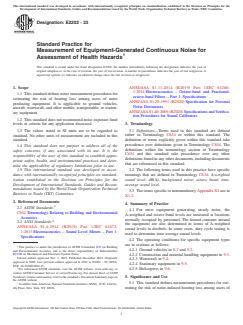
ASTM E2202-23 - Standard Practice for Measurement of Equipment-Generated Continuous Noise for Assessment of Health Hazards
REDLINE ASTM E2202-23 - Standard Practice for Measurement of Equipment-Generated Continuous Noise for Assessment of Health Hazards
Get Certified
Connect with accredited certification bodies for this standard

BSMI (Bureau of Standards, Metrology and Inspection)
Taiwan's standards and inspection authority.
Sponsored listings
Frequently Asked Questions
ASTM E2202-23 is a standard published by ASTM International. Its full title is "Standard Practice for Measurement of Equipment-Generated Continuous Noise for Assessment of Health Hazards". This standard covers: SIGNIFICANCE AND USE 5.1 This standard defines measurement procedures for estimating the risk of noise-induced hearing loss among users of noise producing equipment. It is applicable to ground vehicles, aircraft, watercraft, and mobile, transportable, and stationary equipment. The primary approach is to separately measure the sound level at operator ear locations for each normal operating condition. These levels can be combined with operational use scenarios and exposure criteria to define noise exposure severity. The data can also be used to define hearing protection requirements or administrative controls to preclude hearing hazards. 5.2 The practice has the following limitations: 5.2.1 The practice uses field portable measurement equipment. 5.2.2 The practice produces data which may be compared with applicable criteria or limits if the limits are in terms of the quantities measured in this standard or which can be calculated from the measured data. SCOPE 1.1 This standard defines noise measurement procedures for estimating the risk of hearing loss among users of noise producing equipment. It is applicable to ground vehicles, aircraft, watercraft, and other mobile, transportable, or stationary equipment. 1.2 This standard does not recommend noise exposure limit levels or criteria for any application discussed. 1.3 The values stated in SI units are to be regarded as standard. No other units of measurement are included in this standard. 1.4 This standard does not purport to address all of the safety concerns, if any, associated with its use. It is the responsibility of the user of this standard to establish appropriate safety, health, and environmental practices and determine the applicability of regulatory limitations prior to use. 1.5 This international standard was developed in accordance with internationally recognized principles on standardization established in the Decision on Principles for the Development of International Standards, Guides and Recommendations issued by the World Trade Organization Technical Barriers to Trade (TBT) Committee.
SIGNIFICANCE AND USE 5.1 This standard defines measurement procedures for estimating the risk of noise-induced hearing loss among users of noise producing equipment. It is applicable to ground vehicles, aircraft, watercraft, and mobile, transportable, and stationary equipment. The primary approach is to separately measure the sound level at operator ear locations for each normal operating condition. These levels can be combined with operational use scenarios and exposure criteria to define noise exposure severity. The data can also be used to define hearing protection requirements or administrative controls to preclude hearing hazards. 5.2 The practice has the following limitations: 5.2.1 The practice uses field portable measurement equipment. 5.2.2 The practice produces data which may be compared with applicable criteria or limits if the limits are in terms of the quantities measured in this standard or which can be calculated from the measured data. SCOPE 1.1 This standard defines noise measurement procedures for estimating the risk of hearing loss among users of noise producing equipment. It is applicable to ground vehicles, aircraft, watercraft, and other mobile, transportable, or stationary equipment. 1.2 This standard does not recommend noise exposure limit levels or criteria for any application discussed. 1.3 The values stated in SI units are to be regarded as standard. No other units of measurement are included in this standard. 1.4 This standard does not purport to address all of the safety concerns, if any, associated with its use. It is the responsibility of the user of this standard to establish appropriate safety, health, and environmental practices and determine the applicability of regulatory limitations prior to use. 1.5 This international standard was developed in accordance with internationally recognized principles on standardization established in the Decision on Principles for the Development of International Standards, Guides and Recommendations issued by the World Trade Organization Technical Barriers to Trade (TBT) Committee.
ASTM E2202-23 is classified under the following ICS (International Classification for Standards) categories: 17.140.01 - Acoustic measurements and noise abatement in general. The ICS classification helps identify the subject area and facilitates finding related standards.
ASTM E2202-23 has the following relationships with other standards: It is inter standard links to ASTM E2202-02(2016), ASTM C634-22. Understanding these relationships helps ensure you are using the most current and applicable version of the standard.
ASTM E2202-23 is available in PDF format for immediate download after purchase. The document can be added to your cart and obtained through the secure checkout process. Digital delivery ensures instant access to the complete standard document.
Standards Content (Sample)
This international standard was developed in accordance with internationally recognized principles on standardization established in the Decision on Principles for the
Development of International Standards, Guides and Recommendations issued by the World Trade Organization Technical Barriers to Trade (TBT) Committee.
Designation: E2202 − 23
Standard Practice for
Measurement of Equipment-Generated Continuous Noise for
Assessment of Health Hazards
This standard is issued under the fixed designation E2202; the number immediately following the designation indicates the year of
original adoption or, in the case of revision, the year of last revision. A number in parentheses indicates the year of last reapproval. A
superscript epsilon (´) indicates an editorial change since the last revision or reapproval.
1. Scope ANSI/ASA S1.11-2014 (R2019) Part 1/IEC 61260-
1:2014 Electroacoustics - Octave-band and Fractional-
1.1 This standard defines noise measurement procedures for
octave-band Filters – Part 1: Specifications
estimating the risk of hearing loss among users of noise
ANSI/ASA S1.25-1991 (R2020) Specification for Personal
producing equipment. It is applicable to ground vehicles,
Noise Dosimeters
aircraft, watercraft, and other mobile, transportable, or station-
ANSI/ASA S1.40-2006 (R2020) Specifications and Verifica-
ary equipment.
tion Procedures for Sound Calibrators
1.2 This standard does not recommend noise exposure limit
3. Terminology
levels or criteria for any application discussed.
3.1 Definitions—Terms used in this standard are defined
1.3 The values stated in SI units are to be regarded as
either in Terminology C634 or within this standard. The
standard. No other units of measurement are included in this
definition of terms explicitly given within this standard take
standard.
precedence over definitions given in Terminology C634. The
1.4 This standard does not purport to address all of the
definitions within the terminology section of Terminology
safety concerns, if any, associated with its use. It is the
C634 and this standard take precedence over any other
responsibility of the user of this standard to establish appro-
definitions found in any other documents, including documents
priate safety, health, and environmental practices and deter-
that are referenced in this standard.
mine the applicability of regulatory limitations prior to use.
1.5 This international standard was developed in accor- 3.2 The following terms used in this practice have specific
dance with internationally recognized principles on standard- meanings that are defined in Terminology C634: A-weighted
ization established in the Decision on Principles for the sound level, dB(A); background noise; octave band; time-
Development of International Standards, Guides and Recom- average sound level.
mendations issued by the World Trade Organization Technical
3.3 The terms specific to nonmandatory Appendix X1 are in
Barriers to Trade (TBT) Committee.
X1.2.
2. Referenced Documents
4. Summary of Practice
2.1 ASTM Standards:
4.1 For most equipment generating steady noise, the
C634 Terminology Relating to Building and Environmental
A-weighted and octave band levels are measured at locations
Acoustics
normally occupied by personnel. The hazard contours around
2.2 ANSI Standards:
the equipment are also determined in terms of A-weighted
ANSI/ASA S1.4-2014 (R2019) Part 1/IEC 61672-
sound levels in decibels. In some cases, duty cycle testing is
1:2013 Electroacoustics – Sound Level Meters – Part 1:
used to determine time average sound levels.
Specifications
4.2 The operating conditions for specific equipment types
are in sections as follows:
This practice is under the jurisdiction of ASTM Committee E33 on Building
4.2.1 Ground vehicles in 8.2 and 9.2.
and Environmental Acoustics and is the direct responsibility of Subcommittee
E33.08 on Mechanical and Electrical System Noise.
4.2.2 Construction and material handling equipment in 9.3.
Current edition approved Nov. 1, 2023. Published December 2023. Originally
4.2.3 Watercraft in 9.4.
approved in 2002. Last previous edition approved in 2016 as E2202 – 02 (2016).
4.2.4 Stationary equipment in 9.5.
DOI: 10.1520/E2202-23.
For referenced ASTM standards, visit the ASTM website, www.astm.org, or 4.2.5 Helicopters in 9.6.
contact ASTM Customer Service at service@astm.org. For Annual Book of ASTM
Standards volume information, refer to the standard’s Document Summary page on 5. Significance and Use
the ASTM website.
3 5.1 This standard defines measurement procedures for esti-
Available from American National Standards Institute (ANSI), 25 W. 43rd St.,
4th Floor, New York, NY 10036. mating the risk of noise-induced hearing loss among users of
Copyright © ASTM International, 100 Barr Harbor Drive, PO Box C700, West Conshohocken, PA 19428-2959. United States
E2202 − 23
noise producing equipment. It is applicable to ground vehicles, grade), free from gravel or other loose material. Vehicles
aircraft, watercraft, and mobile, transportable, and stationary having nonrubber-padded tracks shall be driven on level,
equipment. The primary approach is to separately measure the compact earth. Measurements shall not be made when the road
sound level at operator ear locations for each normal operating surface is wet, covered with snow or ice, or during precipita-
condition. These levels can be combined with operational use tion.
scenarios and exposure criteria to define noise exposure
8. Measurement Location and Orientation
severity. The data can also be used to define hearing protection
requirements or administrative controls to preclude hearing
8.1 If possible, measure at the probable head position of the
hazards.
occupant of interest with the occupant absent. If an operator
must be present to operate the equipment under test, measure
5.2 The practice has the following limitations:
the operator position by placing the microphone 15 cm from
5.2.1 The practice uses field portable measurement equip-
the more exposed ear. If there is a wall or reflective surface less
ment.
than 30 cm from that ear, measure midway between the ear and
5.2.2 The practice produces data which may be compared
the surface.
with applicable criteria or limits if the limits are in terms of the
quantities measured in this standard or which can be calculated
8.2 For ground equipment or watercraft, sound measure-
from the measured data.
ments shall be made at:
8.2.1 Each operator or crew position.
6. Instrumentation
8.2.2 Representative positions where one or more individu-
6.1 Requirements:
als (for example, passengers) will be located, and
6.1.1 Sound level meters and microphones shall conform to 8.2.3 Occasionally occupied positions during typical opera-
requirements for type 1, as specified by ANSI/ASA S1.4 Part
tion or maintenance of the item or system.
1/IEC 61672-1.
8.3 For aircraft sound measurements shall be made at or
6.1.2 Band filter sets shall meet the requirements for Order
near the head positions of all crew stations and at a represen-
3, Type 3-D, Extended Range, as specified by ANSI/ASA
tative number of passenger stations. Whenever possible, mea-
S1.11 Part 1/IEC 61260-1.
surements should be made with the crew member or passenger
6.1.3 Acoustic calibrators shall meet ANSI/ASA S1.40.
absent. The measurement shall be at the elevation of the center
6.1.4 Noise dosimeters shall meet ANSI/ASA S1.25.
of the head (80 cm above the seat reference point or, if
6.2 Calibration: standing, at 160 cm above the floor). If practical during each
6.2.1 All noise measurement instrumentation shall have measurement, the microphone shall be rotated in a 15 to 30 cm
undergone a complete electro-acoustical calibration in accor- diameter horizontal circle with the microphone sensing ele-
dance with manufacturer’s instruction no more than 1 year ment facing up.
prior to the noise measurement.
8.4 Noise Contours—Where the steady-state sound level
6.2.2 The noise measurement instrumentation, including
around stationary equipment is 85 dB(A) or greater, the
microphones and filter sets, shall undergo an end to end
distances and directions from the noise source at which the
calibration check with an acoustical calibrator prior to the start
sound level equals 85 dB(A) shall be determined. The 85
of the measurement, and after completion, on the day of the
dB(A) contours shall also be determined for mobile equipment
measurement. If the sensitivity after the measurements differs
which could, at times, be stationary. The 85 dB(A) contour
from the sensitivity before the measurement by more than 0.5
shall be determined from measurements made around the noise
dB, the data shall be discarded.
source at angular increments not greater than 45 degrees, and
also at the noisiest angle.
7. Test Environment
NOTE 1—The 85 dB(A) contour is the most commonly used. Certain
jurisdictions use other values such as 84 dB(A) or 90 dB(A). For
7.1 Test Site—Equipment shall be tested in its exact operat-
equipment capable of generating very high noise levels additional
ing location if the location is known and such testing is
contours may be specified such as a 103 dB(A) contour within which
feasible. When this is not possible, the test site shall be a
double hearing protection may be required by certain jurisdictions. For
uniform flat paved surface or hemi-anechoic chamber. It shall
these cases, the appropriate contour level shall be measured.
be free of reflecting surfaces such as buildings, trees, or
hillsides within 30 m. A grass surface, free of ice, snow, or 9. Equipment Configuration and Operating Conditions
vegetation over 15 cm tall may be substituted if the equipment
9.1 General—Systems shall be operated as required to
is not normally operated on a paved surface.
accomplish their intended missions or functions. The operating
7.2 Background Noise—When practical, background noise, conditions listed are preferred but other conditions may be
including wind noise, shall be at least 10 dB below that of the added if they are judged to result in more accurate noise
equipment noise being measured; however, background noise exposure estimates.
shall always be at least 10 dB below the criteria. A windscreen
9.2 Ground Vehicles:
shall be used at wind velocities of 10 km/h or more. Measure-
9.2.1 Equipment Openings—All windows, vents, and access
ments shall not be made at wind velocities of 20 km/h or more.
openings shall be in the normal operation position. If it is
7.3 Surface and Grade for Vehicle Testing—Vehicles shall possible to operate with these in either the open or closed
be driven along a dry, smooth, paved, and level road (<1 % positions, both configurations shall be tested.
E2202 − 23
9.2.2 Vehicle Speed and Gear—The vehicle speed shall be
D = main rotor diameter.
measured by a calibrated speedometer or other velocity mea-
9.6.1.2 Level Flight—At lower forward airspeed of either
suring device. Measurements shall be made at either 8 or 16
0.9V or 0.9VNE,
H
km/h increments up to the maximum vehicle speed. If 16 km/h
increments are selected, measurements shall start at 16 km/h
where:
rather than 8 km/h.
V = maximum horizontal velocity at maximum continu-
H
9.2.3 Load-Carrying Equipment—All load-carrying equip-
ous power, and
ment shall be operated at the maximum payload including any
VNE = velocity never exceeded.
towed trailers at maximum payload.
9.6.2 Gross Weight and Rotor Speed Conditions—Noise
9.2.4 All subsystems and auxiliary equipment normally in
measurements shall be made while the helicopter is in flight at
use shall be operating. Where heaters and air conditioners may
maximum design gross weight and at normal 65 % of rated
be used at the same time (such as humidity control) both shall
rotor speed.
be operated. Where both heaters and air conditioners are
9.6.3 Helicopter Subsystems and Equipment—The subsys-
present, t
...
This document is not an ASTM standard and is intended only to provide the user of an ASTM standard an indication of what changes have been made to the previous version. Because
it may not be technically possible to adequately depict all changes accurately, ASTM recommends that users consult prior editions as appropriate. In all cases only the current version
of the standard as published by ASTM is to be considered the official document.
Designation: E2202 − 02 (Reapproved 2016) E2202 − 23
Standard Practice for
Measurement of Equipment-Generated Continuous Noise for
Assessment of Health Hazards
This standard is issued under the fixed designation E2202; the number immediately following the designation indicates the year of
original adoption or, in the case of revision, the year of last revision. A number in parentheses indicates the year of last reapproval. A
superscript epsilon (´) indicates an editorial change since the last revision or reapproval.
1. Scope
1.1 This standard defines noise measurement procedures for estimating the risk of hearing loss among users of noise producing
equipment. It is applicable to ground vehicles, aircraft, watercraft, and other mobile, transportable, or stationary equipment.
1.2 This standard does not recommend noise exposure limit levels or criteria for any application discussed.
1.3 The values stated in SI units are to be regarded as standard. No other units of measurement are included in this standard.
1.4 This standard does not purport to address all of the safety concerns, if any, associated with its use. It is the responsibility
of the user of this standard to establish appropriate safety and healthsafety, health, and environmental practices and determine
the applicability of regulatory limitations prior to use.
1.5 This international standard was developed in accordance with internationally recognized principles on standardization
established in the Decision on Principles for the Development of International Standards, Guides and Recommendations issued
by the World Trade Organization Technical Barriers to Trade (TBT) Committee.
2. Referenced Documents
2.1 ASTM Standards:
C634 Terminology Relating to Building and Environmental Acoustics
2.2 ANSI Standards:
ANSI S 1.1 Acoustical Terminology
ANSI S 1.4ANSI/ASA S1.4-2014 (R2019) Part 1/IEC 61672-1:2013 Specification forElectroacoustics – Sound Level Meters –
Part 1: Specifications
ANSI S 1.11ANSI/ASA S1.11-2014 (R2019) Part 1/IEC 61260-1:2014 Specification for Octave-Band and Fractional-Octave-
Band Analog and Digital FiltersElectroacoustics - Octave-band and Fractional-octave-band Filters – Part 1: Specifications
ANSI S1.25ANSI/ASA S1.25-1991 (R2020) Specification for Personal Noise Dosimeters
ANSI S 1.40ANSI/ASA S1.40-2006 (R2020) Specification for AcousticalSpecifications and Verification Procedures for Sound
Calibrators
This practice is under the jurisdiction of ASTM Committee E33 on Building and Environmental Acoustics and is the direct responsibility of Subcommittee E33.08 on
Mechanical and Electrical System Noise.
Current edition approved Oct. 1, 2016Nov. 1, 2023. Published October 2016December 2023. Originally approved in 2002. Last previous edition approved in 20092016
as E2202 – 02 (2009). DOI: 10.1520/E2202-02R16.(2016). DOI: 10.1520/E2202-23.
For referenced ASTM standards, visit the ASTM website, www.astm.org, or contact ASTM Customer Service at service@astm.org. For Annual Book of ASTM Standards
volume information, refer to the standard’s Document Summary page on the ASTM website.
Available from American National Standards Institute (ANSI), 25 W. 43rd St., 4th Floor, New York, NY 10036.
Copyright © ASTM International, 100 Barr Harbor Drive, PO Box C700, West Conshohocken, PA 19428-2959. United States
E2202 − 23
3. Terminology
3.1 Definitions—Terms used in this standard are defined either in Terminology C634 or within this standard. The definition of
terms explicitly given within this standard take precedence over definitions given in Terminology C634. The definitions within the
terminology section of Terminology C634 and this standard take precedence over any other definitions found in any other
documents, including documents that are referenced in this standard.
3.2 Except as noted in The following Appendix X1, the terms and symbols terms used in this practice have specific meanings that
are defined in Terminology C634.: A-weighted sound level, dB(A); background noise; octave band; time-average sound level.
3.3 The terms specific to nonmandatory Appendix X1 are in X1.2.
4. Summary of Practice
4.1 For most equipment generating steady noise, the A-weighted and octave band levels are measured at locations normally
occupied by personnel. The hazard contours around the equipment are also determined in terms of A-weighted sound levels in
decibels. In some cases, duty cycle testing is used to determine time-weightedtime average sound levels.
4.2 The operating conditions for specific equipment types are in sections as follows:
4.2.1 Ground vehicles in 8.2 and 9.2.
4.2.2 Construction and material handling equipment in 9.3.
4.2.3 Watercraft in 9.4.
4.2.4 Stationary equipment in 9.5.
4.2.5 Helicopters in 9.6.
5. Significance and Use
5.1 This standard defines measurement procedures for estimating the risk of noise-induced hearing loss among users of noise
producing equipment. It is applicable to ground vehicles, aircraft, watercraft, and mobile, transportable, and stationary equipment.
The primary approach is to separately measure the sound level at operator ear locations for each normal operating condition. These
levels can be combined with operational use scenarios and exposure criteria to define noise exposure severity. The data can also
be used to define hearing protection requirements or administrative controls to preclude hearing hazard.hazards.
5.2 The practice has the following limitations:
5.2.1 The practice uses field portable measurement equipment.
5.2.2 The practice produces data which may be compared with applicable criteria or limits if the limits are in terms of the
quantities measured in this standard or which can be calculated from the measured data.
6. Instrumentation
6.1 Requirements:
6.1.1 Sound level meters and microphones shall conform to requirements for type 1, as specified by ANSI S1.4.ANSI/ASA S1.4
Part 1/IEC 61672-1.
6.1.2 Band filter sets shall meet the requirements for Order 3, Type 3-D, Extended Range, as specified by ANSI S1.11.ANSI/ASA
S1.11 Part 1/IEC 61260-1.
6.1.3 Acoustic calibrators shall meet ANSIANSI/ASA S1.40.
E2202 − 23
6.1.4 Noise dosimeters shall meet ANSIANSI/ASA S1.25.
6.2 Calibration:
6.2.1 All noise measurement instrumentation shall have undergone a complete electro-acoustical calibration in accordance with
manufacturer’s instruction no more than 1 year prior to the noise measurement.
6.2.2 The noise measurement instrumentation, including microphones and filter sets, shall undergo an end to end calibration check
with an acoustical calibrator prior to the start of the measurement, and after completion, on the day of the measurement. If the
sensitivity after the measurements differs from the sensitivity before the measurement by more than 0.5 dB, the data shall be
discarded.
7. Test Environment
7.1 Test Site—Equipment shall be tested in its exact operating location if the location is known and such testing is feasible. When
this is not possible, the test site shall be a uniform flat paved surface or hemi-anechoic chamber. It shall be free of reflecting
surfaces such as buildings, trees, or hillsides within 30 m. A grass surface, free of ice, snow, or vegetation over 15 cm tall may
be substituted if the equipment is not normally operated on a paved surface.
7.2 Background Noise—When practical, background noise, including wind noise, shall be at least 10 dB below that of the
equipment noise being measured; however, background noise shall always be at least 10 dB below the criteria. A windscreen shall
be used at wind velocities of 10 km/h or more. Measurements shall not be made at wind velocities of 20 km/h or more.
7.3 Surface and Grade for Vehicle Testing—Vehicles shall be driven along a dry, smooth, paved, and level road (<1 % grade), free
from gravel or other loose material. Vehicles having nonrubber-padded tracks shall be driven on level, compact earth.
Measurements shall not be made when the road surface is wet, covered with snow or ice, or during precipitation.
8. Measurement Location and Orientation
8.1 If possible, measure at the probable head position of the occupant of interest with the occupant absent. If an operator must
be present to operate the equipment under test, measure the operator position by placing the microphone 15 cm from the more
exposed ear. If there is a wall or reflective surface less than 30 cm from that ear, measure midway between the ear and the surface.
8.2 For ground equipment or watercraft, sound measurements shall be made at:
8.2.1 Each operator or crew position.
8.2.2 Representative positions where one or more individuals (for example, passengers) will be located, and
8.2.3 Occasionally occupied positions during typical operation or maintenance of the item or system.
8.3 For aircraft sound measurements shall be made at or near the head positions of all crew stations and at a representative number
of passenger stations. Whenever possible, measurements should be made with the crew member or passenger absent. The
measurement shall be at the elevation of the center of the head (80 cm above the seat reference point or, if standing, at 160 cm
above the floor). If practical during each measurement, the microphone shall be rotated in a 15 to 30 cm diameter horizontal circle
with the microphone sensing element facing up.
8.4 Noise Contours—Where the steady-state sound level around stationary equipment is 85 dB(A) or greater, the distances and
directions from the noise source at which the sound level equals 85 dB(A) shall be determined. The 85 dB(A) contours shall also
be determined for mobile equipment which could, at times, be stationary. The 85 dB(A) contour shall be determined from
measurements made around the noise source at angular increments not greater than 45 degrees, and also at the noisiest angle.
NOTE 1—The 85 dB(A) contour is the most commonly used. Certain jurisdictions use other values such as 84 dB(A) or 90 dB(A). For equipment capable
of generating very high noise levels additional contours may be specified such as a 103 dB(A) contour within which double hearing protection may be
required by certain jurisdictions. For these cases, the appropriate contour level shall be measured.
E2202 − 23
9. Equipment Configuration and Operating Conditions
9.1 General—Systems shall be operated as required to accomplish their intended missions or functions. The operating conditions
listed are preferred but other conditions may be added if they are judged to result in more accurate noise exposure estimates.
9.2 Ground Vehicles:
9.2.1 Equipment Openings—All windows, vents, and access openings shall be in the normal operation position. If it is possible
to operate with these in either the open or closed positions, both configurations shall be tested.
9.2.2 Vehicle Speed and Gear—The vehicle speed shall be measured by a calibrated speedometer or other velocity measuring
device. Measurements shall be made at either 8 or 16 km/h increments up to the maximum vehicle speed. If 16 km/h increments
are selected, measurements shall start at 16 km/h rather than 8 km/h.
9.2.3 Load-Carrying Equipment—All load-carrying equipment shall be operated at the maximum payload including any towed
trailers at maximum payload.
9.2.4 All subsystems and auxiliary equipment normally in use shall be operating. Where heaters and air conditioners may be used
at the same time (such as humidity control) both shall be operated. Where both heaters and air conditioners are present, the one
producing the higher sound level shall be operated.
9.3 Construction and Materials-Handling Equipment:
9.3.1 Duty cycle testing may be used. Define a duty cycle typical of the anticipated use of the equipment. If more than one type
of duty cycle is applicable, specify the most frequently used and the noisiest duty cycles.
9.3.2 Duty cycles shall be as short as practical and the noise exposure of sufficient cycles shall be measured for a minimum
duration of 1 h at rated capacity.
9.3.3 The equipment shall be operated at a test site typical of the environment in which the equipment is to be used.
9.3.4 Measure the time-averaged A-weighted sound level L (r) at the operator ear position where r is the applicable exchange
avg
rate (see Appendix X1).
NOTE 2—The exchange rate must be specified if the measurements are for a jurisdiction which uses exchange rates other than 5 dB per doubling of time.
9.3.5 If the operator is in a enclosed cab, measure L (r) for cab doors and windows closed and cab doors and windows open.
avg
When the cab doors and windows are closed measure with all heater, air conditioners and other noise-pr
...
Questions, Comments and Discussion
Ask us and Technical Secretary will try to provide an answer. You can facilitate discussion about the standard in here.
Loading comments...