

ASTM F3557-22
(Practice)Standard Practice for Field Measurements of Snow Sport Freestyle Terrain Jumps
General Information
- Abstract
SIGNIFICANCE AND USE
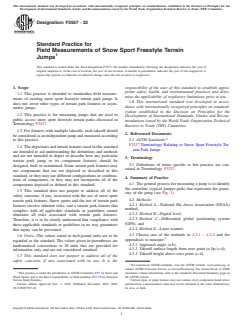
5.1 This practice serves the purpose of measuring snow sports freestyle terrain jump features and may be used as a method for recreating jumps in the field or two-dimensional jump profiles of existing jumps.
SCOPE
1.1 This practice is intended to standardize field measurements of existing snow sport freestyle terrain park jumps. It does not cover other types of terrain park features or asymmetric jumps.
1.2 This practice is for measuring jumps that are used in public access snow sport freestyle terrain parks discussed in Terminology F3237.
1.3 For features with multiple takeoffs, each takeoff should be considered as an independent jump and measured according to this practice.
1.4 The depictions and terrain features used in this standard are intended to aid understanding the definitions and methods and are not intended to depict or describe how any particular terrain park jump or its component features should be designed, built or maintained. Some terrain park features may use components that are not depicted or described in this standard, or they may use different configurations or combinations of components, or they may not incorporate all of the components depicted or defined in this standard.
1.5 This standard does not purport to address all of the safety concerns, if any, associated with the use of snow sport terrain park features. Snow sports and the use of terrain park features involve inherent risks, and a terrain park feature that complies with all applicable standards or guidelines cannot eliminate all risks associated with terrain park features. Therefore, it is to be clearly understood that compliance with these applicable standards or guidelines in no way guarantees that injury can be prevented.
1.6 Units—The values stated in inch-pound units are to be regarded as the standard. The values given in parentheses are mathematical conversions to SI units that are provided for information only and are not considered standard.
1.7 This standard does not purport to address all of the safety concerns, if any, associated with its use. It is the responsibility of the user of this standard to establish appropriate safety, health, and environmental practices and determine the applicability of regulatory limitations prior to use.
1.8 This international standard was developed in accordance with internationally recognized principles on standardization established in the Decision on Principles for the Development of International Standards, Guides and Recommendations issued by the World Trade Organization Technical Barriers to Trade (TBT) Committee.
- Status
- Published
- Publication Date
- 31-Oct-2022
- Technical Committee
- F27 - Snow and Water Sports
- Drafting Committee
- F27.70 - Freestyle Terrain Jump Features

Overview
ASTM F3557-22: Standard Practice for Field Measurements of Snow Sport Freestyle Terrain Jumps establishes uniform methods for measuring the physical dimensions and profiles of snow sport freestyle terrain jumps in public access parks. Developed by ASTM’s Committee F27 on Snow and Water Sports, this standard focuses exclusively on jumps, providing procedures for accurate field measurement to document or recreate existing terrain features. Adoption of ASTM F3557-22 promotes consistent data collection, enabling ski area operators, designers, and inspectors to ensure appropriate jump profiles and support park management objectives.
Key Topics
Scope and Applicability:
- Defines the standardization of measurements for non-asymmetric, public access freestyle terrain jumps only.
- Each takeoff on features with multiple takeoffs is measured independently per the standard.
- Does not cover other terrain park features, asymmetric jumps, or design/maintenance guidelines.
Measurement Methods:
Four practical methods are referenced, each requiring trained personnel familiar with measurement equipment:- National Ski Areas Association (NSAA) traditional method
- Digital level
- Differential GPS
- Laser scanning
Measurement Parameters:
The standard details specific measurements critical for documenting jump geometry, including:- Approach angle
- Takeoff (length, height, transition radius, lip angle, width)
- Knuckle and landing characteristics (width, angles, lengths)
- Parent slope angle
- Overall jump feature length
Centerline Determination:
Emphasizes the importance of identifying the jump’s centerline, typically marking the most common jumper path, as the basis for all subsequent measurements.Precision and Units:
- Distance: within 0.5 ft (0.3 m)
- Angles: within 1°
- Standard units are inch-pound; SI units are for informational purposes.
Limitations and Safety:
- Compliance mitigates some risks but cannot eliminate inherent hazards associated with snow sports.
- Users must assess all safety, health, and regulatory requirements independently.
Applications
ASTM F3557-22 is invaluable for:
Terrain Park Operators:
Provides a uniform approach for documenting, auditing, and replicating jump profiles, supporting safe and consistent park design and operation.Ski Area Inspectors & Regulators:
Facilitates inspection, comparison, and verification of existing jump configurations against documented standards.Designers & Builders:
Assists in replicating or modifying existing freestyle features, aiding in park planning and maintenance documentation.Incident Investigation:
Provides objective data for analysis of incidents or performance concerns involving freestyle terrain jumps.Park User Education:
Aids in the development of educational materials by illustrating typical jump dimensions and profiles.
Related Standards
ASTM F3237 - Terminology Relating to Snow Sport Freestyle Terrain Park Jumps:
Provides definitions of terms used in ASTM F3557-22 to ensure consistency in communication and documentation.NSAA Freestyle Terrain Resource Guide:
Referenced for additional measurement procedures and best practices in terrain park management.International Standardization Principles:
Developed under World Trade Organization (WTO) guidelines to facilitate harmonization of safety and measurement practices internationally.
Keywords: ASTM F3557-22, snow sport, freestyle terrain, jump measurement, terrain park, field measurement, ski jumps, snow park safety, jump profiles, terrain feature documentation, recreational snow sports, ASTM standards
Frequently Asked Questions
ASTM F3557-22 is a standard published by ASTM International. Its full title is "Standard Practice for Field Measurements of Snow Sport Freestyle Terrain Jumps". This standard covers: SIGNIFICANCE AND USE 5.1 This practice serves the purpose of measuring snow sports freestyle terrain jump features and may be used as a method for recreating jumps in the field or two-dimensional jump profiles of existing jumps. SCOPE 1.1 This practice is intended to standardize field measurements of existing snow sport freestyle terrain park jumps. It does not cover other types of terrain park features or asymmetric jumps. 1.2 This practice is for measuring jumps that are used in public access snow sport freestyle terrain parks discussed in Terminology F3237. 1.3 For features with multiple takeoffs, each takeoff should be considered as an independent jump and measured according to this practice. 1.4 The depictions and terrain features used in this standard are intended to aid understanding the definitions and methods and are not intended to depict or describe how any particular terrain park jump or its component features should be designed, built or maintained. Some terrain park features may use components that are not depicted or described in this standard, or they may use different configurations or combinations of components, or they may not incorporate all of the components depicted or defined in this standard. 1.5 This standard does not purport to address all of the safety concerns, if any, associated with the use of snow sport terrain park features. Snow sports and the use of terrain park features involve inherent risks, and a terrain park feature that complies with all applicable standards or guidelines cannot eliminate all risks associated with terrain park features. Therefore, it is to be clearly understood that compliance with these applicable standards or guidelines in no way guarantees that injury can be prevented. 1.6 Units—The values stated in inch-pound units are to be regarded as the standard. The values given in parentheses are mathematical conversions to SI units that are provided for information only and are not considered standard. 1.7 This standard does not purport to address all of the safety concerns, if any, associated with its use. It is the responsibility of the user of this standard to establish appropriate safety, health, and environmental practices and determine the applicability of regulatory limitations prior to use. 1.8 This international standard was developed in accordance with internationally recognized principles on standardization established in the Decision on Principles for the Development of International Standards, Guides and Recommendations issued by the World Trade Organization Technical Barriers to Trade (TBT) Committee.
SIGNIFICANCE AND USE 5.1 This practice serves the purpose of measuring snow sports freestyle terrain jump features and may be used as a method for recreating jumps in the field or two-dimensional jump profiles of existing jumps. SCOPE 1.1 This practice is intended to standardize field measurements of existing snow sport freestyle terrain park jumps. It does not cover other types of terrain park features or asymmetric jumps. 1.2 This practice is for measuring jumps that are used in public access snow sport freestyle terrain parks discussed in Terminology F3237. 1.3 For features with multiple takeoffs, each takeoff should be considered as an independent jump and measured according to this practice. 1.4 The depictions and terrain features used in this standard are intended to aid understanding the definitions and methods and are not intended to depict or describe how any particular terrain park jump or its component features should be designed, built or maintained. Some terrain park features may use components that are not depicted or described in this standard, or they may use different configurations or combinations of components, or they may not incorporate all of the components depicted or defined in this standard. 1.5 This standard does not purport to address all of the safety concerns, if any, associated with the use of snow sport terrain park features. Snow sports and the use of terrain park features involve inherent risks, and a terrain park feature that complies with all applicable standards or guidelines cannot eliminate all risks associated with terrain park features. Therefore, it is to be clearly understood that compliance with these applicable standards or guidelines in no way guarantees that injury can be prevented. 1.6 Units—The values stated in inch-pound units are to be regarded as the standard. The values given in parentheses are mathematical conversions to SI units that are provided for information only and are not considered standard. 1.7 This standard does not purport to address all of the safety concerns, if any, associated with its use. It is the responsibility of the user of this standard to establish appropriate safety, health, and environmental practices and determine the applicability of regulatory limitations prior to use. 1.8 This international standard was developed in accordance with internationally recognized principles on standardization established in the Decision on Principles for the Development of International Standards, Guides and Recommendations issued by the World Trade Organization Technical Barriers to Trade (TBT) Committee.
ASTM F3557-22 is classified under the following ICS (International Classification for Standards) categories: 97.220.20 - Winter sports equipment. The ICS classification helps identify the subject area and facilitates finding related standards.
ASTM F3557-22 is available in PDF format for immediate download after purchase. The document can be added to your cart and obtained through the secure checkout process. Digital delivery ensures instant access to the complete standard document.
Standards Content (Sample)
This international standard was developed in accordance with internationally recognized principles on standardization established in the Decision on Principles for the
Development of International Standards, Guides and Recommendations issued by the World Trade Organization Technical Barriers to Trade (TBT) Committee.
Designation: F3557 − 22
Standard Practice for
Field Measurements of Snow Sport Freestyle Terrain
Jumps
This standard is issued under the fixed designation F3557; the number immediately following the designation indicates the year of
original adoption or, in the case of revision, the year of last revision. A number in parentheses indicates the year of last reapproval. A
superscript epsilon (´) indicates an editorial change since the last revision or reapproval.
1. Scope responsibility of the user of this standard to establish appro-
priate safety, health, and environmental practices and deter-
1.1 This practice is intended to standardize field measure-
mine the applicability of regulatory limitations prior to use.
ments of existing snow sport freestyle terrain park jumps. It
1.8 This international standard was developed in accor-
does not cover other types of terrain park features or asym-
dance with internationally recognized principles on standard-
metric jumps.
ization established in the Decision on Principles for the
1.2 This practice is for measuring jumps that are used in
Development of International Standards, Guides and Recom-
public access snow sport freestyle terrain parks discussed in
mendations issued by the World Trade Organization Technical
Terminology F3237.
Barriers to Trade (TBT) Committee.
1.3 For features with multiple takeoffs, each takeoff should
2. Referenced Documents
be considered as an independent jump and measured according
to this practice. 2.1 ASTM Standards:
F3237 Terminology Relating to Snow Sport Freestyle Ter-
1.4 The depictions and terrain features used in this standard
rain Park Jumps
are intended to aid understanding the definitions and methods
and are not intended to depict or describe how any particular
3. Terminology
terrain park jump or its component features should be
3.1 Definitions of terms specific to this practice are con-
designed, built or maintained. Some terrain park features may
tained in Terminology F3237.
use components that are not depicted or described in this
standard, or they may use different configurations or combina-
4. Summary of Practice
tions of components, or they may not incorporate all of the
4.1 The general process for measuring a jump is to identify
components depicted or defined in this standard.
the centerline (typical jumper path) that represents the geom-
1.5 This standard does not purport to address all of the
etry of the jump (see Fig. 1).
safety concerns, if any, associated with the use of snow sport
4.2 Methods:
terrain park features. Snow sports and the use of terrain park
4.2.1 Method A—National Ski Areas Association (NSAA)
features involve inherent risks, and a terrain park feature that
method,
complies with all applicable standards or guidelines cannot
4.2.2 Method B—Digital level,
eliminate all risks associated with terrain park features.
4.2.3 Method C—Differential global positioning system
Therefore, it is to be clearly understood that compliance with
(GPS), and
these applicable standards or guidelines in no way guarantees
4.2.4 Method E—Laser scanner.
that injury can be prevented.
4.3 Choose one of the methods in 4.2.1 – 4.2.4 and the
1.6 Units—The values stated in inch-pound units are to be
appendixes to measure:
regarded as the standard. The values given in parentheses are
4.3.1 Approach angle (a-b),
mathematical conversions to SI units that are provided for
4.3.2 Takeoff surface length from zero point to lip (c-d),
information only and are not considered standard.
4.3.3 Takeoff height above zero point (c-d),
1.7 This standard does not purport to address all of the
safety concerns, if any, associated with its use. It is the
For referenced ASTM standards, visit the ASTM website, www.astm.org, or
contact ASTM Customer Service at service@astm.org. For Annual Book of ASTM
This practice is under the jurisdiction of ASTM Committee F27 on Snow and Standards volume information, refer to the standard’s Document Summary page on
Water Sports and is the direct responsibility of Subcommittee F27.70 on Freestyle the ASTM website.
Terrain Jump Features. Certain types of jump features may not contain every component listed above
Current edition approved Nov. 1, 2022. Published December 2022. DOI: and therefore a measurement value may not be obtained or the value obtained may
10.1520/F3557-22. be zero, or both.
Copyright © ASTM International, 100 Barr Harbor Drive, PO Box C700, West Conshohocken, PA 19428-2959. United States
F3557 − 22
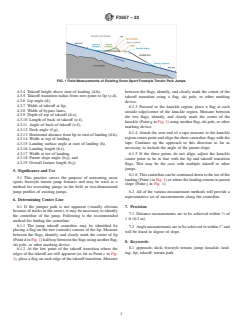
FIG. 1 Field Measurements of Existing Snow Sport Freestyle Terrain Park Jumps
4.3.4 Takeoff height above start of landing (d-h), between the flags, identify, and clearly mark the center of the
4.3.5 Takeoff transition radius from zero point to lip (c-d), takeoff transition using a flag, ski pole, or other marking
4.3.6 Lip angle (d),
device.
4.3.7 Width of takeoff at lip,
6.1.3 Proceed to the knuckle region; place a flag at each
4.3.8 Width of bypass lanes,
outside edge/corner of the knuckle region. Measure between
4.3.9 Depth of top of takeoff (d-e),
the two flags, identify, and clearly mark the center of the
4.3.10 Length of back of takeoff (e-f),
knuckle (Point g in Fig. 1) using another flag, ski pole, or other
4.3.11 Angle of back of takeoff (e-f),
marking device.
4.3.12 Deck angle (f-g),
6.1.4 Attach the zero end of a tape measure to the knuckle
4.3.13 Horizontal distance from lip to start of landing (d-h),
region center point and align the three centerline flags with the
4.3.14 Width at top of landing,
tape. Continue up the approach in this direction as far as
4.3.15 Landing surface angle at start of landing (h),
necessary to include the angle of the parent slope.
4.3.16 Landing length (h-i),
4.3.17 Width at toe of landing,
6.1.5 If the three points do not align, adjust the knuckle
4.3.18 Parent slope angle (b-j), and
center point to be in line with the lip and takeoff transition
4.3.19 Overall feature length (b-j).
flags. This may be the case with multiple takeoff or other
jumps.
5. Significance and Use
6.1.6 Thiscenterlinecanbecontinueddowntothetoeofthe
5.1 This practice serves the purpose of measuring snow
landing(PointiinFig.1)orwherethelandingreturnstoparent
sports freestyle terrain jump features and may be used as a
slope (Point j in Fig. 1).
method for recreating jumps in the field or two-dimensional
jump profiles of existing jumps. 6.2 All of the various measurement methods will provide a
representative set of measurements along the centerline.
6. Determining Center Line
6.1 If the jumper path is not apparent (visually obvious 7. Precision
because of tracks in the snow), it may be necessary to identify
7.1 Distance measurements are to be achieved within ⁄2 of
the centerline of the jump. Following is the recommended
1 ft (0.3 m).
method for finding the centerline:
6.1.1 The jump takeoff centerline may be identified by
7.2 Angle measurements are to be achieved to within 1° and
placing a flag on the two (outside) corners of the lip. Measure
will be listed in degree of slope.
between the flags, identify, and clearly mark the center of lip
(PointdinFig.1)halfwaybetweentheflagsusinganotherflag,
...