

ASTM F3237-23
(Terminology)Standard Terminology Relating to Snow Sport Freestyle Terrain Park Jumps
General Information
- Abstract
SIGNIFICANCE AND USE
2.1 A standard terminology is needed to allow freestyle terrain park designers, builders, ski resorts, accident investigators, and scientists to use a common language in describing freestyle terrain park jumps and related parameters for a jumper using the feature.
2.2 Angles are taken with respect to horizontal, with positive values indicating an increase in elevation and negative values indicating a decrease in elevation along the path of travel for a terrain park participant using the jump.
SCOPE
1.1 This terminology covers the terms required to describe a cross sectional profile of a snow sport freestyle terrain park jump and related parameters for a jumper using the feature and does not cover any other terrain park feature.
1.2 The terms are presented in a sequence considered to be the most logical with definitions presented later calling upon those presented earlier. This terminology standard does not require the use of any specific units; Imperial units (feet, seconds, degrees) or metric units (meters, seconds, degrees) can be used.
1.3 The depictions used in this standard are intended to aid in understanding the definitions and are not intended to depict or describe how any particular terrain park jump or its component features should be designed, built or maintained. Some terrain park jumps may use different configurations or combinations of features, or they may not incorporate all of the features depicted or defined in this standard.
1.4 This standard does not purport to address all of the safety concerns, if any, associated with the use of snow sport terrain park features. Snow sports and the use of terrain park features involve inherent risks, and a terrain park feature that complies with all applicable standards or guidelines cannot eliminate all risks associated with terrain park features. Therefore, it is to be clearly understood that compliance with these applicable standards or guidelines in no way guarantees that injury can be prevented.
1.5 This international standard was developed in accordance with internationally recognized principles on standardization established in the Decision on Principles for the Development of International Standards, Guides and Recommendations issued by the World Trade Organization Technical Barriers to Trade (TBT) Committee.
- Status
- Published
- Publication Date
- 30-Jun-2023
- Technical Committee
- F27 - Snow and Water Sports
- Drafting Committee
- F27.70 - Freestyle Terrain Jump Features



Overview
ASTM F3237-23: Standard Terminology Relating to Snow Sport Freestyle Terrain Park Jumps provides a comprehensive vocabulary for professionals involved in the design, construction, maintenance, and analysis of freestyle terrain park jumps. Developed by ASTM International, this standard establishes a unified set of terms to enhance communication and understanding among terrain park designers, ski resorts, builders, scientists, and accident investigators. This standard solely addresses the terminology for the cross-sectional profiles of snow sport freestyle terrain park jumps and their key elements, supporting both Imperial and metric units.
By standardizing essential terms and definitions, ASTM F3237-23 enables clear documentation, informed analysis, and safer installation and operation of terrain park features, fostering consistency throughout the snow sports industry.
Key Topics
Standardized Vocabulary: Establishes definitions for core elements such as:
- Terrain park
- Parent slope and ground slope
- Jump, jumper, and jumper kinematics
- Specific jump elements: approach, takeoff, lip, deck, knuckle, landing, and runout
Angles and Measurement: All angles are referenced with respect to the horizontal, with clear conventions for positive (increase in elevation) and negative (decrease in elevation) values along the skier or snowboarder’s path.
Sequential Terminology: Terms are defined in a logical order, supporting a clear build-up from general terrain features to detailed jump elements and landing parameters.
Comprehensive Jump Elements: The standard outlines the full profile of a terrain park jump, including approach, takeoff, deck, knuckle region, landing area, transitions, and runout, along with points for measuring velocity and angle.
Jumper Kinematics: Definitions cover the mechanics of movement for skiers and snowboarders using the jump, detailing aspects such as takeoff and landing velocities, angles, and body positions at critical moments.
Applications
ASTM F3237-23 is vital for:
- Freestyle Terrain Park Design: Ensures designers and builders use uniform terminology, improving design clarity and communication with clients and regulators.
- Ski Resort Operations: Facilitates consistent descriptions of jump features in documentation, maintenance logs, and safety procedures.
- Accident Investigation and Research: Allows scientists and investigators to reliably describe jump profiles and kinematic parameters when analyzing incidents, leading to more accurate reporting and root cause analysis.
- Industry Training: Supports education for new terrain park staff, equipment manufacturers, and athletes by providing a common language for discussing freestyle jump design and safety.
- Standards Compliance and Best Practice: Contributes to harmonized practices across international boundaries by adhering to World Trade Organization TBT principles.
Related Standards
- ASTM F27 Committee on Snow and Water Sports: Oversees related standards for snow and water sport equipment, facilities, and safety.
- ASTM F2957: Standard Guide for Snow Ski and Snowboard Terrain Parks – Safety and Design.
- ISO and CEN Standards: International standards may reference or complement ASTM F3237-23 for global compatibility.
- Local Safety Guidelines: National and regional guidelines often build upon the standardized terminology introduced by ASTM F3237-23.
Practical Value
Using ASTM F3237-23 improves communication and reduces errors throughout the snow sport freestyle terrain park jump lifecycle-from design to maintenance, from athlete instruction to incident reviews. By adopting this common terminology, organizations can enhance operational efficiency, safety awareness, and the overall quality of terrain park environments.
Keywords: ASTM F3237-23, snow sport jumps, terrain park jumps, freestyle terrain park, standardized terminology, jump kinematics, ski resort safety, jump design, ASTM standards
Frequently Asked Questions
ASTM F3237-23 is a standard published by ASTM International. Its full title is "Standard Terminology Relating to Snow Sport Freestyle Terrain Park Jumps". This standard covers: SIGNIFICANCE AND USE 2.1 A standard terminology is needed to allow freestyle terrain park designers, builders, ski resorts, accident investigators, and scientists to use a common language in describing freestyle terrain park jumps and related parameters for a jumper using the feature. 2.2 Angles are taken with respect to horizontal, with positive values indicating an increase in elevation and negative values indicating a decrease in elevation along the path of travel for a terrain park participant using the jump. SCOPE 1.1 This terminology covers the terms required to describe a cross sectional profile of a snow sport freestyle terrain park jump and related parameters for a jumper using the feature and does not cover any other terrain park feature. 1.2 The terms are presented in a sequence considered to be the most logical with definitions presented later calling upon those presented earlier. This terminology standard does not require the use of any specific units; Imperial units (feet, seconds, degrees) or metric units (meters, seconds, degrees) can be used. 1.3 The depictions used in this standard are intended to aid in understanding the definitions and are not intended to depict or describe how any particular terrain park jump or its component features should be designed, built or maintained. Some terrain park jumps may use different configurations or combinations of features, or they may not incorporate all of the features depicted or defined in this standard. 1.4 This standard does not purport to address all of the safety concerns, if any, associated with the use of snow sport terrain park features. Snow sports and the use of terrain park features involve inherent risks, and a terrain park feature that complies with all applicable standards or guidelines cannot eliminate all risks associated with terrain park features. Therefore, it is to be clearly understood that compliance with these applicable standards or guidelines in no way guarantees that injury can be prevented. 1.5 This international standard was developed in accordance with internationally recognized principles on standardization established in the Decision on Principles for the Development of International Standards, Guides and Recommendations issued by the World Trade Organization Technical Barriers to Trade (TBT) Committee.
SIGNIFICANCE AND USE 2.1 A standard terminology is needed to allow freestyle terrain park designers, builders, ski resorts, accident investigators, and scientists to use a common language in describing freestyle terrain park jumps and related parameters for a jumper using the feature. 2.2 Angles are taken with respect to horizontal, with positive values indicating an increase in elevation and negative values indicating a decrease in elevation along the path of travel for a terrain park participant using the jump. SCOPE 1.1 This terminology covers the terms required to describe a cross sectional profile of a snow sport freestyle terrain park jump and related parameters for a jumper using the feature and does not cover any other terrain park feature. 1.2 The terms are presented in a sequence considered to be the most logical with definitions presented later calling upon those presented earlier. This terminology standard does not require the use of any specific units; Imperial units (feet, seconds, degrees) or metric units (meters, seconds, degrees) can be used. 1.3 The depictions used in this standard are intended to aid in understanding the definitions and are not intended to depict or describe how any particular terrain park jump or its component features should be designed, built or maintained. Some terrain park jumps may use different configurations or combinations of features, or they may not incorporate all of the features depicted or defined in this standard. 1.4 This standard does not purport to address all of the safety concerns, if any, associated with the use of snow sport terrain park features. Snow sports and the use of terrain park features involve inherent risks, and a terrain park feature that complies with all applicable standards or guidelines cannot eliminate all risks associated with terrain park features. Therefore, it is to be clearly understood that compliance with these applicable standards or guidelines in no way guarantees that injury can be prevented. 1.5 This international standard was developed in accordance with internationally recognized principles on standardization established in the Decision on Principles for the Development of International Standards, Guides and Recommendations issued by the World Trade Organization Technical Barriers to Trade (TBT) Committee.
ASTM F3237-23 is classified under the following ICS (International Classification for Standards) categories: 01.040.97 - Domestic and commercial equipment. Entertainment. Sports (Vocabularies); 97.220.20 - Winter sports equipment. The ICS classification helps identify the subject area and facilitates finding related standards.
ASTM F3237-23 is available in PDF format for immediate download after purchase. The document can be added to your cart and obtained through the secure checkout process. Digital delivery ensures instant access to the complete standard document.
Standards Content (Sample)
This international standard was developed in accordance with internationally recognized principles on standardization established in the Decision on Principles for the
Development of International Standards, Guides and Recommendations issued by the World Trade Organization Technical Barriers to Trade (TBT) Committee.
Designation: F3237 − 23
Standard Terminology Relating to
Snow Sport Freestyle Terrain Park Jumps
This standard is issued under the fixed designation F3237; the number immediately following the designation indicates the year of
original adoption or, in the case of revision, the year of last revision. A number in parentheses indicates the year of last reapproval. A
superscript epsilon (´) indicates an editorial change since the last revision or reapproval.
1. Scope investigators, and scientists to use a common language in
describing freestyle terrain park jumps and related parameters
1.1 This terminology covers the terms required to describe a
for a jumper using the feature.
cross sectional profile of a snow sport freestyle terrain park
jump and related parameters for a jumper using the feature and
2.2 Angles are taken with respect to horizontal, with posi-
does not cover any other terrain park feature.
tive values indicating an increase in elevation and negative
values indicating a decrease in elevation along the path of
1.2 The terms are presented in a sequence considered to be
travel for a terrain park participant using the jump.
the most logical with definitions presented later calling upon
those presented earlier. This terminology standard does not
3. Terminology
require the use of any specific units; Imperial units (feet,
seconds, degrees) or metric units (meters, seconds, degrees)
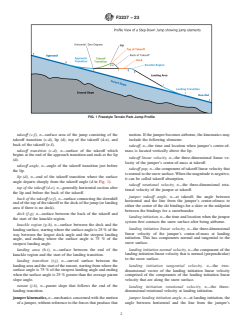
3.1 Refer to Fig. 1.
can be used.
3.2 Definitions:
1.3 The depictions used in this standard are intended to aid
terrain park, n—designated area of a ski resort or other
in understanding the definitions and are not intended to depict
similar facility containing natural or man-made freestyle
or describe how any particular terrain park jump or its
features such as jumps and jibs.
component features should be designed, built or maintained.
parent slope, n—sliding surface within the terrain park upon
Some terrain park jumps may use different configurations or
combinations of features, or they may not incorporate all of the which the feature is placed or constructed. The parent slope
features depicted or defined in this standard. angle may vary with position.
1.4 This standard does not purport to address all of the
average parent slope, n—straight line approximation of the
safety concerns, if any, associated with the use of snow sport
parent slope angle.
terrain park features. Snow sports and the use of terrain park
ground slope, n—natural or man-made surface underlying the
features involve inherent risks, and a terrain park feature that
parent slope.
complies with all applicable standards or guidelines cannot
eliminate all risks associated with terrain park features.
average ground slope, n—straight line approximation of the
Therefore, it is to be clearly understood that compliance with
ground slope angle.
these applicable standards or guidelines in no way guarantees
that injury can be prevented. jump, n—man-made feature that allows a user an opportunity
to become airborne, generally consisting of the jump ele-
1.5 This international standard was developed in accor-
ments given below.
dance with internationally recognized principles on standard-
ization established in the Decision on Principles for the
jumper or jumper system, n—a skier or snowboarder and his
Development of International Standards, Guides and Recom-
or her equipment.
mendations issued by the World Trade Organization Technical
Barriers to Trade (TBT) Committee.
jump elements, n—parts of a jump which may include the
following (refer to Fig. 1, labels in italics indicate the points
2. Significance and Use
on the sliding surface):
2.1 A standard terminology is needed to allow freestyle
approach (a-b), n—downhill sloping surface leading into the
terrain park designers, builders, ski resorts, accident
approach transition.
approach transition (b-c), n—surface connecting the ap-
This terminology is under the jurisdiction of ASTM Committee F27 on Snow
and Water Sports and is the direct responsibility of Subcommittee F27.70 on
proach (b) to the area where the slope is horizontal. The
Freestyle Terrain Jump Features.
approach transition starts where the surface angle is 75 % of
Current edition approved July 1, 2023. Published August 2023. Originally
the steepest approach angle, and ends where the surface angle
approved in 2018. Last previous edition approved in 2018 as F3237 – 18. DOI:
10.1520/F3237-23. departs zero (horizontal) closest to the lip (c).
Copyright © ASTM International, 100 Barr Harbor Drive, PO Box C700, West Conshohocken, PA 19428-2959. United States
F3237 − 23
FIG. 1 Freestyle Terrain Park Jump Profile
takeoff (c-f), n—surface area of the jump consisting of the motion. If the jumper becomes airborne, the kinematics may
takeoff transition (c-d), lip (d), top of the takeoff (d-e), and include the following elements:
back of the takeoff (e-f).
takeoff, n—the time and location when jumper’s center-of-
takeoff transition (c-d), n—surface of the takeoff which
mass is located vertically above the lip.
begins at the end of the approach transition and ends at the lip
takeoff linear velocity, n—the three-dimensional linear ve-
(d).
locity of the jumper’s center-of-mass at takeoff.
takeoff angle, n—angle of the takeoff transition just before
takeoff pop, n—the component of takeoff linear velocity that
the lip.
is normal to the snow surface.
...
This document is not an ASTM standard and is intended only to provide the user of an ASTM standard an indication of what changes have been made to the previous version. Because
it may not be technically possible to adequately depict all changes accurately, ASTM recommends that users consult prior editions as appropriate. In all cases only the current version
of the standard as published by ASTM is to be considered the official document.
Designation: F3237 − 18 F3237 − 23
Standard Terminology Relating to
Snow Sport Freestyle Terrain Park Jumps
This standard is issued under the fixed designation F3237; the number immediately following the designation indicates the year of
original adoption or, in the case of revision, the year of last revision. A number in parentheses indicates the year of last reapproval. A
superscript epsilon (´) indicates an editorial change since the last revision or reapproval.
1. Scope
1.1 This terminology covers the terms required to describe a cross sectional profile of a snow sport freestyle terrain park jump and
related parameters for a jumper using the feature and does not cover any other terrain park feature.
1.2 The terms are presented in a sequence considered to be the most logical with definitions presented later calling upon those
presented earlier. This terminology standard does not require the use of any specific units; Imperial units (feet, seconds, degrees)
or metric units (meters, seconds, degrees) can be used.
1.3 The depictions used in this standard are intended to aid in understanding the definitions and are not intended to depict or
describe how any particular terrain park jump or its component features should be designed, built or maintained. Some terrain park
jumps may use different configurations or combinations of features, or they may not incorporate all of the features depicted or
defined in this standard.
1.4 This standard does not purport to address all of the safety concerns, if any, associated with the use of snow sport terrain park
features. Snow sports and the use of terrain park features involve inherent risks, and a terrain park feature that complies with all
applicable standards or guidelines cannot eliminate all risks associated with terrain park features. Therefore, it is to be clearly
understood that compliance with these applicable standards or guidelines in no way guarantees that injury can be prevented.
1.5 This international standard was developed in accordance with internationally recognized principles on standardization
established in the Decision on Principles for the Development of International Standards, Guides and Recommendations issued
by the World Trade Organization Technical Barriers to Trade (TBT) Committee.
2. Significance and Use
2.1 A standard terminology is needed to allow freestyle terrain park designers, builders, ski resorts, accident investigators, and
scientists to use a common language in describing freestyle terrain park jumps.jumps and related parameters for a jumper using
the feature.
2.2 Angles are taken with respect to horizontal, with positive values indicating an increase in elevation and negative values
indicating a decrease in elevation along the path of travel for a terrain park participant using the jump.
3. Terminology
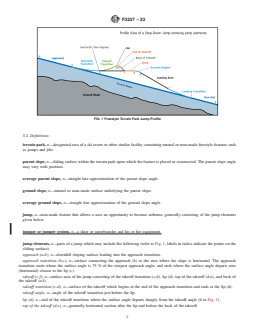
3.1 Refer to Fig. 1.
This terminology is under the jurisdiction of ASTM Committee F27 on Snow and Water Sports and is the direct responsibility of Subcommittee F27.70 on Freestyle
Terrain Jump Features.
Current edition approved Feb. 1, 2018July 1, 2023. Published March 2018August 2023. Originally approved in 2018. Last previous edition approved in 2018 as
F3237 – 18. DOI: 10.1520/F3237-18.10.1520/F3237-23.
Copyright © ASTM International, 100 Barr Harbor Drive, PO Box C700, West Conshohocken, PA 19428-2959. United States
F3237 − 23
FIG. 1 Freestyle Terrain Park Jump Profile
3.2 Definitions:
terrain park, n—designated area of a ski resort or other similar facility containing natural or man-made freestyle features such
as jumps and jibs.
parent slope, n—sliding surface within the terrain park upon which the feature is placed or constructed. The parent slope angle
may vary with position.
average parent slope, n—straight line approximation of the parent slope angle.
ground slope, n—natural or man-made surface underlying the parent slope.
average ground slope, n—straight line approximation of the ground slope angle.
jump, n—man-made feature that allows a user an opportunity to become airborne, generally consisting of the jump elements
given below.
jumper or jumper system, n—a skier or snowboarder and his or her equipment.
jump elements, n—parts of a jump which may include the following (refer to Fig. 1, labels in italics indicate the points on the
sliding surface):
approach (a-b), n—downhill sloping surface leading into the approach transition.
approach transition (b-c), n—surface connecting the approach (b) to the area where the slope is horizontal. The approach
transition starts where the surface angle is 75 % of the steepest approach angle, and ends where the surface angle departs zero
(horizontal) closest to the lip (c).
takeoff (c-f), n—surface area of the jump consisting of the takeoff transition (c-d), lip (d), top of the takeoff (d-e), and back of
the takeoff (e-f).
takeoff transition (c-d), n—surface of the takeoff which begins at the end of the approach transition and ends at the lip (d).
takeoff angle, n—angle of the takeoff transition just before the lip.
lip (d), n—end of the takeoff transition where the surface angle departs sharply from the takeoff angle (d in Fig. 1).
top of the takeoff (d-e), n—generally horizontal section after the lip and before the back of the takeoff.
F3237 − 23
back of the takeoff (e-f), n—surface connec
...