

ASTM A560/A560M-12(2018)
(Specification)Standard Specification for Castings, Chromium-Nickel Alloy
General Information
- Abstract
ABSTRACT
This guide covers standard specification for chromium-nickel alloy castings intended for heat-resisting and elevated-temperature corrosion applications, such as structural members, containers, supports, hangers, spacers, and the like, in corrosive environments. The alloy for the castings shall be made by electric-arc or induction-furnace process. Heat treatment shall be performed wherein the material shall conform to the required chemical composition for carbon, manganese, silicon, sulfur, phosphorus, nitrogen, nitrogen + carbon, iron, titanium, aluminum, columbium, chromium, and nickel. Tensile and Charpy requirements of the alloy used for the casting shall conform to the specified values of tensile strength, yield point, elongation, and unnotched Charpy impact. Mechanical tests like tension test and impact test, if required, shall be made from each melt.
SCOPE
1.1 This specification covers chromium-nickel alloy castings intended for heat-resisting and elevated-temperature corrosion applications, such as structural members, containers, supports, hangers, spacers, and the like, in corrosive environments up to 2000 °F [1090 °C].
1.2 The values stated in either SI units or inch-pound units are to be regarded separately as standard. The values stated in each system may not be exact equivalents; therefore, each system shall be used independently of the other. Combining values from the two systems may result in nonconformance with this standard.
1.3 This international standard was developed in accordance with internationally recognized principles on standardization established in the Decision on Principles for the Development of International Standards, Guides and Recommendations issued by the World Trade Organization Technical Barriers to Trade (TBT) Committee.
- Status
- Published
- Publication Date
- 28-Feb-2018
- Technical Committee
- A01 - Steel, Stainless Steel and Related Alloys
- Drafting Committee
- A01.18 - Castings


Overview
ASTM A560/A560M-12(2018): Standard Specification for Castings, Chromium-Nickel Alloy is an international standard developed by ASTM International to provide requirements for chromium-nickel alloy castings intended for heat-resisting and elevated-temperature corrosion applications. This standard is essential for manufacturers, suppliers, and users of alloy castings used in corrosive and high-temperature environments, including structural members, containers, supports, hangers, and spacers.
The standard outlines the appropriate manufacturing processes, chemical composition requirements, and mechanical property benchmarks. It ensures that castings conform to stringent quality and safety metrics for performance at elevated temperatures-up to 2000 °F [1090 °C].
Key Topics
Material Scope and Intended Use
- Covers chromium-nickel alloy castings for environments requiring heat resistance and corrosion protection.
- Intended for use up to 2000 °F [1090 °C] in structural and industrial applications.
Manufacturing Process
- Specifies production via electric arc or induction furnace processes.
- Allows for different molding methods, including sand, shell, investment, or centrifugal molds.
- Requires agreement on any heat treatment between manufacturer and purchaser.
Chemical Composition and Grades
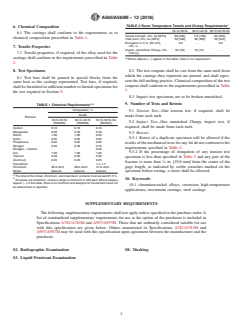
- Mandates strict adherence to defined chemical compositions, including maximums and ranges for carbon, manganese, silicon, sulfur, phosphorus, nitrogen, iron, titanium, aluminum, columbium, chromium, and nickel.
- Lists specific grades such as 50 Cr-50 Ni, 60 Cr-40 Ni, and 50 Cr-50 Ni-Cb, each with defined minimum chemical and mechanical properties.
Mechanical Properties and Testing
- Mechanical properties include minimum requirements for tensile strength, yield point, and elongation.
- Charpy impact testing may be required to assess toughness.
- Specifies requirements for testing frequency and procedures, including guidance on retests.
Ordering and Supplementary Requirements
- Provides a checklist for ordering information (quantity, grade, pattern or drawing, process, and test options).
- Offers optional supplementary requirements for enhanced verification, such as radiographic and liquid penetrant examinations.
Applications
ASTM A560/A560M-12(2018) is widely used in industries where high temperature and corrosive conditions demand reliable, durable materials. Key application areas include:
- Structural Components: Supports, hangers, and spacers in furnaces, kilns, and high-temperature processing equipment.
- Containers and Vessels: Castings for bins, tanks, and reaction vessels that handle corrosive substances at elevated temperatures.
- Industrial Processing: Components in petrochemical plants, refineries, and power generation where heat and corrosion resistance are critical.
- Investment Castings: Precision components manufactured using investment casting processes for high-performance applications.
This standard helps ensure that all parties-from manufacturers to end users-benefit from consistent product quality, heightened safety, and reliable performance. It also streamlines procurement and regulatory compliance for high-temperature alloy castings.
Related Standards
To apply ASTM A560/A560M-12(2018) effectively and ensure full compliance, familiarity with related ASTM standards is recommended:
- ASTM A781/A781M: Common requirements for steel and alloy castings used in industrial applications.
- ASTM A957/A957M: Specifies requirements for steel and alloy investment castings, including supplementary criteria.
- World Trade Organization TBT Principles: The standard aligns with internationally recognized guidelines on standardization and trade barriers.
For comprehensive coverage of specifications, reference the latest versions of these standards through the ASTM International website or contact ASTM customer service.
Keywords: ASTM A560, chromium-nickel alloy castings, heat-resisting applications, elevated-temperature corrosion, industrial castings, mechanical properties, chemical composition, investment castings, ASTM standards, high-temperature alloys.
Relations
- Effective Date
- 01-Mar-2018
- Effective Date
- 01-Sep-2018
- Effective Date
- 01-Jun-2018
- Effective Date
- 15-May-2018
- Effective Date
- 01-Jan-2018
- Effective Date
- 01-May-2017
- Effective Date
- 01-Dec-2016
- Effective Date
- 01-Oct-2014
- Effective Date
- 01-May-2014
- Effective Date
- 01-Mar-2014
- Effective Date
- 01-Oct-2013
- Effective Date
- 01-Nov-2012
- Effective Date
- 01-Mar-2012
- Effective Date
- 01-Jan-2012
- Effective Date
- 01-Nov-2008
Get Certified
Connect with accredited certification bodies for this standard

Element Materials Technology
Materials testing and product certification.

Inštitut za kovinske materiale in tehnologije
Institute of Metals and Technology. Materials testing, metallurgical analysis, NDT.
Sponsored listings
Frequently Asked Questions
ASTM A560/A560M-12(2018) is a technical specification published by ASTM International. Its full title is "Standard Specification for Castings, Chromium-Nickel Alloy". This standard covers: ABSTRACT This guide covers standard specification for chromium-nickel alloy castings intended for heat-resisting and elevated-temperature corrosion applications, such as structural members, containers, supports, hangers, spacers, and the like, in corrosive environments. The alloy for the castings shall be made by electric-arc or induction-furnace process. Heat treatment shall be performed wherein the material shall conform to the required chemical composition for carbon, manganese, silicon, sulfur, phosphorus, nitrogen, nitrogen + carbon, iron, titanium, aluminum, columbium, chromium, and nickel. Tensile and Charpy requirements of the alloy used for the casting shall conform to the specified values of tensile strength, yield point, elongation, and unnotched Charpy impact. Mechanical tests like tension test and impact test, if required, shall be made from each melt. SCOPE 1.1 This specification covers chromium-nickel alloy castings intended for heat-resisting and elevated-temperature corrosion applications, such as structural members, containers, supports, hangers, spacers, and the like, in corrosive environments up to 2000 °F [1090 °C]. 1.2 The values stated in either SI units or inch-pound units are to be regarded separately as standard. The values stated in each system may not be exact equivalents; therefore, each system shall be used independently of the other. Combining values from the two systems may result in nonconformance with this standard. 1.3 This international standard was developed in accordance with internationally recognized principles on standardization established in the Decision on Principles for the Development of International Standards, Guides and Recommendations issued by the World Trade Organization Technical Barriers to Trade (TBT) Committee.
ABSTRACT This guide covers standard specification for chromium-nickel alloy castings intended for heat-resisting and elevated-temperature corrosion applications, such as structural members, containers, supports, hangers, spacers, and the like, in corrosive environments. The alloy for the castings shall be made by electric-arc or induction-furnace process. Heat treatment shall be performed wherein the material shall conform to the required chemical composition for carbon, manganese, silicon, sulfur, phosphorus, nitrogen, nitrogen + carbon, iron, titanium, aluminum, columbium, chromium, and nickel. Tensile and Charpy requirements of the alloy used for the casting shall conform to the specified values of tensile strength, yield point, elongation, and unnotched Charpy impact. Mechanical tests like tension test and impact test, if required, shall be made from each melt. SCOPE 1.1 This specification covers chromium-nickel alloy castings intended for heat-resisting and elevated-temperature corrosion applications, such as structural members, containers, supports, hangers, spacers, and the like, in corrosive environments up to 2000 °F [1090 °C]. 1.2 The values stated in either SI units or inch-pound units are to be regarded separately as standard. The values stated in each system may not be exact equivalents; therefore, each system shall be used independently of the other. Combining values from the two systems may result in nonconformance with this standard. 1.3 This international standard was developed in accordance with internationally recognized principles on standardization established in the Decision on Principles for the Development of International Standards, Guides and Recommendations issued by the World Trade Organization Technical Barriers to Trade (TBT) Committee.
ASTM A560/A560M-12(2018) is classified under the following ICS (International Classification for Standards) categories: 77.150.40 - Nickel and chromium products. The ICS classification helps identify the subject area and facilitates finding related standards.
ASTM A560/A560M-12(2018) has the following relationships with other standards: It is inter standard links to ASTM A560/A560M-12, ASTM A781/A781M-18c, ASTM A781/A781M-18b, ASTM A781/A781M-18a, ASTM A781/A781M-18, ASTM A781/A781M-17, ASTM A781/A781M-16, ASTM A781/A781M-14b, ASTM A781/A781M-14a, ASTM A781/A781M-14, ASTM A781/A781M-13a, ASTM A781/A781M-12b, ASTM A781/A781M-12a, ASTM A781/A781M-12, ASTM A781/A781M-08. Understanding these relationships helps ensure you are using the most current and applicable version of the standard.
ASTM A560/A560M-12(2018) is available in PDF format for immediate download after purchase. The document can be added to your cart and obtained through the secure checkout process. Digital delivery ensures instant access to the complete standard document.
Standards Content (Sample)
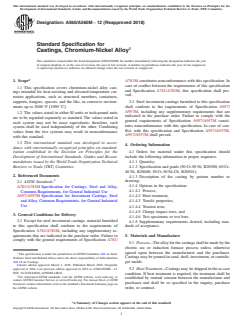
This international standard was developed in accordance with internationally recognized principles on standardization established in the Decision on Principles for the
Development of International Standards, Guides and Recommendations issued by the World Trade Organization Technical Barriers to Trade (TBT) Committee.
Designation: A560/A560M −12 (Reapproved 2018)
Standard Specification for
Castings, Chromium-Nickel Alloy
This standard is issued under the fixed designationA560/A560M; the number immediately following the designation indicates the year
of original adoption or, in the case of revision, the year of last revision. A number in parentheses indicates the year of last reapproval.
A superscript epsilon (´) indicates an editorial change since the last revision or reapproval.
1. Scope* A781M constitutes nonconformance with this specification. In
case of conflict between the requirements of this specification
1.1 This specification covers chromium-nickel alloy cast-
and Specification A781/A781M, this specification shall pre-
ings intended for heat-resisting and elevated-temperature cor-
vail.
rosion applications, such as structural members, containers,
supports, hangers, spacers, and the like, in corrosive environ-
3.2 Steel investment castings furnished to this specification
ments up to 2000 °F [1090 °C].
shall conform to the requirements of Specification A957/
A957M, including any supplementary requirements that are
1.2 The values stated in either SI units or inch-pound units
indicated in the purchase order. Failure to comply with the
are to be regarded separately as standard. The values stated in
general requirements of Specification A957/A957M consti-
each system may not be exact equivalents; therefore, each
tutes nonconformance with this specification. In case of con-
system shall be used independently of the other. Combining
flict with this specification and Specification A957/A957M,
values from the two systems may result in nonconformance
A957/A957M shall prevail.
with this standard.
1.3 This international standard was developed in accor-
4. Ordering Information
dance with internationally recognized principles on standard-
4.1 Orders for material under this specification should
ization established in the Decision on Principles for the
include the following information in proper sequence:
Development of International Standards, Guides and Recom-
4.1.1 Quantity;
mendations issued by the World Trade Organization Technical
Barriers to Trade (TBT) Committee. 4.1.2 Specification and grade (50 Cr-50 Ni, R20500; 60 Cr-
40 Ni, R20600; 50 Cr-50 Ni-Cb, R20501);
2. Referenced Documents
4.1.3 Description of the casting by pattern number or
drawing;
2.1 ASTM Standards:
4.1.4 Options in the specification:
A781/A781M Specification for Castings, Steel and Alloy,
4.1.4.1 Process,
Common Requirements, for General Industrial Use
A957/A957M Specification for Investment Castings, Steel 4.1.4.2 Heat treatment,
and Alloy, Common Requirements, for General Industrial 4.1.4.3 Tensile properties,
Use
4.1.4.4 Tension tests,
4.1.4.5 Charpy impact tests, and
3. General Conditions for Delivery
4.1.4.6 Test specimens or test bars.
3.1 Except for steel investment castings, material furnished
4.1.5 Supplementary requirements desired, including stan-
to this specification shall conform to the requirements of
dards of acceptance.
Specification A781/A781M, including any supplementary re-
quirements that are indicated in the purchase order. Failure to
5. Materials and Manufacture
comply with the general requirements of Specification A781/
5.1 Process—The alloy for the castings shall be made by the
electric arc or induction furnace process unless otherwise
agreed upon between the manufacturer and the purchaser.
This specification is under the jurisdiction of ASTM Committee A01 on Steel,
Castings may be poured in sand, shell, investment, or centrifu-
Stainless Steel and Related Alloys and is the direct responsibility of Subcommittee
A01.18 on Castings.
gal molds.
Current edition approved March 1, 2018. Published March 2018. Originally
5.2 HeatTreatment—Castings may be shipped in the as-cast
approved in 1966. Last previous edition approved in 2012 as A560/A560M – 12.
DOI: 10.1520/A0560_A0560M-12R18.
condition. If heat treatment is required, the treatment shall be
For referenced ASTM standards, visit the ASTM website, www.astm.org, or
established by mutual consent between the manufacturer and
contact ASTM Customer Service at service@astm.org. For Annual Book of ASTM
purchaser and shall be so specified in the inquiry, purchase
Standards volume information, refer to the standard’s Document Summary page on
the ASTM website. order, or contract.
*A Summary of Changes section appears at the end of this standard
Copyright © ASTM International, 100 Barr Harbor Drive, PO Box C700, West Conshohocken, PA 19428-2959. United States
A560/A560M − 12 (2018)
A
TABLE 2 Room Temperature Tensile and Charpy Requirements
6. Chemical Composition
50 Cr-50 Ni 60 Cr-40 Ni 50 Cr-50 Ni-Cb
6.1 The castings shall conform to the requirements as to
Tensile strength, min, ksi [MPa] 80 [550] 110 [76
...