

ASTM A456/A456M-24
(Specification)Standard Specification for Magnetic Particle Examination of Large Crankshaft Forgings
General Information
- Abstract
ABSTRACT
This test method deals with the acceptance criteria for the magnetic particle examination of forged steel crankshafts and forgings having large main bearing journal or crankpin diameters. Covered here are three classes of forgings, which shall be evaluated under two areas of inspection, namely: major critical areas, and minor critical areas. During inspection, magnetic particle indications shall be classified as: surface indications, which include nonmetallic inclusions or stringers, open or twist cracks, flakes, or pipes; open or pinpoint indications; and non-open indications. Procedures for dimpling, depressing, inspection, and product marking are also mentioned.
SCOPE
1.1 This is an acceptance specification for the magnetic particle inspection of forged steel crankshafts having main bearing journals or crankpins 4 in. [200 mm] or larger in diameter.
1.2 There are three classes, with acceptance standards of increasing severity:
1.2.1 Class 1.
1.2.2 Class 2 (originally the sole acceptance standard of this specification).
1.2.3 Class 3 (formerly covered in Supplementary Requirement S1 of Specification A456 – 64 (1970)).
1.3 This specification is not intended to cover continuous grain flow crankshafts (see Specification A983/A983M); however, Specification A986/A986M may be used for this purpose.
Note 1: Specification A668/A668M is a product specification which may be used for slab-forged crankshaft forgings that are usually twisted in order to set the crankpin angles, or for barrel forged crankshafts where the crankpins are machined in the appropriate configuration from a cylindrical forging.
1.4 The values stated in either SI units or inch-pound units are to be regarded separately as standard. The values stated in each system may not be exact equivalents; therefore, each system shall be used independently of the other. Combining values from the two systems may result in non-conformance with the standard.
1.5 Unless the order specifies the applicable “M” specification designation, the material shall be furnished to the inch units.
1.6 This international standard was developed in accordance with internationally recognized principles on standardization established in the Decision on Principles for the Development of International Standards, Guides and Recommendations issued by the World Trade Organization Technical Barriers to Trade (TBT) Committee.
- Status
- Published
- Publication Date
- 30-Apr-2024
- Technical Committee
- A01 - Steel, Stainless Steel and Related Alloys
- Drafting Committee
- A01.06 - Steel Forgings and Billets
Buy Documents
ASTM A456/A456M-24 - Standard Specification for Magnetic Particle Examination of Large Crankshaft<brk/> Forgings
REDLINE ASTM A456/A456M-24 - Standard Specification for Magnetic Particle Examination of Large Crankshaft<brk/> Forgings
Overview
ASTM A456/A456M-24 is the standard specification issued by ASTM International for the magnetic particle examination of large forged steel crankshafts. This document sets forth acceptance criteria and examination procedures for crankshafts with main bearing journals or crankpins of 4 inches (100 mm) diameter or larger. It ensures consistency and rigor in nondestructive testing (NDT) methods used for detecting surface and near-surface discontinuities, such as cracks, inclusions, and other defects that could impact the structural integrity and reliability of crankshaft forgings in demanding applications.
The standard covers three classes of forgings, each with varying levels of acceptance severity, and defines inspection areas as major or minor critical. It outlines the classification and treatment of detected indications, as well as requirements for product marking and inspection documentation.
Keywords: ASTM A456/A456M, magnetic particle examination, large crankshaft forgings, nondestructive testing, acceptance criteria, forged steel crankshafts, major critical areas, minor critical areas.
Key Topics
Scope and Applicability
- Applies to forged steel crankshafts with main bearing journals or crankpins 4 in. [100 mm] or larger
- Not intended for continuous grain flow crankshafts (see ASTM A983/A983M and A986/A986M)
Classification
- Three classes of crankshaft forgings (Class 1, 2, and 3) defined by increasingly stringent acceptance criteria
Inspection and Test Procedures
- Magnetic particle testing performed in accordance with referenced ASTM practices (e.g., A966/A966M, A275/A275M)
- Distinction between major critical areas (primary load-bearing surfaces) and minor critical areas
Indication Classification
- Surface indications such as open cracks, flakes, pipes, and nonmetallic inclusions
- Differentiation between open (visible or dye-penetrant detected), pinpoint, and non-open indications
Defect Remediation
- Procedures for dimpling (material removal) and depressing (flattening or relieving) to treat detected indications
- Limitation on the size and location of allowable repairs to ensure bearing surface integrity
Product Marking and Traceability
- Requirements for marking and documenting crankshafts validated through the specified inspection process
Applications
Compliance with ASTM A456/A456M-24 is vital to manufacturers, quality assurance teams, and purchasers of large forged steel crankshafts used in:
- Industrial Engines: Large engines in marine, power generation, and heavy-duty transportation sectors require crankshafts verified to be free from critical surface and subsurface defects.
- Automotive and Truck Manufacturing: High-performance and commercial engine components must meet strict safety and durability requirements through comprehensive nondestructive examination.
- Railway and Locomotive Applications: Crankshafts in locomotive engines are subject to significant cyclic loads, making magnetic particle inspection essential for reliability.
- Aerospace and Defense: Forgings for aircraft engines or military vehicles are examined to help ensure operational safety under demanding conditions.
By following this standard, stakeholders can reliably assess the structural soundness of crankshaft forgings, reduce failure risks, and maintain regulatory and safety compliance across industries.
Related Standards
For comprehensive quality and safety in crankshaft forging and inspection, several related ASTM standards are referenced and commonly used alongside ASTM A456/A456M:
- ASTM A275/A275M: Practice for Magnetic Particle Examination of Steel Forgings
- ASTM A668/A668M: Specification for Steel Forgings, Carbon and Alloy, for General Industrial Use
- ASTM A788/A788M: Specification for Steel Forgings, General Requirements
- ASTM A966/A966M: Practice for Magnetic Particle Examination of Steel Forgings Using Alternating Current
- ASTM A983/A983M: Specification for Continuous Grain Flow Forged Crankshafts
- ASTM A986/A986M: Specification for Magnetic Particle Examination of Continuous Grain Flow Crankshaft Forgings
- ASTM E1316: Terminology for Nondestructive Examinations
- ASTM E1417/E1417M: Practice for Liquid Penetrant Testing
Selecting and applying the relevant combination of these standards enables organizations to implement a robust quality control process for critical crankshaft forgings.
Relations
- Effective Date
- 01-May-2024
Buy Documents
ASTM A456/A456M-24 - Standard Specification for Magnetic Particle Examination of Large Crankshaft<brk/> Forgings
REDLINE ASTM A456/A456M-24 - Standard Specification for Magnetic Particle Examination of Large Crankshaft<brk/> Forgings
Get Certified
Connect with accredited certification bodies for this standard

Element Materials Technology
Materials testing and product certification.

Inštitut za kovinske materiale in tehnologije
Institute of Metals and Technology. Materials testing, metallurgical analysis, NDT.
Sponsored listings
Frequently Asked Questions
ASTM A456/A456M-24 is a technical specification published by ASTM International. Its full title is "Standard Specification for Magnetic Particle Examination of Large Crankshaft<brk/> Forgings". This standard covers: ABSTRACT This test method deals with the acceptance criteria for the magnetic particle examination of forged steel crankshafts and forgings having large main bearing journal or crankpin diameters. Covered here are three classes of forgings, which shall be evaluated under two areas of inspection, namely: major critical areas, and minor critical areas. During inspection, magnetic particle indications shall be classified as: surface indications, which include nonmetallic inclusions or stringers, open or twist cracks, flakes, or pipes; open or pinpoint indications; and non-open indications. Procedures for dimpling, depressing, inspection, and product marking are also mentioned. SCOPE 1.1 This is an acceptance specification for the magnetic particle inspection of forged steel crankshafts having main bearing journals or crankpins 4 in. [200 mm] or larger in diameter. 1.2 There are three classes, with acceptance standards of increasing severity: 1.2.1 Class 1. 1.2.2 Class 2 (originally the sole acceptance standard of this specification). 1.2.3 Class 3 (formerly covered in Supplementary Requirement S1 of Specification A456 – 64 (1970)). 1.3 This specification is not intended to cover continuous grain flow crankshafts (see Specification A983/A983M); however, Specification A986/A986M may be used for this purpose. Note 1: Specification A668/A668M is a product specification which may be used for slab-forged crankshaft forgings that are usually twisted in order to set the crankpin angles, or for barrel forged crankshafts where the crankpins are machined in the appropriate configuration from a cylindrical forging. 1.4 The values stated in either SI units or inch-pound units are to be regarded separately as standard. The values stated in each system may not be exact equivalents; therefore, each system shall be used independently of the other. Combining values from the two systems may result in non-conformance with the standard. 1.5 Unless the order specifies the applicable “M” specification designation, the material shall be furnished to the inch units. 1.6 This international standard was developed in accordance with internationally recognized principles on standardization established in the Decision on Principles for the Development of International Standards, Guides and Recommendations issued by the World Trade Organization Technical Barriers to Trade (TBT) Committee.
ABSTRACT This test method deals with the acceptance criteria for the magnetic particle examination of forged steel crankshafts and forgings having large main bearing journal or crankpin diameters. Covered here are three classes of forgings, which shall be evaluated under two areas of inspection, namely: major critical areas, and minor critical areas. During inspection, magnetic particle indications shall be classified as: surface indications, which include nonmetallic inclusions or stringers, open or twist cracks, flakes, or pipes; open or pinpoint indications; and non-open indications. Procedures for dimpling, depressing, inspection, and product marking are also mentioned. SCOPE 1.1 This is an acceptance specification for the magnetic particle inspection of forged steel crankshafts having main bearing journals or crankpins 4 in. [200 mm] or larger in diameter. 1.2 There are three classes, with acceptance standards of increasing severity: 1.2.1 Class 1. 1.2.2 Class 2 (originally the sole acceptance standard of this specification). 1.2.3 Class 3 (formerly covered in Supplementary Requirement S1 of Specification A456 – 64 (1970)). 1.3 This specification is not intended to cover continuous grain flow crankshafts (see Specification A983/A983M); however, Specification A986/A986M may be used for this purpose. Note 1: Specification A668/A668M is a product specification which may be used for slab-forged crankshaft forgings that are usually twisted in order to set the crankpin angles, or for barrel forged crankshafts where the crankpins are machined in the appropriate configuration from a cylindrical forging. 1.4 The values stated in either SI units or inch-pound units are to be regarded separately as standard. The values stated in each system may not be exact equivalents; therefore, each system shall be used independently of the other. Combining values from the two systems may result in non-conformance with the standard. 1.5 Unless the order specifies the applicable “M” specification designation, the material shall be furnished to the inch units. 1.6 This international standard was developed in accordance with internationally recognized principles on standardization established in the Decision on Principles for the Development of International Standards, Guides and Recommendations issued by the World Trade Organization Technical Barriers to Trade (TBT) Committee.
ASTM A456/A456M-24 is classified under the following ICS (International Classification for Standards) categories: 77.140.85 - Iron and steel forgings. The ICS classification helps identify the subject area and facilitates finding related standards.
ASTM A456/A456M-24 has the following relationships with other standards: It is inter standard links to ASTM A456/A456M-08(2023). Understanding these relationships helps ensure you are using the most current and applicable version of the standard.
ASTM A456/A456M-24 is available in PDF format for immediate download after purchase. The document can be added to your cart and obtained through the secure checkout process. Digital delivery ensures instant access to the complete standard document.
Standards Content (Sample)
This international standard was developed in accordance with internationally recognized principles on standardization established in the Decision on Principles for the
Development of International Standards, Guides and Recommendations issued by the World Trade Organization Technical Barriers to Trade (TBT) Committee.
Designation: A456/A456M − 24
Standard Specification for
Magnetic Particle Examination of Large Crankshaft
Forgings
This standard is issued under the fixed designation A456/A456M; the number immediately following the designation indicates the year
of original adoption or, in the case of revision, the year of last revision. A number in parentheses indicates the year of last reapproval.
A superscript epsilon (´) indicates an editorial change since the last revision or reapproval.
1. Scope* mendations issued by the World Trade Organization Technical
Barriers to Trade (TBT) Committee.
1.1 This is an acceptance specification for the magnetic
particle inspection of forged steel crankshafts having main
2. Referenced Documents
bearing journals or crankpins 4 in. [200 mm] or larger in
2.1 ASTM Standards:
diameter.
A275/A275M Practice for Magnetic Particle Examination of
1.2 There are three classes, with acceptance standards of
Steel Forgings
increasing severity:
A668/A668M Specification for Steel Forgings, Carbon and
1.2.1 Class 1.
Alloy, for General Industrial Use
1.2.2 Class 2 (originally the sole acceptance standard of this
A788/A788M Specification for Steel Forgings, General Re-
specification).
quirements
1.2.3 Class 3 (formerly covered in Supplementary Require-
A966/A966M Practice for Magnetic Particle Examination of
ment S1 of Specification A456 – 64 (1970)).
Steel Forgings Using Alternating Current
A983/A983M Specification for Continuous Grain Flow
1.3 This specification is not intended to cover continuous
grain flow crankshafts (see Specification A983/A983M); Forged Carbon and Alloy Steel Crankshafts for Medium
Speed Diesel Engines
however, Specification A986/A986M may be used for this
purpose. A986/A986M Specification for Magnetic Particle Examina-
tion of Continuous Grain Flow Crankshaft Forgings
NOTE 1—Specification A668/A668M is a product specification which
E1316 Terminology for Nondestructive Examinations
may be used for slab-forged crankshaft forgings that are usually twisted in
E1417/E1417M Practice for Liquid Penetrant Testing
order to set the crankpin angles, or for barrel forged crankshafts where the
crankpins are machined in the appropriate configuration from a cylindrical
3. Terminology
forging.
3.1 Definitions of Terms Specific to This Standard:
1.4 The values stated in either SI units or inch-pound units
are to be regarded separately as standard. The values stated in 3.1.1 For definitions of terms used in this standard, refer to
Specification A788/A788M and Terminology E1316.
each system may not be exact equivalents; therefore, each
system shall be used independently of the other. Combining
4. Classification of Indications
values from the two systems may result in non-conformance
with the standard. 4.1 Magnetic particle indications on the surface of the
crankshaft shall be classified as follows:
1.5 Unless the order specifies the applicable “M” specifica-
4.1.1 Open cracks, flake, or pipe.
tion designation, the material shall be furnished to the inch
4.1.2 Nonmetallic inclusions or stringers occurring in a
units.
longitudinal direction.
1.6 This international standard was developed in accor-
4.1.3 Twist cracks or nonmetallic inclusions usually occur-
dance with internationally recognized principles on standard-
ring at 45° to 70° from the axis of the journal.
ization established in the Decision on Principles for the
4.2 They shall also be classified as follows:
Development of International Standards, Guides and Recom-
4.2.1 Open indications are visible after removal of the
magnetic particles or can be detected by the use of contrast dye
penetrant, as described in Type II of Practice E1417/E1417M.
This specification is under the jurisdiction of ASTM Committee A01 on Steel,
Stainless Steel and Related Alloys, and is the direct responsibility of Subcommittee
A01.06 on Steel Forgings and Billets. For referenced ASTM standards, visit the ASTM website, www.astm.org, or
Current edition approved May 1, 2024. Published May 2024. Originally contact ASTM Customer Service at service@astm.org. For Annual Book of ASTM
approved in 1999. Last previous edition approved in 2023 as A456/A456M – 08 Standards volume information, refer to the standard’s Document Summary page on
(2023). DOI: 10.1520/A0456_A0456M-24. the ASTM website.
*A Summary of Changes section appears at the end of this standard
Copyright © ASTM International, 100 Barr Harbor Drive, PO Box C700, West Conshohocken, PA 19428-2959. United States
A456/A456M − 24
4.2.1.1 Pinpoint indications are open indications ⁄16 in. 7.1.2 The critical areas of any main bearing journal shall be
[1.5 mm] in maximum dimension, as detected by application of that area plus or minus 60° from the 12 o’clock position on top
Type II of Practice E1417/E1417M. of the journal extending ⁄8 in. [10 mm] above the thrust collar
4.2.2 Non-open indications are indications which are not around the fillet and ⁄8 in. [16 mm] into the journal along its
visually detectable as described in 4.2.1. axis measured from approximately the blend of the journal
surface and the fillet, as shown in Fig. 1 and Fig. 2.
5. Ordering Information 7.1.3 The critical area of any crankpin or main journal also
includes that surface area closer than ⁄4 in. [6 mm] to the
5.1 The inquiry and purchase agreement shall contain a
junction of the radius blend and the journal surface of any oil
statement that the crankshaft(s) is (are) to be subject to
hole.
acceptance according to this specification. If reference to class
is omitted, Class 2 shall apply. 7.2 Minor Critical Areas—Minor critical areas include all
machined fillets, thrust bearing, and bearing surfaces not
5.2 The use of Supplementary Requirements S1 and S2
specified as major critical areas.
should be specified if required.
8. Acceptance Standards
6. Procedure
8.1 Class 1:
6.1 Magnetic particle inspection shall be conducted accord-
8.1.1 Major Critical Areas:
ing to Practice A966/A966M, except when Supplementary
8.1.1.1 Open indications over ⁄4 in. [6 mm] in length shall
Requirement S1 is to be used. The use of prod type contacts is
be removed by dimpling to a depth no greater than ⁄16 in.
not permitted on finished crankshafts. Magnetic leeches may
1 1
[5 mm]. Open indications over ⁄16 in. to ⁄4 in. [1.5 mm to
only be used on noncritical parts of the crankshaft when
6 mm] in length shall be depressed as in 8.2.2.3.
Supplementary Requirement S2 is utilized.
8.1.1.2 Pinpoint indications are permissible, except in clus-
1 1
ters of more than five in any ⁄4 in. by ⁄4 in. [6 mm by 6 mm]
7. Areas of Inspection
area, in which case they must be dimpled to a depth of no more
7.1 Major Critical Areas: than ⁄16 in. [5 mm]. If they do not open or increase in number
7.1.1 The critical area of any crankpin shall be that area plus they are acceptable and need not be removed.
or minus 60° from the 6 o’clock position of the pin extending 8.1.1.3 Non-open indications are acceptable up to and
⁄8 in. [10 mm] above the thrust collar around the fillet, and including ⁄2 in. [13 mm] in length. If non-open indications are
5 1
⁄8 in. [16 mm] into the pin along its axis measured from over ⁄2 in. [13 mm], depress, and if they are not open or are
approximately the blend of the pin surface and fillet, as shown worsening, accept them. Otherwise remove by dimpling to a
in Fig. 1 and Fig. 2. maximum depth of ⁄16 in. [5 mm].
Metric Equivalents
3 5
⁄8 in. = [10 mm] ⁄8 in. = [16 mm]
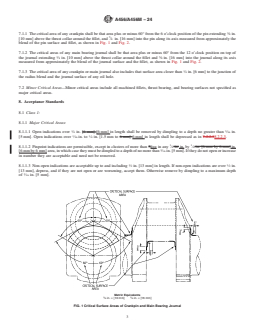
FIG. 1 Critical Surface Areas of Crankpin and Main Bearing Journal
A456/A456M − 24
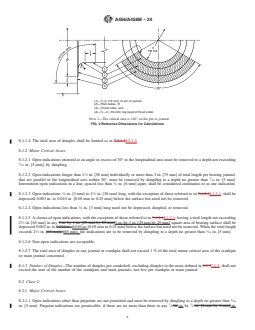
(1)— ⁄8 in. [16 mm] on pin or journal,
(2)—Fillet radius, R,
(3)—Thrust collar, and
(4)— ⁄8 –in. [10-mm] ring beyond thrust collar.
NOTE 1—The critical area is 120° on the pin or journal.
FIG. 2 Reference Dimensions for Calculations
8.1.1.4 The total area of dimples shall be limited as in 8.2.1 Major Critical Areas:
8.2.1.3.
8.2.1.1 Open indications other than pinpoints are not per-
8.1.2 Minor Critical Areas:
mitted and must be removed by dimpling to a depth no greater
8.1.2.1 Open indications oriented at an angle in excess of
than ⁄16 in. [5 mm]. Pinpoint indications are permissible, if
1 1
30° to the longitudinal axis must be removed to a depth not
there are no more than three in any ⁄4 in. by ⁄4 in. [6 mm by
exceeding ⁄16 in. [5 mm], by dimpling. 6 mm] square area. Pinpoints in excess of three must be
1 3
8.1.2.2 Open indications longer than 1 ⁄2 in. [38 mm]
dimpled to a depth of ⁄16 in. [5 mm] and reduced to no more
individually or more than 3 in. [75 mm] of total length per than three pinpoints unless they are removed at a lesser depth.
bearing journal, that are parallel to the longitudinal axis within
If no more than three pinpoints remain at the ⁄16 in. [5 mm]
30°, must be removed by dimpling to a depth no greater than depth, they are acceptable and need not be removed.
⁄16 in. [5 mm]. Intermittent open indications in a line, spaced
8.2.
...
This document is not an ASTM standard and is intended only to provide the user of an ASTM standard an indication of what changes have been made to the previous version. Because
it may not be technically possible to adequately depict all changes accurately, ASTM recommends that users consult prior editions as appropriate. In all cases only the current version
of the standard as published by ASTM is to be considered the official document.
Designation: A456/A456M − 08 (Reapproved 2023) A456/A456M − 24
Standard Specification for
Magnetic Particle Examination of Large Crankshaft
Forgings
This standard is issued under the fixed designation A456/A456M; the number immediately following the designation indicates the year
of original adoption or, in the case of revision, the year of last revision. A number in parentheses indicates the year of last reapproval.
A superscript epsilon (´) indicates an editorial change since the last revision or reapproval.
1. Scope Scope*
1.1 This is an acceptance specification for the magnetic particle inspection of forged steel crankshafts having main bearing
journals or crankpins 4 in. [200 mm] or larger in diameter.
1.2 There are three classes, with acceptance standards of increasing severity:
1.2.1 Class 1.
1.2.2 Class 2 (originally the sole acceptance standard of this specification).
1.2.3 Class 3 (formerly covered in Supplementary Requirement S1 of Specification A456 – 64 (1970)).
1.3 This specification is not intended to cover continuous grain flow crankshafts (see Specification A983/A983M); however,
Specification A986/A986M may be used for this purpose.
NOTE 1—Specification A668/A668M is a product specification which may be used for slab-forged crankshaft forgings that are usually twisted in order
to set the crankpin angles, or for barrel forged crankshafts where the crankpins are machined in the appropriate configuration from a cylindrical forging.
1.4 The values stated in either SI units or inch-pound units are to be regarded separately as standard. The values stated in each
system may not be exact equivalents; therefore, each system shall be used independently of the other. Combining values from the
two systems may result in non-conformance with the standard.
1.5 Unless the order specifies the applicable “M” specification designation, the material shall be furnished to the inch units.
1.6 This international standard was developed in accordance with internationally recognized principles on standardization
established in the Decision on Principles for the Development of International Standards, Guides and Recommendations issued
by the World Trade Organization Technical Barriers to Trade (TBT) Committee.
This specification is under the jurisdiction of ASTM Committee A01 on Steel, Stainless Steel and Related Alloys, and is the direct responsibility of Subcommittee A01.06
on Steel Forgings and Billets.
Current edition approved March 15, 2023May 1, 2024. Published April 2023May 2024. Originally approved in 1999. Last previous edition approved in 20182023 as
A456/A456M – 08 (2018).(2023). DOI: 10.1520/A0456_A0456M-08R23.10.1520/A0456_A0456M-24.
*A Summary of Changes section appears at the end of this standard
Copyright © ASTM International, 100 Barr Harbor Drive, PO Box C700, West Conshohocken, PA 19428-2959. United States
A456/A456M − 24
2. Referenced Documents
2.1 ASTM Standards:
A275/A275M Practice for Magnetic Particle Examination of Steel Forgings
A668/A668M Specification for Steel Forgings, Carbon and Alloy, for General Industrial Use
A788/A788M Specification for Steel Forgings, General Requirements
A966/A966M Practice for Magnetic Particle Examination of Steel Forgings Using Alternating Current
A983/A983M Specification for Continuous Grain Flow Forged Carbon and Alloy Steel Crankshafts for Medium Speed Diesel
Engines
A986/A986M Specification for Magnetic Particle Examination of Continuous Grain Flow Crankshaft Forgings
E1316 Terminology for Nondestructive Examinations
E1417/E1417M Practice for Liquid Penetrant Testing
3. Terminology
3.1 Definitions of Terms Specific to This Standard:
3.1.1 For definitions of terms used in this standard, refer to Specification A788/A788M and Terminology E1316.
4. Classification of Indications
4.1 Magnetic particle indications on the surface of the crankshaft shall be classified as follows:
4.1.1 Open cracks, flake, or pipe.
4.1.2 Nonmetallic inclusions or stringers occurring in a longitudinal direction.
4.1.3 Twist cracks or nonmetallic inclusions usually occurring at 4545° to 70° from the axis of the journal.
4.2 They shall also be classified as follows:
4.2.1 Open indications are visible after removal of the magnetic particles or can be detected by the use of contrast dye penetrant,
as described in Type II of Practice E1417/E1417M.
4.2.1.1 Pinpoint indications are open indications ⁄16 in. [1.5 mm] in maximum dimension, as detected by application of Type II
of Practice E1417/E1417M.
4.2.2 Non-open indications are indications which are not visually detectable as described in 3.2.14.2.1.
5. Ordering Information
5.1 The inquiry and purchase agreement shall contain a statement that the crankshaft(s) is (are) to be subject to acceptance
according to this specification. If reference to class is omitted, Class 2 shall apply.
5.2 The use of Supplementary Requirements S1 and S2 should be specified if required.
6. Procedure
6.1 Magnetic particle inspection shall be conducted according to Practice A966/A966M, except when Supplementary
Requirement S1 is to be used. The use of prod type contacts is not permitted on finished crankshafts. Magnetic leeches may only
be used on noncritical parts of the crankshaft when Supplementary Requirement S2 is utilized.
7. Areas of Inspection
7.1 Major Critical Areas:
For referenced ASTM standards, visit the ASTM website, www.astm.org, or contact ASTM Customer Service at service@astm.org. For Annual Book of ASTM Standards
volume information, refer to the standard’s Document Summary page on the ASTM website.
A456/A456M − 24
7.1.1 The critical area of any crankpin shall be that area plus or minus 60° from the 6 o’clock position of the pin extending ⁄8 in.
[10 mm] above the thrust collar around the fillet, and ⁄8 in. [16 mm] into the pin along its axis measured from approximately the
blend of the pin surface and fillet, as shown in Fig. 1 and Fig. 2.
7.1.2 The critical areas of any main bearing journal shall be that area plus or minus 60° from the 12 o’clock position on top of
3 5
the journal extending ⁄8 in. [10 mm] above the thrust collar around the fillet and ⁄8 in. [16 mm] into the journal along its axis
measured from approximately the blend of the journal surface and the fillet, as shown in Fig. 1 and Fig. 2.
7.1.3 The critical area of any crankpin or main journal also includes that surface area closer than ⁄4 in. [6 mm] to the junction of
the radius blend and the journal surface of any oil hole.
7.2 Minor Critical Areas—Minor critical areas include all machined fillets, thrust bearing, and bearing surfaces not specified as
major critical areas.
8. Acceptance Standards
8.1 Class 1:
8.1.1 Major Critical Areas:
1 3
8.1.1.1 Open indications over ⁄4 in. [6 mm] [6 mm] in length shall be removed by dimpling to a depth no greater than ⁄16 in.
1 1
[5 mm]. Open indications over ⁄16 in. to ⁄4 in. [1.5 mm to 6 mm] 6 mm] in length shall be depressed as in 7.2.2.38.2.2.3.
1 1
8.1.1.2 Pinpoint indications are permissible, except in clusters of more than 5five in any ⁄4-in. in. by ⁄4-in. [6-mm by 6-mm] in.
[6 mm by 6 mm] area, in which case they must be dimpled to a depth of no more than ⁄16 in. [5 mm]. If they do not open or increase
in number they are acceptable and need not be removed.
1 1
8.1.1.3 Non-open indications are acceptable up to and including ⁄2 in. [13 mm] in length. If non-open indications are over ⁄2 in.
[13 mm], depress, and if they are not open or are worsening, accept them. Otherwise remove by dimpling to a maximum depth
of ⁄16 in. [5 mm].
Metric Equivalents
3 5
⁄8 in. = [10 mm] ⁄8 in. = [16 mm]
FIG. 1 Critical Surface Areas of Crankpin and Main Bearing Journal
A456/A456M − 24
(1)— ⁄8 in. [16 mm] on pin or journal,
(2)—Fillet radius, R,
(3)—Thrust collar, and
(4)— ⁄8 –in. [10-mm] ring beyond thrust collar.
NOTE 1—The critical area is 120° on the pin or journal.
FIG. 2 Reference Dimensions for Calculations
8.1.1.4 The total area of dimples shall be limited as in 7.2.1.38.2.1.3.
8.1.2 Minor Critical Areas:
8.1.2.1 Open indications oriented at an angle in excess of 30° to the longitudinal axis must be removed to a depth not exceeding
⁄16 in. [5 mm], by dimpling.
8.1.2.2 Open indications longer than 1 ⁄2 in. [38 mm] individually or more than 3 in. [75 mm] of total length per bearing journal,
that are parallel to the longitudinal axis within 30°, must be removed by dimpling to a depth no greater than ⁄16 in. [5 mm].
Intermittent open indications in a line, spaced less than ⁄4 in. [6 mm] apart, shall be considered continuous or as one indication.
1 1
8.1.2.3 Open indications ⁄8 in. [3 mm] to 1 ⁄2 in. [38 mm] long, with the exception of those referred to in 7.1.2.18.1.2.1, shall be
depressed 0.003 in. to 0.010 in. [0.05 mm to 0.25 mm] below the surface but need not be removed.
8.1.2.4 Open indications less than ⁄8 in. [3 mm] long need not be depressed, dimpled, or removed.
8.1.2.5 A cluster of open indications, with the exception of those referred to in 7.1.2.18.1.2.1, having a total lengt
...